 Atria Review (2026)
Atria is credit-metered — AI credits and brand-tracking slots cap what you can generate and monitor, so a heavy user burns through Core's allowance and steps up to Plus.
Visit Atria → Affiliate link — the rest of this page is the honest version, including who should skip it.
Watch the 2-minute review
Same honest take, in video form — from our YouTube channel.
Pricing (2026)
✓ Pricing re-verified 17 Aug 2026
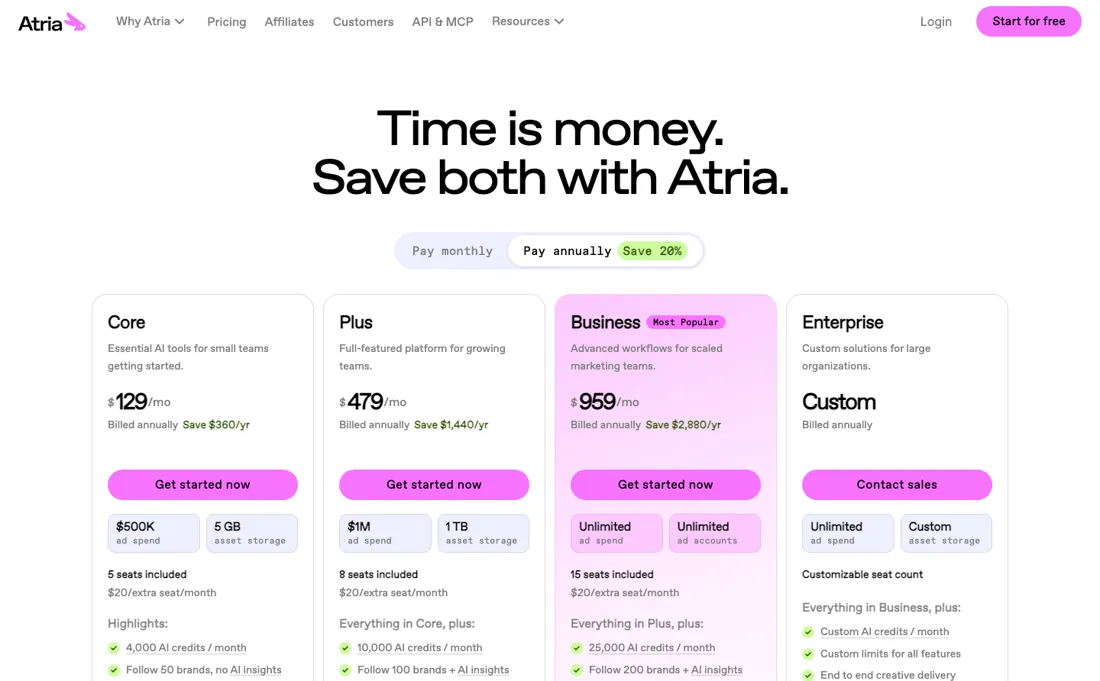
Core is $129/mo, a stated $360 saving a year. That covers 5 seats, 4,000 AI credits a month, 50 brands followed without AI insights, 5 connected ad accounts, $500K of ad spend analysed a month, 5GB of asset storage and 3 brand profiles. Plus $479/mo (a stated $1,440 saving): 8 seats, 10,000 credits, 100 brands with AI insights, 10 ad accounts, $1M of ad spend, 1TB storage, 8 brand profiles.
Business $959/mo (a stated $2,880 saving): unlimited ad spend. Enterprise is custom. Extra seats are $20 each a month on every tier. Note the step from Core to Plus is far steeper than the tier names suggest — it is roughly 3.7x the price for 2.5x the credits. Plans change — always verify the live price on their site.
Correction after re-checking: The pricing page lists annual-billing rates behind a "Pay monthly Pay annually Save 20%" toggle: Core $129/mo, Plus $479/mo, Business $959/mo, Enterprise custom, with extra seats at $20/month on any plan. Those are the annual rates — Plus carries "Save $1,440/yr" next to its "$479 /mo Billed annually" — and the help centre lists the same plan at "starting at $599/mo", which is the monthly-billing rate. Neither figure supersedes the other; both are current, for different billing cycles, and the dossier's Plus monthly line matches neither. Core includes 5 seats, 4,000 AI credits, 50 brands followed (no AI insights), 5 ad accounts and a $500K/mo ad-spend cap. Plus: 8 seats, 10,000 credits, 100 brands with AI insights, 10 ad accounts, $1M spend. Business: 15 seats, 25,000 credits, 200 brands, unlimited spend and ad accounts. The homepage offers a no-card start with 1,000 free credits; the help centre separately documents a 7-day trial that does require a card. (re-verified 26 Jul 2026)
What the price did
We capture Atria’s own pricing page every month and keep the figures, so this is our record of the page — not a forecast, and not someone else’s summary.
Worth stating plainly because we had this wrong ourselves: Atria's prices have not moved. Our captures of the pricing page from July and August 2026 are byte-for-byte identical and both carry the same three annual savings ($360, $1,440 and $2,880) that the page still showed when we re-read it on 17 August 2026. The Plus figure we previously published, around $269 a month on annual billing, does not appear in any of those three readings.
What the pricing page doesn’t say
Two honest notes. And it's specialized for Meta/TikTok ad creative research and generation, so it's a performance-marketing tool, not a general design suite. Its edge is competitor ad intelligence plus creative generation in one place; if you only need one of those, a cheaper single-purpose tool may fit.
What Atria does
Competitor ad research and AI creative generation for Meta and TikTok in one platform. Credit-metered: Core is about $159/month ($129 annual) with 4,000 AI credits and 50 brands tracked, and heavy users step up to Plus at roughly twice that.

What buyers report about Atria
Recurring themes from the buyer-review sites listed at the foot of this page, read in August 2026. We have not run Atria ourselves, so this is other buyers' experience rather than ours. We summarise it here because the complaints are usually the part a vendor page leaves out.
- • A 25M+ ad library with semantic search and an AI agent trained on over $5B of ad spend — for creative research that corpus is the product.
- • Radar analytics with letter-grade creative scoring gives a concrete read rather than a vague one.
- • 2.6 out of 5 across 7 Trustpilot reviews (read 25 August 2026), with billing complaints and support problems the pattern. Seven reviews is far too small a sample to lean on, but the theme is consistent enough to check your own cancellation route first.
- • There is no video generation, and multiple users flag it as a gap they expected to be covered.
- • Core starts around $129-$159 per cycle, Plus $479, Business $959. Solo creators name the entry price as the barrier.
When the paid plan is worth it
Atria's entry point is free but thin: the homepage offers "No credit card required" with "1,000 free credits included", while the help centre separately documents a trial lasting 7 days from signup that does ask for a card for verification. Neither is a working tier. The real decision is Core against Plus. Core, listed at $129/mo on annual billing, gives 4,000 AI credits / month, "Follow 50 brands, no AI insights", "Connect 5 ad accounts" and a $500K monthly ad-spend ceiling.
Plus, at $479/mo on annual billing, adds 10,000 credits, "Follow 100 brands + AI insights", "Connect 10 ad accounts" and $1M spend. Upgrading pays back where the AI layer on tracked brands earns its keep, or where the spend cap binds — cross $500K and you have no choice. What it does not fix is the meter itself. Credits "don't carry over to the next month", and generation, transcription, URL analysis and Radar all draw on the same pool, so a heavy generator on Plus still buys top-ups. Custom metrics sit above Plus, on Business.
Our monthly capture read this vendor's pricing page in July 2026 and again in August 2026, and the amounts were the same both times. We keep watching — the registry records what moves.
How to actually use Atria
First value comes from connecting Meta, not from browsing the library. Open the workspace menu, go to Settings > My Connections, click Connect next to Meta, approve the Pages and Businesses, and check that the review screen lists both ads_management and business_management. Then add the account under Ad accounts in the Analytics & Launch sidebar. TikTok populates once authorised.
Distilled from Vendor material only. Sources fetched this session: Atria's pricing page (tryatria.com/pricing — it renders annual-billing rates by default, behind a "Pay monthly / Pay annually" toggle) and the tryatria.com homepage; and the Atria Help Center on Intercom (intercom.help/atria-e5456f8f6b7b), specifically "Set up a free trial", "How to connect your ad account", "How can I connect Instagram to Atria and troubleshoot saving ads?" and the "Troubleshooting" article, plus "Choose your Atria plan" and "Understand and manage AI credits" from Account and Billing. Every quoted string in getting_started was re-read on the article that carries it, not on the collection index. No independent walkthrough was found. Searches surfaced only Atria's own pages, competitor blogs (Trendtrack, Gethookd) and affiliate/SEO review sites (max-productive.ai, hackceleration.com, dupple.com, aazarshad.com); none of those qualify as independent, and none is cited here.
Common Atria setup mistakes
Where Atria setups actually go wrong, and what it costs you when they do. Same sources as the setup notes above — not from a walkthrough we ran ourselves.
Where people stall: data is not there on day one.
- The vendor writes "First-time sync can take a few hours — this is normal", and only treats it as broken "If after 24 hours data still isn't showing up" — their timing, not ours.
- Permissions are the other wall.
- If your Meta Business Manager role is too narrow you hit "Launch Permission Not Granted", and an admin has to grant you "Manage ad accounts", or at minimum Manage campaigns.
- Scope catches people too: Atria says "Launching ads to TikTok directly from Atria is not available yet", and the Instagram DM-to-save flow can show "Coming soon" during an Instagram API change, leaving the Chrome extension as the fallback.
Atria vs AdCreative.ai, side by side
Both columns come from the same place: each vendor’s own published pricing, read on the date shown in the sources at the foot of this page. We do not average them into a score.
Both names above are affiliate links: we may earn a commission if you sign up, at no extra cost to you. Neither changes what this table says: both columns come straight from the vendors’ own pricing pages.
The natural comparison is AdCreative.ai or Foreplay — close ad-creative/research tools — Atria combines research and generation; compare credit limits and brand-tracking at your workload.
More on Atria
Everything we publish about Atria links back here — the review stays the honest hub:
The ex-banker filter — the same yardstick on every review (how we review): My ex-banker filter is simple: does Atria remove a real cost — time, errors, missed revenue — bigger than what it charges? If the job above is genuinely yours, it's worth a look. We never publish fake or “exclusive” prices, so always confirm the current plan on their site.
Frequently asked questions
What does Atria cost?
On annual billing, read on 17 August 2026: Core $129 a month, Plus $479 and Business $959, with Enterprise on quote and extra seats at $20 each. Atria advertises annual as 20% off. Those figures were identical in our July and August captures, so a quote you were given earlier this summer should still hold.
What do you get for the jump from Core to Plus?
Ask this before upgrading, because the step is steep: $129 to $479 a month is about 3.7x the price for 2.5x the AI credits (4,000 to 10,000), double the brands followed (50 to 100), twice the ad accounts and twice the ad spend ceiling ($500K to $1M). The feature that actually changes rather than scales is AI insights on the brands you follow, which Core does not include at all. If insights are the reason you are buying, Core is not the plan.
What is missing that people expect?
Video generation. Multiple users flag it as a gap they assumed would be covered by a creative-intelligence platform, and it is the thing to check against your own workflow before you commit. The ad library and semantic search over it are the part reviewers rate; producing the creative is not what this tool does.
What should I weigh before buying Growth & Revenue software?
It depends on whether you have the bottleneck it solves. Small teams get the most out of this category when one clear problem is already costing real hours or revenue; buying ahead of that just adds cost and another login. Price it against the hours or lost deals it removes, not against its feature list, and start on the smallest plan that covers the job.
Is this a hands-on review of Atria?
This is a researched assessment, not a hands-on test — where we've used a tool ourselves, we say so explicitly. We name what each tool is genuinely good and bad at, and we earn a commission only if you sign up, at no cost to you.
- Buyer reviews on Trustpilot, SourceForge and practitioner reviews, read August 2026.
- Re-verified 2026-08-17 on their own pricing page, annual billing, which Atria advertises as 20% off.
- A dated screenshot of that pricing page, kept on this site as the receipt.
We list our sources because most review sites do not. How we review →
Others in this category
The growth & revenue tools closest to Atria that we have also reviewed. They overlap rather than match:
New dossiers, cost-traps we found, and tools that earned a keep — no hype, no sponsored-disguised-as-advice. Unsubscribe anytime.
This is our researched assessment — not a paid placement. The “Visit” links on this page are affiliate links: we may earn a commission if you sign up, at no extra cost to you, and it never changes our take. How we review →
Spotted an error? Tell us — we verify and fix fast, whether or not it flatters the product.