Consensus Review (2026)
 By Daan Haket · Researched and written with an AI assistant · who does what
Study quality, sample sizes and conflicting results still need your judgment, and the AI summary layer can smooth over genuine scientific disagreement.
researchers, clinicians, students and writers who want evidence-backed answers drawn from peer-reviewed papers instead of the open web.
your questions are practical/commercial rather than research-based (a general AI assistant fits), or you need full systematic-review rigor (this accelerates it, not replaces it).
Transparency: the “Visit” links on this page are affiliate links — we may earn a commission if you sign up, at no extra cost to you. No vendor can pay for a better review or verdict. How we make money →
Pricing (2026)
✓ Pricing re-verified 28 Sep 2026
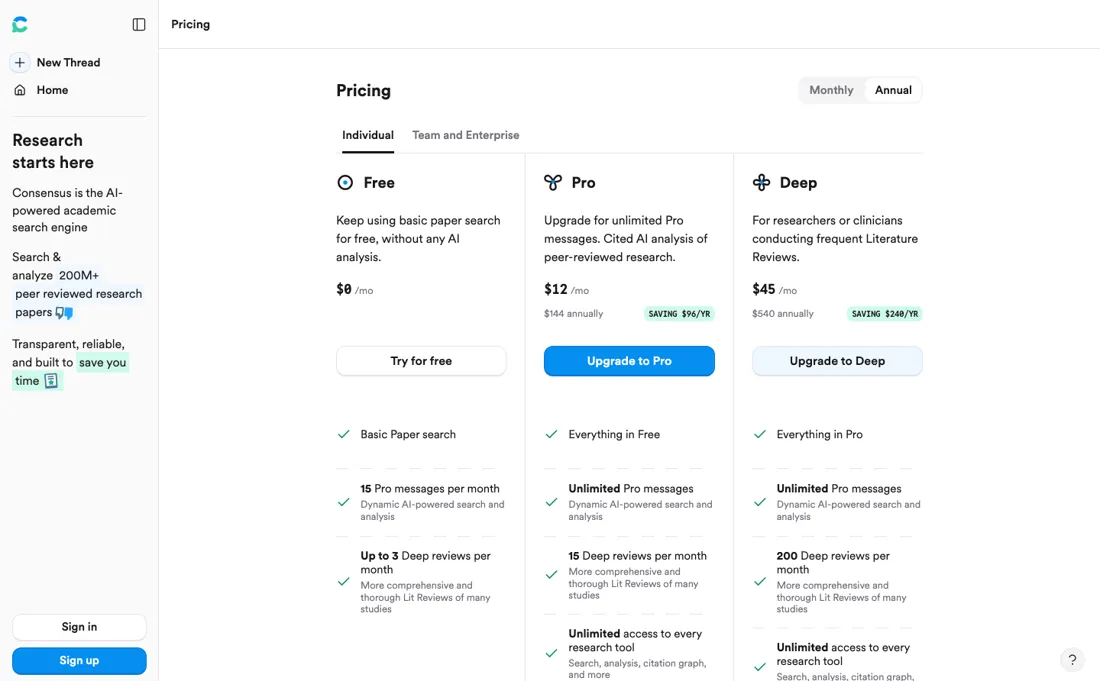
Free: $0, 10 Pro messages and up to 3 Deep reviews a month. Pro: $20 a month billed monthly, or $12 a month billed annually ($144 a year), with unlimited Pro messages, 15 Deep reviews a month and 500 API and MCP uses included, then $0.05 a use up to 1,000. Deep: $65 monthly, or $45 a month billed annually ($540 a year), with 200 Deep reviews and 2,000 API and MCP uses, then $0.05 a use up to 10,000.
Students and faculty with a school email and US healthcare professionals with an NPI number can get up to 40% off. Team and Enterprise carry no amount on the page; the vendor's machine-readable pricing file puts Team at up to 200 seats with 50 Deep searches per seat and Enterprise on contract, and on 28 September it still gave Free 15 Pro messages where the rendered page said 10; re-read on 21 October 2026, that file has been aligned at 10 Pro messages and 3 Deep Searches a month, and it describes the student discount as 40% off for 12 months with a verified .edu or student email.
The unit that matters is Deep reviews rather than seats. Correction: our earlier reading, which we could not confirm at the time, put Pro at about $15 a month or roughly $10 annually. The paid amounts are rendered in the browser from Stripe and could not be re-read on 21 October 2026 without one, so the dollar figures above still date from 28 September. Plans change — always verify the live price on their site.
Category context: IT & Productivity. Across the 39 tools in this category that we researched with a public US-dollar price, the median entry price is $15 a month (lowest paid plan as listed, per seat where the vendor prices per seat). Consensus’s entry price of $12 a month sits below that median. Compare pricing conditions in the Software Cost Atlas →
What the price did
We capture Consensus’s own pricing page every month and keep the figures, so this is our record of the page — not a forecast, and not someone else’s summary.
For July and August 2026 there is nothing to chart: Consensus renders its prices in the browser from Stripe, and our monthly capture read an empty page twice. The first amounts we could read directly came on 28 September 2026: Pro $20 a month or $12 billed annually, Deep $65 or $45. The figures we quoted before that, about $15 and $10 for Pro, came from third-party trackers, so the difference is not evidence of a price rise.
What the pricing page doesn’t say
It searches peer-reviewed literature, which is its strength and its boundary: it can tell you what published studies found, not whether those studies are good. Treat it as a dramatically faster literature scan, not an oracle; click through to the papers that matter. Consensus's own developer notes (read 21 October 2026) add three limits worth knowing before you pay. The corpus is English-first: non-English papers are indexed where metadata exists, but ranking and summaries are tuned for English.
It is not a news feed: papers published in the last few weeks may not be indexed yet. And the Consensus Meter is described as a heuristic, not a formal meta-analysis.
Watch the video review
The video version of this review, from our YouTube channel.
⚡ Short on time? Watch the 30-second verdict Short.
What Consensus does
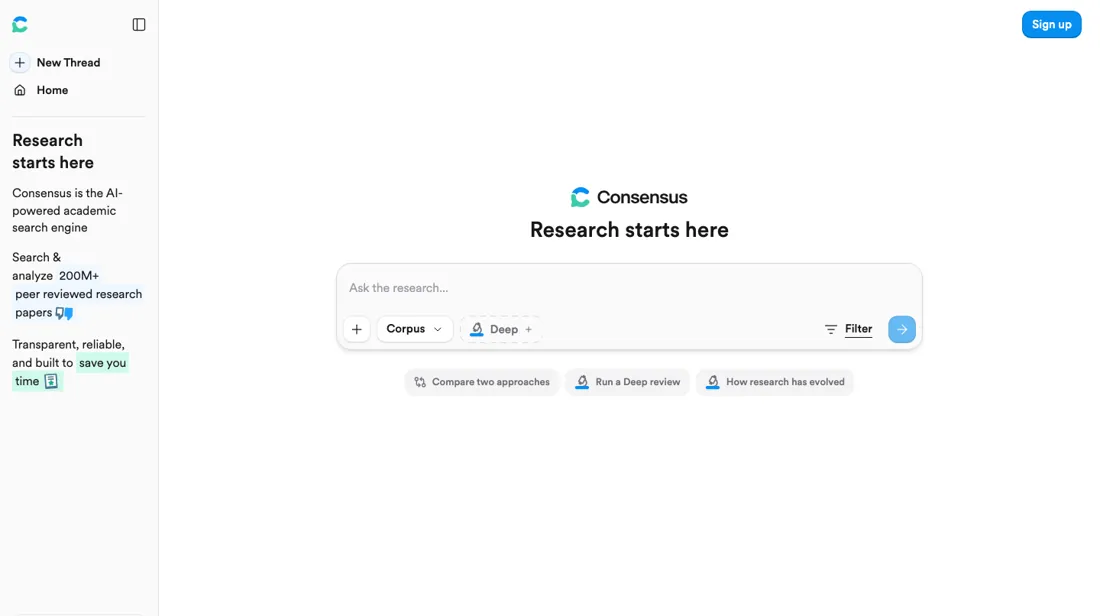
AI search across peer-reviewed literature: it reports what published studies found, not whether those studies are sound.
What buyers report about Consensus
Hands-on: not tested by usReported by buyers: practitioner and academic-tool reviews, read August 2026
Themes from the buyer-review sites listed at the foot of this page, read in August 2026. We have not run Consensus ourselves, so this is other buyers' experience rather than ours. We summarise it here because the complaints are usually the part a vendor page leaves out.
- • Answers are grounded in cited papers rather than generated, which is why researchers trust it where they don't trust a general chatbot.
- • The free tier is usable — 20 searches a month is enough to judge it properly.
- • The Consensus Meter reflects the papers retrieved for your specific query, not a settled reading of the whole literature. In new or contested fields it can look more decisive than the evidence is.
- • It is a starting point for understanding a question, not a substitute for reading the papers.
When the paid plan is worth it
The free plan already covers quick search and basic queries, so if you only skim abstracts occasionally, paying may not be worth it. The real break-even point is Deep Search usage: Pro, $20 a month or $12 a month billed annually (read 28 September 2026), adds unlimited Pro Search plus 15 Deep Searches a month, and it pays off once you're regularly leaning on that AI-synthesized analysis rather than just scanning ranked results.
If 15 Deep Searches a month isn't enough — a systematic-review push burns through that fast — the Deep tier ($65 a month, or $45 billed annually) adds 200 Deep Searches a month, but it's priced and built for heavy users and small research teams, not occasional readers. What upgrading does not fix: it won't make the underlying studies more rigorous, and it won't replace your own judgment on sample sizes or conflicting results.
Teams pricing runs on shared seats with consolidated billing rather than a flat group rate, so cost scales with headcount, and annual billing lowers the effective monthly price but commits you to a year upfront.
Questions we checked
Facts about Consensus that would change a buying decision, and where we stand on each. An unanswered question does not mean the feature is missing; it means we have not confirmed it yet.
- Are preprints in the default Consensus index or not? Sources disagree
Applies to: all plans, web app and MCP server.
Why it matters: a clinician or reviewer who assumes peer-reviewed-only results may cite an unreviewed preprint.
Answer: llms.txt says preprints are included by default and tagged, with exclude_preprints to filter them out; llms-full.txt says the default index excludes preprints and some surfaces allow opting them in. Both were read on 21 October 2026.
Checked: Consensus llms.txt (2026-10-21); Consensus llms-full.txt (2026-10-21) - How many API and MCP uses does Pro include: 500 or 100? Sources disagree
Applies to: Pro, $20 a month or $12 billed annually.
Why it matters: an agent wired to Consensus stops at the quota with HTTP 429, so the real number decides whether Pro or Deep is needed.
Answer: The rendered pricing page read on 28 September 2026 gave Pro 500 API and MCP uses a month, then $0.05 a use up to 1,000. The MCP table in llms-full.txt, read on 21 October 2026, gives Pro 100 included monthly searches and Deep 500. The two may count different things, but neither page says so.
Checked: Consensus pricing (2026-09-28); Consensus llms-full.txt (2026-10-21) - How long does the student discount last? Per public documentation
Applies to: Pro, for students with a school email.
Why it matters: a discount that ends after a year changes the cost of a multi-year degree.
Answer: The machine-readable pricing file read on 21 October 2026 says 40% off for 12 months with a verified .edu or student email. The rendered pricing page read on 28 September said 'up to 40%' for students, faculty and US healthcare professionals, without a duration.
Checked: Consensus pricing.md (2026-10-21); Consensus pricing (2026-09-28)
Have a public source that answers one of these? How we review explains how we check and correct.
How to actually use Consensus
The fastest path to real value is the web app at consensus.app, which works immediately without an account — you get anonymous access with a 3-paper-per-search limit. Creating a free account raises that to 10 papers per search plus 30 searches a month. For agent or IDE workflows, the MCP server also starts without an account: point an MCP-compatible client (Claude Desktop, ChatGPT, Cursor, Claude Code, VS Code Copilot, Windsurf) at https://mcp.consensus.app/mcp, complete the OAuth sign-in, and you're searching in under 2 minutes on most platforms.
Three things trip people up. The URL must end in the /mcp path or the connection fails. OAuth sessions expire after a few hours, so tools quietly stop working with 401 errors, and a plain reconnect click often doesn't fix it — a full client restart does. And Claude Code specifically sometimes needs a second attempt before the tool list populates. For agent builders the notes list per-plan MCP quotas rather than one number: 30 searches a month on Free, 100 on Pro and 500 on Deep or Teams, each at one query per second per user, with Enterprise custom.
Sources for this review
- Consensus pricing (rendered) · read 28 Sep 2026: plan amounts, Deep review and API/MCP allowances, discounts
- Consensus machine-readable pricing · read 21 Oct 2026: tier limits, Team seats, student discount
- Consensus llms.txt · read 21 Oct 2026: corpus, preprints, freshness, English-first
- Consensus llms-full.txt · read 21 Oct 2026: MCP quotas per plan, HTTP 429, distribution apps, Consensus Meter caveat
- Consensus product changelog · read 21 Oct 2026: Skills (5 October 2026), Perplexity connector (20 October 2026); read by Codex, quote-checked
- Consensus help: how to use Deep review · read 21 Oct 2026: Skill uses a Deep credit, checkmark meaning, PDF export; read by Codex, quote-checked
Full research notes and reading history (133 words)
vendor docs (docs.consensus.app, consensus.app/llms-full.txt) plus third-party pricing trackers for the Deep Search limits, as the vendor's own pricing and help pages were blocked. Pricing re-read 28 September 2026 in a rendered (playwright) browser at consensus.app/pricing?billing=monthly and ?billing=annually (Free $0; Pro $20 or $12/mo annually, $144/yr; Deep $65 or $45/mo annually, $540/yr; Deep review and API/MCP allowances; up to 40% off for students, faculty and US HCPs), plus consensus.app/.well-known/pricing.md (tier limits, no amounts) and consensus.app/llms-full.txt (MCP rate-limit table).
Re-read 21 October 2026 by plain fetch: consensus.app/.well-known/pricing.md (tier limits, student discount), consensus.app/llms.txt and llms-full.txt (constraints, MCP quotas, distribution apps); the help centre returned 403 and docs.consensus.app a Cloudflare check, so the changelog and Deep review guide come from Codex's quote-checked reading the same day. The rendered pricing page needs a browser and was not re-read.
The natural comparison is Elicit or Semantic Scholar — the research-AI peer set — Consensus leans consumer-friendly consensus summaries; Elicit leans structured extraction for reviews.
Frequently asked questions
What does Consensus cost?
Read on the rendered pricing page on 28 September 2026: Free at $0 with 10 Pro messages and up to 3 Deep reviews a month; Pro $20 a month, or $12 a month billed annually ($144 a year); Deep $65 a month, or $45 billed annually ($540). Our earlier answer of about $15 and $10 for Pro came from third-party trackers, because the page could not be read at the time. Students and faculty with a school email and US clinicians with an NPI number can get up to 40% off.
What is actually rationed between the tiers?
Deep reviews, and now API and MCP uses. Pro gives unlimited Pro messages but 15 Deep reviews and 500 API and MCP uses a month; Deep raises that to 200 reviews and 2,000 uses, with extra uses at $0.05 each up to 1,000 and 10,000 a month respectively. Consensus's developer file (llms-full.txt) lists lower MCP search quotas, 100 a month on Pro and 500 on Deep, so check the quota in your account before you wire it into an agent. For occasional literature checks Free or Pro is enough; for weekly deep syntheses the Deep allowance is the number that matters.
Is the free tier useful for research?
For finding papers and getting a sense of consensus on a question, yes. What it does not give you is the depth features that make it faster than a normal search, so treat it as a way to judge whether the interface fits your workflow rather than as the working tool.
Do Consensus Skills use up my Deep allowance?
Yes. Skills, ready-to-run research workflows, appear in the product changelog on 5 October 2026, and the Deep review help article says each Skill uses a Deep credit (both read by Codex on 21 October 2026 and quote-checked). On Free that means three Skill runs, or three Deep reviews, use up the month; on Pro the same 15 a month covers both.
How do I know whether Consensus read the whole paper?
Look for the checkmark. The Deep review guide says a citation without a checkmark means the abstract was used rather than the full text. For a claim you intend to rely on, open those uncheckmarked papers yourself; a Deep report can be exported as PDF for that review.
Can I use Consensus inside ChatGPT, Claude or Perplexity?
Yes. Its developer notes (llms-full.txt, read 21 October 2026) list a ChatGPT app and a Claude directory integration as thin wrappers over the same MCP server, with the rate limits and entitlements of your own account tier, and the changelog adds a Perplexity connector on 20 October 2026. If MCP calls exceed your plan's quota the server answers with HTTP 429 and a Retry-After header, which a client should wait out rather than retry.
Does Consensus include preprints?
Its own files disagree. llms.txt (read 21 October 2026) says preprints are included by default and tagged, and can be filtered out with exclude_preprints; llms-full.txt, read the same day, says the default index excludes preprints and some surfaces let you opt them in. Set the filter explicitly in your search rather than rely on either default.
Is this a hands-on review of Consensus?
This is a researched assessment, not a hands-on test — where we've used a tool ourselves, we say so explicitly. We name what each tool is good and bad at, and we earn a commission only if you sign up, at no cost to you.
- Buyer reviews on practitioner and academic-tool reviews, read August 2026.
- Re-verified 28 September 2026 in a rendered browser, monthly and annual tabs.
- A dated screenshot of that pricing page, kept on this site as the receipt.
Others in this category
Reviewed it & productivity tools that share ground with Consensus — comparable in what they do, not drop-in swaps:
New reviews, price changes we recorded, and the cost conditions we found. No sponsored placements. Unsubscribe anytime.
This is our researched assessment — not a paid placement. The “Visit” links on this page are affiliate links: we may earn a commission if you sign up, at no extra cost to you, and it never changes our take. How we review →