 Assembly Review (2026)
Transparency: the “Visit” links on this page are affiliate links — we may earn a commission if you sign up, at no extra cost to you. No vendor can pay for a better review or verdict. How we make money →
Active contacts bite first: Starter stops at 50, and the step to 500 costs $70 more a month on yearly billing ($90 monthly).
Visit Assembly → Affiliate link — we may earn a commission if you sign up; it does not change what this page says.
Watch the 2-minute review
The video version of this review, from our YouTube channel.
Pricing (2026)
✓ Pricing re-verified 28 Sep 2026
Assembly, the client-portal platform at assembly.com, publishes five tiers. Free, a free-forever plan: $0 with 5 active contacts, 1 internal user, 50 build credits a month and 3 apps. Starter: $29 a month billed yearly or $49 monthly, 50 active contacts, 1 internal user. Professional: $99 billed yearly or $139 monthly, 500 active contacts, 3 internal users included and each extra one +$29 a month yearly or +$39 monthly.
Advanced: $499 billed yearly or $599 monthly, unlimited active contacts, 5 internal users included and each extra one +$59 or +$79. Enterprise is quoted after a demo. Every paid plan includes 200 build credits a month and 5 apps; extra credits are $0.60 each up to 10,000 a month, unused credits roll over for one month, and extra apps are $5 a month each.
If you bill clients through Assembly, cards cost 2.9% + $0.30 on every plan and ACH 1% (capped at $10 from Professional up); the table also lists store fees of 2.0%, 1.5%, 1% and 0.7% from Free to Advanced, invoices at +0.7% down to +0.3% and recurring subscriptions at +1.1% down to +0.5%. The FAQ says there are no setup, hosting or per-client fees, no contracts on self-serve plans, and downgrades take effect at the end of the billing period.
Correction: until 28 September 2026 this field described a different company's employee-recognition plan at $3 per user; that was never the price of Assembly's client portal. Plans change — always verify the live price on their site.
What the price did
We capture Assembly’s own pricing page every month and keep the figures, so this is our record of the page — not a forecast, and not someone else’s summary.
Two readings of the right page. On 15 August 2026, the reading behind our plan sections, Starter was $29 a month billed yearly, Professional $99 and Advanced $499, with extra internal users at $29 and $59, automation tasks capped by plan and Enterprise from a $2,000 minimum. On 28 September 2026 the three yearly-billed prices and the extra-user rates are unchanged; monthly billing reads $49, $139 and $599, a free plan has appeared, build credits for the AI app builder have replaced the automation-task caps, and no Enterprise minimum is printed. The monthly Price Watch captures that showed a single $3 figure were of a different company's recognition product and are not a record of Assembly's pricing.
What the pricing page doesn’t say
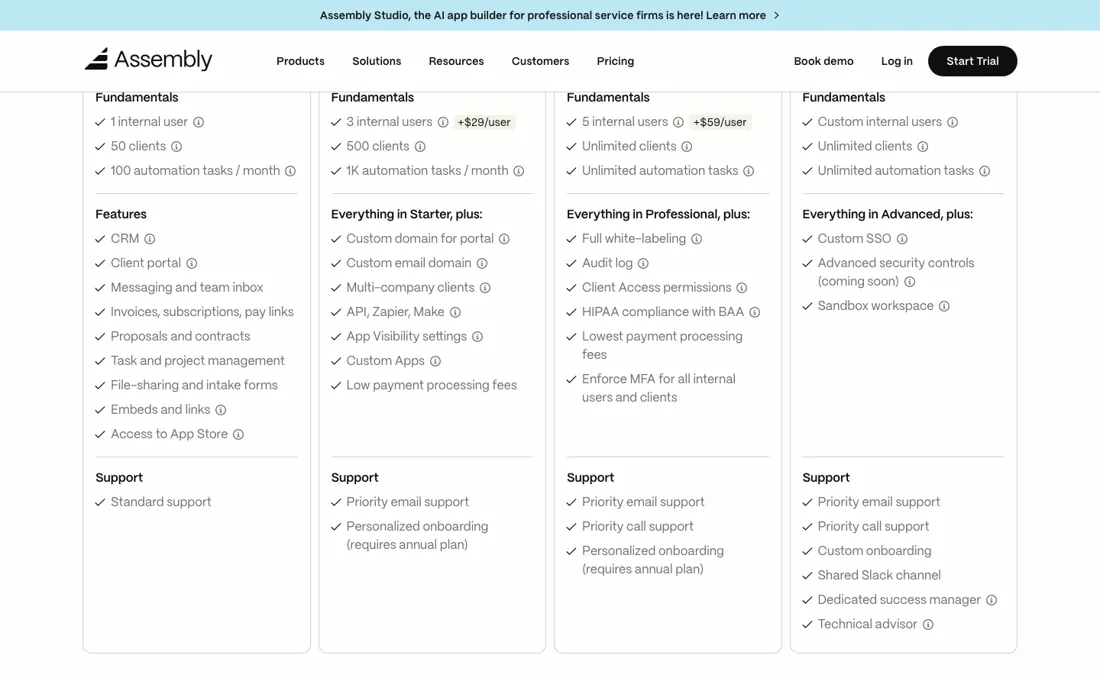
Two meters run at once. Internal users are the other, and they get dearer as you climb: an extra colleague is $29 a month on Professional and $59 on Advanced (yearly-billed; $39 and $79 monthly), so the more expensive plan makes each additional person more expensive too. A newer third meter is build credits for the AI app builder — 200 a month on every paid plan, $0.60 each beyond that.
What Assembly does
Branded client portal for agencies and professional service firms: messaging, invoices, proposals, contracts and e-signatures in one place.
What buyers report about Assembly
Recurring themes from the buyer-review sites listed at the foot of this page, read in September 2026. We have not run Assembly ourselves, so this is other buyers' experience rather than ours. We summarise it here because the complaints are usually the part a vendor page leaves out.
- • Owners in accounting and marketing describe the portal as clean and professional enough to put in front of clients, and say it cut the back-and-forth of client email (July 2025).
- • Reviewers value messaging, file sharing and billing sitting in one place instead of separate tools, and say non-technical clients find their way around it.
- • Support is named repeatedly: hands-on help through onboarding and quick personal replies, most recently in January 2026.
- • The layout is called rigid: 2025 reviewers want more control over layout and find it hard to customise beyond the standard modules.
- • Billing gaps named by users: no native accounting integrations, no built-in invoice reminders and no self-serve client subscription setup (July 2025); an older review also misses partial payments on invoices.
- • Messaging lacks snooze and team-member tagging, and some find the dashboard spartan and features hard to locate (2024-2025).
Pages read (September 2026): Capterra
When the paid plan is worth it
Starter is a real plan rather than a demo: $29 a month billed yearly ($49 monthly) carries the CRM, the branded client experience, messaging, billing, contracts and e-signature, file sharing, forms and tasks, plus the API, Zapier, Make and the MCP connector. What it does not carry is room — 1 internal user and 50 active contacts — so what pushes you up is usually a count. The Free plan below it (5 contacts, 3 apps) is for trying the portal, not for running a firm on it.
Professional at $99 billed yearly ($139 monthly) is where the portal starts looking like yours: a custom domain, a custom email domain, the Assembly badge removed, app-visibility settings and the automation builder, with 3 internal users and 500 contacts. Advanced at $499 ($599) is a compliance tier more than a capacity one: audit log, client access permissions, enforced MFA and HIPAA with a BAA, plus unlimited contacts and 5 users.
Three things paying more does not fix. Extra internal users cost more on the pricier plan — +$29 a month on Professional, +$59 on Advanced, yearly-billed — the reverse of how a tier ladder usually works. Build credits stay at 200 a month on every paid tier, so heavy app building costs $0.60 a credit whichever plan you are on. And the card fee is 2.9% + $0.30 on every plan; only the smaller store, invoice and subscription percentages fall as you climb. Read on 28 September 2026.
Our monthly capture read this vendor's pricing page in July 2026 and again in August 2026, and the amounts were the same both times. We keep watching — the registry records what moves.
How to actually use Assembly
Assembly's own documentation puts two setup steps in an order that matters, and your plan decides whether you can follow it. A custom domain is a Professional feature ($99 a month billed yearly, $139 monthly), and the domain guide advises setting one up before you invite clients — otherwise, in its words, they will need to log in again. A firm that starts on Starter and moves the portal to portal.yourfirm.com later pays for that ordering with a second round of client logins.
Connecting it is Settings > Domains, a CNAME added at your registrar, then 5 minutes to 24 hours of waiting; the docs single out Cloudflare, where the proxy — the orange cloud — has to be off. Getting clients in runs three ways: one at a time, a CSV bulk import, or direct sign-up. The import is where the documented limits bite — First name, Last name and Email are required (or a Full name field that has to contain both), 200 rows per CSV file, and a comma anywhere in a field value makes the import fail.
The last step asks for Import only or Import and invite, and clients left in Not invited status get no email notifications at all, which the docs suggest using on purpose while you upload files and assign forms first. Automations need Professional: the September 2026 comparison table leaves the automation builder off Free and Starter. The automations guide we read on 7 August 2026 listed three templates — assign a contract or a form when a client first logs in, and upload files or folders when a client or company is created — plus a build-from-scratch option.
The AI app builder, documented as a private beta then, is on every plan by 28 September 2026 and metered in build credits: planning an app is free, failed builds cost nothing, and the pricing FAQ puts a typical app at a few dozen credits. Every limit and timing above is what the vendor documents, not something we measured.
Distilled from Assembly's own pricing page, re-read 15 August 2026 with both the yearly and monthly billing tabs open, plus their documentation at assembly.com/docs — the custom-domains, inviting-clients and automations guides and the Studio welcome page — read 7 August 2026. No independent hands-on walkthrough was found: searches returned vendor material, review-directory listings and comparison pages, and directory ratings are not used as evidence here. Pricing re-read 28 September 2026 in a rendered (playwright) browser at assembly.com/pricing: the plan cards on both the Pay Yearly and Pay Monthly tabs ($0; $29/$49; $99/$139; $499/$599), the expanded 'Compare all features' table (contacts, included and additional internal users, build credits, apps, features per tier, payment processing fees) and the pricing FAQ (build credits, $0.60 add-on credits, one-month rollover, $5 extra apps, no setup or per-client fees). assembly.com/llms.txt and /pricing.md return 404. The earlier price, price_history and buyer_qa fields described a different company's employee-recognition product and were replaced.
The natural comparison is Copilot or HoneyBook — the direct client-portal peers — compare on client count and cost per extra internal user, not on the feature list.
Frequently asked questions
What does Assembly cost?
There is a free plan with 5 active contacts, 1 internal user and 3 apps. The paid plans, read on 28 September 2026: Starter $29 a month billed yearly or $49 monthly, Professional $99 or $139, Advanced $499 or $599, and Enterprise quoted after a demo. Extra internal users are +$29 a month on Professional and +$59 on Advanced when billed yearly ($39 and $79 monthly). Self-serve plans have no contract, and downgrades take effect at the end of the billing period.
What does Assembly take when my clients pay through it?
Card payments are 2.9% + $0.30 on every plan, and ACH is 1%, capped at $10 per payment from Professional up. The comparison table read on 28 September 2026 also lists store fees of 2.0% on Free, 1.5% on Starter, 1% on Professional and 0.7% on Advanced, with invoices at +0.7% down to +0.3% and recurring subscriptions at +1.1% down to +0.5%. The FAQ says there are no setup, hosting or per-client fees. Run those percentages against your monthly billing before you pick a tier.
Do I need to budget for the AI app builder?
Only if you build a lot. Every paid plan includes 200 build credits a month (Free gets 50), unused credits roll over for one extra month, and planning an app or a failed build costs nothing; the FAQ says a typical app takes a few dozen credits. Beyond that, credits are $0.60 each, up to 10,000 a month, at the same rate on every paid plan. Using live apps consumes no credits, and paid plans include 5 apps before the $5-a-month charge per extra app.
What should I weigh before buying Business Operations software?
Judge it on evidence rather than adjectives. Look for a published security page, single sign-on and role controls on the plan you would actually buy (they are often gated to higher tiers), a status page with real incident history, and a clear answer on where your data is stored. If the tool will hold anything sensitive, those four answers matter more than any feature comparison.
Is this a hands-on review of Assembly?
This is a researched assessment, not a hands-on test — where we've used a tool ourselves, we say so explicitly. We name what each tool is good and bad at, and we earn a commission only if you sign up, at no cost to you.
- Buyer reviews on Capterra (the Assembly client-portal listing, formerly Copilot), read September 2026.
- Re-verified 28 September 2026 in a rendered browser, both billing tabs and the full comparison table.
- A dated screenshot of that pricing page, kept on this site as the receipt.
Others in this category
Reviewed business operations tools that share ground with Assembly — comparable in what they do, not drop-in swaps:
Also in business operations, for browsing rather than as an alternative:
New reviews, price changes we recorded, and the cost conditions we found. No sponsored placements. Unsubscribe anytime.
This is our researched assessment — not a paid placement. The “Visit” links on this page are affiliate links: we may earn a commission if you sign up, at no extra cost to you, and it never changes our take. How we review →