 Thryv Review (2026)$85 or $340, Nothing Between
Two published tiers, $85 and $340, and nothing between them.
Watch the 2-minute review
Same honest take, in video form — from our YouTube channel.
⚡ Short on time? Watch the 30-second verdict Short.
Pricing (2026)
✓ Pricing re-verified 25 Aug 2026
Starter is $99 a month and Signature $399 a month on monthly billing. Annual billing is stated to save 15%, which our 1 August reading put at $85 and $340, with Signature billed $4,068 a year. Amplify is custom-priced. A free trial is offered, and the growth add-ons sold alongside these plans are not priced on the page. Plans change — always verify the live price on their site.
What the pricing page doesn’t say
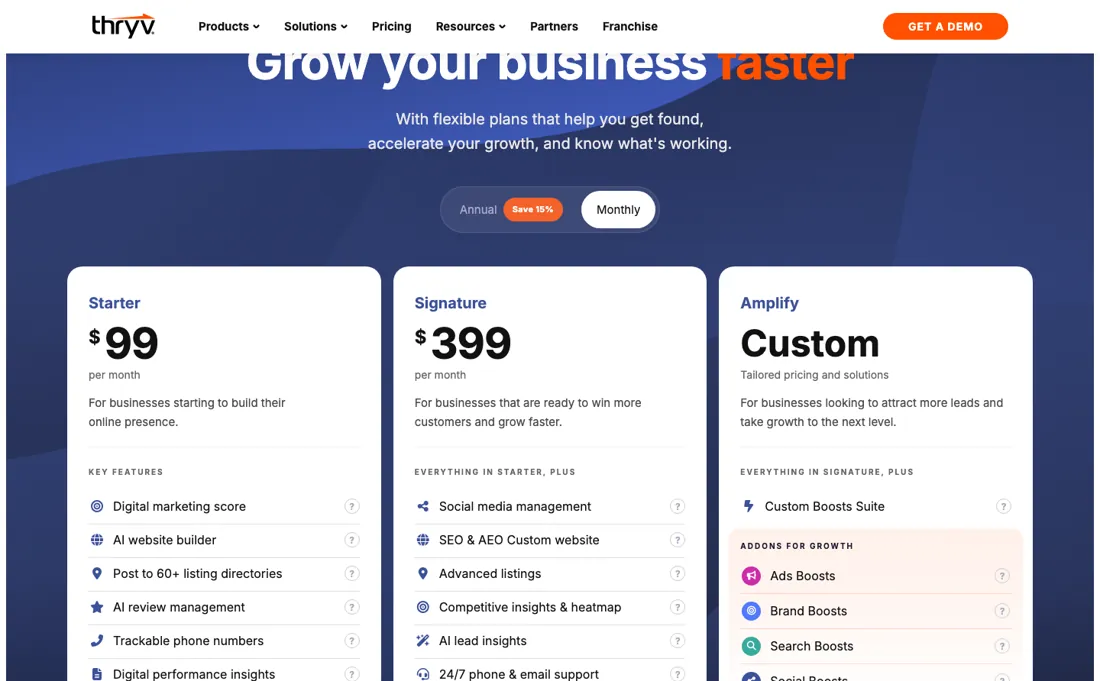
That makes the decision unusually blunt: not which plan fits, but whether a fourfold step is worth taking all at once. Signature is billed annually at $4,068 — that is a year committed up front, and the monthly figure is a division rather than a payment option. Before that call, list which of the bundled parts you would otherwise buy separately: Thryv's case rests on replacing four or five tools, and if you only want two of them the arithmetic usually favours keeping them.
What Thryv does
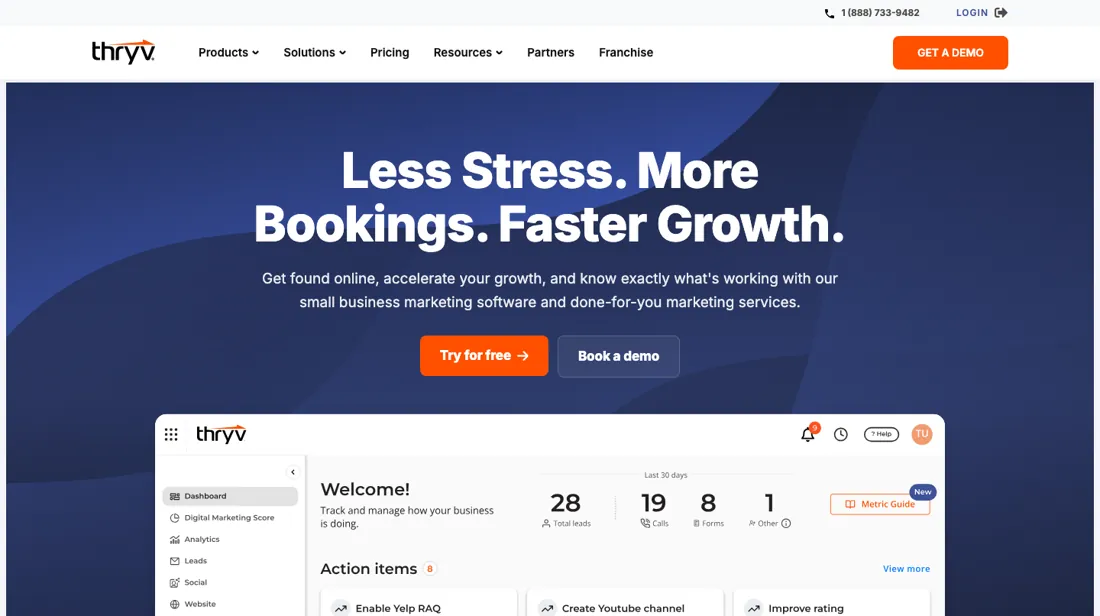
All-in-one platform for small service businesses: CRM, scheduling, invoicing, reviews and marketing.
What buyers report about Thryv
Recurring themes from the buyer-review sites listed at the foot of this page, read in August 2026. We have not run Thryv ourselves, so this is other buyers' experience rather than ours. We summarise it here because the complaints are usually the part a vendor page leaves out.
- • It genuinely replaces four or five separate tools for a small service business, and 68% of G2 reviews are five-star. Roughly 4.2 across 5,000+ reviews on four platforms.
- • For an owner who does not want to integrate anything, one system and one bill is the appeal.
- • The contract is a six-month minimum, then auto-renewing month to month — and cancellation is the top complaint on both Trustpilot and the BBB. Multiple customers describe being told their cancellation was not fully processed.
- • The BBB lists 89 billing complaints out of 357 total in three years, with auto-renewal the recurring theme.
- • Sales is described as pushy, with SEO and lead-generation promises that did not match what arrived. Get any performance claim in writing.
- • The advertised $244/month base is per location, and bundles run $646, $881 and $1,475.
- • Glitches, slowdowns and outright crashes are reported alongside account lockouts.
Four times the price, with nothing in between
Two published tiers: Starter at $85 a month, and Signature at $340 a month billed $4,068 annually. Annual billing is stated to save 15%, which puts the month-to-month Signature rate at around $400. Higher tiers and add-on services are not priced on the page, and there is a free trial (2026-08-01, read on their own pricing page). The gap is the thing to plan around: $85 to $340 is four times, with nothing in between.
So the question is not which plan suits you but whether the whole jump is worth taking in one step — and it is worth noticing that Signature is billed annually at $4,068. That is a year committed up front; the $340 monthly figure is a division rather than a payment option. The way to answer it is to list the bundled parts and mark the ones you would otherwise buy separately, with their prices.
Thryv's whole case rests on replacing four or five tools with one — CRM, scheduling, invoicing, reviews, marketing — and that case is either obviously true for your business or obviously not. If you would use two of the five, the arithmetic almost always favours keeping the two tools you already know; if you would use all five and you are currently paying for each, the bundle wins comfortably. Ask about the unpriced parts before the call ends.
Higher tiers and add-on services exist and are not on the page, and in a bundled product the add-ons are where the quote drifts away from the advertised number. Use the free trial on the module you are least sure about rather than the one that sold you. In an all-in-one, the weakest component is what determines whether you actually retire the tool it was supposed to replace — and a bundle you only half-adopt is the expensive outcome.
How to actually use Thryv
List the bundled parts and mark the ones you would otherwise pay for separately, with their actual prices beside them. Thryv's case is replacing four or five tools with one, so that list settles it: use two of the five and keeping your existing tools is usually cheaper; use all five and the bundle wins comfortably. Then price the commitment honestly. The annual toggle takes Starter from $99 to $85 and Signature from $399 to $340, a stated saving of 15 per cent — but both annual figures are printed per month, and the page does not say whether the year is charged in one payment or spread across twelve.
Ask, because $340 a month and roughly $4,080 up front are different commitments to a business with a quarter to get through. The gap from Starter's $85 to Signature's $340 is four times with nothing in between, so this is a single large step rather than a gradual upgrade. Ask what is not on the page before you finish the call. Higher tiers and add-on services exist and are unpriced publicly, and in a bundled product that is exactly where a quote drifts from the advertised figure.
Use the free trial on the module you are least confident about — the scheduling, or the invoicing, whichever you would find hardest to give up your current tool for. In an all-in-one it is the weakest component that decides whether you actually retire anything, and a bundle you only half-adopt is the expensive outcome.
Distilled from Thryv's own pricing page, thryv.com/pricing, read 10 September 2026 in a browser with the billing toggle switched both ways (the page refuses plain HTTP clients with a 403). Monthly shows Starter $99 and Signature $399; Annual shows $85 and $340, both labelled per month, with the toggle marked 'Save 15%'. Custom is 'Tailored pricing and solutions' with no figure. The page does not state whether the annual term is charged up front, and prints no yearly total — the roughly $4,080 we mention is our own arithmetic on $340 a month.
The natural comparison is Jobber or HoneyBook — the direct small-service-business peers — compare on which of your existing tools each one actually replaces, not on the feature count.
The ex-banker filter — the same yardstick on every review (how we review): My ex-banker filter is simple: does Thryv remove a real cost — time, errors, missed revenue — bigger than what it charges?
Frequently asked questions
What should I weigh before buying Business Operations software?
Judge it on evidence rather than adjectives. Look for a published security page, single sign-on and role controls on the plan you would actually buy (they are often gated to higher tiers), a status page with real incident history, and a clear answer on where your data is stored. If the tool will hold anything sensitive, those four answers matter more than any feature comparison.
Is this a hands-on review of Thryv?
This is a researched assessment, not a hands-on test — where we've used a tool ourselves, we say so explicitly. We name what each tool is genuinely good and bad at, and we have no affiliate relationship with Thryv — we earn nothing whether you sign up or not.
- Buyer reviews on G2, Trustpilot, the BBB and PissedConsumer, read August 2026.
- Read 2026-08-25 on their own pricing page.
- A dated screenshot of that pricing page, kept on this site as the receipt.
Others in this category
Nothing we have reviewed in business operations does the same job as Thryv; these are neighbours by category only:
New dossiers, cost-traps we found, and tools that earned a keep — no hype, no sponsored-disguised-as-advice. Unsubscribe anytime.
This is our researched assessment — not a paid placement. How we review →