Why B2B Founders Are Ditching Google Drive for Proton Drive's Zero-Knowledge Security
When your startup's intellectual property is worth millions and regulatory compliance can make or break your business, storing sensitive documents on traditional cloud platforms becomes a calculated risk that many technical founders are no longer willing to take. Proton Drive emerges as a compelling alternative, offering military-grade encryption where even Proton itself cannot access your files. For B2B SaaS companies handling customer data, financial records, or proprietary code, this zero-knowledge architecture represents a fundamental shift in how we approach data sovereignty.
Unlike mainstream cloud storage providers that can decrypt your files for law enforcement requests or internal analytics, Proton Drive encrypts everything client-side before it ever leaves your device. This means your business-critical documents remain truly private, even from Proton's own employees. For founders operating in regulated industries or serving enterprise clients with strict data residency requirements, this architectural difference isn't just a nice-to-have—it's becoming a competitive necessity.
Core Features That Matter for Business Operations
Proton Drive's feature set reflects its security-first philosophy while maintaining the usability standards modern businesses demand. The platform builds on Proton's decade-long expertise in encrypted communications, extending the same zero-knowledge principles to file storage and collaboration.
End-to-End Encryption Architecture
The cornerstone of Proton Drive is its client-side encryption model. Every file is encrypted on your device using AES-256 encryption before upload, with keys that never touch Proton's servers in unencrypted form. This means that even if Proton's infrastructure were compromised, your business data remains cryptographically protected. For B2B founders, this translates to genuine data sovereignty—you control access to your information, not the cloud provider.
The encryption extends beyond just file contents. Filenames, folder structures, and metadata are all encrypted, ensuring that even file organization patterns remain private. This level of protection is particularly valuable for companies in competitive markets where project names or client lists could reveal strategic information to competitors.
Secure File Sharing and Collaboration
Proton Drive enables secure sharing through encrypted links with granular permission controls. You can set expiration dates, download limits, and password protection for shared files. More importantly, recipients don't need Proton accounts to access shared content—the decryption happens in their browser using the shared key. This removes friction from client interactions while maintaining security standards that exceed what's possible with traditional platforms.
Version control and collaborative editing capabilities are built with the same security principles. Multiple team members can work on documents simultaneously while maintaining end-to-end encryption throughout the process. For distributed teams handling sensitive business documents, this ensures productivity doesn't come at the cost of security.
Cross-Platform Accessibility
Native applications are available for Windows, macOS, iOS, and Android, with a web interface that works across all major browsers. The sync functionality maintains encryption integrity across devices while providing the seamless experience users expect from modern cloud storage. Files are cached locally in encrypted form, ensuring offline access without compromising security.
The mobile applications deserve particular attention for business use cases. They support automatic camera roll backup with full encryption, making it safe to store sensitive photos of whiteboards, documents, or prototypes. For founders who frequently capture ideas or documentation on mobile devices, this encrypted backup capability provides peace of mind.
Advanced Search and Organization
Despite the encryption, Proton Drive maintains full-text search capabilities through client-side indexing. Your device creates and maintains an encrypted search index, allowing you to quickly locate files by content, filename, or metadata without compromising privacy. This addresses one of the traditional trade-offs between security and usability in encrypted storage solutions.
Folder organization supports nested structures with granular sharing permissions. You can create separate encrypted spaces for different projects, clients, or team members, with each space maintaining its own access controls. This organizational flexibility is crucial for agencies or consultancies managing multiple client projects simultaneously.
Pricing Structure and Value Analysis
Proton Drive's pricing model reflects its position as a premium security solution rather than a commodity storage service. The cost structure rewards long-term commitments and higher storage tiers, making it most cost-effective for established businesses with significant storage needs.
Individual Plans
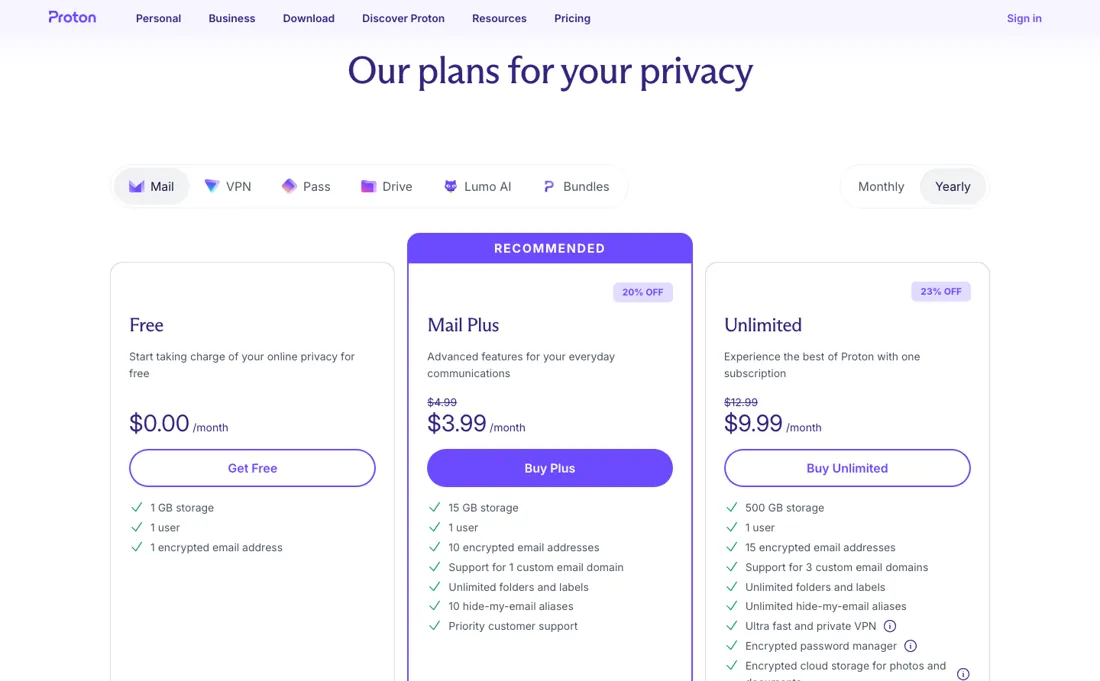
The Free tier provides 1GB of storage with basic encryption features, sufficient for testing the platform but inadequate for serious business use. The Plus plan at $4.99 monthly (or $47.88 annually) offers 200GB of storage, priority support, and advanced sharing features. For solo founders or very small teams, this represents reasonable value given the security benefits.
The Unlimited plan at $9.99 monthly ($119.88 annually) provides 500GB of storage plus access to Proton's full suite including encrypted email, calendar, and VPN services. This bundled approach can be cost-effective for founders who value having all communication and storage under a single, encrypted umbrella.
Business and Enterprise Solutions
Proton's business plans start at $6.99 per user monthly for the Professional tier, which includes 500GB per user, advanced admin controls, and priority support. The enterprise pricing requires custom quotes but typically starts around $30 per user monthly for organizations requiring dedicated infrastructure, compliance certifications, and custom integrations.
When compared to enterprise-grade solutions from traditional providers, Proton's pricing becomes more competitive. Microsoft 365 Business Premium costs $22 per user monthly, while Google Workspace Business Plus is $18 per user monthly. Neither offers Proton's level of encryption by default, making Proton's premium pricing justifiable for security-conscious organizations.
Storage Cost Comparison
At the 500GB tier, Proton Drive costs approximately $0.24 per GB annually on the Unlimited plan. Google Drive charges $0.20 per GB annually for similar storage, while Dropbox Business costs around $0.30 per GB annually. The premium for Proton's encryption represents roughly 20% over Google's pricing—a modest cost for military-grade security.
For larger storage requirements, the economics become more favorable. Enterprise customers often negotiate better per-GB rates, and the security benefits become more valuable as data volumes increase. A single data breach can cost millions in remediation, regulatory fines, and lost business, making Proton's security premium a sound investment for risk management.
Advantages for B2B Operations
Proton Drive's strengths align particularly well with the needs of B2B SaaS companies and professional services firms. The security architecture addresses compliance requirements while the feature set supports modern business workflows.
Regulatory Compliance Benefits
GDPR and Data Residency: Proton's Swiss jurisdiction and zero-knowledge architecture provide strong protection against data localization requirements. Since Proton cannot decrypt your data, cross-border data transfers become less problematic from a compliance perspective. This is particularly valuable for companies serving European clients or operating across multiple jurisdictions.
Industry-Specific Requirements: Healthcare, financial services, and legal firms benefit from Proton's encryption meeting or exceeding industry security standards. The platform's architecture makes it easier to demonstrate due diligence in data protection, which can be crucial for client contracts and regulatory audits.
Competitive Advantages
For B2B companies, offering clients the option to collaborate through Proton Drive can become a differentiator. When pitching enterprise clients who are increasingly security-conscious, the ability to demonstrate that all project files and communications are end-to-end encrypted provides a competitive edge over firms using traditional cloud storage.
The platform's Swiss privacy laws also offer protection against government surveillance that can be valuable when working with international clients or on sensitive projects. This legal protection, combined with technical encryption, creates a compelling value proposition for high-value client relationships.
Team Productivity Benefits
Despite the security focus, Proton Drive maintains productivity features that teams expect. Real-time collaboration, automatic syncing, and mobile access ensure that security doesn't come at the cost of efficiency. The learning curve is minimal for teams migrating from other cloud storage platforms.
The integrated nature of Proton's suite also provides workflow benefits. Teams can seamlessly move between encrypted email, calendar scheduling, and file sharing without switching platforms or compromising security. This integration reduces context switching and maintains security boundaries across all business communications.
Limitations and Considerations
While Proton Drive offers compelling security benefits, it's important to understand the trade-offs and limitations that come with zero-knowledge encryption.
Performance and Speed Constraints
Client-side encryption requires additional processing power, which can impact upload and download speeds, particularly on mobile devices or older hardware. Large file transfers may take longer compared to traditional cloud storage, though the difference is often negligible on modern devices with fast internet connections.
The sync functionality, while reliable, can be slower than competitors like Dropbox or Google Drive. This is particularly noticeable when working with large numbers of small files or complex folder structures. For teams that frequently work with large media files or extensive codebases, this performance impact should be considered.
Integration Ecosystem Limitations
Proton Drive's third-party integration ecosystem is limited compared to established platforms. There's no native integration with popular business tools like Slack, Salesforce, or project management platforms. This can create workflow friction for teams heavily invested in specific tool ecosystems.
The lack of advanced collaboration features like real-time document editing (similar to Google Docs) means teams may need to maintain hybrid workflows, using Proton for storage and security while relying on other platforms for content creation and editing.
Learning Curve and Change Management
While the interface is intuitive, the security model requires some user education. Team members need to understand the importance of secure password management and the implications of losing access credentials. Unlike traditional platforms where providers can reset access, Proton's zero-knowledge model means lost credentials can result in permanently inaccessible data.
Migration from existing platforms requires careful planning, particularly for large data volumes or complex folder structures. The process isn't as seamless as switching between traditional cloud providers, and businesses should budget time for proper migration and team training.
ROI Analysis for B2B Founders
Calculating the return on investment for Proton Drive requires considering both direct cost savings and risk mitigation benefits. For B2B companies, the value proposition extends beyond simple storage costs to encompass competitive advantages and compliance benefits.
Direct Cost Analysis
Consider a 25-person B2B SaaS company currently using Google Workspace Business Standard at $12 per user monthly ($3,600 annually). Migrating to Proton's Professional plan at $6.99 per user monthly would cost $2,097 annually—a savings of $1,503 per year while gaining superior encryption.
However, this comparison assumes equivalent functionality. If the company needs to maintain some Google services for integration purposes, the cost equation changes. A hybrid approach might involve Proton for sensitive data storage while maintaining minimal Google licenses for specific integrations.
Risk Mitigation Value
The average cost of a data breach for small to medium businesses is approximately $2.9 million according to IBM's 2023 Cost of a Data Breach Report. Even a 1% reduction in breach probability due to superior encryption could justify Proton's premium pricing many times over.
For companies in regulated industries, compliance violations can cost significantly more. GDPR fines can reach 4% of annual revenue, making robust data protection not just a security measure but a business continuity requirement. The cost of implementing Proton Drive is minimal compared to potential regulatory penalties.
Competitive Advantage Quantification
B2B companies that can demonstrate superior data security often command premium pricing. If enhanced security positioning allows a company to charge even 5% more for their services, the ROI on Proton Drive becomes substantial. For a company generating $1 million annually, this could mean $50,000 in additional revenue—far exceeding Proton's costs.
Client retention also improves when businesses can demonstrate commitment to data security. The cost of acquiring new customers is typically 5-25 times higher than retaining existing ones, making security-driven retention valuable even beyond direct revenue impacts.
Productivity and Efficiency Gains
While harder to quantify, the integrated nature of Proton's suite can reduce context switching and improve team efficiency. If each team member saves just 15 minutes daily by having unified encrypted communications and storage, the time savings for a 25-person team equals 6.25 hours daily or approximately $125,000 annually in productivity gains at typical SaaS company salary levels.
Alternative Solutions Comparison
Understanding Proton Drive's position requires comparing it against both traditional cloud storage providers and other security-focused alternatives.
Traditional Cloud Storage
Google Drive: Offers superior integration ecosystem and collaboration features but provides limited encryption options. Google can access your data for various purposes, making it unsuitable for highly sensitive business information. Pricing is competitive, but the security trade-offs are significant for risk-conscious businesses.
Dropbox Business: Provides excellent sync performance and extensive third-party integrations. However, encryption is primarily for data in transit and at rest, not end-to-end. Dropbox has experienced security breaches in the past, raising questions about long-term data security for sensitive business information.
Microsoft OneDrive: Integrates seamlessly with Microsoft 365 ecosystem and offers reasonable security features. However, like Google, Microsoft retains the ability to access your data and has complied with government data requests. The encryption model doesn't provide the zero-knowledge guarantees that Proton offers.
Security-Focused Competitors
Tresorit: Offers similar end-to-end encryption with better third-party integrations than Proton. However, pricing is significantly higher—often 2-3x Proton's rates for comparable storage. The Swiss jurisdiction advantage is similar, but the feature set is more limited outside of core storage functionality.
SpiderOak: Provides zero-knowledge encryption with strong security credentials. However, the user interface is less polished than Proton's, and the company lacks Proton's broader ecosystem of encrypted services. Pricing is comparable, but the overall user experience is inferior.
Sync.com: Offers end-to-end encryption with Canadian jurisdiction and competitive pricing. The feature set is robust, but the company lacks Proton's established reputation in the security community. Integration options are limited compared to traditional providers.
Enterprise Security Solutions
For larger organizations, dedicated enterprise security solutions like Vera or Microsoft Purview offer advanced data loss prevention and encryption capabilities. However, these solutions typically cost $20-50 per user monthly and require significant IT resources to implement and maintain. Proton Drive provides similar security benefits with much lower implementation complexity and cost.
Implementation Strategy for B2B Teams
Successfully deploying Proton Drive in a B2B environment requires careful planning and phased implementation to minimize disruption while maximizing security benefits.
Pilot Program Approach
Start with a small team or specific project to test Proton Drive's functionality and performance in your environment. Choose a group that handles sensitive data but isn't critical to daily operations. This allows you to identify potential issues and develop best practices before wider deployment.
During the pilot phase, focus on understanding the performance characteristics, integration requirements, and user experience differences compared to your current solution. Document workflows that work well and identify areas where workarounds or additional tools might be needed.
Data Migration Planning
Develop a comprehensive migration strategy that prioritizes sensitive data while maintaining business continuity. Consider a hybrid approach where highly sensitive files move to Proton Drive first, while less critical data remains on existing platforms during the transition period.
Establish clear data classification policies to help team members understand what should be stored on Proton Drive versus other platforms. This classification system will also be valuable for ongoing compliance and security management.
Team Training and Adoption
Invest in proper training to ensure team members understand both the benefits and responsibilities that come with zero-knowledge encryption. Emphasize the importance of secure password management and the implications of lost access credentials.
Create documentation and workflows that help team members integrate Proton Drive into their daily routines. Focus on making security practices feel natural rather than burdensome to encourage adoption and compliance.
Long-term Strategic Considerations
Proton Drive represents more than just a storage solution—it's a strategic investment in data sovereignty and privacy that aligns with broader trends in business security and regulation.
Regulatory Landscape Evolution
Data protection regulations continue to evolve globally, with increasing emphasis on corporate responsibility for data security. Early adoption of zero-knowledge encryption positions companies ahead of regulatory requirements rather than scrambling to achieve compliance after new rules are implemented.
The trend toward data localization and sovereignty requirements makes Proton's Swiss jurisdiction and encryption architecture increasingly valuable. As governments impose stricter controls on data access and storage, having a provider that cannot comply with decryption requests becomes a competitive advantage.
Client Expectations and Market Positioning
Enterprise clients are becoming more sophisticated in their security requirements and vendor evaluations. Being able to demonstrate end-to-end encryption for all client data and communications can become a significant differentiator in competitive situations.
The security-conscious positioning also attracts higher-value clients who are willing to pay premium prices for superior data protection. This client segment often has longer contract terms and lower churn rates, improving overall business metrics.
Final Verdict: Is Proton Drive Right for Your Business?
Proton Drive excels as a security-first storage solution for B2B companies that prioritize data sovereignty and regulatory compliance over convenience features and ecosystem integrations. The platform's zero-knowledge encryption architecture provides genuine privacy protection that traditional cloud providers cannot match, making it particularly valuable for companies handling sensitive business data or serving security-conscious clients.
The pricing premium over traditional solutions—typically 20-40% higher—is justified by the security benefits and risk mitigation value, especially for companies in regulated industries or those handling high-value intellectual property. The integrated nature of Proton's ecosystem also provides workflow benefits that can offset some of the third-party integration limitations.
However, businesses heavily dependent on specific tool ecosystems or requiring advanced collaboration features may find Proton Drive's limitations challenging. The performance characteristics, while acceptable for most use cases, may not meet the needs of teams working with large files or requiring instant synchronization.
For B2B SaaS companies, professional services firms, and other businesses where data security directly impacts client trust and regulatory compliance, Proton Drive represents a strategic investment in competitive positioning and risk management. The platform's Swiss jurisdiction, proven encryption architecture, and growing feature set make it a compelling choice for forward-thinking founders who view data sovereignty as a business advantage rather than a technical requirement.
Ready to take control of your business data with military-grade encryption? Start your Proton Drive journey today with a free account to test the platform's security and performance with your team's workflows. The investment in data sovereignty and regulatory compliance will pay dividends as privacy regulations tighten and enterprise clients demand higher security standards from their vendors.