 BookX Review (2026)
The free plan is a demonstration rather than a plan.
Visit BookX → Affiliate link — the rest of this page is the honest version, including who should skip it.
Pricing (2026)
✓ Pricing re-verified 8 Sep 2026
- Free — $0 a monthone service and one team member, with unlimited bookings on every tier
- Starter — $9.99 a month, or $107.99 a yearfive locations and team members, unlimited services, full-day, multi-day and bundle bookings, deposits at checkout
- Growth — $19.99 a month, or $203.99 a yearten locations and team members, deposits and multi-payment options, workflows, Shopify Flow and POS, seasonal pricing
- Business — $39.99 a month, or $407.99 a yeartwenty locations and team members, the all-in-one booking widget, two-way Google Calendar sync, Klaviyo and webhooks, priority support
| This tool | $9.99 | 2nd cheapest of 16 |
| Cheapest | $8.33 | QuillBot |
| Median | $45 | |
| Most expensive | $699 | Wing Assistant |
Entry price per month, USD. Our own dated readings of 16 operations & workflow tools — not a market survey, and cheapest is not best.
Four tiers billed in USD every 30 days, and the meter is locations and team members rather than bookings — every tier, the free one included, carries unlimited bookings. Free costs nothing and covers one service and one team member, minute or hour scheduling, lead and buffer time, email notifications, timezone and multi-language support, blockout dates and slots, and live support by chat, email and Zoom.
Starter is $9.99 a month or $107.99 a year (10% off) and lifts that to five locations and team members with unlimited services, full-day, multi-day and bundle bookings, Google Calendar and Zoom, book-now-pay-later and partial payments, customer reschedule and cancel, and a universal booking button. Growth is $19.99 or $203.99 a year (15%) for ten locations and team members, deposits and multi-payment options, workflows and a custom email sender, Shopify Flow and POS, seasonal pricing and advanced bundle and multi-day conditions.
Business is $39.99 or $407.99 a year (15%) for twenty locations and team members, the all-in-one booking widget, two-way Google Calendar sync per team member, advanced seasonal pricing, Klaviyo and webhook integrations and priority support. Every paid tier has a 14-day free trial. What the table does not publish is what happens above twenty locations or team members: the ladder simply ends there. Plans change — always verify the live price on their site.
What the pricing page doesn’t say
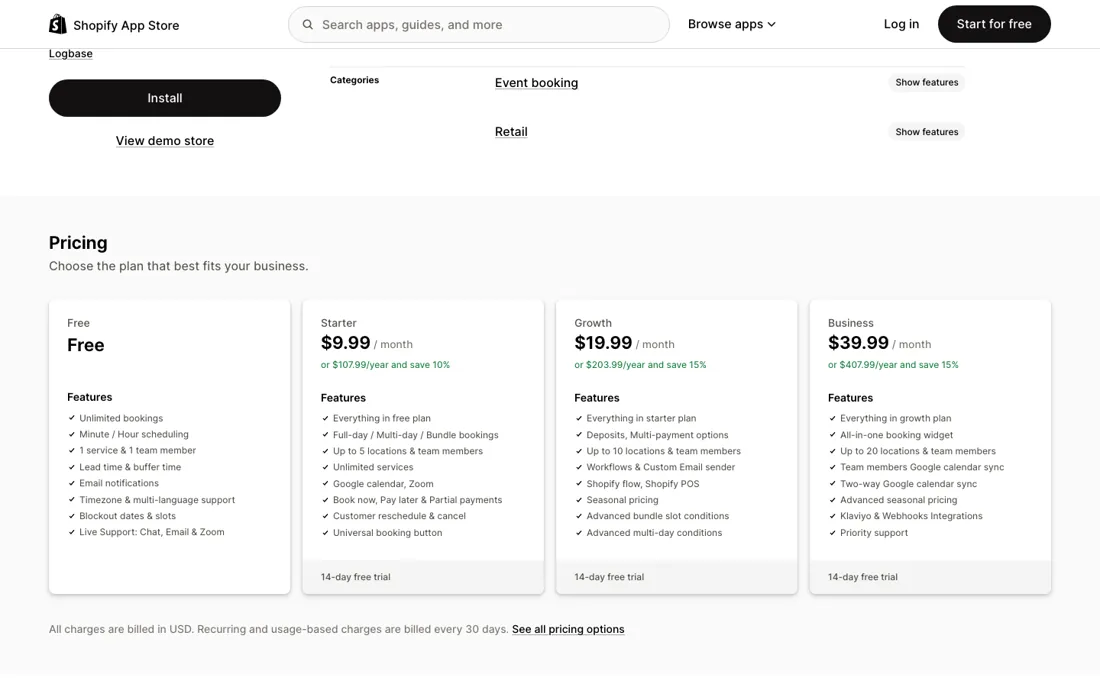
One service and one team member means a salon with two stylists, or a studio running two class types, is already on Starter — so treat $9.99 a month as the real entry price, not zero. From there the ladder is gated on locations and team members rather than on how much you actually book: five, ten and twenty at $9.99, $19.99 and $39.99. A busy single-location business therefore pays the same as a quiet one, which is generous, while a small chain climbs the ladder for reasons that have nothing to do with volume.
Above twenty locations or team members the published table stops and you have to ask. And the whole thing only exists inside Shopify — the calendar rides on your storefront, checkout and POS — so there is nothing here for a business that takes bookings anywhere else.
What BookX does
Shopify appointment booking that lives in the storefront: Calendly-style slots for services, classes, rentals and events, with staff and multi-location schedules, deposits and partial payments, and the money taken at your own checkout. Bookings are unlimited on every tier — the ladder is gated on locations and team members. Free covers 1 service and 1 team member; Starter $9.99 a month or $107.99 a year, Growth $19.99 or $203.99, Business $39.99 or $407.99, for 5, 10 and 20 locations and team members. Read 8 Sep 2026.
What buyers report about BookX
Recurring themes from the buyer-review sites listed at the foot of this page, read in September 2026. We have not run BookX ourselves, so this is other buyers' experience rather than ours. We summarise it here because the complaints are usually the part a vendor page leaves out.
- • Rental and tour operators are the clearest fit: a Dutch rental business names seasonal pricing, multi-day and full-day bookings as the features it runs on, and reports fast replies at weekends.
- • It bends to unusual scheduling. A kayak tour company of about a year says the configuration options cover almost everything they need.
- • Live support by chat, email and Zoom is on every tier including the free one, and reviewers in several countries confirm getting help outside business hours.
- • The same tour operator who recommends it says the app is not intuitive and that they need support often — praise for the help desk and a complaint about the interface arrive in one review.
- • The free tier's 'one service' means one product, which is not obvious. A merchant who attached three classes in January 2026 says the app locked them out with no explanation, and another gave up after 17 minutes because they could not test more than one service without paying.
- • Manual invoices are a gap: a merchant reported in March 2026 that booking slots could not be picked when sending one, which matters if most bookings are invoiced rather than self-served.
- • In February 2025 a merchant published emails in which a Logbase employee pressed them to take down a negative review; the co-founder replied publicly on the listing apologising and said it did not reflect company policy.
The free plan is a demo, and the meter is staff, not bookings
Every tier carries unlimited bookings, the free one included, so nothing here meters what you sell. What the ladder gates is locations and team members, and that makes the free plan a demonstration rather than a plan: one service and one team member means a salon with two stylists, or a studio running two class types, is already on Starter. Treat $9.99 a month as the entry price, not zero.
Above that the steps are small and specific. Deposits and multiple payment options are Growth at $19.99, not Starter — Starter carries book-now-pay-later and partial payments, which is a different thing. Shopify Flow, POS and seasonal pricing are Growth too. Two-way Google Calendar sync per team member, Klaviyo and webhooks are Business at $39.99. That is not a number being withheld behind a sales call, it is a ceiling with nothing above it — so if you schedule across more sites or a bigger roster than that, settle the arrangement before you build on it.
How to actually use BookX
Setup is guided. Install, click Get Started, and pick one of eight service templates — regular, full-day or multi-day, each in a pay-at-checkout and a pay-later variant, plus a custom route and a service without a product. Name the service, link your products to it, set the booking slots, then optionally set lead time and capacity. Finally enable the BookX app embed in the Theme Editor and preview the widget; you can skip that and return to it.
Before you take a real booking, do the three checks the vendor files under Mandatory: disable the dynamic checkout button, disable the accelerated checkout buttons on the cart page and cart drawer, and enable cart checkout validation. Express checkout otherwise routes buyers around the slot logic. One trap the free tier sets: a service is tied to a product, so one service means one product. Merchants who attached several classes on Free have reported being locked out with no explanation why.
Distilled from the BookX help centre at bookeasy.helpkit.so — the Getting Started article and the three articles filed under Mandatory Checks — read on 8 September 2026, together with the plan table and the 605 merchant reviews on apps.shopify.com/appointment-booking-bookeasy the same day
BookX vs SimplyBook.me, side by side
Both columns come from the same place: each vendor’s own published pricing, read on the date shown in the sources at the foot of this page. We do not average them into a score.
Both names above are affiliate links: we may earn a commission if you sign up, at no extra cost to you. Neither changes what this table says: both columns come straight from the vendors’ own pricing pages.
The natural comparison is SimplyBook.me — SimplyBook.me is a standalone booking platform with its own booking page, client records and payment providers, and it works whatever you sell on. BookX makes sense the other way round: you are already committed to Shopify and you want the calendar, the staff schedule and the money to sit inside that storefront instead of beside it. The trade is reach against integration — SimplyBook.me can take a booking from someone who never sees your shop, BookX cannot, but BookX takes the payment through the checkout you already run and keeps the appointment in the same admin as the order.
More on BookX
Everything we publish about BookX links back here — the review stays the honest hub:
The ex-banker filter — the same yardstick on every review (how we review): My ex-banker filter is simple: does BookX remove a real cost — time, errors, missed revenue — bigger than what it charges?
Frequently asked questions
What should I weigh before buying Operations & Workflow software?
Usually it sits on top rather than replacing everything. Tools in this class tend to become the layer where work is tracked and handed off, while your existing systems stay the source of truth for their own data. Before you buy, map which tools it would replace outright and which it would merely sync with. If the answer is that it syncs with all of them, you are adding a layer rather than removing one.
Is this a hands-on review of BookX?
This is a researched assessment, not a hands-on test — where we've used a tool ourselves, we say so explicitly. We name what each tool is genuinely good and bad at, and we earn a commission only if you sign up, at no cost to you.
- Buyer reviews on the Shopify App Store listing (apps.shopify.com/appointment-booking-bookeasy), including the one- to three-star filter, read September 2026.
- Read 2026-09-08 on apps.shopify.com/appointment-booking-bookeasy and checked against the vendor's own pricing section on logbase.io, which lists the same tiers.
- A dated screenshot of that pricing page, kept on this site as the receipt.
Others in this category
The operations & workflow tools closest to BookX that we have also reviewed. They overlap rather than match:
New dossiers, cost-traps we found, and tools that earned a keep — no hype, no sponsored-disguised-as-advice. Unsubscribe anytime.
This is our researched assessment — not a paid placement. The “Visit” links on this page are affiliate links: we may earn a commission if you sign up, at no extra cost to you, and it never changes our take. How we review →