 Toggl Review (2026)Annual Saves 33% on Premium, 25% on Starter
Toggl's honesty problem is the good kind: the free tier is so capable that many teams never need to pay — the paid line is drawn exactly at 'do you bill clients' (budgets, rates, profitability). Throughout this review we weigh it against Harvest.
Visit Toggl → Affiliate link — we may earn a commission if you sign up; it does not change what this page says.
Watch the 2-minute review
The video version of this review, from our YouTube channel.
⚡ Short on time? Watch the 30-second verdict Short.
Pricing (2026)
✓ Pricing re-verified 9 Sep 2026
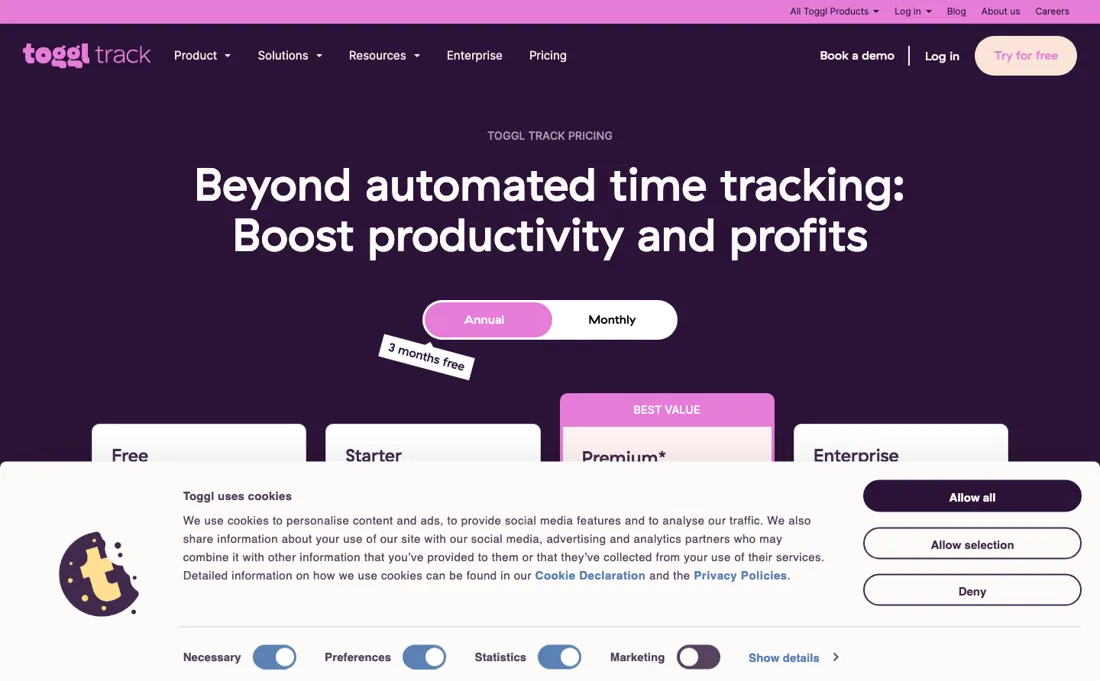
Free is $0 for a limited number of users and the page calls it free forever. Starter is $9 per user a month billed annually and $12 monthly; Premium is $16 annually and $24 monthly; Enterprise is quoted. The introductory $14 Premium rate renewing at $18 that we recorded in August is gone — Premium now carries one annual price. The billing toggle advertises 'Annual (Save 33.3%)' and '4 months free', which holds exactly for Premium but not for Starter, where $12 to $9 is 25%.
Trial is 30 days; Enterprise adds volume discounts on annual and multiple workspaces under one organisation. Plans change — always verify the live price on their site.
What the pricing page doesn’t say
If you do, Starter earns itself fast; if you track time for personal discipline, resist the upgrade. Time tracking's real cost everywhere is adoption: the tool is frictionless, but the habit still has to be built.
What Toggl does
Time tracking and capacity planning for freelancers, consultants and agencies, with budgets, rates and profitability per project. Relaunched from Toggl Track to Toggl in 2026.
What buyers report about Toggl
Recurring themes from the buyer-review sites listed at the foot of this page, read in August 2026. We have not run Toggl ourselves, so this is other buyers' experience rather than ours. We summarise it here because the complaints are usually the part a vendor page leaves out.
- • Starting a timer is effortless, which is the whole battle with time tracking — 4.6 on G2 across 1,500+ reviews, 4.7 on Capterra.
- • The free plan genuinely does what a solo or small team needs day to day. Reviewers describe it as covering up to five users; Toggl's own page now says only 'a limited number of users' without naming one.
- • Syncing is the most common complaint: a timer started on mobile does not always stop on desktop, and entries can take seconds to a minute to appear on another device.
- • Bulk-editing several entries in the calendar view is awkward compared with the rest of the tool.
- • Support is slow, including for long-standing customers.
- • Reviewers on small teams call the paid tiers steep for time tracking. They were writing against Premium at $18 a user on annual billing; it is $16 as of September 2026, with Starter unchanged at $9.
One question decides this: do you bill clients?
Free is $0 for a limited number of users and Toggl calls it free forever. The introductory $14 rate renewing at $18 that we recorded in August is no longer on the page. Check the annual promise against the plan, because it only holds for one of them. The toggle offers '4 months free' and 'Save 33.3%', and Premium delivers exactly that: $24 monthly against $16 annually is eight months' money for twelve.
Starter does not — $12 to $9 is 25%, which is three months, not four. On a ten-person team the annual switch saves $960 a year on Premium and $360 on Starter, so the discount is worth most to the tier that already costs most. The line between free and paid is the genuinely useful thing here. Behind the paywall sits the client-billing layer: billable rates, team revenue reports, capacity.
So the question is binary rather than gradual. If you invoice by time, Starter at $108 a licence a year costs less than an hour and a half of billable time at a $75 rate, and the first unbilled hour it catches has paid for it. If you track time for your own discipline rather than to bill anyone, the free plan is the product. Premium adds profitability and labour costs, fixed-fee projects, timesheet approvals and SSO.
At 78% above Starter, name the one report you would actually open before taking it. One change since that reading is the name, and it is worth stating plainly because it affects what you are buying. Read on toggl.com on 18 September 2026, Toggl Track has relaunched simply as Toggl, positioned as a time tracking and capacity planning platform rather than a timer. The pricing page describes itself the same way — 'now with capacity management and project planning' — and the plan cards carry it through: PTO, public holidays and flexible hours from Starter, capacity and margin monitoring on Premium, plus Toggl AI, which answers plain-language questions about hours logged, billable versus non-billable and projects over estimate.
Two things did not change. Every price above is the same at this reading, and Toggl's own site states that existing Toggl Track and Toggl Plan users keep both products, supported.
How to actually use Toggl
Answer one question before you look at plans: do you bill anyone by the hour? If yes, Starter is the plan — billable rates and revenue reporting are exactly what sits behind the paywall, and one recovered unbilled hour covers the year. If no, stay free; the free tier is a real product rather than a trial and a great many teams never need more. Start it on one person or one project rather than the whole team.
The thing that fails in time tracking is never the software, it is the habit — so find out whether the logging survives a busy week before you buy licences for everyone. If you are weighing annual against monthly, the toggle's promise does not apply evenly. It advertises '4 months free', and Premium delivers exactly that: $24 a month becomes $16. Starter goes $12 to $9, which is 25% — three months, not four. Worth knowing before you assume the same saving carries to the cheaper plan.
Distilled from toggl.com/track/pricing read on 9 September 2026 — the four plan cards (Free, Starter, Premium, Enterprise) in both the annual and the monthly state of the billing toggle, together with the toggle's own '4 months free / Save 33.3%' claim and the feature lists each card carries.
The natural comparison is Harvest or Clockify — the classic trio — Clockify undercuts on price, Harvest bundles invoicing; Toggl wins on tracking UX and reporting depth. Weigh it against Harvest on the job you actually need done.
Frequently asked questions
What does Toggl cost?
Free is $0 for a limited number of users. Starter is $9 per user a month on annual billing and $12 monthly; Premium is $16 annually and $24 monthly; Enterprise is quoted. Read on 9 September 2026. The first-year $14 Premium rate that renewed at $18, which our August capture recorded, is no longer on the page — Premium now carries a single annual price.
How much does annual billing actually save?
On Premium, exactly what the toggle claims: $24 a month becomes $16, which is eight months' money for twelve — the advertised "4 months free". On Starter it is less: $12 becomes $9, a 25% cut, or three months. For a ten-person team that is $960 a year saved on Premium and $360 on Starter, so the discount is worth most to the tier that already costs most.
Is the free plan enough for a small team?
It covers a limited number of users with time tracking, which is genuinely enough for a freelancer or a pair. What it does not include is the budgeting and profitability reporting that make it a business tool — those start on Starter and Premium respectively. If you bill clients from the data, you are on a paid plan.
What should I weigh before buying Operations & Workflow software?
Usually it sits on top rather than replacing everything. Tools in this class tend to become the layer where work is tracked and handed off, while your existing systems stay the source of truth for their own data. Before you buy, map which tools it would replace outright and which it would merely sync with. If the answer is that it syncs with all of them, you are adding a layer rather than removing one.
Is this a hands-on review of Toggl?
This is a researched assessment, not a hands-on test — where we've used a tool ourselves, we say so explicitly. We name what each tool is good and bad at, and we earn a commission only if you sign up, at no cost to you.
- Buyer reviews on G2 and Capterra, read August 2026.
- Re-verified 2026-09-09 on toggl.com/track/pricing.
- A dated screenshot of that pricing page, kept on this site as the receipt.
Others in this category
Reviewed operations & workflow tools that share ground with Toggl — comparable in what they do, not drop-in swaps:
New reviews, price changes we recorded, and the cost conditions we found. No sponsored placements. Unsubscribe anytime.
This is our researched assessment — not a paid placement. The “Visit” links on this page are affiliate links: we may earn a commission if you sign up, at no extra cost to you, and it never changes our take. How we review →