 Velora Review (2026)Three Products, One Invoice
Transparency: the “Visit” links on this page are affiliate links — we may earn a commission if you sign up, at no extra cost to you. No vendor can pay for a better review or verdict. How we make money →
Velora is three acquired products (Keela, Aplos, Raisely) being unified into one platform, and that's the honest watch-out: integration between them is newer than the marketing suggests, so check how deeply the pieces actually connect for your workflow before committing. Throughout this review we weigh it against Blackbaud.
Visit Velora → Affiliate link — we may earn a commission if you sign up; it does not change what this page says.
Watch the 2-minute review
The video version of this review, from our YouTube channel.
⚡ Short on time? Watch the 30-second verdict Short.
Pricing (2026)
✓ Pricing re-verified 25 Sep 2026
Quote-only. joinvelora.com (read in a browser on 5 September 2026) has no pricing page and no amount anywhere; every call to action is 'Talk to sales'. Velora bundles Keela (CRM), Aplos (accounting) and Raisely (fundraising) for nonprofits, and the individual product prices are not shown on the unified site. The products' own pricing pages still publish them — read 25 September 2026, Keela from $164 a month billed annually ($190 monthly) for up to 1,000 contacts, Aplos Lite at $79 a month, and Raisely with no monthly fee — but whether a Velora contract uses those rates is something only sales can confirm.
Our earlier note of Keela 'from about $134' is out of date. Plans change — always verify the live price on their site.
Category context: Operations & Workflow. Across the 49 tools in this category that we researched with a public US-dollar price, the median entry price is $25 a month (lowest paid plan as listed, per seat where the vendor prices per seat). Compare pricing conditions in the Software Cost Atlas →
The honest knock
Costs also stack per product and per contact count — a growing donor base raises the CRM bill. For nonprofits though, purpose-built beats adapted business software in fund accounting specifically.
What Velora does
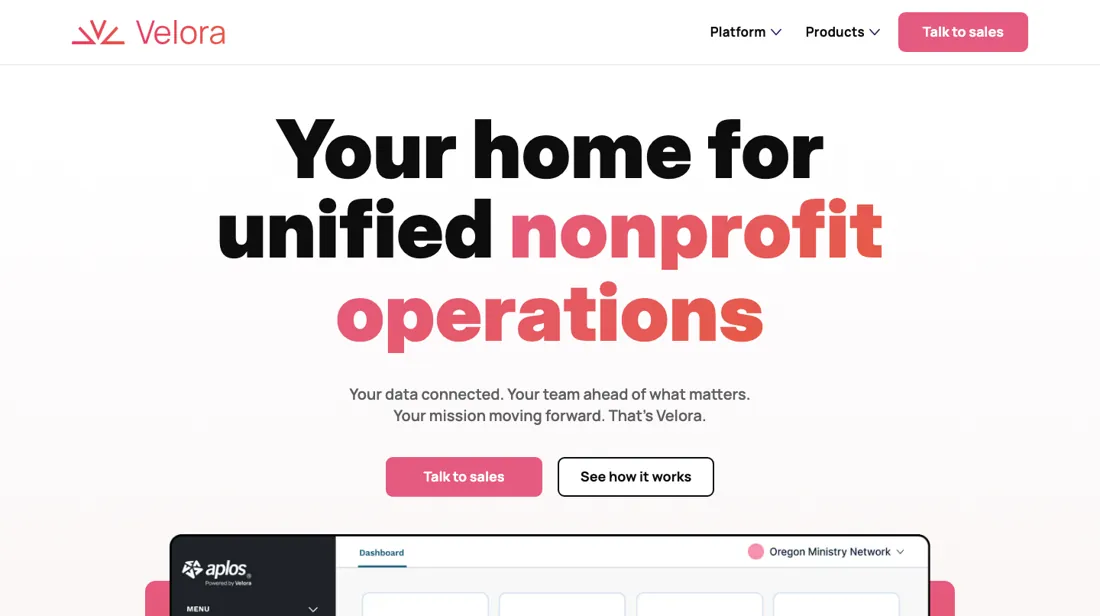
Unified operations platform for nonprofits: Keela (donor CRM), Aplos (fund accounting) and Raisely (online fundraising) as one connected suite — donor management, campaigns and finances built for charities instead of adapted from business software.
What buyers report about Velora
Recurring themes from the buyer-review sites listed at the foot of this page, read in August 2026. We have not run Velora ourselves, so this is other buyers' experience rather than ours. We summarise it here because the complaints are usually the part a vendor page leaves out.
- • Keela, Aplos and Raisely under one roof means donor CRM, fund accounting and online giving finally share a record instead of three exports.
- • The Smart Ask feature suggesting personalised donation amounts is reported to outperform generic asks.
- • Reviewers writing about Keela as a standalone product cite $134/month at 1,000 contacts on annual billing, rising to $379 at 10,000 — for a small charity a real line item to justify to a board. Those figures predate the Velora merge and are not published under the Velora name.
- • It is a consolidation of three previously separate products, so ask specifically how deep the integration goes in the areas you care about.
- • The independent review base under the Velora name is still thin — much of the history sits under Keela, Aplos and Raisely separately.
No published price, so ask about the plumbing
Velora publishes no prices. The site (read 10 September 2026) carries four product lines — Fundraising, built on Raisely; CRM, built on Keela; Fund Accounting and Grant Management, both built on Aplos — plus an AI layer, Mission Assistant. Every call to action is 'Talk to sales'; there is no pricing page and no amount anywhere. The products' own sites still carry list prices (read 25 September 2026): Keela from $164 a month on annual billing, Aplos Lite at $79.
Velora does not repeat them, so treat them as a benchmark rather than a quote. Budget for the shape of the bill instead of its size: it is priced per product and the CRM meters on contact count, so settle three things in the first call — which products you are buying, what the contact tier is, and what the price does as your donor list grows. But the number is not the risk here.
Velora is three acquired products — Keela, Aplos and Raisely — being unified into one platform, and the integration between them is newer than the marketing suggests. That turns the evaluation into one very specific question, and it is worth asking in exactly these terms during a demo. When a donation comes in through Raisely, does it appear against the right donor record in Keela without anyone touching it? And does it post to Aplos as a journal entry against the right fund?
If the honest answer involves a CSV export at any step, you are buying three products with one invoice rather than one platform, and the re-keying is a staff cost that will dwarf the licence difference. Ask the same question about the direction that matters most to finance: restricted funds. A donation given for a specific programme has to arrive in the ledger tagged as restricted, and that tag has to survive the trip from the donation page.
That is precisely the kind of thing that gets lost between systems that used to be separate companies. Where the case is genuinely strong is fund accounting itself. Restricted funds, grant tracking and nonprofit-specific reporting are things that general business accounting software handles badly and purpose-built software handles properly, and no amount of configuring a commercial ledger closes that gap. If the accounting side is your actual pain, that is the part to buy first and the part that justifies the price — with the integration question answered before you add the rest.
How to actually use Velora
Ask one question in the demo and make them show you rather than tell you. A donation comes in through Raisely: does it land against the right donor in Keela and post to Aplos as a journal entry against the right fund, with nobody touching it? These are three acquired products being unified, so the integration is the thing to verify, not the feature lists. If a CSV appears at any step, you are buying three products with one invoice.
Test the restricted-fund path specifically. A gift given for a named programme has to arrive in the ledger still tagged as restricted, and that tag is exactly what gets lost between systems that used to belong to different companies. Your finance volunteer or treasurer should watch this part, not your fundraiser. Buy the piece that hurts first rather than the suite. If fund accounting is the problem, start with Aplos, where purpose-built genuinely beats adapted business software; if donor management is, start with Keela and price it against your contact count, since that is what the CRM meters.
Costs stack per product, so adding the third one should follow evidence that the first two talk to each other.
Distilled from joinvelora.com read on 10 September 2026 — the product menu and the four product sections (Velora Fundraising built on Raisely, Velora CRM built on Keela, Velora Fund Accounting and Velora Grant Management both built on Aplos), the Mission Assistant entry, the 'A donor gives / The donor is remembered / The dollar is stewarded' flow that describes the intended integration, and the 'Coming Soon: Proactive Intelligence' block. Every call to action on the site is 'Talk to sales'; there is no pricing page and no currency amount anywhere on it. Re-read 25 September 2026: still no pricing page (joinvelora.com/pricing returns 404) and every call to action is 'Talk to sales'. The underlying products' own pricing pages, read the same day: keela.co/pricing (contact tiers from $164 a month billed annually or $190 monthly up to 1,000 contacts, to $438 or $489 at 7,501-10,000+, 'No Transaction Fees'), aplos.com/pricing (Lite $79, Core $129, Advanced from $229 a month, 15-day trial without a card) and raisely.com/pricing (no monthly fee; optional donor tips or a 4% flat fee, plus card processing from 1.4% + 30c).
The natural comparison is Blackbaud or Bloomerang plus QuickBooks — the legacy giant vs a DIY stack — Velora sits between: integrated and nonprofit-native without Blackbaud's enterprise weight. Weigh it against Blackbaud on the job you actually need done.
Frequently asked questions
How much does Velora cost?
Velora itself does not say: re-read 25 September 2026, the site has no pricing page and every button leads to sales. The products it is built on still publish their own rates. Keela's CRM runs from $164 a month on annual billing, or $190 monthly, for up to 1,000 contacts and climbs to $438 or $489 at 7,501 to 10,000+ contacts. Aplos lists Lite at $79 a month, Core at $129 and Advanced from $229. Whether a Velora contract prices the pieces at those rates, bundles them lower or charges something else is the first thing to get in writing.
Does the Raisely fundraising piece really have no monthly fee?
On Raisely's own pricing page, yes (read 25 September 2026): no contract and no monthly, setup or hosting fees. The platform is paid for through an optional tip that donors are asked to add on top of their gift. Switch the tip off and you pay a flat 4% of all transactions, excluding tax, unless you qualify for enterprise pricing. Card processing comes on top either way, from 1.4% plus 30 cents per transaction at Stripe's discounted nonprofit rate; the page's worked example uses the Australian rate, so check the one in your own country.
What would a small nonprofit pay for the CRM and accounting together?
At the standalone list prices, at least $243 a month: Keela's entry tier at $164 billed annually for up to 1,000 contacts plus Aplos Lite at $79 (both read 25 September 2026 on the products' own pricing pages). With Keela on monthly billing it is $269. Past 1,000 contacts the CRM tier moves up to $243 on its own, so contact growth is what raises the bill. Hold a Velora quote against these figures rather than reading them as Velora's price, because the unified site publishes none.
What should I weigh before buying Operations & Workflow software?
Usually it sits on top rather than replacing everything. Tools in this class tend to become the layer where work is tracked and handed off, while your existing systems stay the source of truth for their own data. Before you buy, map which tools it would replace outright and which it would merely sync with. If the answer is that it syncs with all of them, you are adding a layer rather than removing one.
Is this a hands-on review of Velora?
This is a researched assessment, not a hands-on test — where we've used a tool ourselves, we say so explicitly. We name what each tool is good and bad at, and we earn a commission only if you sign up, at no cost to you.
- Buyer reviews on GetApp and nonprofit-software reviews, read August 2026.
- Velora’s own published pricing page.
Others in this category
Reviewed operations & workflow tools that share ground with Velora — comparable in what they do, not drop-in swaps:
New reviews, price changes we recorded, and the cost conditions we found. No sponsored placements. Unsubscribe anytime.
This is our researched assessment — not a paid placement. The “Visit” links on this page are affiliate links: we may earn a commission if you sign up, at no extra cost to you, and it never changes our take. How we review →