Post Purchase Upsell Hero Review (2026)2.5% of Upsell Revenue
 By Daan Haket · Researched and written with an AI assistant · who does what
The 2.5% comes off revenue, not margin.
shopify stores that want post-purchase upsells with no fixed monthly cost, where the bill only exists once the app has already added revenue, and that are comfortable being early on an app a few months old.
you already do more than $20,000 of upsell revenue a month and would rather pay a flat fee than 2.5% of the first slice, you sell thin-margin add-ons where a revenue percentage eats the profit on the extra sale, or you want an app with more than a few months of track record.
Transparency: the “Visit” links on this page are affiliate links — we may earn a commission if you sign up, at no extra cost to you. No vendor can pay for a better review or verdict. How we make money →
Pricing (2026)
✓ Pricing re-verified 19 Sep 2026
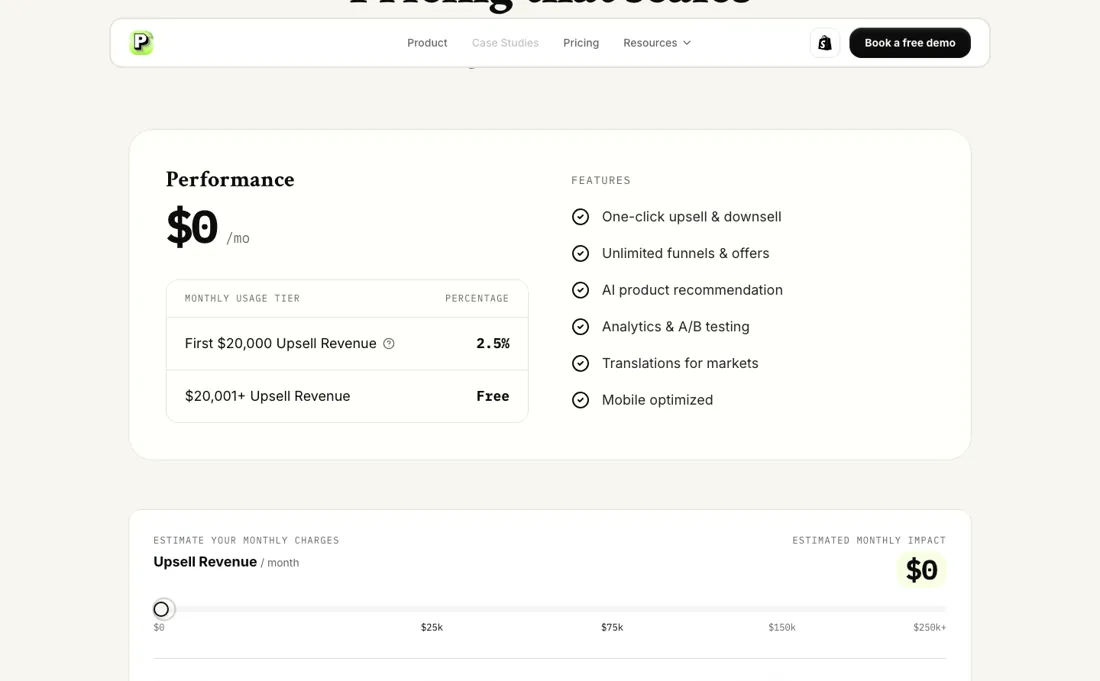
One plan, Performance, free to install, at $0 a month plus usage charges. The usage table, read from the listing's own pricing-estimator data, has two tiers: 2.5% on the first $20,000 of upsell revenue in a month, and $0 from $20,001 up. In practice that is a commission with a ceiling — the app cannot charge more than $500 in a month, and a month in which it sells nothing costs nothing.
There is no paid tier above it: unlimited funnels and offers, one-click upsell and downsell, AI product recommendations, analytics and A/B testing and market translations all sit on that single plan. Charges are billed in USD every 30 days. The vendor's own site publishes no prices at all — its pricing link leads to the same single-plan listing — so the listing is the only place the meter is stated.
Full pricing notes (3 more paragraphs)
Neither page defined how 'upsell revenue' is measured, so we asked, and the vendor answered in writing on 21 September 2026 with permission to quote it. The figure is net: the amount the customer is actually charged for the accepted upsell item, after any discount set on that offer, and nothing from the original cart is included. Refunds and cancellations of an accepted upsell are reversed automatically through Shopify — proportionally for partial refunds, with the 2.5% coming off alongside, and no support ticket needed — while refunds of original cart items never move the figure, because they were never billed.
There is no multi-day attribution window either: the offer exists only on the Shopify post-purchase page between payment and the order confirmation, and the merchant sets how long that moment stays open, with a default of 20 minutes, any value from 1 to 59 minutes, or Shopify's own 60-minute default. The vendor says the full rule now sits in its help center under Pricing and billing.
That is the vendor's account of its own meter, dated and on the record, but it is not something we have audited against a live bill.
Plans change — always verify the live price on their site.
Category context: Growth & Revenue. Across the 83 tools in this category that we researched with a public US-dollar price, the median entry price is about $30 a month (lowest paid plan as listed, per seat where the vendor prices per seat). Compare pricing conditions in the Software Cost Atlas →
What the pricing page doesn’t say
On a $40 upsell carrying a 20% margin the app takes a dollar of the eight you actually made — fine. On discounted or thin-margin add-ons the same percentage is a far bigger share of the profit, and the meter reads revenue either way. There is also no flat option to escape to: a store doing $20,000 of upsell revenue a month pays the full $500 and cannot buy out of the percentage, while the free-above-$20,001 tier only rewards stores already past that line.
And the app is young — it launched on 19 June 2026, so at the end of August there were barely ten weeks of merchant experience behind it. Post-purchase offers also depend on your store's checkout supporting the post-purchase extension; check that before you plan around them.
Watch the video review
The video version of this review, from our YouTube channel.
What Post Purchase Upsell Hero does
One-click post-purchase upsell and downsell offers for Shopify, with targeting rules, AI product recommendations, A/B testing and a revenue dashboard.
What buyers report about Post Purchase Upsell Hero
Hands-on: not tested by usReported by buyers: Shopify App Store listing apps, read September 2026
Themes from the buyer-review sites listed at the foot of this page, read in September 2026. We have not run Post Purchase Upsell Hero ourselves, so this is other buyers' experience rather than ours. We summarise it here because the complaints are usually the part a vendor page leaves out.
- • Funnel control is what reviewers describe in the most detail, and it is unusually specific: you can let the AI pick the product or build the funnel yourself and mix the two, stack offers so a customer who declines still sees a second one, and set the discount, the timer, how many products appear and which collections stay out.
- • Segmentation by customer type is named as the reason to keep it: a German electronics store runs separate funnels so refurbished buyers, new-device buyers and existing subscription customers each see offers that fit, and says it has run reliably since launch.
- • Setup is repeatedly described as taking minutes rather than a project, with several merchants saying they had put off post-purchase upsells because they did not know how, and that the app did the work for them.
- • Two merchants report switching from a named competitor: one moved off OCU calling this cheaper and considerably better in function, and a haircare store with over 3,000 store reviews says it turned them around after long scepticism about automated upsells.
- • The reviewers themselves flag the biggest limit of their own reviews: one writes plainly that they have not been live long enough to say anything solid about revenue, and explains they are reviewing the setup rather than the result.
- • One reviewer in the set rates it one star; the remaining 35 are five-star, so the listing carries a single dissenting account and no spread of moderate criticism to calibrate against.
- • Revenue claims in the reviews are merchants' own figures, not audited and not comparable: an Austrian store reports an upsell conversion rate above 20% and more than 13 euros revenue per display. Treat that as one shop's arithmetic on its own traffic and margin, not as a benchmark.
Where the ratings disagree. The number is 4.9 but the sample is 36, and it is concentrated twice over. Nearly every review comes from a German or Austrian store, and nearly every reviewer had been running the app for days to about a month when they wrote — 4 days, 6 days, 9 days, 10 days, 22 days, about a month. So this is a young, single-market review set describing first impressions of setup, and it should not be read alongside a four-figure rating as though the two mean the same thing. What it does support well is the claim about configurability, because that is what merchants describe concretely; what it cannot yet support is durability.
Pages read (September 2026): Shopify App Store
What the money actually buys
There is no premium tier, which makes the sum unusually short: the app charges 2.5% of the first $20,000 of upsell revenue it generates in a month and nothing at all above $20,001. The most it can cost you is $500 in a month; the least is nothing. The question that replaces 'which tier' is whether the attribution is honest, because attribution is the entire invoice. Every feature is included — unlimited funnels and offers, one-click upsell and downsell, AI product recommendations, analytics and A/B testing, translations for markets — so you are not paying for capability at all.
You are paying a commission on what the app says it earned you. Verify that claim against your own numbers in the first month and the model is genuinely aligned with your interests. Skip the check and you are trusting the meter that writes the bill.
How to actually use Post Purchase Upsell Hero
There is nothing to weigh up before installing, which is unusual: the plan is $0 a month and a bill only exists once the app has already sold something. That makes the install itself the test rather than the commitment. Build one funnel on your best-selling product, let the AI recommendation pick the follow-up offer for a second funnel, and run both long enough to compare — A/B testing sits on the same free plan, so there is no tier to buy in order to run the comparison properly.
What to watch from week one is the number the billing rests on: the upsell revenue the app attributes to itself. Check it against your own order data early rather than at the end of the month, because 2.5% of that figure is the invoice, and attribution is exactly where upsell apps and merchants tend to disagree. The offers themselves appear after checkout, so test on a real order rather than a preview to see what your customers will actually be shown. Read on apps.shopify.com/post-purchase-upsell-hero, 31 August 2026.
Distilled from Post Purchase Upsell Hero listing on the Shopify App Store (apps.shopify.com/post-purchase-upsell-hero), re-read 19 September 2026 — the single plan, the usage table read from the listing's own pricing-estimator data, feature list, integrations and developer details; and the vendor's own site https://postpurchaseupsellhero.com/ (read 19 September 2026 — targeting rules, A/B testing, 130-plus languages, the OfferPage editor, and the absence of any published price). No hands-on run.
Post Purchase Upsell Hero vs AfterSell, side by side
Each column shows the vendor’s own published entry price, read on the date shown. Entry prices can cover different services or units, so check what each one buys. We do not average them into a score.
Both names above are affiliate links: we may earn a commission if you sign up, at no extra cost to you. Neither changes what this table says.
The natural comparison is AfterSell — AfterSell is the established name for post-purchase upsells on Shopify and sells on breadth and track record. Post Purchase Upsell Hero sells on the pricing model: no monthly fee, 2.5% of the first $20,000 of upsell revenue it generates, nothing above that. If you want the more proven option, that is AfterSell. If you would rather pay nothing until the upsells have already earned it, and can live with an app that launched in June 2026, this is the cheaper experiment — and the one you can stop without having paid for the trial..
Visit Post Purchase Upsell Hero →
Frequently asked questions
What is the most this can cost me in a month?
$500, and the structure that produces it is unusually easy to check. The listing's usage table has exactly two steps: 2.5% on upsell revenue up to $20,000 in a month, and nothing at all above $20,001. Two and a half per cent of $20,000 is $500, so that is the ceiling by construction — a store doing $80,000 of upsell revenue pays the same $500 as one doing $20,000, and an effective rate of 0.6% instead of 2.5%. A month in which the app sells nothing costs nothing. The bill is therefore worst, in percentage terms, for the store that is just getting going, and best for the one that is already winning.
The whole bill rests on 'upsell revenue'. Who counts it, and how?
The app does, and until we asked, neither the listing nor the vendor's own site defined the term. The vendor answered in writing on 21 September 2026, with permission to quote it: the figure is net — the amount the customer is actually charged for the accepted upsell item, after any discount set on that offer, with nothing from the original cart counted. An accepted upsell that is later refunded or cancelled comes off that month's figure automatically through Shopify, proportionally for a partial refund, and the 2.5% comes off with it; refunds of original cart items never move it, because they were never billed. There is no multi-day attribution window: the offer exists only on Shopify's post-purchase page between payment and the order confirmation, open for as long as the merchant sets it (20 minutes by default, anything from 1 to 59 minutes, or Shopify's own 60-minute default), and nothing accepted after that counts. The vendor has since put the rule in its help centre under Pricing and billing. It is still a commission on a figure the vendor calculates, so check the first month's attributed total against your own order data before you let it run.
Will it actually run on my store?
It depends on a Shopify mechanism rather than on your theme, and that is the thing to check first. Post-purchase offers appear in the window between payment and the thank-you page, which requires your checkout to support Shopify's post-purchase extension — no app can add that for you. Both pages are clear that no coding is needed and that any theme works, and the vendor's site says offers carry no additional shipping fees and appear in 130-plus languages. But if your checkout cannot host a post-purchase extension, the single feature you are installing this for does not render at all, and since the plan is free to install you will find that out without being billed. Verify it on a test order before you build offers.
Is this a hands-on review of Post Purchase Upsell Hero?
This is a researched assessment, not a hands-on test — where we've used a tool ourselves, we say so explicitly. We name what each tool is good and bad at, and we earn a commission only if you sign up, at no cost to you.
- Buyer reviews on Shopify App Store listing apps.shopify.com/post-purchase-upsell-hero (36 reviews, 4.9 average: 35 five-star and 1 one-star), read September 2026.
- Re-verified 2026-09-19 on apps.shopify.com/post-purchase-upsell-hero and the vendor's own site; amounts unchanged since 31 August, USD.
- A dated screenshot of that pricing page, kept on this site as the receipt.
Others in this category
Reviewed growth & revenue tools that share ground with Post Purchase Upsell Hero — comparable in what they do, not drop-in swaps:
New reviews, price changes we recorded, and the cost conditions we found. No sponsored placements. Unsubscribe anytime.
This is our researched assessment — not a paid placement. The “Visit” links on this page are affiliate links: we may earn a commission if you sign up, at no extra cost to you, and it never changes our take. How we review →