 Barcodes Talk Review (2026)
Transparency: the “Visit” links on this page are affiliate links — we may earn a commission if you sign up, at no extra cost to you. No vendor can pay for a better review or verdict. How we make money →
The honest caveat is about fit, not the codes.
Visit Barcodes Talk → Affiliate link — we may earn a commission if you sign up; it does not change what this page says.
Watch the 2-minute review
The video version of this review, from our YouTube channel.
⚡ Short on time? Watch the 30-second verdict Short.
Pricing (2026)
✓ Pricing re-verified 19 Sep 2026
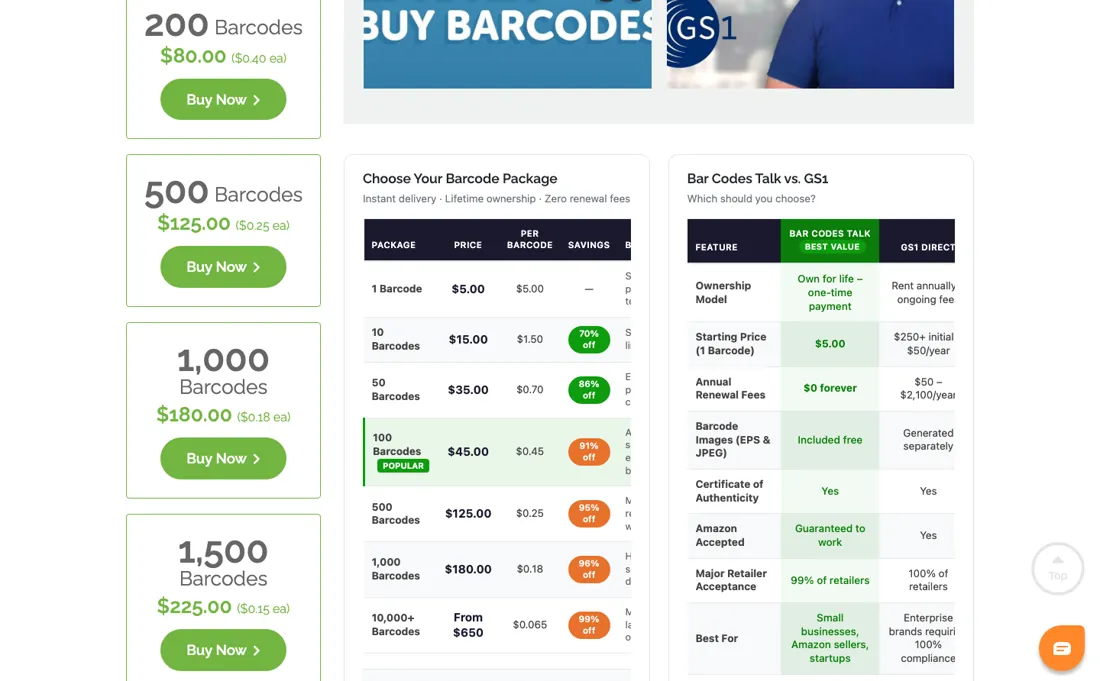
One-off purchase, no subscription and no renewal. The full published ladder runs eighteen rungs: 1 barcode $5.00; 5 for $10.00 ($2.00 each); 10 for $15.00 ($1.50); 25 for $25.00 ($1.00); 50 for $35.00 ($0.70); 100 for $45.00 ($0.45); 200 for $80.00 ($0.40); 500 for $125.00 ($0.25); 1,000 for $180.00 ($0.18); 1,500 for $225.00 ($0.15); 2,000 for $260.00 ($0.13); 2,500 for $300.00 ($0.12); 5,000 for $500.00 ($0.10); 10,000 for $650.00 ($0.065); 25,000 for $1,200.00 ($0.048); 50,000 for $2,300.00 ($0.046); 75,000 for $3,225.00 ($0.043); and 100,000 for $3,500.00 ($0.035).
Larger quantities are quote-only. The unit price drops fastest between one and a hundred codes. Every purchase includes both UPC and EAN formats, high-resolution EPS and JPEG images, a Certificate of GTIN Assignment, Excel and PDF spreadsheets of the assigned numbers, instant download, and the vendor's Works for Amazon Guarantee. Unchanged from our 5 September reading. Plans change — always verify the live price on their site.
Category context: Operations & Workflow. Across the 49 tools in this category that we researched with a public US-dollar price, the median entry price is $25 a month (lowest paid plan as listed, per seat where the vendor prices per seat). Compare pricing conditions in the Software Cost Atlas →
What the pricing page doesn’t say
Some large retailers and brand registries — notably certain Amazon Brand Registry and big-box requirements — increasingly ask for a GS1-issued prefix tied to your own company, and a third-party barcode (legitimate and globally unique as it is) may not satisfy that specific gatekeeping. For most marketplaces and independent retail it's completely fine and far cheaper; just confirm your channel's exact requirement first.
What Barcodes Talk does
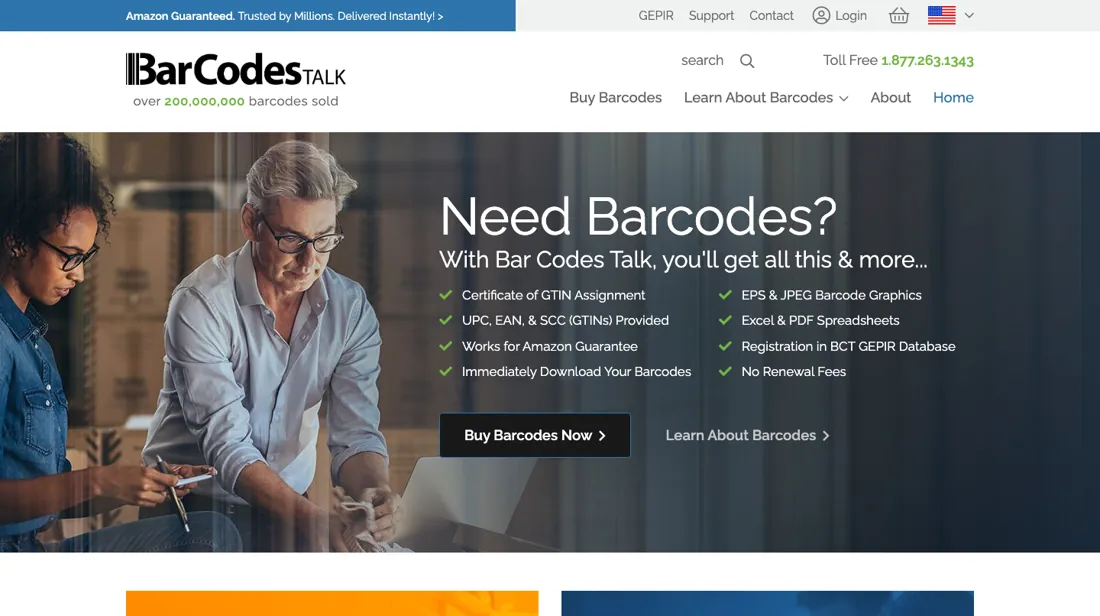
Authentic UPC and EAN barcodes for retail and Amazon listings. Buy GS1-sourced barcodes for your products as a one-time purchase, without an annual GS1 membership.
What buyers report about Barcodes Talk
Recurring themes from the buyer-review sites listed at the foot of this page, read in August 2026. We have not run Barcodes Talk ourselves, so this is other buyers' experience rather than ours. We summarise it here because the complaints are usually the part a vendor page leaves out.
- • $5 for one barcode, $45 for 100, $180 for 1,000 — one-time, lifetime, no renewals. GS1 US charges $250 for 10 plus $50 a year, and $750 for 100 plus $150 a year.
- • Codes arrive in Excel, PDF, EPS and JPEG, ready for Amazon Seller Central, Shopify, Walmart, WooCommerce and most POS systems. Reviewers name speed of delivery.
- • These are resold codes, not codes licensed to your company directly. Before you buy, check that your marketplace and your retail buyers accept resold barcodes — some verify the registrant against the GS1 database, and that is not a question you want to discover after printing packaging.
- • One reviewer reports a PayPal payment hold delaying delivery, resolved in 48 hours.
- • The independent review base is thin, and much of what ranks is the vendor's own comparison content.
When the paid plan is worth it
There is no free tier and no subscription — the only ladder is quantity. The buy page runs many more tiers than those quoted here: "1 Barcodes - $5.00", "10 Barcodes - $15.00 ($1.50 ea)", "100 Barcodes - $45.00 ($0.45 ea)", "1,000 Barcodes - $180.00 ($0.18 ea)" and "100,000 Barcodes - $3,500.00 ($0.035 ea)". The unit price falls fastest at the bottom, so stepping off single codes into a small block is the one move that pays for itself the moment you expect more than a handful of SKUs.
It keeps falling above that, but the rungs tighten near the top: $0.048 each at 25,000 against $0.035 at 100,000. Because the codes carry no renewal fee and, per their help centre, do not expire, buying headroom is cheap — but coming back later costs nothing either, so there is no lock-in argument for a bigger block. What more spend does not buy is a GS1 company prefix in your own name.
Their Works for Amazon Guarantee carves out Brand Registry sellers, where GTINs must be rented from GS1, and also excludes books, restricted major brands, misconfigured bundles and category-rule breaches. No quantity tier changes that.
How to actually use Barcodes Talk
Checkout is the whole setup: choose a quantity, pay once, and the package downloads immediately — "UPC & EAN formats · High-res images (EPS & JPEG) · Certificate of GTIN Assignment". Nothing is provisioned for you afterwards. The part that catches people is what "registering" actually means. Their help centre says there is no universal barcode database: you match each number to a product in your own system, then submit the product data separately to every store, marketplace and distributor.
A purchase does auto-create a listing in Bar Codes Talk's own BCT GEPIR — their registry, not GS1's. So a GS1 lookup still surfaces the original pre-2002 prefix holder rather than your company, and that mismatch is what triggers Amazon's "not GS1" messages. Their documented fix is an Amazon case with the certificate plus product photos, "typically takes 1-3 business days", and they say Amazon can take "up to 72 hours to recognize new GS1 registrations" (their claim, not our timing). Brand Registry sellers are excluded outright, so plan the channel before you buy.
Distilled from Vendor material only, named concretely: the pricing rows and the included-with-purchase footer on barcodestalk.com/buy-barcodes; the Freshdesk help centre at support.barcodestalk.com — the FAQ solution index (16000020575), the Cost folder (16000074423), "Learn How to Register UPC & EAN Barcodes" (16000019158), "Works for Amazon Guarantee" (16000099826), "Will my bar code work with Amazon and other online retailers?" (16000080206) and "Why should I purchase from Bar Codes Talk instead of directly from GS1?" (16000020190); their /learn-about-barcodes resources article on Amazon rejecting valid barcodes; and, for the GS1 comparison only, GS1 US's own get-started guide. No independent walkthrough of Bar Codes Talk was found. Everything that surfaced was either the vendor's own content, a competing barcode reseller's blog (nationwidebarcode.com, gtin.info, gs1-us.info), or an affiliate-style comparison page (bestecision.com) — none of which count as independent. The one genuine user-forum thread (t-shirtforums.com) redirected to a paywall proxy and could not be read.
The natural comparison is GS1 directly — GS1 costs more and can carry ongoing fees, but it's the only route when a channel demands a prefix registered to your company.
Frequently asked questions
How many barcodes do I actually need?
One for every uniquely sellable version of a product, which is almost always more than people expect. The vendor puts it as a worked example: a product sold in three colours and four sizes needs twelve separate barcodes, and the same logic applies to flavours, scents and pack sizes. Their free Barcode Quantity Calculator takes your line-up and returns a count without an account. Get this right before you pay, because the ladder rewards buying a block: a single code is $5, but 25 are $25 ($1.00 each) and 100 are $45 ($0.45 each). Overshooting is cheap and the codes carry no renewal fee, so a small cushion for next year's SKUs costs cents. Undershooting only means a second order, which is allowed and never conflicts with the first — just less efficient.
Will these work on Amazon and in shops?
On Amazon, yes for listing purposes, and the vendor backs it with a Works for Amazon Guarantee: if Amazon will not accept a listing, their team reviews the case and works with you to resolve it. Amazon requires a valid UPC or EAN to create a catalogue listing, and these are real GS1-originated GTINs. Note that the FNSKU Amazon assigns for FBA tracking is a separate thing Amazon issues, not something you buy here; their free tool prints those labels. Retail is where you check first. The page claims acceptance by 99% of retailers and admits the remainder in its own FAQ: a small number of retailers specifically require barcodes rented directly from GS1. That group includes certain brand-registry and big-box requirements. Confirm your specific channel's rule in writing before you buy from anyone.
Is this really cheaper than going to GS1 directly?
On their numbers, by a wide margin — but those numbers are one seller describing its competitor, so treat them as a starting point rather than a quote. Their comparison table puts a single barcode at $5.00 one-off against "$250+ initial + $50/year" at GS1, with annual renewals of "$50 – $2,100/year" depending on how many codes you hold, and $0 forever on their own side. The structural difference is real and not disputed: GS1 licenses a company prefix you keep paying for, and a pre-2002 broker code is sold outright with no renewal. Price your own case at GS1's published rates before deciding, because the gap narrows if you need only a handful of codes for a single year, and it closes entirely if your retailer insists on a prefix in your own name.
Whose company will a GS1 lookup show for my barcode?
Not yours, and this is the thing to understand before buying. The vendor states plainly that its inventory originates from GS1-USA prefixes registered before 2002, which it says means they are owned outright rather than licensed, made possible by the 2002 UCC class-action settlement. Those prefixes were issued to whoever held them then, so a GS1 registry lookup surfaces that original holder rather than your business; a purchase here creates a listing in Bar Codes Talk's own BCT GEPIR registry instead. For most marketplaces and independent retail nobody ever performs that lookup. Where it bites is brand-registry and big-box onboarding that checks the prefix against your legal entity. Registering is your own work either way: the FAQ is explicit that you assign each code to a product in your own records, then submit product data separately to every store, marketplace and distributor you sell through.
What should I weigh before buying Operations & Workflow software?
Usually it sits on top rather than replacing everything. Tools in this class tend to become the layer where work is tracked and handed off, while your existing systems stay the source of truth for their own data. Before you buy, map which tools it would replace outright and which it would merely sync with. If the answer is that it syncs with all of them, you are adding a layer rather than removing one.
Is this a hands-on review of Barcodes Talk?
This is a researched assessment, not a hands-on test — where we've used a tool ourselves, we say so explicitly. We name what each tool is good and bad at, and we earn a commission only if you sign up, at no cost to you.
- Buyer reviews on practitioner reviews and pricing comparisons, read August 2026.
- Prices re-verified 2026-09-19 on barcodestalk.com/buy-barcodes.
- A dated screenshot of that pricing page, kept on this site as the receipt.
Others in this category
Reviewed operations & workflow tools that share ground with Barcodes Talk — comparable in what they do, not drop-in swaps:
New reviews, price changes we recorded, and the cost conditions we found. No sponsored placements. Unsubscribe anytime.
This is our researched assessment — not a paid placement. The “Visit” links on this page are affiliate links: we may earn a commission if you sign up, at no extra cost to you, and it never changes our take. How we review →