 HiBob Review (2026)No Public Price, Quote Only
Opaque pricing and an implementation fee mean the real cost only surfaces in a sales call — and it's built for scaling mid-size companies, so it's heavy and expensive for a small team. Throughout this review we weigh it against BambooHR.
Visit HiBob → Affiliate link — we may earn a commission if you sign up; it does not change what this page says.
Watch the 2-minute review
The video version of this review, from our YouTube channel.
⚡ Short on time? Watch the 30-second verdict Short.
Pricing (2026)
✓ Pricing re-verified 28 Sep 2026
Quote-only, and re-verified as such on 2026-08-17 and again on 2026-09-28: HiBob publishes no price list. Its machine-readable site index (llms.txt) now lists pricing-plans and pricing-packages pages, but both describe custom pricing without an amount, hibob.com/pricing leads to a demo-request form, and neither our July nor our August 2026 capture retrieved an amount. HiBob's own pricing FAQ confirms the model: generally per employee, Core HR in every plan with modules added on, and pricing that 'may vary slightly by region'.
Pricing is per employee per month with modules bolted on, and third-party estimates cluster in the mid-teens per employee per month, plus a one-off implementation fee of roughly 10-20% of the annual contract. Those are estimates, not HiBob's numbers, and the whole thing is negotiated. Get it in writing, including what happens to the per-employee rate as headcount changes mid-term. Plans change — always verify the live price on their site.
Correction after re-checking: Quote-only: HiBob publishes no price list anywhere on its site, and the pricing page is a demo request form. Every plan starts with Core HR and you layer on modules such as Performance, Learning, Payroll, Hiring, Planning and Compensation; the vendor states the quote is determined by employee headcount, the modules you choose and any implementation or support services. Sandbox is a purchased add-on rather than a default, and there is no published free tier or free trial. (re-verified 5 August 2026)
What the price did
We capture HiBob’s own pricing page every month and keep the figures, so this is our record of the page — not a forecast, and not someone else’s summary.
There is nothing to chart. We capture HiBob's site monthly and neither the July nor the August 2026 reading contains a single amount, and on 17 August 2026 there was still no published pricing page. Three dated readings, no public price — so every figure in circulation came from a sales conversation or a third-party estimate. A fourth reading on 28 September 2026 found the same: hibob.com/pricing leads to a demo form, and the pricing-plans page offers a custom quote with no figure.
What HiBob does
HRIS with onboarding, time-off and people analytics, built for scaling mid-size companies. Quote-only, per employee per month: third-party estimates cluster in the mid-teens, plus a one-off implementation fee reported at roughly 10–20% of the annual value. Get the number in writing.
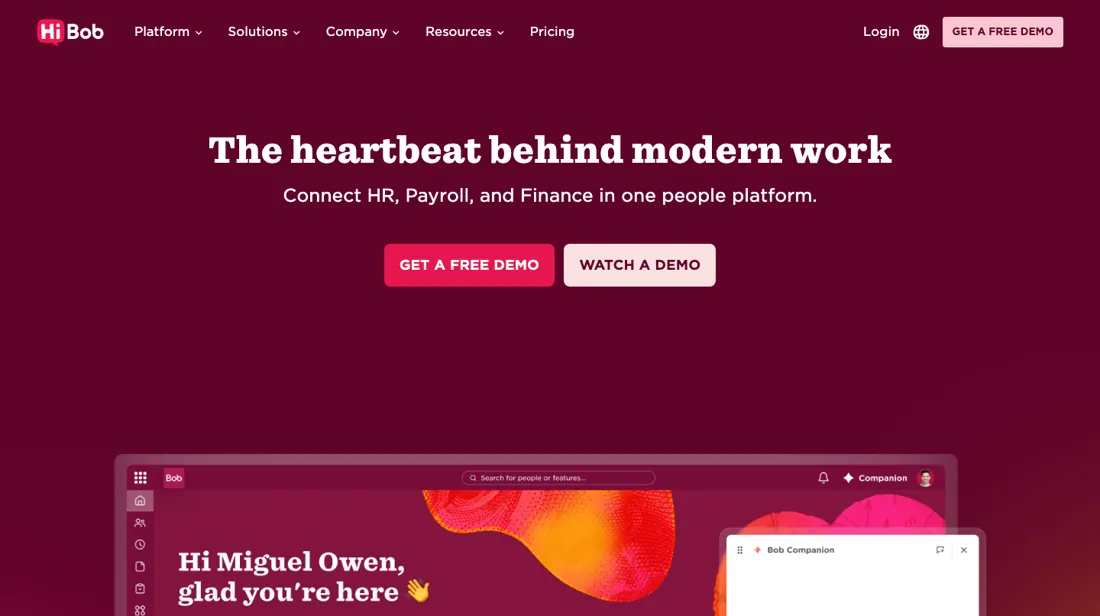
What buyers report about HiBob
Recurring themes from the buyer-review sites listed at the foot of this page, read in August 2026. We have not run HiBob ourselves, so this is other buyers' experience rather than ours. We summarise it here because the complaints are usually the part a vendor page leaves out.
- • The interface is repeatedly called the best in the category, and the culture and survey tools are what people teams actually use.
- • Analytics impress reviewers who came from spreadsheet-based reporting.
- • Pricing transparency tops the complaint list — you take a demo before you see a number, and the figure moves with modules, headcount and country footprint.
- • Setup has a real learning curve.
- • Recruiting features are lighter than a dedicated ATS, and the mobile app trails the web version.
What actually drives the quote
There is no plan to choose, so there is no upgrade to weigh: HiBob publishes no price list at all: its pricing pages describe custom pricing without an amount, and neither our July nor our August 2026 capture retrieved one. Re-verified on 17 August and 28 September 2026 and still true. The useful question is what moves the number you will be quoted, and the structure is known even when the figures are not: pricing is per employee per month, with modules bolted on.
That gives you two levers and one trap. The levers are headcount and module count. The trap is that both change after you sign. Headcount changes because you are buying an HRIS precisely because you are growing. Module count changes because HiBob's own account of implementation puts Core HR go-lives at 60 to 120 days, with each additional module such as Talent or Compensation adding another 20 to 30 days.
So the single most important thing to get in writing is not this year's rate but what happens to the per-employee rate as headcount changes mid-term, in both directions. A rate that only ratchets upward is a very different contract from one that flexes. Third-party estimates put the per-employee rate in the mid teens per month with a one-off implementation fee of roughly 10 to 20% of the annual contract.
We are repeating those as estimates and not as HiBob's numbers, because HiBob has published neither — and the whole thing is negotiated anyway. Use them as a sanity check on what you are offered, not as a budget. One cost sits outside the licence entirely and is easy to miss: Sandbox is a separately purchased capability. Without it you have nowhere safe to test configuration changes on a system that holds your payroll-adjacent data — so decide whether you need it before the negotiation rather than discovering it during the first change request.
And a related warning from HiBob's own developer docs. API service users start with no permissions enabled, and a call can return 200 OK with fields silently missing when the service user lacks access — so a half-configured integration looks like empty data rather than an error. That is an implementation cost measured in confusion rather than in money.
How to actually use HiBob
There is no self-serve signup. HiBob's pricing page is a demo request form, so the route to first value starts with a sales conversation and a contract, not an account. After signing, an implementation manager runs the first data import and walks through the errors with you, which means your real preparation work is having a clean employee spreadsheet ready before that session rather than assembled during it. HiBob's own account of the process puts Core HR go-lives at an average of 60 to 120 days, with each additional module such as Talent or Compensation adding another 20-30 days per module.
The documented sticking points sit on the integration side. Sandbox is a separately purchased capability, so without it you have nowhere safe to test changes. The people search endpoint allows 50 requests per minute.
Distilled from HiBob pricing page, pricing-plans page, platform FAQ, implementation blog post and apidocs.hibob.com developer docs, read 5 August 2026; pricing re-read 28 September 2026 by plain fetch of hibob.com/pricing (redirects to a demo-request form), hibob.com/pricing-plans (FAQ: generally per employee, Core HR in every plan, modules added, may vary slightly by region; no amount), hibob.com/pricing-packages (no amount) and hibob.com/llms.txt (lists the pricing pages as custom pricing).
HiBob vs Gusto, side by side
Both columns come from the same place: each vendor’s own published pricing, read on the date shown in the sources at the foot of this page. We do not average them into a score.
Both names above are affiliate links: we may earn a commission if you sign up, at no extra cost to you. Neither changes what this table says: both columns come straight from the vendors’ own pricing pages.
The natural comparison is BambooHR or Gusto — simpler, more transparently priced HR platforms. Weigh it against BambooHR on the job you actually need done.
Frequently asked questions
What does HiBob cost?
HiBob does not say. No amount in either of our monthly captures, none on 17 August 2026 and none on 28 September 2026, when its pricing link led to a demo form. It is priced per employee per month with modules, and negotiated. The estimates you will find elsewhere sit in the mid-teens per employee per month, but they are third-party guesses rather than HiBob's list.
What should the quote include?
Three things people get caught by: the per-employee rate and which modules it covers, the one-off implementation fee (commonly quoted at 10-20% of the annual value), and what happens when headcount moves during the term — whether you are billed on actual employees or on a committed minimum.
Is quote-only a warning sign here?
Not for this class of product — HR platforms at this level are almost all negotiated, because the price genuinely depends on headcount and modules. What matters is that you cannot comparison-shop from the website, so budget time for parallel quotes rather than expecting to compare list prices.
What should I weigh before buying Operations & Workflow software?
Usually it sits on top rather than replacing everything. Tools in this class tend to become the layer where work is tracked and handed off, while your existing systems stay the source of truth for their own data. Before you buy, map which tools it would replace outright and which it would merely sync with. If the answer is that it syncs with all of them, you are adding a layer rather than removing one.
Is this a hands-on review of HiBob?
This is a researched assessment, not a hands-on test — where we've used a tool ourselves, we say so explicitly. We name what each tool is good and bad at, and we earn a commission only if you sign up, at no cost to you.
- Buyer reviews on G2 and Capterra, read August 2026.
- HiBob’s own published pricing page.
Others in this category
Reviewed operations & workflow tools that share ground with HiBob — comparable in what they do, not drop-in swaps:
New reviews, price changes we recorded, and the cost conditions we found. No sponsored placements. Unsubscribe anytime.
This is our researched assessment — not a paid placement. The “Visit” links on this page are affiliate links: we may earn a commission if you sign up, at no extra cost to you, and it never changes our take. How we review →