Zedonk Review (2026)Four Floors, Not Four Prices
 By Daan Haket · Researched and written with an AI assistant · who does what
The 'starting from' wording is doing real work: £166/mo is the floor of the cheapest module, billed annually, so a working setup for a brand that sells wholesale quickly stacks toward £332/mo and beyond — about £4,000 a year before add-ons.
small and mid-size fashion brands that need sales, production, inventory and wholesale in one system built around size curves, seasons and linesheets.
you want self-serve, monthly-cancellable software rather than an annual, demo-led ERP. Fashion is the design centre, though the FAQ names lifestyle, interior-design and petswear clients too, so a non-fashion product brand is not ruled out.
Transparency: the “Visit” links on this page are affiliate links — we may earn a commission if you sign up, at no extra cost to you. No vendor can pay for a better review or verdict. How we make money →
Pricing (2026)
✓ Pricing re-verified 20 Oct 2026
“Prices starting from: £166 per month paid annually”Source: zedonk.co.uk/pricing, read 20 Oct 2026
Modular fashion-ERP, priced per building block and billed annually, all listed as 'prices starting from': PLM £166/mo, ERP Essential £166/mo, B2C £250/mo and B2B £332/mo. The two upper cards read 'All ERP Essential Features PLUS' — Shopify integration and barcode generation on B2C, the B2B digital showroom on B2B — so those tiers contain the ERP rather than sitting on top of it.
No self-serve signup: every tier goes through a demo, and the FAQ states the displayed plans are 'merely examples' and that a plan can be changed at any time. Onboarding and training are included in every plan; the FAQ puts implementation cost (customisation, data migration, integrations) in a separate figure quoted in a consultation. The general FAQ puts the floor as 'from as little as £1990 per year', which is the £166 card times twelve, rounded. Plans change — always verify the live price on their site.
Category context: Operations & Workflow. Across the 53 tools in this category that we researched with a public US-dollar price, the median entry price is $29 a month (lowest paid plan as listed, per seat where the vendor prices per seat). Compare pricing conditions in the Software Cost Atlas →
What the pricing page doesn’t say
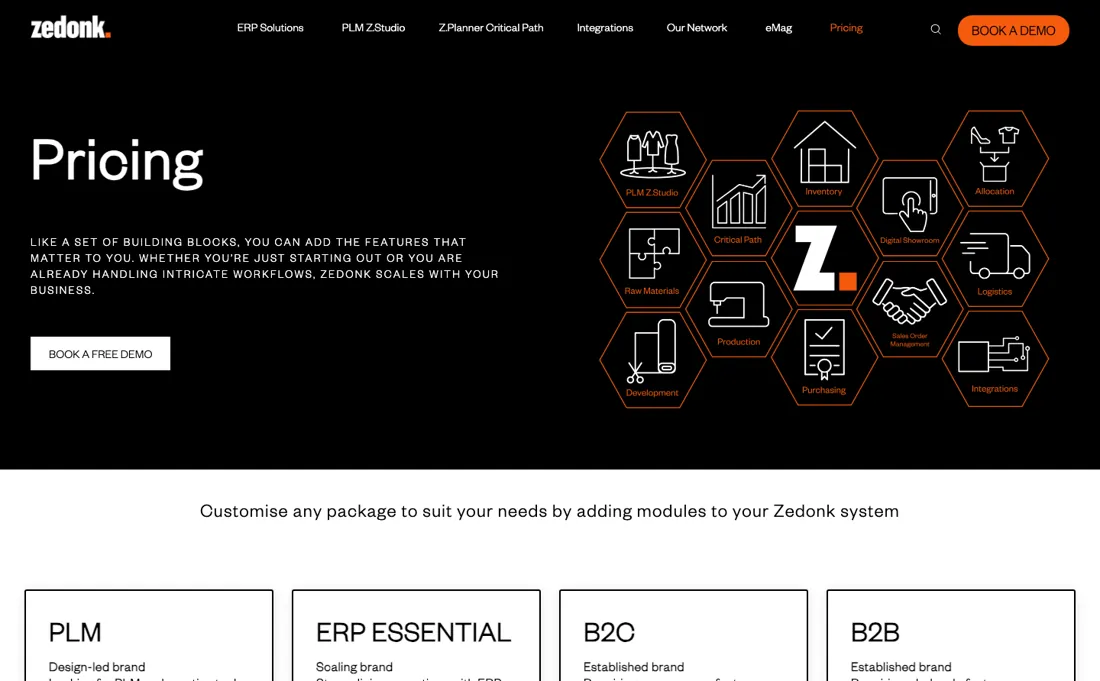
There is no trial and no public total: you find out your actual price in a demo call. Budget for the stack, not the sticker.
Watch the video review
The video version of this review, from our YouTube channel.
⚡ Short on time? Watch the 30-second verdict Short.
What Zedonk does
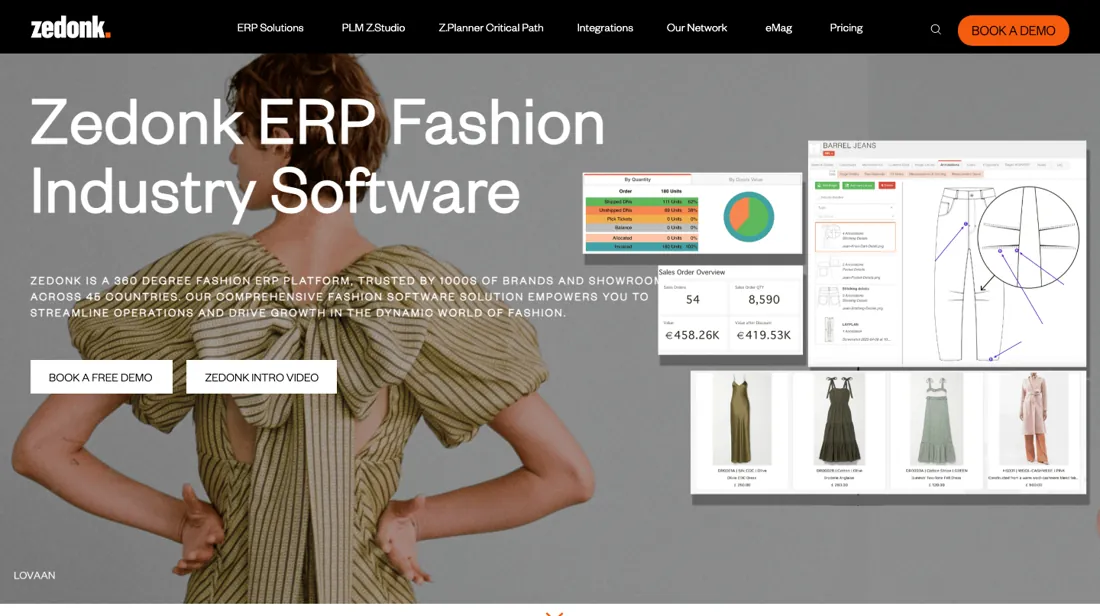
Fashion-industry ERP for small and mid-size brands — modular sales, production, inventory and wholesale management with a B2B digital showroom, priced per module on annual billing.
What buyers report about Zedonk
Hands-on: not tested by usReported by buyers: SourceForge, Capterra, GoodFirms and CrowdReviews, read August 2026
Themes from the buyer-review sites listed at the foot of this page, read in August 2026. We have not run Zedonk ourselves, so this is other buyers' experience rather than ours. We summarise it here because the complaints are usually the part a vendor page leaves out.
- • Built specifically for fashion — inventory, orders and production tracking in the language the industry actually uses, rather than generic ERP adapted to it.
- • Support and training are included in the price, with documentation, live online sessions, webinars and phone support.
- • From £166/month paid annually, and reviewers name the price as high against general alternatives.
- • The review base is very small — a couple of reviews is not a verdict. Ask for references in your own segment before committing.
Four prices, none of which is a price
Zedonk is a modular fashion ERP billed annually, and every figure on the page is prefixed 'prices starting from'. PLM is £166 a month, ERP Essential £166, B2C £250 adding Shopify integration and barcodes, and B2B £332 adding the digital wholesale showroom (price re-verified 2026-09-09 against zedonk.co.uk, unchanged on 2026-09-27). Those four words are doing more work than the numbers. There is no self-serve signup and no trial — every tier goes through a demo — so none of these is a quote.
£332 a month is £3,984 a year, and that is the floor of the wholesale option rather than its price. One thing the page does settle, and it is worth knowing before the call. B2C and B2B are both described as 'All ERP Essential Features PLUS' — Shopify and barcodes at £250, the digital showroom at £332 — so the wholesale tier already contains the ERP rather than stacking on it.
A wholesale brand is looking at £3,984 a year, not the £5,976 you would get by adding the two cards together. The FAQ then takes the tiers away again: the four displayed plans are 'merely examples', and your plan is assembled from modules and can change at any time. So ask for your stack written out line by line with a total at the bottom — not because the cards are ambiguous, but because yours will not be one of them.
The useful way to size whether any of it is worth having is per style rather than per month. A brand producing four collections a year at sixty styles each is running 240 styles through the system; at £3,984 that is £16.60 a style for tech packs, costings, production tracking and order management. Put your own two numbers in. Two things to establish before the annual commitment. What the renewal looks like, since this is billed yearly and quoted privately.
And what implementation costs, which is a separate question from the licence: every plan includes onboarding and training at no extra cost, but Zedonk's own FAQ puts customisation, data migration and integrations in a one-time figure you only get in a consultation. Get that one-time number in the same email as the monthly one.
Our monthly capture read this vendor's pricing page every month from August 2026 to October 2026, and the amounts were the same all 3 times, including £166, £250 and £332 from the pricing above. We keep watching — the registry records what moves.
Questions we are still checking
Facts about Zedonk that would change a buying decision, and where we stand on each. An unanswered question does not mean the feature is missing; it means we have not confirmed it yet.
- What renewal, notice period and data-export terms does the F2iT subscription agreement set? Still checking
Applies to: all plans, billed annually.
Why it matters: an annual ERP holding your styles, orders and costings is only safe to leave if export and notice are written down.
Checked: Zedonk terms and conditions (2026-10-20); Zedonk pricing (2026-10-20) - Which of the 100+ integrations are in the licence, and which count as paid implementation work? Still checking
Applies to: B2C (Shopify named) and B2B; Joor, NuORDER, EDI, Xero, QuickBooks.
Why it matters: the one-time implementation figure covers integrations, so the answer moves the first-year cost.
Checked: Zedonk integrations (2026-10-20); Zedonk pricing FAQ (2026-10-20) - Is the '£1990 per year' in the FAQ the same floor as the £166-a-month card? Per public documentation
Applies to: PLM and ERP Essential.
Why it matters: two different floor figures on one site make a buyer wonder which one a quote starts from.
Answer: The FAQ says prices start from as little as £1990 a year and links to the pricing page; £166 a month paid annually is £1,992, so we read both as the same floor, rounded.
Checked: Zedonk FAQ (2026-10-20); Zedonk pricing (2026-10-20)
Have a public source that answers one of these? How we review explains how we check and correct.
How to actually use Zedonk
Go into the demo with your own numbers rather than questions. Styles per season, collections per year, whether you sell wholesale, retail or both, how many suppliers and factories, and how many people need access. Those five figures determine your quote, and having them written down turns a sales call into a pricing conversation. Ask for the stack line by line with a total. Every price says 'starting from', and the FAQ is explicit that the four displayed plans are examples rather than products — your plan is assembled from modules.
B2C and B2B do include ERP Essential ('All ERP Essential Features PLUS'), so £332 is the top of a standard wholesale setup rather than a component of one. Then ask what sits outside the licence. Onboarding and training are included in every plan, but Zedonk's own FAQ puts customisation, data migration and integrations in a separate one-time figure you only get in a consultation. And ask what the price becomes at renewal, since there is no trial and the billing is annual.
Prepare your data in Zedonk's own CSV and Excel import templates, which the FAQ says are free on every plan, and ask for them before you sign so you can see which fields your current spreadsheets lack. If you wholesale through Joor or NuORDER, trade with retailers over EDI, or ship through a 3PL, name the platform in the demo: the integrations page lists those categories, but its full list did not render when we read it on 20 October 2026.
And request the written subscription agreement with F2iT Limited early, because that document, not the website terms, holds renewal and termination.
Sources for this review
- Zedonk pricing · read 20 Oct 2026: four module cards, 'prices starting from', paid annually, pricing FAQ
- Zedonk FAQ · read 20 Oct 2026: £1990-a-year floor, demo, server and credentials, import templates, training, 45 countries, non-fashion clients
- Zedonk integrations · read 20 Oct 2026: Shopify, Joor, NuORDER, EDI, EPOS, 3PL, Xero, QuickBooks
- Zedonk terms and conditions · read 20 Oct 2026: subscription governed by a separate written agreement with F2iT Limited
- Z.Planner critical path · read 20 Oct 2026: Gantt phases, milestones, automatic timeline shift, links to Z.Hub and Z.Studio
Full research notes and reading history (175 words)
zedonk.co.uk/pricing read on 9 September 2026 — the four module cards (PLM, ERP Essential, B2C, B2B) with their 'prices starting from' figures and feature lists, and the Pricing FAQs on the same page covering modularity, what support is included and what ERP implementation costs — together with zedonk.co.uk the same day. Re-read 27 September 2026 by plain fetch of zedonk.co.uk/pricing: the four cards (PLM £166, ERP Essential £166, B2C £250, B2B £332 a month paid annually, all 'prices starting from') and the six Pricing FAQs unchanged.
The FAQs also state that Zedonk integrates with over 100 platforms, from B2B marketplaces to eCommerce and accountancy tools, and that every plan includes onboarding, training, the knowledge base, webinars, the Helpdesk and a built-in AI assistant. Re-read 20 October 2026: zedonk.co.uk/pricing through Codex's quote check (all four 'starting from' figures, paid annually), and by plain fetch zedonk.co.uk/faq/ (floor of £1990 a year, server and credentials at start, free import templates, 45 countries, non-fashion clients), zedonk.co.uk/integrations/ and zedonk.co.uk/our-solutions/z-planner-critical-path/, plus Codex's reading of zedonk.co.uk/terms-conditions/ (separate written agreement with F2iT Limited).
The natural comparison is ApparelMagic — the closest fashion-ERP alternative with a US centre of gravity — both are modular; decide on which one matches your region's size curves, currencies and wholesale workflow, and verify both current price lists yourself..
Frequently asked questions
Do I have to choose one of Zedonk's four plans?
No. The pricing FAQ (read 27 September 2026) calls the displayed plans 'merely examples': Zedonk is modular, so the team assembles your plan from the modules you need, and it can change at any time as the business grows. Treat the four cards (from £166 to £332 a month, paid annually) as reference points and ask for your own stack priced line by line.
What does it cost to implement Zedonk?
A separate one-time figure you only get in a consultation. The FAQ (read 27 September 2026) says ERP implementation cost depends on customisation, data migration, integrations and training, and that a focused setup keeps it predictable for small brands, but it names no number. Onboarding and training are included in every plan, along with the knowledge base, webinars, the Helpdesk and a built-in AI assistant.
Does Zedonk connect to Shopify and my accounting software?
The FAQ (read 27 September 2026) says Zedonk integrates with over 100 platforms, from B2B marketplaces to eCommerce and accountancy tools, without listing them. Shopify integration is named on the B2C card, from £250 a month paid annually, and not on PLM or ERP Essential. Ask in the demo which of your own tools are connected in the quote and which count as integration work in the one-time implementation figure.
What do I get on the first day of a Zedonk subscription?
Per the general FAQ (read 20 October 2026): your own credentials and your own server as soon as the subscription starts, hosted in the cloud, after which the Client Success team books your training sessions. CSV and Excel import templates are included free with every plan, and a live Helpdesk handles questions afterwards. The demo before all this is free, run live over screen-share and tailored after a short pre-call.
Which systems does Zedonk connect to?
The integrations page (read 20 October 2026) names categories and a few platforms: Shopify for direct-to-consumer, Joor and NuORDER alongside its own B2B tools for wholesale, EDI for trading with retailers and department stores, EPOS for shops and pop-ups, 3PL and warehouse logistics, and Xero and QuickBooks, which receive sales invoices, purchase orders and cost of goods sold. The FAQ claims more than 100 platforms, but the page's full list showed 'No integrations in this category' when we read it, so ask for your own tools by name.
Where are my contract terms?
Not on the website. Zedonk's terms and conditions, read on 20 October 2026, say a product subscription is governed by a separate written agreement with F2iT Limited, and the site footer names Zedonk by F2iT Ltd as a company of Dedagroup Stealth. Renewal, notice and data-export terms therefore live in that agreement; ask for it before the demo turns into an order.
What does Z.Planner add?
A critical-path tool shown as a Gantt chart. Per its product page (read 20 October 2026), you set phases for your development and production stages, add milestones such as lookbook shoots, runway shows or factory closures, and compare projected with actual dates; if a phase slips, Z.Planner shifts the linked timeline automatically and a traffic-light flag marks stages at risk. Production dockets in Z.Hub and collections in Z.Studio link into it. The page is undated, so we do not present it as a new release.
Is this a hands-on review of Zedonk?
This is a researched assessment, not a hands-on test — where we've used a tool ourselves, we say so explicitly. We name what each tool is good and bad at, and we earn a commission only if you sign up, at no cost to you.
- Buyer reviews on SourceForge, Capterra, GoodFirms and CrowdReviews, read August 2026.
- Price re-verified 2026-09-09, re-read unchanged 2026-09-27 and again 2026-10-20 against zedonk.co.uk/pricing; unchanged since our August reading.
- A dated screenshot of that pricing page, kept on this site as the receipt.
Others in this category
Reviewed operations & workflow tools that share ground with Zedonk — comparable in what they do, not drop-in swaps:
New reviews, price changes we recorded, and the cost conditions we found. No sponsored placements. Unsubscribe anytime.
This is our researched assessment — not a paid placement. The “Visit” links on this page are affiliate links: we may earn a commission if you sign up, at no extra cost to you, and it never changes our take. How we review →