RocketReach Review (2026)From $19/mo, Searches Capped at 100
 By Daan Haket · Researched and written with an AI assistant · who does what
The published prices are annual rates, and the annual term is doing more work than the page lets on.
sales, recruiting and BD teams whose bottleneck is finding verified direct dials and personal emails, and who can commit to an annual term - that is where the search allowance stops being metered.
you need the outreach engine more than the data, or you cannot commit to a year: monthly billing caps lookups and exports at 100 to 1,000 a month, and platforms like lemlist or Amplemarket build the sequencing around the contacts instead of selling you the contacts first.
Transparency: the “Visit” links on this page are affiliate links — we may earn a commission if you sign up, at no extra cost to you. No vendor can pay for a better review or verdict. How we make money →
Pricing (2026)
✓ Pricing re-verified 19 Sep 2026
| Plan | Price | What you get |
|---|---|---|
| Essentials | $19/month, billed $229 USD annually | email only: unlimited personal and professional email lookups, 1,200 exports a year, 5 active Autopilot jobs, a 500-emails-a-day send limit, Chrome extension and HubSpot |
| Pro | $52/month, billed $619 USD annually | adds unlimited mobile and direct phone numbers, 3,600 exports a year, technographics, news and org charts, 10 active Autopilot jobs, shared team tags and the Salesforce, Outreach, Salesloft and Bullhorn integrations |
| Ultimate | $115/month, billed $1,379 USD annually | 20,000 exports a year, 25 active Autopilot jobs, Salesforce custom mapping, intent topics, healthcare data, suppression lists, single sign-on and advanced team management |
| Enterprise | quote only; the page says plans start at $6K annually | company exports, custom exports, combined credits, customisable packages, a dedicated account manager and higher API limits |
A free account exists: signing up takes no credit card and gives 5 lookups. Above that are three paid plans, all quoted per month on an annual term. Essentials is $19/month, billed $229 USD annually, and is email only: unlimited personal and professional email lookups, 1,200 exports a year, 5 active Autopilot jobs and a send limit of 500 emails a day.
Pro is $52/month, billed $619 USD annually, and adds unlimited mobile and direct phone numbers, 3,600 exports a year, technographics, news and org charts, 10 active Autopilot jobs and the Salesforce, Outreach, HubSpot, Salesloft and Bullhorn integrations. Ultimate is $115/month, billed $1,379 USD annually, with 20,000 exports a year, 25 active Autopilot jobs, Salesforce custom mapping, intent data and healthcare data. Above those, enterprise plans are quote-only and the page says they start at $6K annually.
Read the headline figures as the annual rate: the plan-features table lists searches as unlimited on the annual term but capped at 100, 250 and 1,000 a month on monthly billing, with exports capped at those same numbers instead of the yearly allowances. RocketReach says a lookup is refunded when it returns no verified email or phone number, and that cancelling takes effect from the next term, so you keep access for the term you have already paid for. Plans change — always verify the live price on their site.
Category context: Growth & Revenue. Across the 82 tools in this category that we researched with a public US-dollar price, the median entry price is about $29 a month (lowest paid plan as listed, per seat where the vendor prices per seat). RocketReach’s entry price of $19 a month sits below that median. Compare pricing conditions in the Software Cost Atlas →
What the pricing page doesn’t say
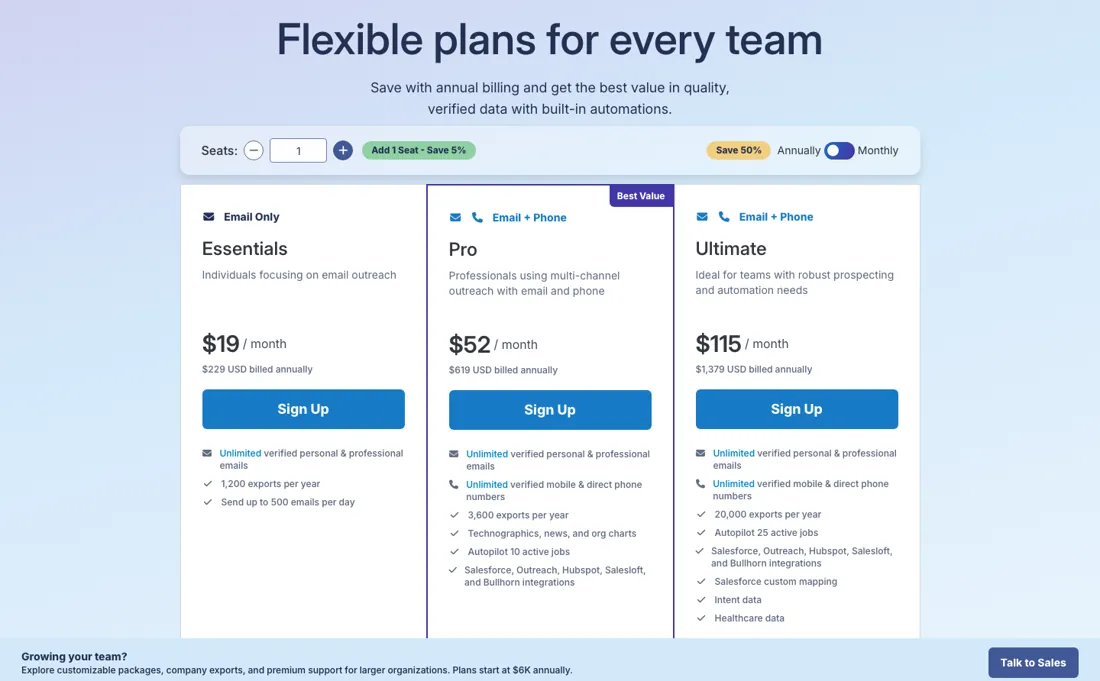
RocketReach's own feature table lists searches as unlimited on the annual term but caps them at 100, 250 and 1,000 a month if you bill monthly, and caps exports at those same numbers instead of 1,200, 3,600 and 20,000 a year. So the $19 on the card is $229 up front, and the flexible-looking monthly option is the one that rations the product. Their FAQ adds that cancelling takes effect from the next term, so a year is a year.
The plan boundary matters more than the price. Essentials is email only: mobile and direct phone numbers start at Pro, and so do the Salesforce, Outreach, Salesloft and Bullhorn integrations, technographics and org charts. Above Ultimate the ladder stops being a ladder, with enterprise starting at $6K annually against $1,379 for Ultimate. And the numbers that sell it are all RocketReach's own, printed on their pricing page: 700 million professionals, 60 million companies, 98% accuracy, 30 million users, 95% of the S&P 500.
We have measured none of them. Contact-data accuracy is the thing that varies most by territory and by seniority, and a database claim is an average, not a promise about your list. The free account is the right answer to that: it costs nothing and needs no card, so run the free lookups against a slice of your own target accounts before you commit to a year. A lookup that finds nothing verified is refunded, per their FAQ, which makes that test cheaper still.
Watch the video review
The video version of this review, from our YouTube channel.
What RocketReach does
Contact data and prospecting: look up verified work and personal email addresses plus direct and mobile phone numbers, filter on 50+ criteria, then push the result into Salesforce, HubSpot, Outreach, Salesloft or Bullhorn. Sequences, an AI email writer and Autopilot jobs that keep a saved search running come with the paid plans, with technographics, org charts and intent topics higher up. The database size (700 million professionals, 60 million companies) and the 98% accuracy figure are RocketReach's own.
What buyers report about RocketReach
Hands-on: not tested by usReported by buyers: TrustRadius, read September 2026
Themes from the buyer-review sites listed at the foot of this page, read in September 2026. We have not run RocketReach ourselves, so this is other buyers' experience rather than ours. We summarise it here because the complaints are usually the part a vendor page leaves out.
- • The Chrome extension is what reviewers single out rather than the web app: several describe finding an address while the LinkedIn profile is already open, and treat that as the reason the tool stays in the workflow.
- • It earns its place when the starting point is thin. Reviewers describe having only a company website or a LinkedIn page and no contact at all, and getting to a named person from there.
- • Used as an enrichment and lead-validation layer, reviewers report it filling gaps that their other platforms leave empty, and moving contacts into a CRM without the manual digging.
- • Data accuracy is the recurring complaint, and it is specific rather than general: reviewers cite too many variants of the same email address, contact information they consider out of date, and how often records are refreshed.
- • Bulk exports and bulk searches are named as the weak spot by a reviewer using it for sales research at volume.
- • Coverage skews to general employees rather than decision-makers: one reviewer looking for managing directors, partners, VPs and CFOs reports that many companies return staff but no C-suite, and that there is no financial information on the company itself.
- • Requests for a wider set of integrations come up alongside the accuracy notes.
Where the ratings disagree. The visible TrustRadius reviews position RocketReach as a supplementary tool rather than a primary database — 'solid option as part of a suite of tools', and explicitly 'may not be appropriate for in-depth research'. That sits against the vendor's own framing of a 700-million-professional database, and it is the more useful expectation to buy on: reviewers who treat it as one source among several rate it well, and the accuracy complaints cluster among those leaning on it alone. Worth noting on dates: the individual reviews on display were written between 2023 and 2025, so they describe the product before the current plan structure.
Pro is where the product turns on, not where it gets bigger
The step from Essentials to Pro is $33 a month, and it is not a volume step. Essentials is email only. Mobile and direct phone numbers start at Pro, and so does everything that puts the data somewhere useful: Salesforce, Outreach, Salesloft and Bullhorn, plus technographics, news and org charts. If a phone number or a CRM sync is the reason you are looking at RocketReach at all, Essentials is not the cheap version of the product, it is a different one, and the honest comparison is Pro against the competition rather than Essentials.
Ultimate is the volume step. For another $63 a month you go from 3,600 exports a year to 20,000 and from 10 active Autopilot jobs to 25, and you pick up Salesforce custom mapping, intent topics, healthcare data, suppression lists and single sign-on. Do that arithmetic against your own list-building rather than the feature table: 3,600 exports a year is 300 a month, which is a lot for one rep and very little for a team of five.
Suppression lists and SSO are the two items that tend to decide it for a team, because both are compliance problems rather than convenience. Where the ladder stops is worth knowing before you start climbing it. The next rung after Ultimate's $1,379 a year is an enterprise plan the page prices from $6K annually, so anyone who outgrows 20,000 exports negotiates rather than upgrades.
How to actually use RocketReach
Work the free tier through the Chrome extension rather than the web app. The extension is included from Essentials up, and it is where a contact database either becomes a habit or does not: a lookup taken while you are already on a prospect's profile costs no extra attention, while a separate tab is a step you quietly stop taking by the third week. Set the term after that test, not before it.
The account page lets you upgrade, downgrade or cancel whenever you like, so there is no penalty for starting on the narrow plan and moving up once you know your own hit rate rather than the published accuracy figure. If more than one person will use it, build the team from your account page before anyone buys a separate subscription. RocketReach prices an added seat at a 5% saving, and the features that make a team behave like one — shared team tags on Pro, suppression lists on Ultimate — only reach people who are inside the same account.
Distilled from RocketReach pricing page: the three plan cards, the Plan Features comparison table and the pricing FAQ, https://rocketreach.co/pricing (vendor, read 2026-09-01). Read from a Netherlands exit, where the page renders localised labels but quotes every amount in USD.
RocketReach vs Apollo, side by side
Each column shows the vendor’s own published entry price, read on the date shown. Entry prices can cover different services or units, so check what each one buys. We do not average them into a score.
Both names above are affiliate links: we may earn a commission if you sign up, at no extra cost to you. Neither changes what this table says.
The natural comparison is Apollo or ZoomInfo — the cheaper all-rounder and the enterprise data giant.
Frequently asked questions
How much can I actually test before paying?
Five lookups. The pricing FAQ, re-read on 19 September 2026, states that creating an account is free and free accounts get 5 lookups with no credit card. That is enough to check whether the database knows your target market at all, and not enough to measure the 98% accuracy the same page advertises. Spend the five on the hardest names on your list rather than the easy ones — senior people, smaller companies, outside the United States — because that is where contact databases differ from each other and where the published average tells you least.
Why is my monthly plan so much more limited than the annual one?
Because the limits, not just the price, change with the term. RocketReach's own plan-features table lists lookups as unlimited on every annual plan but caps them at 100, 250 and 1,000 a month on monthly billing, and caps exports at those same numbers instead of the 1,200, 3,600 and 20,000 a year the cards advertise. So the monthly option is not the same product paid differently; it is a rationed version. The $19 Essentials card means $229 charged up front, and the FAQ adds that cancelling takes effect only from the next term.
Is Essentials enough, or do I need Pro?
It depends on one thing, and it is not volume. What separates the two tiers is capability rather than quantity: a phone number, mobile or direct dial, is a Pro feature, and so is pushing a record into Salesforce, Outreach, Salesloft or Bullhorn, along with technographics and org charts. If either of those is the reason you are looking at RocketReach at all, then no amount of Essentials volume substitutes for it, and the $33 a month between the tiers buys the capability rather than a bigger allowance. If you genuinely only send email, do the arithmetic instead: Essentials' 1,200 exports a year is 100 a month — size that against your own list-building before paying for Pro.
Is this a hands-on review of RocketReach?
This is a researched assessment, not a hands-on test — where we've used a tool ourselves, we say so explicitly. We name what each tool is good and bad at, and we earn a commission only if you sign up, at no cost to you.
- Buyer reviews on TrustRadius, read September 2026.
- Read 2026-09-01 on rocketreach.co/pricing, re-verified 2026-09-19 in a real browser with every amount unchanged.
- A dated screenshot of that pricing page, kept on this site as the receipt.
Others in this category
Reviewed growth & revenue tools that share ground with RocketReach — comparable in what they do, not drop-in swaps:
New reviews, price changes we recorded, and the cost conditions we found. No sponsored placements. Unsubscribe anytime.
This is our researched assessment — not a paid placement. The “Visit” links on this page are affiliate links: we may earn a commission if you sign up, at no extra cost to you, and it never changes our take. How we review →