 Apollo Review (2026)
The credit and export caps are the catch — real usage on enrichment and dialing often runs well above the sticker, and data accuracy is hit-or-miss, so verify before you outreach at scale. Throughout this review we weigh it against ZoomInfo.
Visit Apollo → Affiliate link — the rest of this page is the honest version, including who should skip it.
Watch the 2-minute review
Same honest take, in video form — from our YouTube channel.
⚡ Short on time? Watch the 30-second verdict Short.
Pricing (2026)
✓ Pricing re-verified 11 Sep 2026
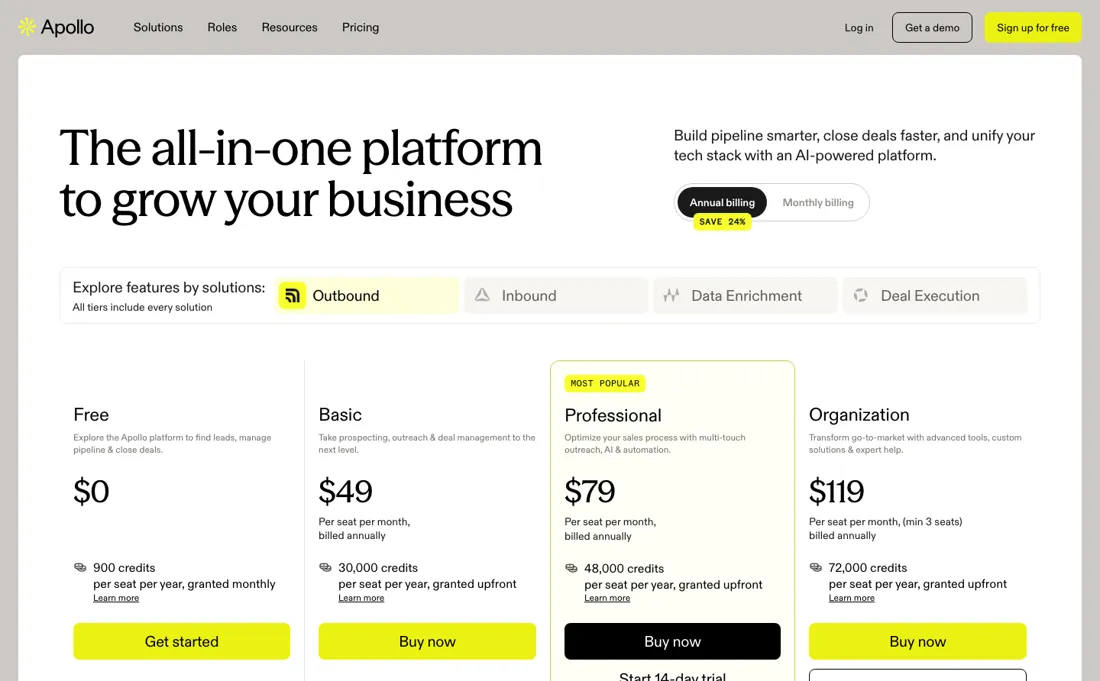
- Free — $0900 credits per seat per year, granted monthly; 2 sequences
- Basic — $49 per user/mo billed annually$65 month to month; 30,000 credits per seat per year, granted upfront
- Professional — $79 per user/mo billed annually$99 month to month; 48,000 credits; the tier most teams land on
- Organization — $119 per user/mo billed annually$149 month to month, three-seat minimum; 72,000 credits. Credit limits mean the effective cost often runs higher than the seat price
A free plan (900 credits per seat per year, 2 sequences); paid Basic $49, Professional $79 and Organization $119 per seat/mo billed annually, or $65, $99 and $149 month to month - the annual saving the page advertises is 24%. Organization carries a three-seat minimum, so it starts at $357/mo. Credit-based limits mean the effective cost often runs higher. Plans change — always verify the live price on their site.
What the price did
We capture Apollo’s own pricing page every month and keep the figures, so this is our record of the page — not a forecast, and not someone else’s summary.
The 7 July and 2 August 2026 captures of apollo.io/pricing are byte for byte identical - the same 9,924 characters and the same text hash - the only page in our monthly set that did not change at all between those runs. Neither capture yielded a price, because the plan table is drawn in the browser rather than served in the HTML. Rendering it on 11 September 2026 returned the same annual ladder as 11 August ($0 / $49 / $79 / $119) and added the month-to-month one the series had never held: $65, $99 and $149.
Apollo’s pricing page, as we read it
What Apollo does
Sales intelligence and engagement platform with a large B2B contact database. Find ideal-fit leads, enrich them and run multichannel outreach from one place.
What buyers report about Apollo
Recurring themes from the buyer-review sites listed at the foot of this page, read in August 2026. We have not run Apollo ourselves, so this is other buyers' experience rather than ours. We summarise it here because the complaints are usually the part a vendor page leaves out.
- • One tool instead of three — reviewers who previously paid for a database, a sequencer and an enrichment tool separately rate the consolidation as the main reason they stay.
- • Breadth of the contact database, and that you can go from a search to a sequence without an export step.
- • Data accuracy outside North America. US contact accuracy runs around 88%; reviewers report bounce rates of 15–25% on large exported lists, including on addresses marked verified.
- • Credits do not roll over, and reviewers describe extra charges appearing in later months with no refund.
- • Slow ticket response, mentioned on both G2 and Trustpilot.
- • Interface lag once lists get very large.
Where the ratings disagree. Apollo scores about 4.7 on G2 across roughly 9,600 reviews, but around 2.9 on Trustpilot across about 1,000. That gap is worth understanding rather than averaging: G2 reviews are mostly written by people mid-contract who like the product, while Trustpilot collects the billing disputes, account suspensions and cancellation attempts. Read the G2 reviews for what the tool does and the Trustpilot ones for what happens when you want to leave.
When the paid plan is worth it
The free tier is a look, not a workflow: 900 credits a year, 2 sequences, and on non-paying plans Apollo only connects Gmail mailboxes - that restriction, not the credit count, is what usually forces the upgrade. Basic at $49/seat/month billed annually ($65 monthly, 30,000 credits/year) buys unlimited sequences and CRM integrations, the jump most small teams need. Professional at $79 ($99 monthly, 48,000 credits) only pays back if you dial or run several mailboxes.
Organization at $119 ($149 monthly) carries a three-seat minimum, so it starts at $357/month - you buy SSO, the international dialer and 72,000 credits a seat, not better data. What upgrading does not fix: the meter. Apollo's own FAQ prices an email at 1 credit, a phone number at 8 and a record enrichment at up to 9, so a dial-heavy month burns a seat's grant far faster than an email-only one, and no tier takes deliverability off your desk.
How to actually use Apollo
Apollo's own route is short: log in, install the Chrome extension, connect a mailbox, build a filtered list, then launch a sequence. Every paid plan includes a live 1:1 onboarding session at no extra cost — typically 30 to 60 minutes, with the invitation arriving within your first 30 days. Apollo's own claim is that most teams send their first sequence in that single session. Teams of 1-20 get the Essential track; 20+ get a Professional track that adds CRM and enrichment setup.
Two things stall people. On a non-paying plan you can only connect Gmail mailboxes, so Outlook users hit a wall at the mailbox step. And Apollo's deliverability page describes domain warm-up as automated but publishes no timeframe, so you are guessing at when a new sending domain is safe — firing the first sequence too early is the common self-inflicted wound. An independent blog walkthrough (rajanarya.com) budgets roughly two days to set up and a first campaign within a week, and advises testing on a small list before exporting hundreds.
Distilled from Apollo's own onboarding page (apollo.io/onboarding), the FAQ text on apollo.io/pricing and Apollo's deliverability page, plus one independent blog walkthrough (rajanarya.com); Apollo's knowledge base blocks automated access.
Apollo vs ZoomInfo, side by side
Both columns come from the same place: each vendor’s own published pricing, read on the date shown in the sources at the foot of this page. We do not average them into a score.
Both names above are affiliate links: we may earn a commission if you sign up, at no extra cost to you. Neither changes what this table says: both columns come straight from the vendors’ own pricing pages.
The natural comparison is ZoomInfo or Lusha — pricier or narrower sales-data tools. Weigh it against ZoomInfo on the job you actually need done.
More on Apollo
Everything we publish about Apollo links back here — the review stays the honest hub:
The ex-banker filter — the same yardstick on every review (how we review): My ex-banker filter is simple: does Apollo remove a real cost — time, errors, missed revenue — bigger than what it charges?
Frequently asked questions
What does Apollo cost per seat, and what do the credits mean?
Read from the pricing table on 11 September 2026: Free $0 with 900 credits per seat per year, Basic $49 with 30,000, Professional $79 with 48,000 and Organization $119 with 72,000 - all per seat per month billed annually, with the credits granted upfront on the paid tiers. Month to month the same tiers are $65, $99 and $149, which is the 24% annual saving the page advertises. Organization carries a three-seat minimum, so it starts at $357 a month before you add anyone. What the credits buy is set out in Apollo's own FAQ: an email address costs 1 credit, a phone number 8, and enriching a record up to 9.
Why do price comparison sites quote Apollo differently?
Because Apollo's plan table is drawn in the browser: fetch the page and no prices come back. What a machine does get is Apollo's own schema.org block on the same URL, and on 11 September 2026 that listed Free $0, Basic $49 and Professional $99, both tagged as monthly, plus an Enterprise "contact for pricing" and no Organization tier at all. Neither number is wrong on its own - $49 is Basic's annual rate and $99 is Professional's monthly rate - but labelling both as monthly puts two different billing terms in one list. The same block's FAQ still says a trial carries 50 credits and 5 mobile credits, while the FAQ on the rendered page says 100. If a comparison page or an AI assistant quotes you Apollo prices, check them against the live table.
What is the real limit on the free plan?
Not the credit count. The free tier gives 900 credits a year, granted monthly, and 2 sequences, but the binding restriction is that non-paying plans can only connect Gmail mailboxes - Apollo's own FAQ says so in as many words, and Outlook users hit a wall at the mailbox step. That is usually what forces the upgrade rather than running out of credits. Note the naming: the card calls it Free, the FAQ calls it the Starter plan, "free forever".
What should I weigh before buying Growth & Revenue software?
It depends on whether you have the bottleneck it solves. Small teams get the most out of this category when one clear problem is already costing real hours or revenue; buying ahead of that just adds cost and another login. Price it against the hours or lost deals it removes, not against its feature list, and start on the smallest plan that covers the job.
Is this a hands-on review of Apollo?
This is a researched assessment, not a hands-on test — where we've used a tool ourselves, we say so explicitly. We name what each tool is genuinely good and bad at, and we earn a commission only if you sign up, at no cost to you.
- Buyer reviews on G2, Capterra and Trustpilot, read August 2026.
- Apollo’s own published pricing page.
- A dated screenshot of that pricing page, kept on this site as the receipt.
Others in this category
Reviewed growth & revenue tools that share ground with Apollo — comparable in what they do, not drop-in swaps:
New dossiers, cost-traps we found, and tools that earned a keep — no hype, no sponsored-disguised-as-advice. Unsubscribe anytime.
This is our researched assessment — not a paid placement. The “Visit” links on this page are affiliate links: we may earn a commission if you sign up, at no extra cost to you, and it never changes our take. How we review →