 FullEnrich Review (2026)A Phone Number Costs 10x
The pay-on-success model is refreshingly honest, but note the 10x: phone numbers eat credits ten times faster than emails, so a calling-heavy motion consumes budget quickly — model your email/phone mix. Throughout this review we weigh it against ZoomInfo.
Visit FullEnrich → Affiliate link — we may earn a commission if you sign up; it does not change what this page says.
Watch the 2-minute review
The video version of this review, from our YouTube channel.
⚡ Short on time? Watch the 30-second verdict Short.
Pricing (2026)
✓ Pricing re-verified 23 Sep 2026
- Free trial — $050 credits to start, no credit card
- Pro — from $29/mo500 credits at $0.058 each; $26/mo billed yearly for 6,000 credits a year; down to $0.035 a credit at 100,000/mo
- Enterprise — quotedfor teams embedding FullEnrich at scale; adds rate limits, BYOK and support
Credit-based, and credits are spent only when data is found and passes verification: a failed lookup costs 0 and a landline returned instead of a mobile costs 0. Credit costs, unchanged: work email 1, personal email 3, mobile phone 10, reverse email lookup 1, a person-plus-company profile 0.25 on its own and free alongside any enrichment. Free trial: 50 credits, no card, more for inviting team members.
Pro monthly, per the vendor's own table: 500 credits $29 ($0.058 each), 750 $42.75, 1,000 $55 ($0.055), 1,500 $79.50, 2,000 $104, 5,000 $255, 10,000 $499, 15,000 $720 ($0.048), 25,000 $1,150, 50,000 $1,950 ($0.039), 100,000 $3,500 ($0.035), above that contact sales. Pro annual (~10% cheaper, credits granted per year): 6,000/yr $312 ($26/mo, $0.052), 9,000 $468, 12,000 $588, 18,000 $852, 24,000 $1,128, 60,000 $2,784, 120,000 $5,448, 180,000 $7,860, 300,000 $12,552, 600,000 $21,228, 1,200,000 $37,800 ($0.032).
Enterprise is custom. Unlimited users on every plan, no seat or platform fee. Credits roll over 3 months on monthly and 12 months on annual. CORRECTION 23 Sep 2026: this dossier previously gave Pro as 'from $55/mo'; $55 is the 1,000-credit step the slider opens on, and the ladder starts at $29 for 500. Reading note: from a Dutch exit the slider prints euros (EUR 0.055 a credit at 1,000) while the calculator's recommended-plan card prints $720/mo. Plans change — always verify the live price on their site.
What the price did
We capture FullEnrich’s own pricing page every month and keep the figures, so this is our record of the page — not a forecast, and not someone else’s summary.
The rate held while the currency sign moved. Our July, August and September 2026 captures of FullEnrich's pricing page all show 15,000 credits a month for 720; July printed that figure with a euro sign, August and September with a dollar sign, and the vendor's machine-readable pricing file declares USD. The per-credit figure of 0.055 at 1,000 credits appears in both later captures. We read that as the page rendering currency by location rather than a price change, and our reading on 23 September 2026 confirmed $720 for 15,000 credits.
What the pricing page doesn’t say
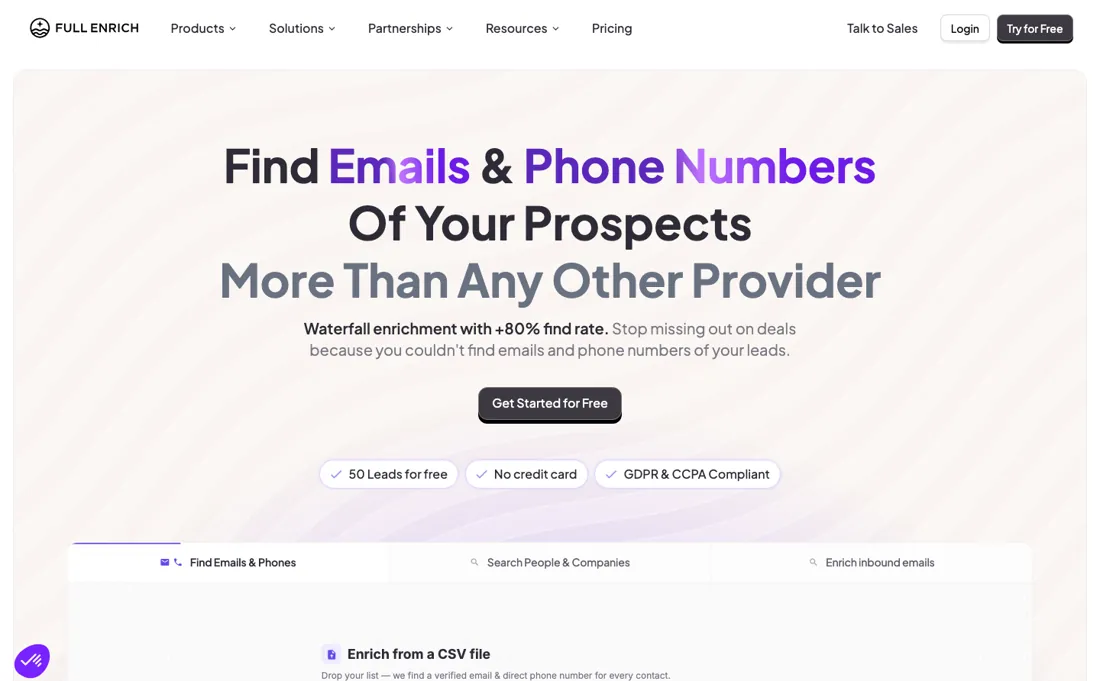
As a waterfall over 20+ providers, its hit rate genuinely beats single databases; the flip side is you're paying a premium per contact versus querying one source that might have sufficed.
What FullEnrich does
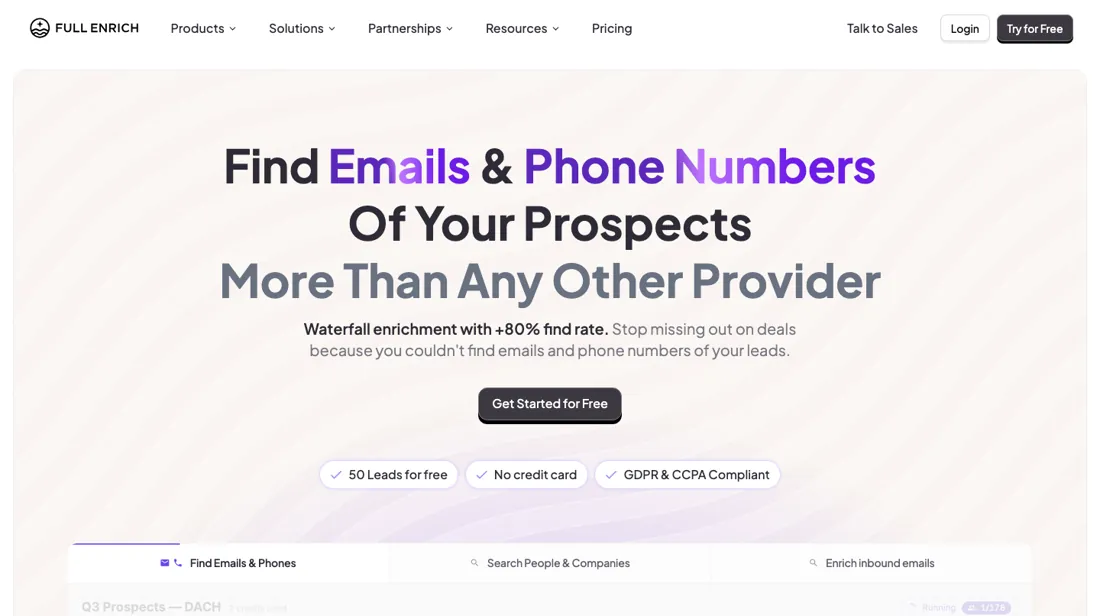
B2B contact enrichment with waterfall data. Find verified emails and direct phone numbers for prospects by combining 15+ data sources in one lookup.
What buyers report about FullEnrich
Recurring themes from the buyer-review sites listed at the foot of this page, read in August 2026. We have not run FullEnrich ourselves, so this is other buyers' experience rather than ours. We summarise it here because the complaints are usually the part a vendor page leaves out.
- • Waterfall enrichment across 15+ providers lifts match rates from the 50-60% a single tool manages to 75-90%. Credits are only spent on successful enrichments, and they roll over for three months. 4.8 on G2 across 172 reviews.
- • Incorrect phone numbers top the complaint list at 11 mentions — the waterfall finds more, but not all of it is right. Verify before you dial.
- • The Chrome extension was discontinued in June 2024, so you are copy-pasting profile URLs into the web app rather than enriching while you browse.
- • Expensive at 8 mentions, integration issues at 7, slow loading at 5.
- • Privacy and GDPR compliance concerns have been raised by users — worth your own check if you operate in the EU.
When the paid plan is worth it
The pay-on-success model is the honest part and it is real: credits are only spent when data is found and passes verification, a landline returned in place of a mobile costs nothing, and a lookup that finds nothing costs nothing. But it also means the sticker price tells you little, because what you spend depends on what you ask for. The number that decides your bill is the 10x. A work email costs 1 credit, a personal email 3, a mobile number 10.
At the 1,000-credit step ($55 a month, $0.055 a credit) that puts an email at 5.5 cents and a mobile at 55 cents, so a calling-heavy motion burns a month of credits in days — and no plan change fixes that; only a different mix does. The volume discount is shallow for longer than the slider suggests. The vendor's own table runs from $29 for 500 credits ($0.058 each) to $720 for 15,000 ($0.048): thirty times the credits for 17% off per credit.
It only steepens past 25,000 — $1,950 for 50,000 ($0.039) and $3,500 for 100,000 ($0.035). Annual billing is about 10% cheaper again and, more usefully, rolls credits over for twelve months instead of three, which is worth more than the discount if your prospecting comes in bursts. What upgrading does not buy is a better hit rate: every plan, the free trial included, runs the same waterfall — 20+ providers on the page, 25+ sources in the vendor's machine-readable pricing file — and users are unlimited everywhere.
Enterprise adds rate limits, bring-your-own-key and support, not data. The test worth running on the 50 free credits is whether the contacts it finds are ones your existing tool missed on your own ICP.
How to actually use FullEnrich
Model your email-to-phone mix before you buy credits, because a mobile number costs ten times an email. Five hundred credits is 500 emails, or 50 phone numbers, or any combination — so a calling-heavy motion has an effective allowance a tenth of what the headline suggests. At $0.055 a credit on Pro's 1,000-credit step, an email is 5.5 cents and a mobile number 55 cents. The pay-on-success model makes the arithmetic unusually clean: you are charged only when verified data is found, so your credit count is a floor on results rather than a budget for attempts.
That means you can compare cost per contact against single-source databases, where you pay for the query whether or not it returns anything. And as a waterfall over 20+ providers (25+ sources in the vendor's machine-readable pricing file), the hit rate is where the premium is meant to come back. Take annual billing if you can, for the rollover rather than the discount: credits carry three months on monthly billing and twelve on annual.
For prospecting that runs in bursts rather than evenly, that difference is worth more than the headline saving.
Distilled from fullenrich.com/pricing, read 23 September 2026 from a Dutch exit (previously 1 September 2026) -- the credit costs, the rollover terms, the 50-credit no-card trial, the plan cards, the calculator and the FAQ. fullenrich.com/pricing.md, the vendor's machine-readable pricing file linked from that page as 'Use our machine-readable pricing', read the same day -- the full monthly and annual USD credit ladders, the zero-credit rules for failed lookups and landlines, the worked example and the plan-difference table; it states it was last updated 14 July 2026 and mirrors the public pricing page. The provider count differs between the vendor's own pages: 20+ in the pricing page's meta description, 25+ sources in pricing.md. fullenrich.com/llms.txt returns 404.
FullEnrich vs Clay, side by side
Both columns come from the same place: each vendor’s own published pricing, read on the date shown in the sources at the foot of this page. We do not average them into a score.
The FullEnrich link above is an affiliate link — we may earn a commission if you sign up, at no extra cost to you — and the other column is a plain link. Neither changes what this table says: both columns come straight from the vendors’ own pricing pages.
The natural comparison is Prospeo or Clay — Clay orchestrates flexibly at platform prices; dedicated finders undercut on email-only — FullEnrich's edge is the waterfall hit-rate on phones. Weigh it against ZoomInfo on the job you actually need done.
Frequently asked questions
What is the cheapest way to start with FullEnrich?
Fifty free credits, then $29. Read 23 September 2026, the free trial gives 50 credits with no card and the full Pro feature set, and the vendor's own price table starts Pro at $29 a month for 500 credits. The pricing page's slider opens one notch higher, on 1,000 credits at $55 marked 'Most popular', which is why $55 is the figure most summaries quote. On annual billing the entry is $26 a month, $312 a year, for 6,000 credits granted up front. One oddity in that annual table: the next step, 9,000 credits for $468, works out at the same $0.052 a credit as the first, so the step up buys volume and nothing off the rate. Fifty credits is five mobile numbers or fifty work emails, enough to check hit rates on a sample of your own list before you pay.
Do I pay for the phone numbers it cannot find?
No, and not for landlines either. Read 23 September 2026, the vendor's pricing file lists a failed lookup at 0 credits and a landline returned instead of a mobile at 0; a mobile that is found and verified costs 10. It also says roughly 30% of raw data is removed by verification before it reaches you. Its own worked example is the useful part: 1,000 contacts enriched for work email and mobile comes to about 800 credits of email at an 80% find rate plus 5,000 to 7,000 of mobile at an assumed 50 to 70%, which points at the 10,000-credit tier at $499 a month, while the same 1,000 contacts for email only fit the $55 tier. Both find rates are the vendor's estimates, so run your own sample on the free credits before you size the plan.
Do extra users cost more, and what does Enterprise add?
Users are free on every plan, including the trial. Read 23 September 2026, there is no seat fee and no platform fee anywhere on the ladder, so a ten-person team pays the same as one person for the same credits. What paying for Pro adds over the trial is control rather than data: per-user credit limits, per-user credit monitoring and low-credit alerts. Enterprise is custom-priced and adds custom rate limits and a priority queue, bring-your-own API key, custom SSO as an add-on, a dedicated account manager and a shared Slack channel, plus reseller and agency terms. The waterfall, search, API, MCP server and HubSpot integration are the same on all three, so nobody is upgrading into a better hit rate.
What should I weigh before buying Growth & Revenue software?
It depends on whether you have the bottleneck it solves. Small teams get the most out of this category when one clear problem is already costing real hours or revenue; buying ahead of that just adds cost and another login. Price it against the hours or lost deals it removes, not against its feature list, and start on the smallest plan that covers the job.
Is this a hands-on review of FullEnrich?
This is a researched assessment, not a hands-on test — where we've used a tool ourselves, we say so explicitly. We name what each tool is good and bad at, and we earn a commission only if you sign up, at no cost to you.
- Buyer reviews on G2 and practitioner reviews, read August 2026.
- Price re-verified 2026-09-23 against the vendor's own pricing page and its machine-readable pricing file fullenrich.com/pricing.md, which declares USD.
- A dated screenshot of that pricing page, kept on this site as the receipt.
Others in this category
Reviewed growth & revenue tools that share ground with FullEnrich — comparable in what they do, not drop-in swaps:
New reviews, price changes we recorded, and the cost conditions we found. No sponsored placements. Unsubscribe anytime.
This is our researched assessment — not a paid placement. The “Visit” links on this page are affiliate links: we may earn a commission if you sign up, at no extra cost to you, and it never changes our take. How we review →