Pumper Bundles Review (2026)Same Features, You Pay for Headroom
 By Daan Haket · Researched and written with an AI assistant · who does what
Every tier ships the same four features, so what you are buying is a ceiling on the revenue the app is allowed to earn you.
shopify stores that want bundles, quantity breaks, BOGO and free-gift offers without touching code, and that value a free tier which is the complete app rather than a feature-stripped demo.
you expect more capability as you pay more — every tier here carries the same features and you are only buying a higher revenue ceiling — or you need conditional bundling logic beyond tiered discounts.
Transparency: the “Visit” links on this page are affiliate links — we may earn a commission if you sign up, at no extra cost to you. No vendor can pay for a better review or verdict. How we make money →
Pricing (2026)
✓ Pricing re-verified 19 Sep 2026
| Plan | Price | What you get |
|---|---|---|
| Free | no published price | Covers up to $300 of extra revenue generated by the app |
| Starter | $9.99 a month, or $94.68 a year (saves 21%) | Covers up to $1,000 of extra revenue |
| Growth | $29.99 a month or $269.88 a year (save 25%) | Covers up to $5,000 of extra revenue |
| Unlimited | $49.99 a month or $449.88 a year (save 25%) | Removes the ceiling |
Summarised from the pricing notes below; the notes carry the conditions.
| This tool | $9.99 | 15th cheapest of 52 |
| Cheapest | $2.99 | MX AI |
| Median | $15 | |
| Most expensive | $450 | Attribuly |
Lowest paid entry price per account a month, billed monthly, in USD, among the 52 e-commerce growth apps we have researched (read between 2026-08-19 and 2026-10-12). Only tools priced in the same unit and on the same billing are compared — not a market survey, and cheapest is not best.
Four tiers on the listing, with a 7-day free trial on the paid ones. The ladder is priced by how much extra revenue the app is allowed to generate for you, not by what it can do: the feature list — unlimited bundles and quantity breaks, chat support seven days a week, bundles on page builders, cart drawer integrations — is identical on all four.
Free covers up to $300 of extra revenue generated by the app. Starter is $9.99 a month, or $94.68 a year (saves 21%), and covers up to $1,000. Growth is $29.99 a month or $269.88 a year (save 25%) and covers up to $5,000. Unlimited is $49.99 a month or $449.88 a year (save 25%) and removes the ceiling. Charges are billed in USD every 30 days.
Full pricing notes (2 more paragraphs)
Two things on the vendor's own site contradict the listing and were unresolved on 19 September 2026: its FAQ says the trial is 14 days with full access and no card, against the listing's 7 days; and it answers 'Are there any hidden charges?' by saying Pumper charges a maximum of $39.99 a month, against the listing's $49.99 top tier. Where the two differ, the listing is the page Shopify bills from.
Neither page defines how the attributed extra revenue that decides your tier is measured. The vendor trades as Profit Pumper (Henq eCommerce LLC, Delaware).
Plans change — always verify the live price on their site.
Category context: Growth & Revenue. Across the 83 tools in this category that we researched with a public US-dollar price, the median entry price is about $30 a month (lowest paid plan as listed, per seat where the vendor prices per seat). Compare pricing conditions in the Software Cost Atlas →
What the pricing page doesn’t say
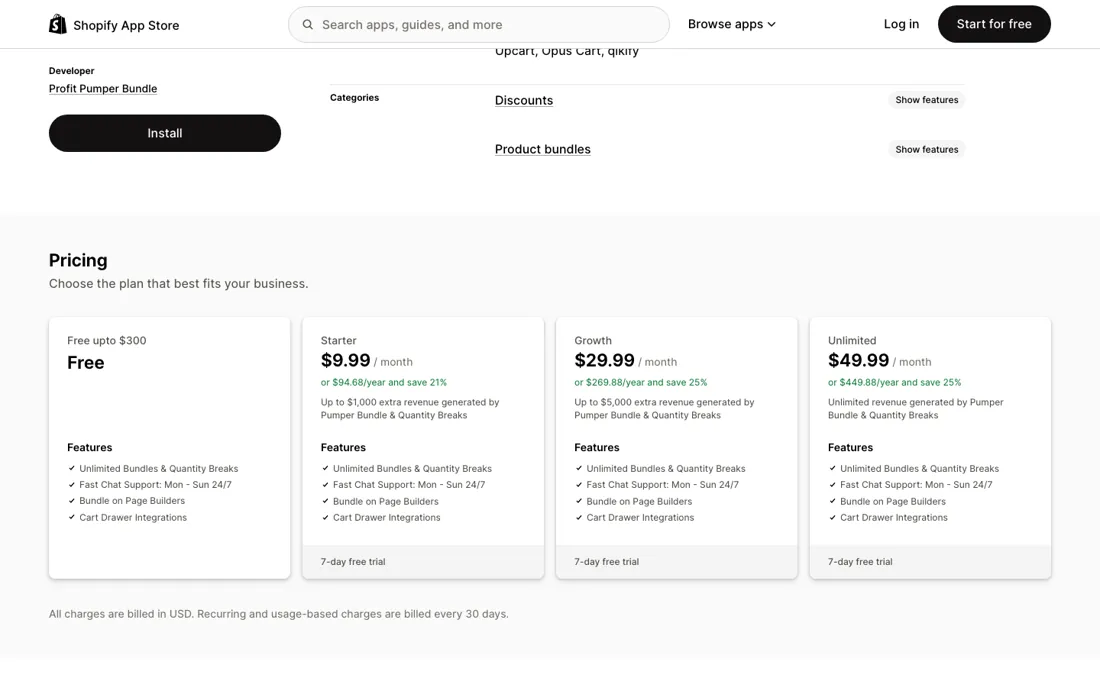
The bill therefore rises exactly when the app is working, and it rises in steps: pass $300 and you owe $9.99, pass $1,000 and you owe $29.99, pass $5,000 and you owe $49.99. Read that in both directions. It makes the free plan unusually generous — the whole app, not a stripped demo — and it makes every upgrade buy you nothing new, only permission to keep going. The one number the pricing table never defines is how that attributed extra revenue is measured, and it is the number the entire ladder rests on.
Watch the video review
The video version of this review, from our YouTube channel.
What Pumper Bundles does
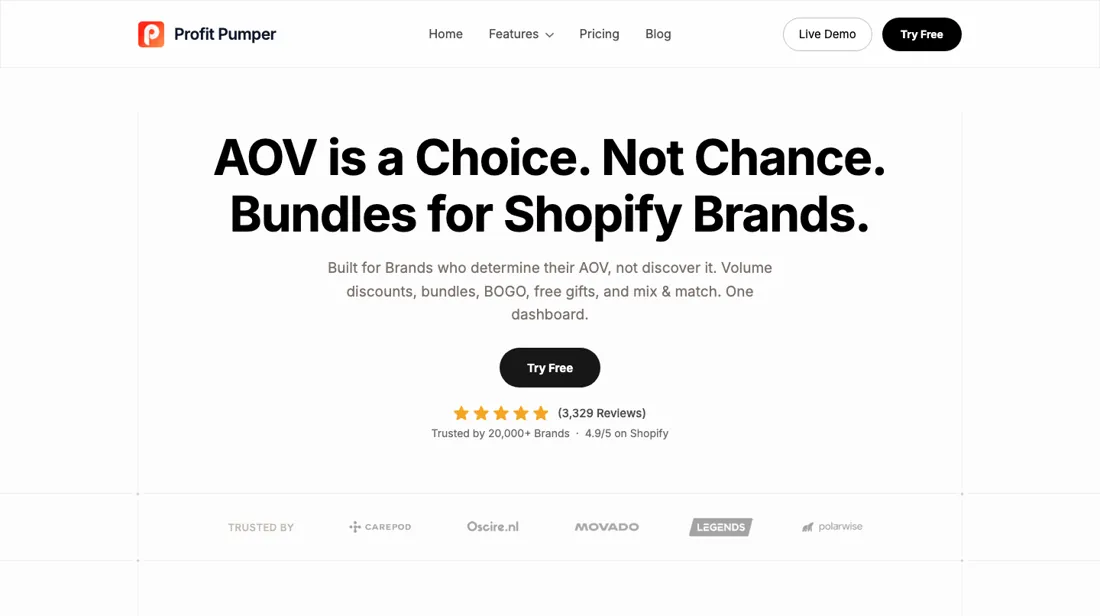
Shopify bundle app by Profit Pumper: unlimited product bundles, quantity breaks, volume and cart discounts, BOGO and free-gift offers, with cart drawer and page builder integrations. The plans are a revenue ceiling rather than a feature ladder — all four carry identical features.
What buyers report about Pumper Bundles
Hands-on: not tested by usReported by buyers: the app's own Shopify App Store review section, read September 2026
Themes from the buyer-review sites listed at the foot of this page, read in September 2026. We have not run Pumper Bundles ourselves, so this is other buyers' experience rather than ours. We summarise it here because the complaints are usually the part a vendor page leaves out.
- • Support is named person by person and described as quick and patient, seven days a week (reviews from May to September 2026).
- • Per-pair discount logic that a merchant says most other apps cannot do, written after testing several competitors including paid ones (July 2026).
- • Slide cart, bundle deals and BOGO offers arriving in one app rather than three (July 2026).
- • The free starter tier is named as a reason merchants tried it at all (May 2026).
- • BOGO and bundle offers did not appear in the slide cart for one merchant (July 2026) — which is the cart-drawer integration the listing advertises, so check it on your own theme before launch.
- • One merchant reports the bundle adding both the discounted units and the single product separately, confusing customers, and held off publishing until it was fixed (May 2026).
- • The $300 revenue threshold that forces the first paid plan is named as a concern by smaller stores (June 2026) — the ceiling is real to the people who hit it, not just a pricing footnote.
Pages read (September 2026): Shopify App Store
When the paid plan is worth it
Read the ladder as a take rate and the decision gets simple. Starter is $9.99 once the app has generated $300, Growth $29.99 past $1,000 and Unlimited $49.99 past $5,000, so the share of attributed revenue you hand back falls from about 3% at the Growth threshold to roughly 1% at the Unlimited one. Every upgrade costs less than the revenue that triggered it, which is the whole design. Annual billing takes another slice: $94.68 against $119.88 on Starter, $269.88 against $359.88 on Growth and $449.88 against $599.88 on Unlimited — $25.20, $90 and $150 saved.
What paying more does not buy is a single extra feature, since all four tiers ship the same four. Nor does it buy a definition: the attributed-revenue figure that decides your tier is never explained on the listing, so an upgrade settles the invoice without settling the question of how the number was reached.
How to actually use Pumper Bundles
Start on Free and treat it as the real product, because it is — the whole app up to $300 of attributed revenue. Build one offer rather than a catalogue: pick the product where a second unit is plausible and put a quantity break on it using a single discount type, Each Unit, Percentage or Flat, instead of testing all three at once. Then check where it renders. The listing names integrations for page builders (GemPages, PageFly) and cart drawers (Upcart, Monster Cart, AMP Slider cart, Opus Cart, qikify), which is another way of saying a themed store with a custom drawer needs verifying rather than assuming — look at the product page and the drawer on a phone before you announce the offer.
Write down your own revenue on that product first. Since the ceiling is measured on revenue the app claims to have created, your own before-and-after figure is the only check you hold on it.
Distilled from the app's Shopify App Store listing (apps.shopify.com/pumper-quantity-breaks-product-bundles-discounts), re-read 19 September 2026 — the four-tier plan table, revenue ceilings, annual prices, the 7-day trial, integrations and support details; and the vendor's own site https://pumper.run/pricing (read 19 September 2026 — the five offer formats, the theme and page-builder compatibility answers, and the FAQ statements on a 14-day trial and a $39.99 maximum that contradict the listing). No hands-on run.
Pumper Bundles vs AfterSell, side by side
Each column shows the vendor’s own published entry price, read on the date shown. Entry prices can cover different services or units, so check what each one buys. We do not average them into a score.
Both names above are affiliate links: we may earn a commission if you sign up, at no extra cost to you. Neither changes what this table says.
The natural comparison is AfterSell — These sit at opposite ends of the same funnel: Pumper Bundles works before the buy — bundles, quantity breaks, BOGO and free-gift offers on the product page and in the cart — while AfterSell works after it, on the post-purchase and thank-you pages. Plenty of stores run both. If you are picking one, pick by where your AOV problem actually is: shoppers who never add a second item, or completed orders you never follow up on. On price Pumper is the cheaper entry, and its free tier is the full app up to $300 of attributed revenue..
Frequently asked questions
Is the trial seven days or fourteen?
Their two pages say different things, and we could not settle it on 19 September 2026. The App Store listing prints a 7-day free trial on each of the three paid tiers. The vendor's own site answers its FAQ question 'Is Profit Pumper free to start?' with a free 14-day trial, full access to every feature, no credit card required. Both were read the same day. It is a week either way rather than a fortune, but it is the week in which you are meant to prove the app lifts your average order value, and a bundle test on a slow product needs the longer one. Assume seven, since that is what the page that actually bills you says.
What is the most this can cost, $39.99 or $49.99?
The listing says $49.99 and the vendor's own FAQ says $39.99, which is the second thing their two pages disagree about. Under 'Are there any hidden charges?' their site answers that Pumper charges a maximum of $39.99 a month and only when it generates meaningful extra revenue. The App Store listing, which is where the charge is actually raised, tops out at the Unlimited tier at $49.99 a month or $449.88 a year. A ten-dollar gap on the ceiling of a four-step ladder suggests one page was updated and the other was not — and the one you should believe is the listing, because Shopify bills from it.
Every tier has the same features. So what am I actually buying?
Permission for the app to keep earning. All four tiers ship the identical four items — unlimited bundles and quantity breaks, chat support seven days a week, bundles on page builders, cart drawer integrations — and what changes is a ceiling on the extra revenue the app is allowed to generate: $300 on Free, $1,000 on Starter at $9.99, $5,000 on Growth at $29.99, and no ceiling on Unlimited at $49.99. Read as a take rate that is good news going up: about 3% of the revenue that triggers the Growth step, roughly 1% at the Unlimited one, and every upgrade costs less than the revenue that caused it. Read as a buyer it means the free plan is the whole product rather than a stripped demo, and that no upgrade will ever add a feature.
How is that 'extra revenue generated by Pumper' measured?
Neither page says, and it is the number the entire ladder rests on. Both the listing and the vendor's site describe the tiers in terms of extra revenue generated by the app, and the vendor's site adds that its analytics attribute revenue to each offer type so you can see which ones move average order value. What neither states is the rule: whether an order that would have happened anyway counts when a bundle was merely shown, how a partly-returned bundle is treated, or over what window an order stays attributed. Since crossing a threshold is what moves you from $9.99 to $29.99 to $49.99, ask for the definition before you rely on the free tier's $300 as a real allowance.
Is this a hands-on review of Pumper Bundles?
This is a researched assessment, not a hands-on test — where we've used a tool ourselves, we say so explicitly. We name what each tool is good and bad at, and we earn a commission only if you sign up, at no cost to you.
- Buyer reviews on the app's own Shopify App Store review section, read September 2026.
- Re-verified 2026-09-19 on apps.shopify.com/pumper-quantity-breaks-product-bundles-discounts AND on the vendor's own site, USD; listed amounts unchanged since 2 September.
- A dated screenshot of that pricing page, kept on this site as the receipt.
Others in this category
Reviewed growth & revenue tools that share ground with Pumper Bundles — comparable in what they do, not drop-in swaps:
New reviews, price changes we recorded, and the cost conditions we found. No sponsored placements. Unsubscribe anytime.
This is our researched assessment — not a paid placement. The “Visit” links on this page are affiliate links: we may earn a commission if you sign up, at no extra cost to you, and it never changes our take. How we review →