 PDWare Review (2026)Quote-Only, Demo Comes First
This is genuine enterprise software with enterprise buying: opaque pricing, demo-first sales and implementation effort — appropriate for portfolio offices planning hundreds of resources, overkill below that.
Visit PDWare → Affiliate link — we may earn a commission if you sign up; it does not change what this page says.
Watch the 2-minute review
The video version of this review, from our YouTube channel.
⚡ Short on time? Watch the 30-second verdict Short.
Pricing (2026)
✓ Pricing re-verified 25 Sep 2026
Quote-only, re-confirmed 25 September 2026: pdware.com has no pricing page (/pricing returns 404) and every route ends in a 'Request pricing' form or a guided demo, with no amount anywhere on the homepage. What the site does publish, in a Pricing & licensing section on its FAQ page that carries no numbers, is the shape of the quote: licensing is based on the size of the planning group and on the types of users on the system, and packages exist for workgroups of 50 users, 100 users, and enterprise-level deployments, with multi-team and enterprise licensing handled by an account executive at sales@pdware.com.
There is no self-serve trial, but there is a pilot: the FAQ says many organisations start with one, validating the software on their own data before committing to a long-term subscription. The same picture holds off-site — the ResourceFirst Workgroup Package is listed on Microsoft's commercial marketplace by Portfolio Decisionware Inc. with no price at all and a contact-me action, its offer identifier carrying the band 10-50. Plans change — always verify the live price on their site.
The honest knock
The honest pre-purchase question is organizational: resource-first planning only works if your PMO will actually maintain forecasts; the tool formalizes discipline, it can't create it.
What PDWare does
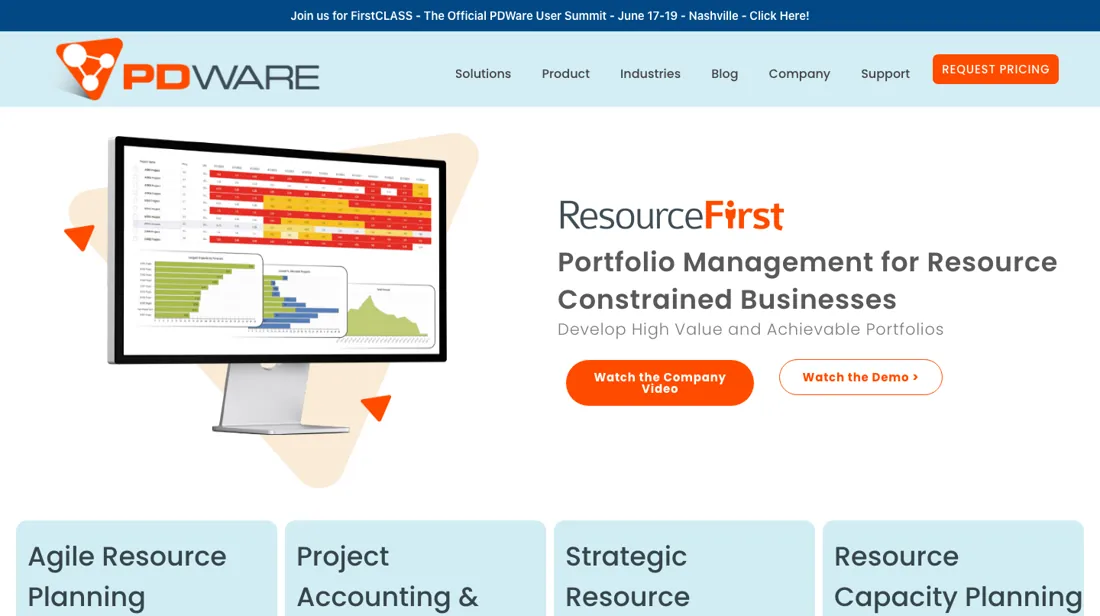
Resource and capacity planning for project teams. Plan who works on what, balance workloads and forecast capacity in real time so projects don't stall on people bottlenecks.
What buyers report about PDWare
Recurring themes from the buyer-review sites listed at the foot of this page, read in August 2026. We have not run PDWare ourselves, so this is other buyers' experience rather than ours. We summarise it here because the complaints are usually the part a vendor page leaves out.
- • Implementation and onboarding are described as seamless with expert guidance throughout — unusual for resource planning software.
- • Easy to use for what it does, with flexible licensing and good value according to reviewers.
- • Pricing is custom and quote-based. Third-party estimates run roughly $50/month for one user, around $400 for ten, and upwards of $3,000 for a hundred — so budget from a quote, not from those figures.
- • The enterprise-grade feature set is excessive for a small team, and reviewers say so directly.
- • Both on-premise and cloud exist, which means the deployment question comes before the pricing one.
What actually drives the quote
There are no published tiers and no self-serve trial: the entry point is a guided demo and everything is quoted, and that holds off-site too — the ResourceFirst listing on Microsoft's commercial marketplace shows no price either, only a contact action. What the FAQ offers in place of a trial is a pilot on your own data before you commit to a subscription, and that is the thing to ask for.
All of it is consistent with what this is — resource and portfolio planning bought by PMOs at pharma and tech enterprises — and it means the useful preparation is not price research but scope definition. Two of the three things that move the quote are no longer guesswork. PDWare's own FAQ says licensing goes on the size of the planning group and on the types of users on the system, and that packages exist for workgroups of 50 users, 100 users and enterprise deployments.
So the number to fix before you ask is not headcount in general but the planning group, split into the people who plan and the people who only view — and the bands to place yourself against are 50 and 100. The third thing, implementation, the FAQ times but does not price — Level 1 in 4 to 6 weeks, about 3 months to maturity — so ask for its cost separately; a blended quote hides the part that does not repeat.
But the question that decides whether to buy at all is organisational rather than commercial. Resource-first planning only works if your PMO will actually maintain the forecasts. The tool formalises discipline; it cannot create it. A portfolio office that already keeps allocation data current will get compounding value from making it queryable. One that intends to start keeping it current because the software arrived is buying a very expensive prompt, and the licence will renew long before the habit does.
So the honest sizing test is headcount under management. Planning hundreds of resources across a portfolio is what this is built for. Below that, the machinery — opaque pricing, demo-first sales, real implementation effort — costs more in elapsed time than the problem costs you today.
How to actually use PDWare
Answer the organisational question before you book the demo, because it decides whether this works regardless of what it costs: will your PMO actually maintain the forecasts? Resource-first planning formalises discipline; it cannot create it. If your current resource plan is a spreadsheet nobody has updated in six weeks, the problem is not the spreadsheet and a tool will not fix it. Then bring the numbers the quote will be built from, since there are no public tiers: how many resources you plan against, how many concurrent projects, how many people will actively plan, and how many need to view rather than edit.
That last split is not a guess — the vendor's FAQ says licensing goes on the size of the planning group and the types of users, in packages of 50 users, 100 users and enterprise. And ask for a pilot rather than a trial: the same FAQ says many organisations validate on their own data before committing, which is the closest this vendor comes to letting you try before you buy.
Ask about implementation explicitly. The FAQ puts a Level 1 implementation at 4 to 6 weeks and maturity at about 3 months, starting from project demand, resource capacity and leadership priorities — ask what Level 1 covers for an organisation your size, who does the work, and what it costs. And be honest about scale. This is built for portfolio offices planning hundreds of resources. Below that it is more machine than the job needs, and the demo will not tell you so.
Distilled from Licensing structure, the pilot route and the absence of any published amount read on 6 September 2026 from a Netherlands exit. pdware.com itself for the navigation and homepage, which end in 'Request pricing' and carry no figure of any kind, and /pricing, which returns 404. pdware.com/faqs-about-pdware-for-resource-management/ for the Pricing & licensing section, the only place the vendor describes how a quote is built: planning-group size, user types, packages for 50 users, 100 users and enterprise deployments, multi-team licensing through sales@pdware.com, and a pilot on your own data in place of a free trial. Cross-checked against Microsoft's commercial marketplace listing for the ResourceFirst Workgroup Package by Portfolio Decisionware Inc., whose record carries no starting price and a contact action rather than a purchase. Re-read 25 September 2026: the homepage still ends in 'Request pricing' with no figure, /pricing still returns 404, and the FAQ's Pricing & licensing answers are unchanged. The same FAQ's Implementation & adoption section gives a Level 1 implementation in 4 to 6 weeks and about 3 months to maturity, which replaces our earlier line that it does not mention implementation; its integration, security (SSO via SAML/LDAP, SOC 2 details on request, 22 permission levels, audit table) and support answers are the source of the buyer questions. The Microsoft marketplace listing was not re-read.
The natural comparison is Planview or Smartsheet — the portfolio-management field — Planview is the giant, Smartsheet the accessible middle; PDWare's edge is resource-first methodology depth.
Frequently asked questions
Is there a free trial of PDWare?
No self-serve one. The FAQ (read 25 September 2026) answers the trial question with a pilot: many organisations validate the software on their own data before committing to a long-term subscription, arranged through an account executive or sales@pdware.com. There is no pricing page (/pricing returns 404), so the pilot is also where you will first see what it costs. Ask what the pilot costs, how long it runs, and whether its configuration carries over if you buy.
How long does a PDWare implementation take?
By the vendor's own FAQ (read 25 September 2026), most organisations complete a Level 1 implementation in 4 to 6 weeks, and reaching maturity typically takes about 3 months. It starts from project demand, resource capacity and strategic priorities from leadership, and does not need detailed project plans or task plans. The FAQ gives no price for that work, and it is the part of year one that does not repeat, so ask for it as a separate line.
Will PDWare connect to our systems and pass a security review?
The FAQ (read 25 September 2026) calls it an open system with a secure API and names SAP, Oracle Financials, Workday, Oracle Time & Labor, Snowflake, Microsoft Project, Smartsheet and Jira as examples; data can also be imported or exported by hand from most views. On security it lists SSO via SAML or LDAP, encryption in transit and at rest, 22 permission levels and an audit table of all transactions. SOC 2 details are available to qualified prospects on request rather than published, so ask for the report early.
What should I weigh before buying Operations & Workflow software?
Usually it sits on top rather than replacing everything. Tools in this class tend to become the layer where work is tracked and handed off, while your existing systems stay the source of truth for their own data. Before you buy, map which tools it would replace outright and which it would merely sync with. If the answer is that it syncs with all of them, you are adding a layer rather than removing one.
Is this a hands-on review of PDWare?
This is a researched assessment, not a hands-on test — where we've used a tool ourselves, we say so explicitly. We name what each tool is good and bad at, and we earn a commission only if you sign up, at no cost to you.
- Buyer reviews on Capterra, GetApp, Software Advice and ITQlick, read August 2026.
- PDWare’s own published pricing page.
Others in this category
Reviewed operations & workflow tools that share ground with PDWare — comparable in what they do, not drop-in swaps:
New reviews, price changes we recorded, and the cost conditions we found. No sponsored placements. Unsubscribe anytime.
This is our researched assessment — not a paid placement. The “Visit” links on this page are affiliate links: we may earn a commission if you sign up, at no extra cost to you, and it never changes our take. How we review →