 MeetGeek Review (2026)20 Hours, Then $0.50 an Hour
The meter is transcription hours and Pro gives you twenty a month, which is about an hour a working day.
Visit MeetGeek → Affiliate link — the rest of this page is the honest version, including who should skip it.
Watch the 2-minute review
Same honest take, in video form — from our YouTube channel.
⚡ Short on time? Watch the 30-second verdict Short.
Pricing (2026)
✓ Pricing re-verified 4 Sep 2026
The page loads on annual billing, so the figures it shows first are the annual ones; both terms are given here. Basic is free with 3 hours of transcription a month. Pro $9.99 per user per month billed annually, $15.99 billed monthly, with 20 hours of transcription. Business $17 per user per month billed annually, $27 billed monthly, with unlimited transcription and team multi-meeting analytics.
Enterprise is quote-only: SSO, SCIM, org-wide settings, on-premise storage, custom retention, custom voice agents and a dedicated account manager. Extra transcription hours are $0.50 each. Downloads and exports and admin user management start on Pro, not Business; API and MCP access are listed on the free Basic plan. A 14-day free trial runs on Pro. Plans change — always verify the live price on their site.
What the pricing page doesn’t say
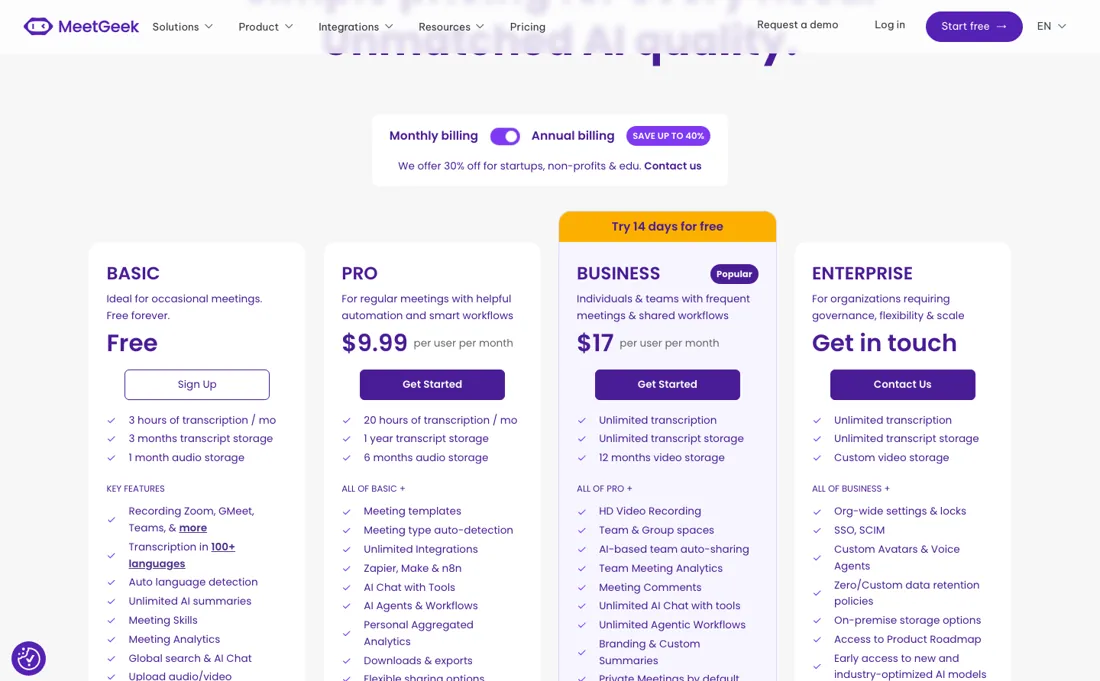
That sounds generous until you count the meetings you would actually record — a sales rep on four calls a day passes it in the first week, and the overage is $0.50 an hour. Unlimited transcription is the real reason to be on Business at $17, so treat Pro as a plan for occasional recording rather than a cheaper version of the same thing. Worth checking before you buy: consent.
A recorder that joins every meeting changes what people say in them, and that is a policy decision rather than a pricing one.
What MeetGeek does
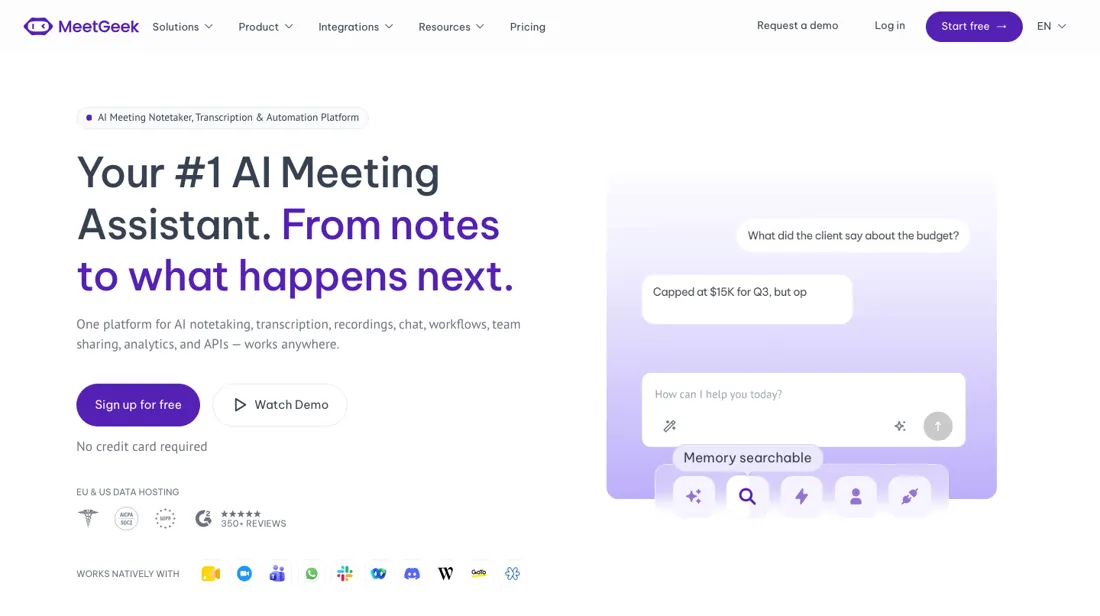
Meeting recorder and note-taker: transcription, summaries and searchable meeting history.
What buyers report about MeetGeek
Recurring themes from the buyer-review sites listed at the foot of this page, read in August 2026. We have not run MeetGeek ourselves, so this is other buyers' experience rather than ours. We summarise it here because the complaints are usually the part a vendor page leaves out.
- • Cross-meeting analytics is the standout — reviewers say it goes deeper than competitors at the same price.
- • It removes note-taking from the call entirely, which is the whole point. Overall score around 4.0.
- • Transcription accuracy is the most common complaint and it degrades noticeably on noisy calls, crosstalk, accents and non-English audio. If your meetings are multilingual, test before committing.
- • The free tier is 3 hours a month with 3-month storage — occasional use only.
- • Pro is $9.99 per user annually but $15.99 monthly; Business $17 annually and $27 monthly. That monthly premium is steep.
When the paid plan is worth it
Basic is free with three hours of transcription a month, Pro is $9.99 a user a month with twenty hours, and Business is $17 with unlimited transcription. Those two figures are the annual prices, which is what the pricing page shows before anyone touches the billing switch; paying monthly makes them $15.99 and $27. Extra hours are $0.50 each. Those numbers make the choice arithmetic rather than instinct, and the answer depends on the switch.
Twenty hours is about an hour a working day, and the overage closes the gap fast. On annual billing, Pro plus fourteen extra hours costs exactly what Business costs, so thirty-four hours a month is the line. On monthly billing the gap is wider — $15.99 against $27 — and the line moves to about forty-two hours. Below it Pro is cheaper; above it you are paying more than Business costs for less than Business gives.
Count the meetings you would actually record rather than the ones you attend, because that is where the estimate goes wrong. A sales rep on four calls a day passes twenty hours in the first week of the month. For that profile Pro is not a cheaper version of Business — it is a plan for occasional recording, and treating it as the budget option produces a bigger bill than the plan above it.
What Business adds beyond the meter is narrower than it looks. Team multi-meeting analytics is the feature that starts there; downloads and exports and admin user management are already on Pro, so a team that moves up for those is paying $17 for something it has at $9.99. Nor is the API a reason to climb: API and MCP access are listed on the free Basic plan. Enterprise is bought for governance instead — SSO, SCIM, org-wide settings, on-premise storage and custom retention.
There is a 14-day trial on Pro. One thing no tier settles: a recorder that joins every meeting changes what people say in them. Consent is a policy decision to make before the rollout, not a setting to find afterwards.
How to actually use MeetGeek
Settle consent before you switch it on, because a recorder that joins every meeting changes what people say in them — and in several jurisdictions it changes what is lawful. Write down who gets told, how they are told, and which meetings are excluded. This is a policy decision rather than a pricing one and it is the step most teams skip. Then count the meetings you would actually record, in hours.
Pro's twenty hours a month is about an hour a working day, which sounds generous until you apply it: a sales rep on four calls a day passes it in the first week. Overage runs $0.50 an hour, and Business with unlimited transcription becomes the cheaper plan past about 34 hours a month on annual billing ($9.99 against $17) or about 42 hours on monthly billing ($15.99 against $27) — so treat Pro as a plan for occasional recording rather than a cheaper version of the same thing.
Use the 14-day trial on your real meeting mix rather than a scheduled test call. Accents, crosstalk, a bad connection and someone dialling in from a car are what transcription accuracy actually has to survive, and every summary built on a poor transcript is confidently wrong.
Distilled from MeetGeek plans and pricing, including the per-plan feature table and the monthly/annual billing switch, https://meetgeek.ai/pricing (read 2026-08-30, re-read in a rendered browser 2026-09-04); MeetGeek help centre, https://support.meetgeek.ai/en/ (read 2026-08-30); MeetGeek API documentation, https://docs.meetgeek.ai/api/getting-started/introduction (read 2026-08-30).
The natural comparison is Fireflies or Otter — the direct meeting-recorder peers — compare the transcription-hour allowance at your real meeting load, since that is the only meter that moves.
More on MeetGeek
Everything we publish about MeetGeek links back here — the review stays the honest hub:
The ex-banker filter — the same yardstick on every review (how we review): My ex-banker filter is simple: does MeetGeek remove a real cost — time, errors, missed revenue — bigger than what it charges?
Frequently asked questions
What should I weigh before buying Video & Audio software?
Judge it on evidence rather than adjectives. Look for a published security page, single sign-on and role controls on the plan you would actually buy (they are often gated to higher tiers), a status page with real incident history, and a clear answer on where your data is stored. If the tool will hold anything sensitive, those four answers matter more than any feature comparison.
Is this a hands-on review of MeetGeek?
This is a researched assessment, not a hands-on test — where we've used a tool ourselves, we say so explicitly. We name what each tool is genuinely good and bad at, and we earn a commission only if you sign up, at no cost to you.
- Buyer reviews on G2, Capterra and practitioner reviews, read August 2026.
- Re-verified 2026-09-04, read on their own pricing page in a rendered browser.
- A dated screenshot of that pricing page, kept on this site as the receipt.
Others in this category
Reviewed video & audio tools that share ground with MeetGeek — comparable in what they do, not drop-in swaps:
Also in video & audio, for browsing rather than as an alternative:
New dossiers, cost-traps we found, and tools that earned a keep — no hype, no sponsored-disguised-as-advice. Unsubscribe anytime.
This is our researched assessment — not a paid placement. The “Visit” links on this page are affiliate links: we may earn a commission if you sign up, at no extra cost to you, and it never changes our take. How we review →