 GeoStock Review (2026)
Transparency: the “Visit” links on this page are affiliate links — we may earn a commission if you sign up, at no extra cost to you. No vendor can pay for a better review or verdict. How we make money →
Know what this is before you buy it: despite the name it is a storefront widget, not an inventory system.
Visit GeoStock → Affiliate link — we may earn a commission if you sign up; it does not change what this page says.
Watch the 2-minute review
The video version of this review, from our YouTube channel.
Pricing (2026)
✓ Pricing re-verified 20 Sep 2026
| This tool | $9.99 | 13th cheapest of 46 |
| Cheapest | $2.99 | MX AI |
| Median | $15 | |
| Most expensive | $450 | Attribuly |
Lowest paid entry price per account a month, billed monthly, in USD, among the 46 e-commerce growth apps we have researched (read between 2026-08-19 and 2026-10-02). Only tools priced in the same unit and on the same billing are compared — not a market survey, and cheapest is not best.
Two plans, no free tier. Base Plan $9.99 a month and Plus Plan $29.99 a month, both with a 14-day free trial, billed in USD every 30 days. Unchanged since the readings of 18 August and 13 September 2026. Rating 4.9 from 99 ratings (92 five-star, two four-star, no three-star, two two-star, three one-star). Developer sohkal llc, 6381 Almaden Rd, San Jose, CA, US; on the App Store since 28 March 2019. Plans change — always verify the live price on their site.
Category context: E-commerce. Across the 33 tools in this category that we researched with a public US-dollar price, the median entry price is $19 a month (lowest paid plan as listed, per seat where the vendor prices per seat). GeoStock’s entry price of $9.99 a month sits below that median. Compare pricing conditions in the Software Cost Atlas →
What the pricing page doesn’t say
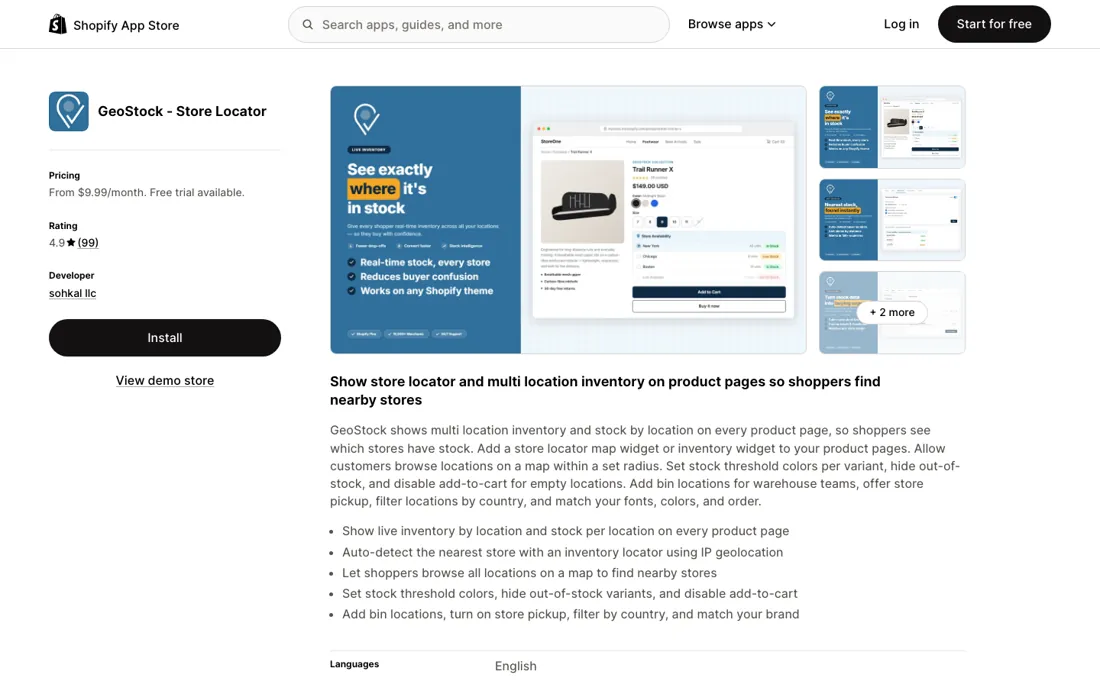
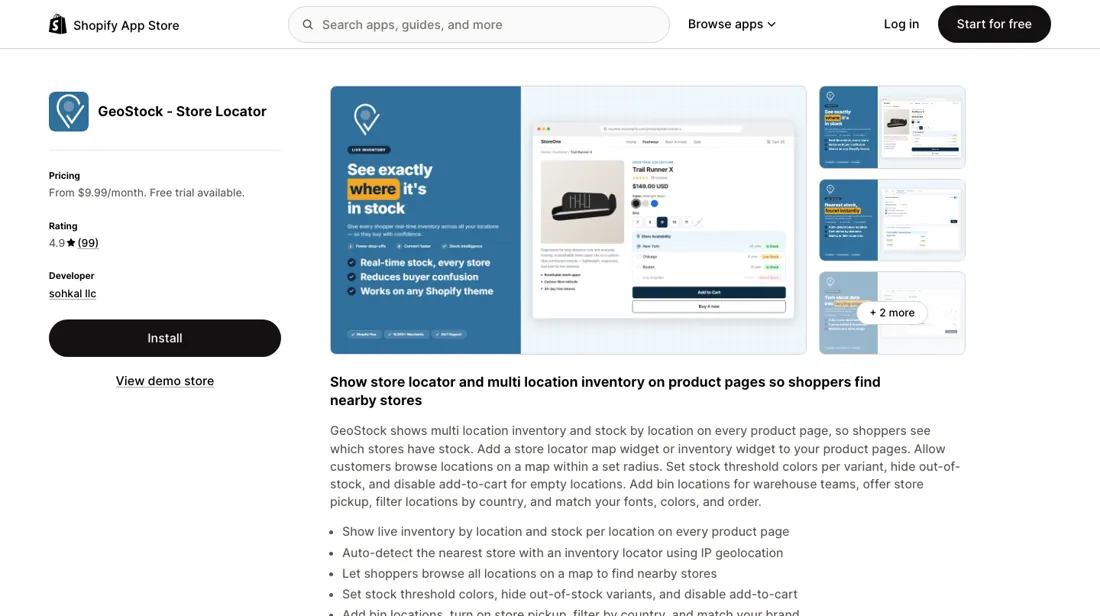
It displays the stock you already track in Shopify per location, and adds a store-locator map — it does not manage, forecast or reconcile anything. If you came looking for multi-location inventory management, that is a different category and a different budget. What it does do well is close a specific gap: a shopper who can see that a nearby store has the item is a shopper who does not abandon.
What GeoStock does
Shows per-location stock on the product page plus a store-locator map, so shoppers can see which branch has the item. It displays inventory rather than managing it.
What buyers report about GeoStock
Recurring themes from the buyer-review sites listed at the foot of this page, read in August 2026. We have not run GeoStock ourselves, so this is other buyers' experience rather than ours. We summarise it here because the complaints are usually the part a vendor page leaves out.
- • Merchants describe the per-location display as the fix for a specific, expensive problem: one branch overselling while another sits on stock. Reviewers call seeing real per-store availability on the product page the thing that changed.
- • Hiding or flagging out-of-stock variants is credited with fewer dead ends for shoppers, and several reviewers connect that directly to conversion rather than to appearance.
- • Setup and support carry an unusual share of the positive reviews: merchants describe configuration as simple, and replies arriving the same day. An Australian jewellery retailer singles the support team out as one of the best they deal with.
- • The one serious complaint is about support silence, not the widget: a merchant reported four days without an answer while pre-sales questions were being replied to quickly (September 2025). The developer answered in the thread, acknowledged the miss and offered to put it right.
- • The admin settings are English-only, which one reviewer notes as an obstacle even while rating the app well — worth knowing if the person maintaining it does not work in English.
- • The record contains almost no criticism of what the app actually does, which is itself a limit: with three quarters of the reviews landing on the same short list of praise, there is little independent evidence about how it behaves on large catalogues or on many locations at once.
Where the ratings disagree. Read the reviews for what they confirm rather than for the score, because they confirm the scope. Merchants describe a storefront display — availability per location, plus a locator — and nobody describes it as inventory management, forecasting or reconciliation. That matches what the app is, and it is the single most common mismatch buyers make in this category. If you came looking for multi-location inventory control, the reviews are telling you the same thing the listing is: that is a different product and a different budget.
Pages read (August 2026): Shopify App Store
When the paid plan is worth it
Read the Plus plan carefully before you triple your spend, because it adds no functionality whatsoever. Basic at $9.99 already carries every feature: stock per location per product, unlimited locations and variants, stock thresholds with custom colours, nearest-store detection by IP, country include and exclude filters, pickup, and widgets on product, cart and collection pages. Plus at $29.99 lists exactly one functional line -- “everything in Basic” -- and then seven service lines: a dedicated onboarding session, priority support with video calls, help integrating a custom theme, same-day fixes, direct access to the dev team and ongoing optimisation guidance.
That can be worth $20 a month if you are on Shopify Plus with a bespoke theme and no in-house developer. It is worth nothing if your theme is standard. Both plans include a 14-day trial. Read on the App Store listing on 19 August 2026 and re-read on 13 September 2026, when the rating stood at 4.9 from 99 reviews.
How to actually use GeoStock
Get your Shopify location data clean before you install, because the widget shows exactly what is in there and wrong stock numbers on a product page are worse than no numbers. Set the stock threshold colours per variant deliberately: showing “2 left” is useful, showing it when the real figure is unreliable trains shoppers to distrust the widget. Start on the $9.99 Base plan, which carries every feature the listing names; Plus at $29.99 is aimed at Shopify Plus merchants and buys onboarding, priority support and theme help rather than extra capability.
Two things merchants raised on the App Store listing in August and September 2026 are worth asking support about early: adding locations made product pages noticeably slower until support moved those accounts to batch loading that fetches every location in one call, and a fallback-location setting can show the next nearest store when an item is out of stock locally instead of a dead end. Both plans include a 14-day trial.
Distilled from apps.shopify.com/product-inventory-information, read 18 August 2026 and re-read 13 September 2026 for the plan contents and the merchant reports dated August and September 2026 on that same listing.
Frequently asked questions
The Plus plan is really a support plan — is the support any good?
It depends which year you ask about, and the reviews split cleanly down the middle of 2026. Every rating below four stars on the listing is about support, and none of them is recent: five reviews dated between July 2021 and 25 September 2025 describe unanswered email, a month-long wait for a reply, and a developer answering that they are a small team of four. The three most recent reviews run the other way. On 22 and 27 August and 3 September 2026, merchants describe support finding that the widget was making a separate API call per location, moving those accounts onto batch loading that fetches every location in one call, and walking a merchant through a fallback-location setting so an out-of-stock item shows the next nearest store instead of a dead end. Today's distribution is 92 of 99 ratings at five stars and three at one. That is what the extra $20 a month buys: priority on a queue that used to be slow and now looks fast. Read on apps.shopify.com/product-inventory-information, 20 September 2026.
What does it get access to in my store?
More than a display widget implies, so read the data-access block before you install. As listed on 20 September 2026 it asks to view customer device and activity data — geolocation, IP address, browser and operating system — plus the store owner's name, email, phone and physical address; to view products, inventory and collections; to edit orders' shipping information; to edit your Online Store theme and its script tags; and to view locales and locations. The geolocation and IP access is what powers nearest-store detection, and the theme access is how the widget reaches your product, cart and collection pages. Note what is absent from that list: nothing in it writes inventory. The app reads the stock you already keep in Shopify, which is also why a wrong number on a product page is a Shopify data problem rather than an app problem — clean your location data first.
Is there a free plan?
No, and that matters more here than usual. Both plans carry a 14-day free trial and then bill in USD every 30 days: Base at $9.99, Plus at $29.99. There is no permanent free tier and no usage meter, so those fourteen days are your entire evaluation window. Spend them on the hard case rather than an easy one: a product stocked unevenly across your locations, a variant that is out of stock nearby but available two branches away, and a page loaded from a country you genuinely sell into, because nearest-store detection runs on IP. If you are weighing Base against Plus, the trial is also the moment to test support response time, since that is the whole of what Plus adds. Figures read on the listing, 20 September 2026.
What should I weigh before buying E-commerce software?
Check your platform and version specifically. Shopify support is close to universal in this category, while WooCommerce, BigCommerce, Magento and headless setups vary a lot, and 'supported' sometimes means a generic API rather than a maintained app. A listing in your own platform's app store, with recent reviews there, is a better signal than the vendor's logo wall.
Is this a hands-on review of GeoStock?
This is a researched assessment, not a hands-on test — where we've used a tool ourselves, we say so explicitly. We name what each tool is good and bad at, and we earn a commission only if you sign up, at no cost to you.
- Buyer reviews on the Shopify App Store listing, including its developer replies, read August 2026.
- Re-verified 2026-09-20 on apps.shopify.com/product-inventory-information.
- A dated screenshot of that pricing page, kept on this site as the receipt.
Others in this category
Reviewed e-commerce tools that share ground with GeoStock — comparable in what they do, not drop-in swaps:
New reviews, price changes we recorded, and the cost conditions we found. No sponsored placements. Unsubscribe anytime.
This is our researched assessment — not a paid placement. The “Visit” links on this page are affiliate links: we may earn a commission if you sign up, at no extra cost to you, and it never changes our take. How we review →