 Teikametrics Review (2026)3% of Spend Above $10K
Read the Advanced tier carefully, because it is not a subscription — it is a subscription plus a percentage.
Watch the 2-minute review
Same honest take, in video form — from our YouTube channel.
⚡ Short on time? Watch the 30-second verdict Short.
Pricing (2026)
✓ Pricing re-verified 30 Aug 2026
| This tool | $179 | 24th cheapest of 25 |
| Cheapest | $4.99 | Scarcity.AI |
| Median | $29 | |
| Most expensive | $250 | Seller Snap |
Entry price per month, USD. Our own dated readings of 25 e-commerce tools — not a market survey, and cheapest is not best.
(2026-08-30, re-read on their own pricing page from a US exit) Essentials, for up to $10K a month in ad spend: $149 a month billed annually, or $179 billed monthly. Advanced, for over $10K a month in ad spend: custom pricing plus 3% of ad spend above $10K. Enterprise, for over $100K a month in ad spend: also custom pricing plus 3% of ad spend above $10K. A free trial and a free opportunity assessment are offered. Plans change — always verify the live price on their site.
What the pricing page doesn’t say
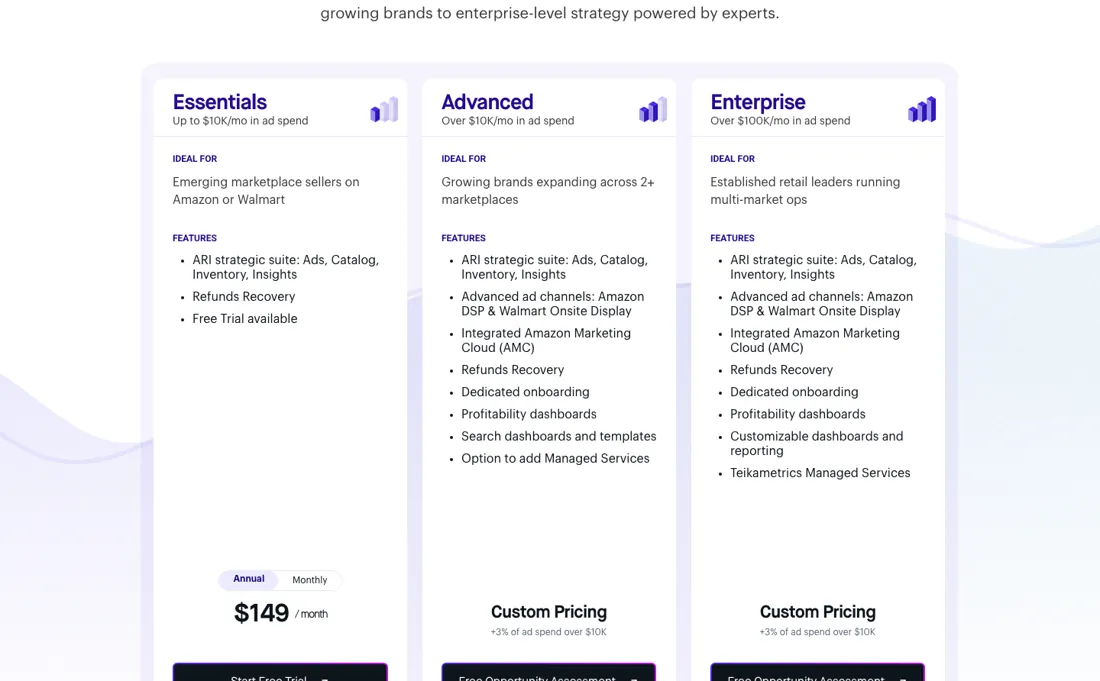
Three per cent of ad spend above $10,000 means a seller spending $40,000 a month pays an extra $900 on top of whatever the custom base is, and that line scales with the thing the product is supposed to make more efficient. That is not automatically wrong — it aligns them with your growth — but it does mean your bill rises when your advertising does, and you should model it at your expected spend rather than your current one.
The $10K threshold is the number to watch: crossing it changes the pricing model, not just the price.
What Teikametrics does
Advertising optimisation for Amazon and Walmart sellers, with inventory and catalogue signals.

What buyers report about Teikametrics
Recurring themes from the buyer-review sites listed at the foot of this page, read in August 2026. We have not run Teikametrics ourselves, so this is other buyers' experience rather than ours. We summarise it here because the complaints are usually the part a vendor page leaves out.
- • Customer service is the standout — reviewers repeatedly name responsiveness and genuine knowledge of Amazon advertising.
- • The AI reduces ACoS and automates bid management, and time saved is the most common positive theme.
- • The Advanced plan charges $1,199-$1,430 a month base plus 3% of ad spend above $10K. In a high-spend month that percentage is the thing that hurts, and reviewers say so.
- • Billing complaints include charges after cancellation and subscriptions that are hard to stop.
- • Setup is complex and onboarding takes longer than expected.
- • Essentials at $149-$179 only covers up to $10K monthly ad spend.
Past $10K the pricing model changes, not the price
Essentials covers up to $10,000 a month in ad spend at $149 a month billed annually, or $179 monthly. Advanced, for anything above that, is custom pricing PLUS 3% of ad spend over $10,000. Enterprise, for over $100,000 a month, is quoted on the same terms: its card carries the identical 3% line, so the percentage does not fall away at the top of the range. A free trial and a free opportunity assessment are offered (2026-08-30, re-read on their own pricing page from a US exit).
The $10,000 threshold is the number to watch, and not because the price steps up. Crossing it changes the pricing MODEL: below it you pay a subscription, above it you pay a subscription plus a percentage of the thing the product is meant to make more efficient. Work that through at your real spend rather than your current one. A seller putting $40,000 a month into ads pays an extra $900 on top of whatever the custom base turns out to be — and at $100,000 that percentage alone is $2,700 a month.
The base is not published, so the honest position is that you cannot cost Advanced without a quote; what you can do is know the percentage component in advance and ask for the base separately. None of this is automatically wrong. A percentage of spend aligns the vendor with your growth in a way a flat fee does not, and for a seller who genuinely improves ROAS the arrangement can be worth having.
But it does mean your bill rises when your advertising does, regardless of whether the returns rise with it — so ask what happens in a month where spend goes up and performance does not. Use Essentials as the anchor for any comparison. At $149 for up to $10K of spend, that is 1.5% of spend at the top of the band — a useful yardstick to hold other tools in this category against, including the ones that publish nothing at all.
How to actually use Teikametrics
Find out which side of $10,000 a month in ad spend you are on before anything else, because that threshold changes the pricing model rather than the price. Below it you pay $149 a month billed annually and that is the whole bill. Above it you pay a custom base plus 3% of everything over $10,000 — $900 a month at $40K of spend, $2,700 at $100K. If you are above it, ask for the base and the percentage as separate lines in the quote, and ask one specific question: what happens in a month where spend rises and performance does not?
A percentage of spend aligns them with your growth, and it also means the invoice goes up in exactly the month you least want it to. Take the free opportunity assessment before the trial. It costs nothing, and what you want from it is a specific claim about your own account — which campaigns are wasting money and how much — that you can check afterwards against your own numbers.
Then use the trial to test the thing the subscription is for: does the automated bidding beat what you were doing manually, on your own catalogue? Set a baseline of your current ROAS before you switch anything on, because without it you will be comparing against a memory.
Distilled from Teikametrics pricing page (teikametrics.com/pricing) and the Teikametrics Help Center index (help.teikametrics.com), read 30 August 2026 from a US exit — the three tiers and their ad-spend bands, the 3%-of-spend line that appears on both Advanced and Enterprise, and the onboarding track the help centre opens with: the risk-free trial, connecting your data, and what to expect after the first AI-powered campaign.
The natural comparison is Perpetua or Helium 10 — the direct marketplace-advertising peers — compare total cost at your real monthly ad spend, including any percentage component.
The ex-banker filter — the same yardstick on every review (how we review): My ex-banker filter is simple: does Teikametrics remove a real cost — time, errors, missed revenue — bigger than what it charges?
Frequently asked questions
What should I weigh before buying E-commerce software?
Check your platform and version specifically. Shopify support is close to universal in this category, while WooCommerce, BigCommerce, Magento and headless setups vary a lot, and 'supported' sometimes means a generic API rather than a maintained app. A listing in your own platform's app store, with recent reviews there, is a better signal than the vendor's logo wall.
Is this a hands-on review of Teikametrics?
This is a researched assessment, not a hands-on test — where we've used a tool ourselves, we say so explicitly. We name what each tool is genuinely good and bad at, and we have no affiliate relationship with Teikametrics — we earn nothing whether you sign up or not.
- Buyer reviews on G2, Gartner Peer Insights and Tekpon, read August 2026.
- 2026-08-30, re-read on their own pricing page from a US exit.
- A dated screenshot of that pricing page, kept on this site as the receipt.
Others in this category
Reviewed e-commerce tools that share ground with Teikametrics — comparable in what they do, not drop-in swaps:
New dossiers, cost-traps we found, and tools that earned a keep — no hype, no sponsored-disguised-as-advice. Unsubscribe anytime.
This is our researched assessment — not a paid placement. How we review →