 Aura Review (2026)Your Sales Volume Picks the Tier
The tier is decided by how much you sell, not by what you need.
Pricing (2026)
✓ Pricing re-verified 28 Aug 2026
| This tool | $37 | 16th cheapest of 23 |
| Cheapest | $4.99 | Scarcity.AI |
| Median | $29 | |
| Most expensive | $250 | Seller Snap |
Entry price per month, USD. Our own dated readings of 23 e-commerce tools — not a market survey, and cheapest is not best.
(2026-08-28, checked line by line against their own pricing page; every figure below is the same as on 1 Aug 2026) Flat per account, not per seat, with unlimited listings on every tier. Starter $37/month ($451 a year), Essential $77 ($931), Plus $157 ($1,891), Pro $237 ($2,851) — annual saves 20%. The ladder is set by monthly sales volume, not by features: Starter up to $15K, Essential up to $50K, Plus up to $250K, Pro up to $1M.
Marketplaces included: 2, 3, 4 and 6. Aura AI covers 250, 500, 1,000 and unlimited listings; Hyperdrive 10, 25, 50 and 100 allocations; user seats 1, 2, 5 and unlimited. Their table adds three things the earlier reading did not record: monthly sales are calculated on a trailing two months, workflows run 5, 10, unlimited and unlimited, and there is a 14-day free trial. Plans change — always verify the live price on their site.
What the pricing page doesn’t say
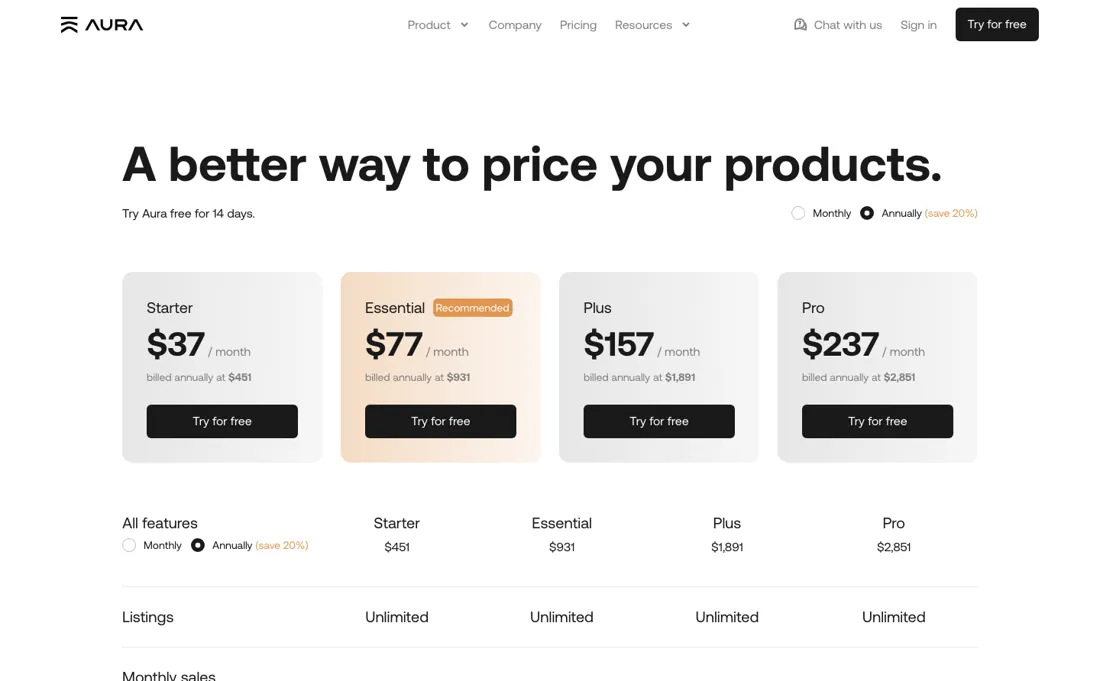
That is unusually honest as a model — a seller doing $10K a month is not subsidising one doing $900K — but it means your bill moves when your business does, in the same month, without you choosing to upgrade. Pass $15K and Starter stops being the plan you are on. Work out which band you land in the way the page measures it: their table says monthly sales are calculated on a trailing two months, so it is a sustained climb rather than a single spike that moves you up.
Two smaller things: the marketplace count is a real cap (two on Starter, so Amazon plus one), and the AI listing allowance is per listing rather than per repricing action, so a large catalogue eats it faster than a busy one.
What Aura does
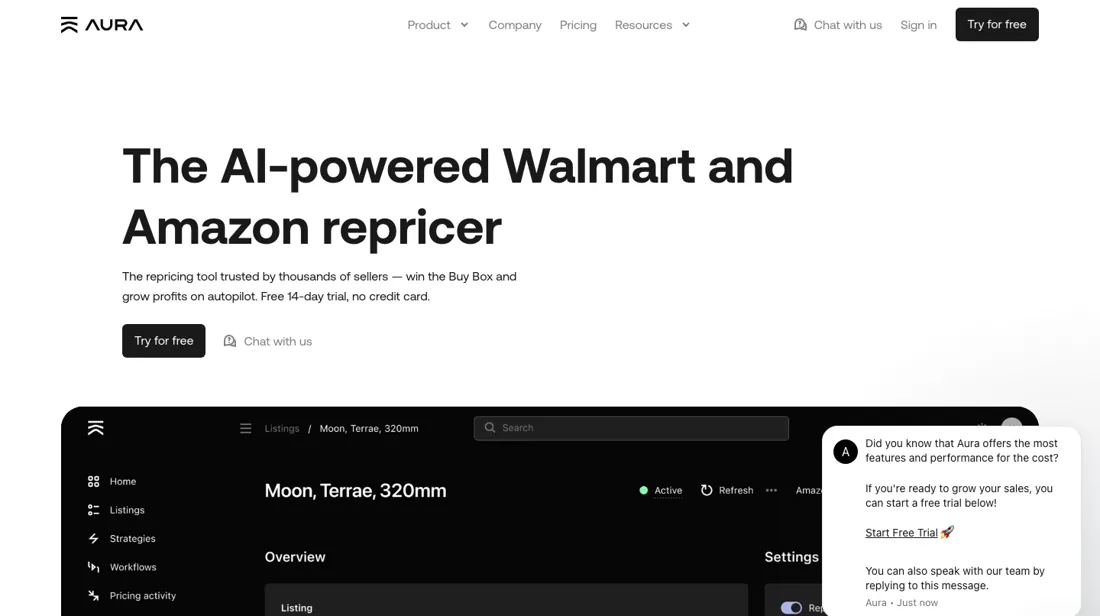
Dynamic repricing for Amazon and Walmart sellers — automated price strategy across marketplaces.
What buyers report about Aura
Recurring themes from the buyer-review sites listed at the foot of this page, read in August 2026. We have not run Aura ourselves, so this is other buyers' experience rather than ours. We summarise it here because the complaints are usually the part a vendor page leaves out.
- • Second in U.S. News's ranking of identity theft protection, and named best for user experience. Apps rate 4.7 on iOS and 4.5 on Android.
- • Three-bureau credit monitoring, up to $1M insurance per adult, plus VPN, antivirus, password manager and parental controls in one subscription.
- • Data broker removal is the weakest part and reviewers say so — if that is your main reason for buying, check what it actually removes.
- • Pricing is inconsistent across platforms, so what you are quoted depends on where you sign up.
- • No social media monitoring at all.
- • Bug fixes are slow. $12/month individual on annual, $22 couple, $32 family; monthly billing runs considerably higher.
When the paid plan is worth it
You do not choose a tier here so much as your sales choose it for you, and that makes the ceilings the thing to read rather than the features. Starter is $37 a month up to $15K in monthly sales, Essential $77 up to $50K, Plus $157 up to $250K, Pro $237 up to $1M. Cross a line and the bill steps: a seller doing $16K a month pays $77 rather than $37 -- more than double the price for a thousand dollars more turnover.
Their table calculates volume on a trailing two months, so plan around a sustained level, not one spike. As a share of sales the picture reverses, and it is worth seeing both ways. At each ceiling the tool costs 0.25% of sales on Starter, 0.15% on Essential, 0.06% on Plus and 0.024% on Pro. So it is most expensive for the smallest seller and almost free at scale -- but only near the top of your band.
Sitting just above a threshold is the worst place to be. What the tiers do carry beyond volume: marketplaces (2, 3, 4 and 6), Aura AI listings (250, 500, 1,000 and unlimited), Hyperdrive allocations (10, 25, 50, 100) and seats (1, 2, 5, unlimited). Listings are unlimited on every tier and the price is per account rather than per seat, so adding people costs nothing until you hit the seat cap. Annual billing takes 20% off.
How to actually use Aura
Work out which band you land in the way Aura measures it: the tier is set by monthly sales volume rather than features, and their table calculates that volume on a trailing two months. Cross $15K on that basis and Starter stops being your plan, without you choosing to upgrade. Then look at it as a take rate, because that is where the model is genuinely fair. At the top of each band you are paying 0.25% of sales on Starter, 0.15% on Essential, 0.06% on Plus and 0.02% on Pro — it gets cheaper as a share of your business the bigger you get.
Just past a threshold it is the opposite: $15,001 of sales puts you on Essential at $77, which is 0.51% of the same $15K. If your volume hovers near a boundary, that is the number to know. Count marketplaces before you count anything else. Two on Starter means Amazon plus one, and that is a hard cap rather than a soft one — three, four and six come with the tiers above.
Check the AI listing allowance the same way: it is counted per listing rather than per repricing action, so a large catalogue consumes it faster than a busy one does. Annual billing saves 20%, and because the tier moves with your sales anyway, committing annually is less binding than it sounds.
Distilled from Aura's own pricing page (https://goaura.com/pricing), read line by line: the plan table sets the ladder by monthly sales volume rather than by features (Starter up to $15K at $37, Essential up to $50K at $77, Plus up to $250K at $157, Pro up to $1M at $237), states that monthly sales are 'Calculated on a trailing 2-months', gives the marketplaces included per tier as 2, 3, 4 and 6, counts the Aura AI (Maven) allowance in listings rather than in repricing actions (250, 500, 1,000 and unlimited), and advertises the 20% annual saving
Aura vs Seller Snap, side by side
Both columns come from the same place: each vendor’s own published pricing, read on the date shown in the sources at the foot of this page. We do not average them into a score.
The Seller Snap link above is an affiliate link — we may earn a commission if you sign up, at no extra cost to you — and the other column is a plain link. Neither changes what this table says: both columns come straight from the vendors’ own pricing pages.
The natural comparison is Seller Snap or RepricerExpress — the direct repricing peers — compare on which marketplaces are included and where the volume band ends, not on the monthly sticker.
The ex-banker filter — the same yardstick on every review (how we review): My ex-banker filter is simple: does Aura remove a real cost — time, errors, missed revenue — bigger than what it charges?
Frequently asked questions
What should I weigh before buying E-commerce software?
Check your platform and version specifically. Shopify support is close to universal in this category, while WooCommerce, BigCommerce, Magento and headless setups vary a lot, and 'supported' sometimes means a generic API rather than a maintained app. A listing in your own platform's app store, with recent reviews there, is a better signal than the vendor's logo wall.
Is this a hands-on review of Aura?
This is a researched assessment, not a hands-on test — where we've used a tool ourselves, we say so explicitly. We name what each tool is genuinely good and bad at, and we have no affiliate relationship with Aura — we earn nothing whether you sign up or not.
- Buyer reviews on U.S. News, Security.org, SafeHome and app-store reviews, read August 2026.
- Aura’s own published pricing page.
- A dated screenshot of that pricing page, kept on this site as the receipt.
Others in this category
Reviewed e-commerce tools that share ground with Aura — comparable in what they do, not drop-in swaps:
New dossiers, cost-traps we found, and tools that earned a keep — no hype, no sponsored-disguised-as-advice. Unsubscribe anytime.
This is our researched assessment — not a paid placement. How we review →