 Pangram Review (2026)The API Unit Changed Tenfold
The unavoidable honest limit of every AI detector, including accurate ones: it is never infallible.
Visit Pangram → Affiliate link — the rest of this page is the honest version, including who should skip it.
Watch the 2-minute review
Same honest take, in video form — from our YouTube channel.
⚡ Short on time? Watch the 30-second verdict Short.
Pricing (2026)
✓ Pricing re-verified 6 Sep 2026
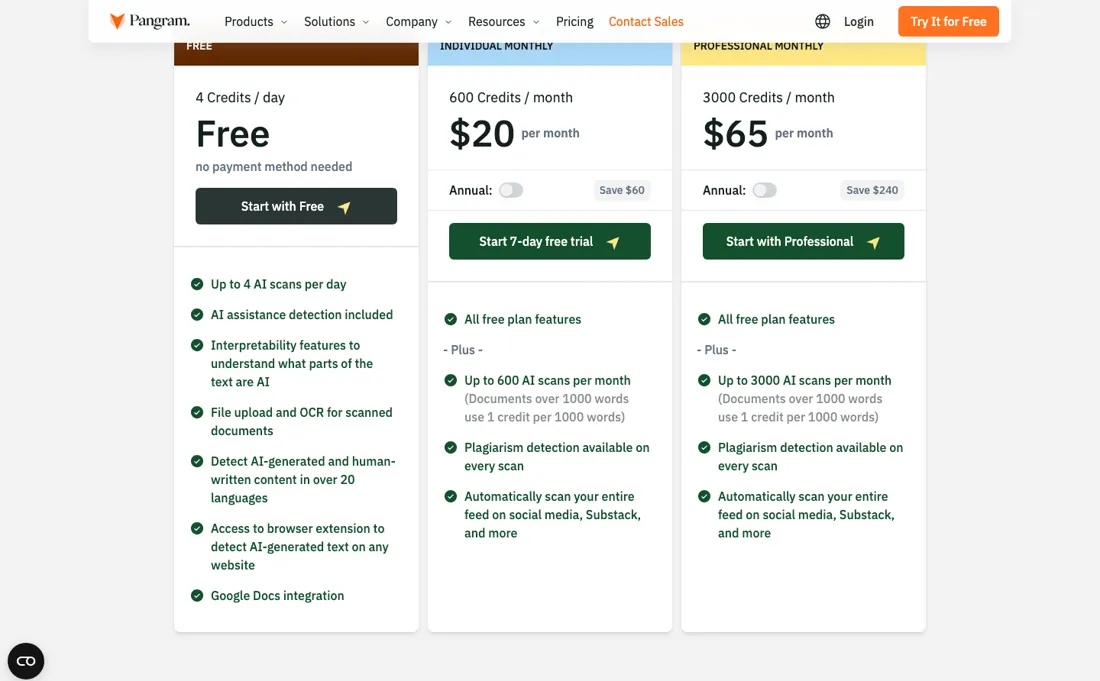
Free: $0, no payment method, up to 2,000 words a day (twenty checks) and 3 image scans a day. Individual $20/mo or $15/mo billed annually ($180 a year) for up to 300,000 words a month and 100 image scans a month. Professional $65/mo or $45/mo annually ($540 a year) for up to 1,500,000 words a month, 500 image scans and $200 of API usage included.
Team $20 per seat/mo or $15 annually, from 2 seats, 300,000 words per seat. Educational Institution and Enterprise are both quote-only; the Enterprise card offers progressive discounting beyond the developer tier. The Developer API is prepaid pay-as-you-go: llms.txt says funds from $5 to $2,000, while the page's own top-up buttons start at $25 ($25/$50/$100/$250/$500/$1,000, with auto-refill). Realtime checks on Pangram 4 cost $0.05 per 100 words where Pangram 3 charged $0.05 per 1,000, and bulk document scans are 20% cheaper than realtime.
A 7-day free trial is offered on Individual and on Team, but not on Professional, whose button reads 'Start with Professional'. Plans change — always verify the live price on their site.
What the price did
We capture Pangram’s own pricing page every month and keep the figures, so this is our record of the page — not a forecast, and not someone else’s summary.
Our monthly captures caught the change that matters here. The July 2026 capture of Pangram's pricing page carries the plan prices ($20, $60, $65, $240) and nothing about per-word API rates. The August 2026 capture adds two lines that spell out the generational split: Pangram 4 at $0.05 per 100 words, and Pangram 3 at $0.05 per 1,000 words. The plan prices themselves did not move between the two, and the reading of 6 September 2026 matches August on every figure: $20/$15 on Individual, $65/$45 on Professional, $20/$15 a seat on Team, and the same two per-word API rates.
What the pricing page doesn’t say
It will occasionally flag genuinely human writing as AI (false positives) and miss some AI text, so it must be used as a signal, never as sole proof for high-stakes calls like academic penalties or hiring. Pangram's pitch is fewer false positives than rivals, which is real progress — but 'fewer' is not 'none'. Pair it with human judgment and the credit meter with your actual volume.
What Pangram does
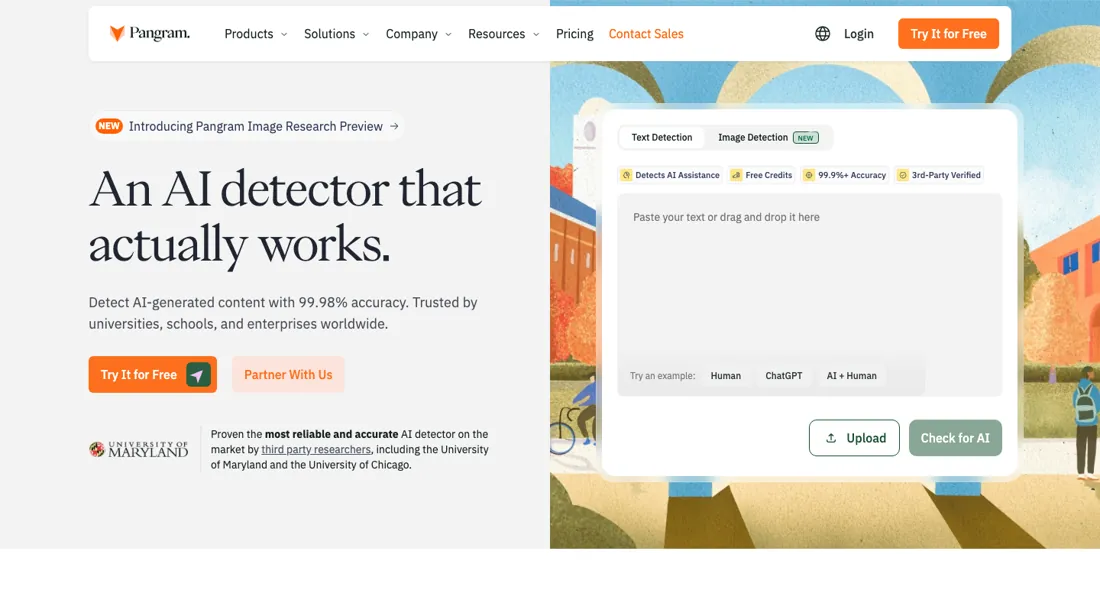
AI content detector. Identifies AI-generated text with a focus on minimizing false positives — used by educators, publishers and platforms to verify whether writing is human or machine, via web app and API. The vendor's Pangram 4.0 release (July 2026) claims a false-positive rate of 1 in 10,000, detection of output from the newest frontier models, resistance to "humanized" text written to evade detection, and improved boundary detection between human and AI passages. An early research preview adds AI image detection, flagging which segments of an image appear AI-generated and verifying C2PA content credentials where present.
What buyers report about Pangram
Recurring themes from the buyer-review sites listed at the foot of this page, read in August 2026. We have not run Pangram ourselves, so this is other buyers' experience rather than ours. We summarise it here because the complaints are usually the part a vendor page leaves out.
- • A 1-in-10,000 false positive rate independently verified by researchers at the University of Chicago and the University of Maryland — that verification is what separates it from every detector that only cites its own numbers.
- • 99.8-100% accuracy on straightforwardly AI-generated text, with a free tier of 4 scans a day.
- • On AI-edited text — a human draft polished by a model — published accuracy drops to 73%. That is the case most real writing now falls into, and it is where accusations go wrong.
- • Users report false positives on older human-written work and on formal academic language, and reliability falls on short text (50 words minimum).
- • Public sentiment reads worse than the metrics because the people who get falsely flagged say so loudly — which is fair, since being wrongly accused costs them more than a missed detection costs anyone.
- • $20/month for 600 credits up to $65, and the credit system adds up if you also run plagiarism checks.
When the paid plan is worth it
The subscription ladder is straightforward. Free is $0 with no payment method, for up to 2,000 words a day — about twenty checks. Individual is $20 a month or $15 annually for up to 300,000 words a month. Professional is $65 or $45 annually for 1,500,000 words, plus 500 image scans and $200 of API usage. Team is $20 a seat ($15 annually) from two seats. Per thousand words that is about $0.05 on Individual and $0.03 on Professional — a real volume discount.
But the number that matters most is on the other side of the page. The Developer API is prepaid pay-as-you-go from $5 to $2,000, and realtime checks on Pangram 4 cost $0.05 per 100 words. That is $0.50 per thousand — ten times the Individual rate and seventeen times Professional's. Bulk document scans are 20% cheaper than realtime, which narrows it but does not close it. So the rule is simple and it is the opposite of what most tools suggest: if the volume can go through a subscription, put it there.
The API is for integration, not for saving money, and anyone routing steady volume through it is paying an order of magnitude more per word than the plan they already qualify for. One correction that applies to older write-ups, ours included: the billing unit changed with the model generation. Pangram 3 charged $0.05 per 1,000 words; Pangram 4 charges $0.05 per 100. Any estimate built on the older figure is off by a factor of ten.
And the limit no tier removes, which belongs in the buying decision rather than the footnotes: every AI detector is fallible. It will sometimes flag genuinely human writing and sometimes miss AI text. Pangram's pitch is fewer false positives than rivals and that is real progress, but fewer is not none — so use it as a signal, never as sole proof for an academic penalty or a hiring decision.
How to actually use Pangram
Calibrate on writing you already know the provenance of, using the free tier's 2,000 words a day. Run ten pieces you wrote yourself and ten you know were machine-generated, and record what it says about each. That gives you a false-positive rate on your own material and in your own subject area, which is the only number that should govern how you use it. Then decide the policy before the subscription, because this is the honest limit of every detector including the accurate ones: it will occasionally flag genuinely human writing and it will miss some AI text.
Never use a score as sole proof for a high-stakes call — an academic penalty, a hiring decision — and write down in advance what a flag actually triggers: a conversation, not a verdict. Size the plan on words a month rather than checks: Individual covers 300,000 words for $15 a month billed annually and Professional 1,500,000 for $45, which is $5.00 and $3.00 per hundred thousand words. Team is $15 a seat annually from two seats.
If you are wiring it into something, note that the billing unit changed with the model generation. Pangram 4 charges $0.05 per 100 words in realtime where Pangram 3 charged $0.05 per 1,000 — a tenfold difference that older write-ups, ours among them, still quote the old side of. Bulk document scans run 20% cheaper than realtime, so batch whatever you can.
Distilled from Plans, allowances and API rates read on pangram.com/pricing and pangram.com/llms.txt on 6 September 2026 from a Netherlands exit. From the page: the Individuals, Teams, Developers and Enterprise & Institutions tabs with their monthly amounts and annual savings ($60 on Individual, $240 on Professional, $60 a seat on Team), the per-card word and image-scan allowances, the Developer API panel with its top-up buttons and the two per-word rates for Pangram 4 and Pangram 3, and the trial wording on each button. From llms.txt: the same plan list with the annual totals spelled out ($180 and $540). Unusually for this motor the machine-readable file and the live page do not contradict each other; the trial buttons and the top-up presets appear only on the page.
The natural comparison is GPTZero or Originality.ai — close AI-detection peers — Pangram competes on lower false positives; compare accuracy claims and per-word credit cost for your volume.
More on Pangram
Everything we publish about Pangram links back here — the review stays the honest hub:
The ex-banker filter — the same yardstick on every review (how we review): My ex-banker filter is simple: does Pangram remove a real cost — time, errors, missed revenue — bigger than what it charges?
Frequently asked questions
What does Pangram cost?
Free for up to 2,000 words a day. Individual is $20 a month, or $15 billed annually ($180 a year), for 300,000 words a month; Professional is $65 or $45 annually ($540) for 1.5 million words plus 500 image scans; Team is $20 per seat from two seats. Read from their own machine-readable plan list on 17 August 2026.
Is there a Pangram promo code?
We have found none, and it is one of the things people search for most about this tool. What exists instead is the annual discount, which is substantial: $15 against $20 on Individual and $45 against $65 on Professional, so a year up front saves 25% to 31%. There is also a free tier of twenty checks a day that needs no payment method at all.
What does the API cost per document?
Watch the unit, because it changed with the model. Realtime checks on Pangram 4 are $0.05 per 100 words; the older Pangram 3 charged $0.05 per 1,000 words. Bulk document scans are 20% cheaper than realtime. Credit is prepaid, from $5 up to $2,000. A 1,000-word essay therefore costs about $0.50 on the current model, not $0.05 — check which generation any quoted rate refers to.
Is there a free trial before I pay?
Yes on two of the three paid tiers, and it is worth noting which two. Individual offers a 7-day free trial and Team a 7-day team trial, read on their pricing page on 6 September 2026. Professional, the 1,500,000-word tier, does not: its button reads 'Start with Professional'. So the plan whose allowance you would most want to try before committing is the one without a trial. The free plan needs no payment method and covers 2,000 words a day, which is the way to calibrate first.
What should I weigh before buying Operations & Workflow software?
Usually it sits on top rather than replacing everything. Tools in this class tend to become the layer where work is tracked and handed off, while your existing systems stay the source of truth for their own data. Before you buy, map which tools it would replace outright and which it would merely sync with. If the answer is that it syncs with all of them, you are adding a layer rather than removing one.
Is this a hands-on review of Pangram?
This is a researched assessment, not a hands-on test — where we've used a tool ourselves, we say so explicitly. We name what each tool is genuinely good and bad at, and we earn a commission only if you sign up, at no cost to you.
- Buyer reviews on independent academic testing and user reviews, read August 2026.
- Re-verified 6 September 2026 on pangram.com/pricing and pangram.com/llms.txt, which agree with each other on every figure.
- A dated screenshot of that pricing page, kept on this site as the receipt.
Others in this category
The operations & workflow tools closest to Pangram that we have also reviewed. They overlap rather than match:
New dossiers, cost-traps we found, and tools that earned a keep — no hype, no sponsored-disguised-as-advice. Unsubscribe anytime.
This is our researched assessment — not a paid placement. The “Visit” links on this page are affiliate links: we may earn a commission if you sign up, at no extra cost to you, and it never changes our take. How we review →