 Webflow Review (2026)Two People Cost $83, Not $25
Three separate bills, and the pricing page shows them on separate tabs.
Visit Webflow → Affiliate link — the rest of this page is the honest version, including who should skip it.
Watch the 2-minute review
Same honest take, in video form — from our YouTube channel.
⚡ Short on time? Watch the 30-second verdict Short.
Pricing (2026)
✓ Pricing re-verified 29 Aug 2026
Webflow bills in two places at once. Site plans, billed yearly: Starter free; $15/mo for a site that does not need a CMS (custom domain, 300 static pages, 10 GB bandwidth); $25/mo for the CMS tier, which the page now calls Premium. Ecommerce site plans are separate again: Standard $29/mo with 500 items and a 2% transaction fee, Plus $74/mo with 5,000 items and no transaction fee, Advanced $212/mo with 15,000 items.
Workspace plans, also billed yearly: Starter free (2 staging sites, 1 full seat), Core $19/mo, Growth $49/mo, and on the freelancer-and-agency tab Freelancer $16/mo and Agency $35/mo. Seats are charged on top of the workspace plan: a full seat is $39/mo billed yearly, a limited seat $15/mo, a review-only seat $0. Platform plans start at Team $2,500/mo with an annual contract required, and Enterprise above it is quote-only.
Add-ons: Optimize from $299/mo by page views, Analyze from $9/mo by sessions, Localize Essential $9/mo and Localize Advanced $29/mo by number of locales, 2,000 AI credits $20/mo billed yearly, and a published bandwidth ladder running from +50 GB at $20/mo billed annually to +2.45 TB at $974/mo, with monthly billing about half again as expensive at every step. Webflow Cloud overages run at $2 per million requests and $2 per 5 hours of CPU usage, with web app bandwidth pooled into the site plan's bandwidth.
Storage is priced on that page again: on the Basic and CMS site plans the D1 and KV stores include 100 MB and then run at $2 per 500 MB, and R2 object storage at $2 per 5 GB; on the Team plan those same lines read $2 per GB. (Re-verified 2026-08-29 on the pricing page itself: every plan, seat and add-on price above was unchanged.) Plans change — always verify the live price on their site.
What the pricing page doesn’t say
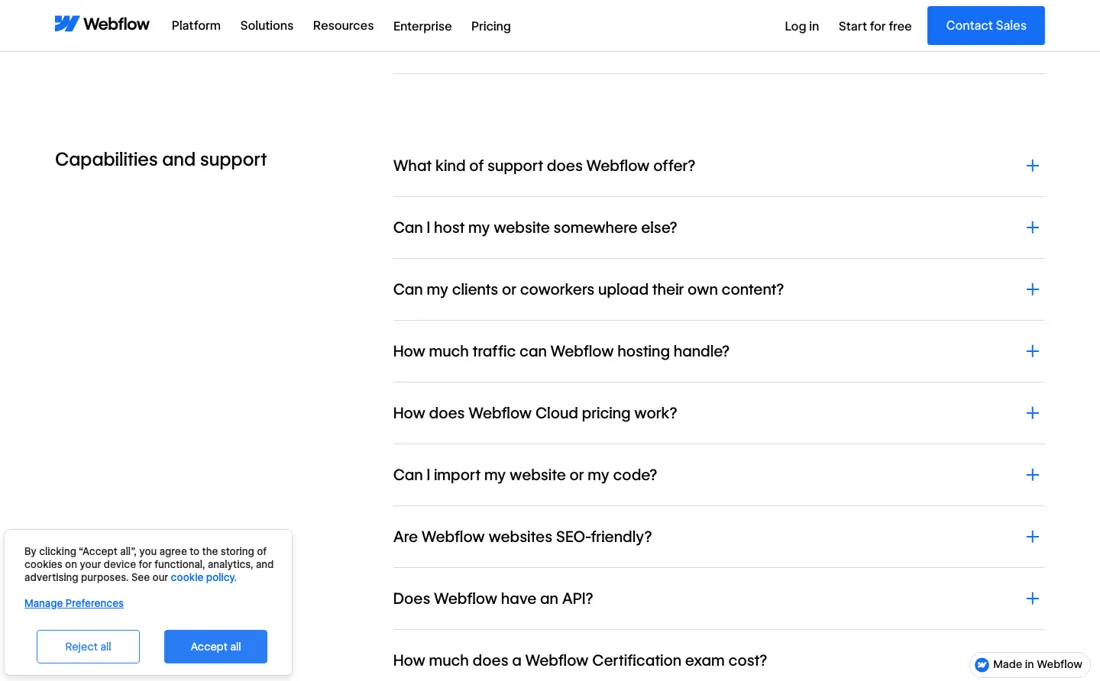
A site plan is what puts your site online: $15 a month for a static site, $25 with the CMS. A workspace plan is what lets your team work on it: $19 or $49 a month. And seats are charged on top of the workspace plan at $39 a month each for anyone who can actually design. So a two-person team on a CMS site is not $25 a month — it is $25 for the site, $19 for the workspace and $39 for the second seat, which is $83, and that is before add-ons.
Two more numbers to find before you commit. The entry ecommerce plan takes a 2% transaction fee on every order, which the $29 headline does not mention and which is the largest single cost for anyone selling real volume; removing it means Plus at $74. And Optimize, the conversion tooling Webflow leads with in its marketing, starts at $299 a month on top of everything else and is priced by page views.
Price your team, your site and your add-ons together, because no single tab on that page shows you a total.
What Webflow does
Visual website builder that writes production code — design, CMS, hosting and ecommerce in one place.
What buyers report about Webflow
Recurring themes from the buyer-review sites listed at the foot of this page, read in August 2026 (the GetApp listing is marked last updated July 2026; the three SourceForge reviews date from July 2020, February 2023 and February 2024). We have not run Webflow ourselves, so this is other buyers' experience rather than ours. We summarise it here because the complaints are usually the part a vendor page leaves out.
- • Design control without a developer, and the exported code is clean — that combination is what reviewers say nothing else matches.
- • Hosting is fast and the CMS is genuinely enough to run a professional site. Around 4.4 on G2 across 975 reviews, 71% of them five stars.
- • GetApp reviewers describe the visual builder as genuinely powerful with real creative control, one graphic designer likening it to stacking blocks with a live preview under the cursor, and a SourceForge reviewer notes non-technical marketing staff could edit copy themselves once the site was built.
- • Pricing stacks. Site plan plus workspace seats plus CMS limits, and multi-site agencies still report bills over $1,000 a month even after the May 2026 simplification.
- • CMS and template ceilings push upgrades you did not plan for.
- • There is no live chat or phone support on any tier — async only. On a launch deadline that is the complaint reviewers remember.
- • Beginners describe a steep learning curve; this is a design tool, not a site builder.
- • The learning curve for anyone without a web-design background is the standing theme on GetApp, and pricing is described as getting confusing and expensive as needs grow.
- • One SourceForge reviewer (a CEO, February 2024) reports that Webflow blocked security headers his organisation needed for SOC 2 compliance unless he moved to an Enterprise Lite tier he puts at $15,000 a year. That is one dated account we could not verify against Webflow's own pages, so treat it as a question to ask rather than a published price.
- • Support is called non-existent by a GetApp reviewer stuck on a bug, and a 2023 SourceForge reviewer separately misses being able to have several people editing at once.
Where the ratings disagree. Watch the numbers the directories quote. GetApp's listing, marked last updated July 2026, still describes the plans as Basic $18, CMS $29 and Business $49 a month; Webflow's own page on 15 August 2026 sells Basic at $15 and Premium at $25, with ecommerce and workspace billed separately on top. The written experience on those sites is worth reading and their price columns are not. The SourceForge sample is also thin — three reviews, none newer than February 2024 — so it is background colour rather than current sentiment.
Three bills, and no tab shows you the total
Webflow charges in three places at once and its pricing page puts them on separate tabs, so the single most useful thing we can do here is add them up. A site plan puts your site online: free on Starter, $15 a month billed yearly for a static site with a custom domain, 300 pages and 10 GB of bandwidth, and $25 for the CMS tier the page now calls Premium.
A workspace plan lets your team work on it: free on Starter with two staging sites and one full seat, then Core $19 or Growth $49. And seats are charged on top of the workspace: a full seat is $39 a month billed yearly, a limited seat $15, a review-only seat free. So a two-person team on a CMS site is not $25 a month. It is $25 for the site, $19 for the workspace and $39 for the second full seat — $83, or 3.3 times the headline, before a single add-on.
Three people is $122 a month, $1,464 a year. That seat structure is also where the easiest saving lives. Only people who actually design need a full seat at $39. Content editors belong on a limited seat at $15 and stakeholders who just leave comments belong on a review-only seat at nothing. Getting that wrong on a ten-person team costs about $312 a month in seats nobody needed. Ecommerce is a separate ladder again, and it contains one number worth doing properly.
Standard is $29 a month for 500 items with a 2% transaction fee; Plus is $74 for 5,000 items and no fee. The $45 difference equals 2% of $2,250, so the moment you sell more than $2,250 a month, Plus is the cheaper plan. That is a low bar — under $27,000 a year — which makes Standard a genuine starter plan rather than a small-business one, and makes the 2% the largest single cost for anyone selling real volume.
Advanced is $212 for 15,000 items. Then the add-ons, which is where the marketing and the invoice part company. Optimize, the conversion tooling Webflow leads with, starts at $299 a month priced by page views — three and a half times the entire two-person setup above. Analyze starts at $9 by sessions, Localize at $9, and 2,000 AI credits are $20. Webflow Cloud overages run $2 per million requests and $2 per five hours of CPU, with web app bandwidth pooled into the site plan's bandwidth.
Above all of it, Platform plans start at Team at $2,500 a month with an annual contract required, and Enterprise is quoted. Price your team, your site and your add-ons together before you compare Webflow with anything, because no single tab on that page will do it for you.
How to actually use Webflow
Add the three bills together before you decide anything. A site plan puts the site online ($15 static, $25 with CMS), a workspace plan lets your team work on it ($19 or $49), and seats are charged on top at $39 each for anyone who designs. A two-person CMS project is $83 a month, not $25 — and no tab on the pricing page shows you that total. Then assign seats deliberately, because this is the easiest money to waste.
Full seats at $39 are only for people who actually build; content editors go on limited seats at $15 and anyone who just reviews and comments goes on a free review-only seat. On a ten-person team, getting that wrong is about $312 a month. If you are selling, do the transaction-fee arithmetic first. Standard at $29 carries a 2% fee; Plus at $74 does not, and the $45 difference is 2% of $2,250 — so above $2,250 a month in sales, Plus is simply cheaper.
Below it, Standard is fine. Leave Optimize until last. It starts at $299 a month and is priced by page views, which is more than three times a working two-person setup — it is a conversion programme, not a feature you switch on while you are still building the site.
Distilled from Webflow's pricing page (webflow.com/pricing), read 29 August 2026 on yearly billing with the ecommerce and workspace accordions expanded — site plans, platform plans, add-ons, seat prices and the AI-credit line come from that page. Its FAQ confirms Webflow Cloud is metered on bandwidth, requests, CPU and storage but prints no overage rate; the per-request and per-CPU figures above come from Webflow's Cloud documentation read earlier and were not re-read on 29 August 2026.
The natural comparison is Framer or WordPress — the two directions people leave for — Framer for a simpler visual builder, WordPress for cheaper hosting and more plugins; compare the total of site plan, workspace and seats, not the entry sticker.
More on Webflow
Everything we publish about Webflow links back here — the review stays the honest hub:
The ex-banker filter — the same yardstick on every review (how we review): My ex-banker filter is simple: does Webflow remove a real cost — time, errors, missed revenue — bigger than what it charges?
Frequently asked questions
What does a Webflow site actually cost once it is live?
Add up three bills, because Webflow charges in three places. A site plan puts the site online: $15 a month billed yearly for Basic without a CMS, $25 for Premium with it, or separate ecommerce plans at $29, $74 and $212. A workspace plan lets your team work on it: Core $19, Growth $49, or Freelancer $16 and Agency $35 on the agency tab. Seats are charged on top of that, at $39 a month per full seat billed yearly, $15 for a limited seat and $0 for review-only. Read on their pricing page on 15 August 2026.
What is metered on Webflow, beyond the plan price?
More than there used to be, and this is what changed since our last full read on 4 August 2026. Bandwidth is now sold as a published ladder of add-ons, from +50 GB at $20 a month billed annually up to +2.45 TB at $974, with monthly billing costing roughly half again as much at every step. AI credits are a separate purchase, $20 a month for 2,000, with an allowance included per workspace tier. And Webflow Cloud app hosting is usage-priced with overage lines such as then $2 per 1M requests and then $2 per 5 CPU hours. Optimize starts at $299 a month by page views and Analyze at $9 a month by sessions.
Is a directory's Webflow pricing reliable?
Not right now. GetApp's Webflow listing, marked last updated July 2026, still describes plans as Basic $18, CMS $29 and Business $49 a month. Webflow's own page on 15 August 2026 sells Basic at $15 and Premium at $25 for site plans, with $29, $74 and $212 for ecommerce and a separate workspace bill. Take the ratings and the written experience from the directories and the price from the vendor.
What should I weigh before buying Website Builders software?
Judge it on evidence rather than adjectives. Look for a published security page, single sign-on and role controls on the plan you would actually buy (they are often gated to higher tiers), a status page with real incident history, and a clear answer on where your data is stored. If the tool will hold anything sensitive, those four answers matter more than any feature comparison.
Is this a hands-on review of Webflow?
This is a researched assessment, not a hands-on test — where we've used a tool ourselves, we say so explicitly. We name what each tool is genuinely good and bad at, and we earn a commission only if you sign up, at no cost to you.
- Buyer reviews on G2, Capterra, GetApp and SourceForge, read August 2026 (the GetApp listing is marked last updated July 2026; the three SourceForge reviews date from July 2020, February 2023 and February 2024).
- Re-verified 2026-08-04, read on their own pricing page with every plan accordion and billing tab open.
- A dated screenshot of that pricing page, kept on this site as the receipt.
New dossiers, cost-traps we found, and tools that earned a keep — no hype, no sponsored-disguised-as-advice. Unsubscribe anytime.
This is our researched assessment — not a paid placement. The “Visit” links on this page are affiliate links: we may earn a commission if you sign up, at no extra cost to you, and it never changes our take. How we review →