 Tapstitch Review (2026)
Printify is cheaper, higher-margin and has a far bigger catalogue — if you're optimising for profit per sale or product breadth, that's the real trade-off. Tapstitch earns its place when garment quality and brand feel matter more than squeezing the last point of margin. Throughout this review we weigh it against Printify.
Visit Tapstitch → Affiliate link — we may earn a commission if you sign up; it does not change what this page says.
Watch the 2-minute review
The video version of this review, from our YouTube channel.
⚡ Short on time? Watch the 30-second verdict Short.
Pricing (2026)
✓ Pricing re-verified 14 Sep 2026
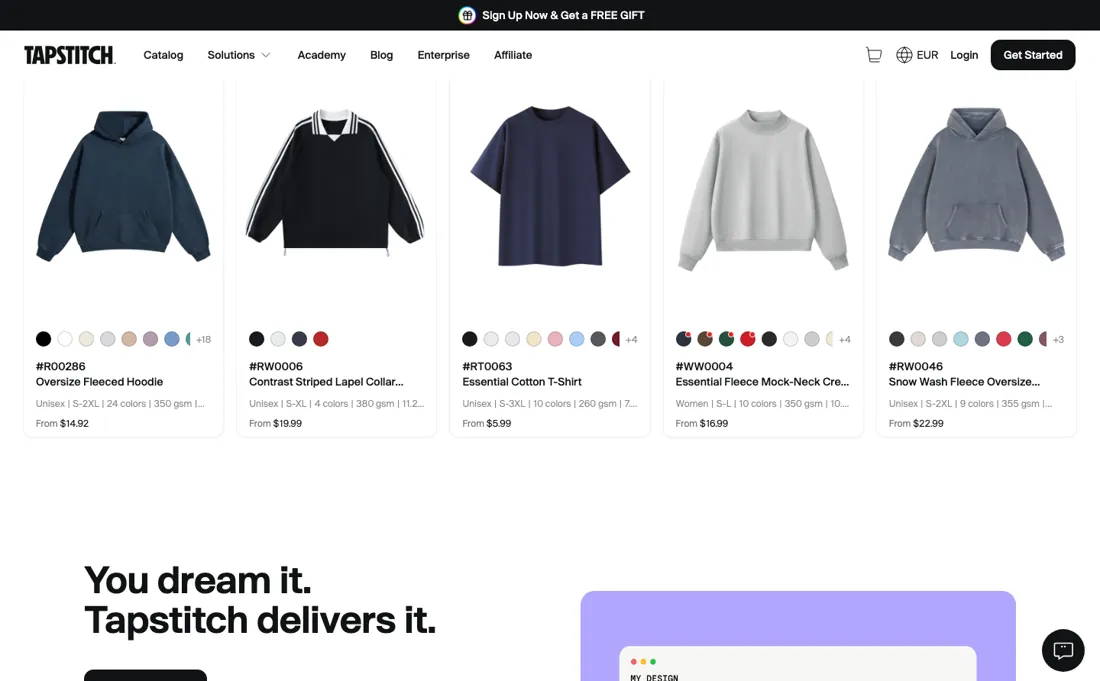
No subscription, no monthly fee and no minimum order quantity — you pay per item, production plus shipping, so there is no plan price to compare. The 48 blanks listed on the all-products page run from $5.99 to $32.99, median $19.99, at fabric weights from 110 to 470 gsm. The honest catch is margin rather than fees. Printify's lower product and shipping costs mean noticeably higher profit per sale, while Tapstitch's premium heavyweight blanks — 250 to 260 gsm tees and 350 to 380 gsm hoodies — sit at the expensive end of that range. Price the finished garment against your retail price, not the platform. Plans change — always verify the live price on their site.
Correction after re-checking: No subscription tier: Tapstitch states the platform is free to use and that you pay only once an order comes in, so the real cost is garment plus customization plus shipping, with shipping calculated at checkout. Catalogue base costs are far below finished retail: the 240 gsm Essential Sorona Boxy T-Shirt lists at $9.99 per item on international fulfillment, a women's Essential Standard Shoulder T-Shirt starts from $6.99, and heavyweight cotton hoodies start from $19.99. The recurring bill most sellers pay is the storefront rather than Tapstitch: its own Shopify FAQ notes Shopify plans start at 29 USD per month. (re-verified 2026-08-04)
What the price did
We capture Tapstitch’s own pricing page every month and keep the figures, so this is our record of the page — not a forecast, and not someone else’s summary.
There is no subscription to track, so what we watch is the catalogue. Our July 2026 capture recorded item prices including $9.99, $14.92 and $19.99; the August 2026 reading returned a similar spread expressed as 'from' prices ($2.99, $5.99, $9.99, $14.92, $19.99). A full count of the all-products page on 14 September 2026 found 48 blanks from $5.99 to $32.99, median $19.99 — no $2.99 entry any more, and a ceiling ten dollars above what our earlier readings recorded.
Tapstitch’s pricing page, as we read it
What Tapstitch does
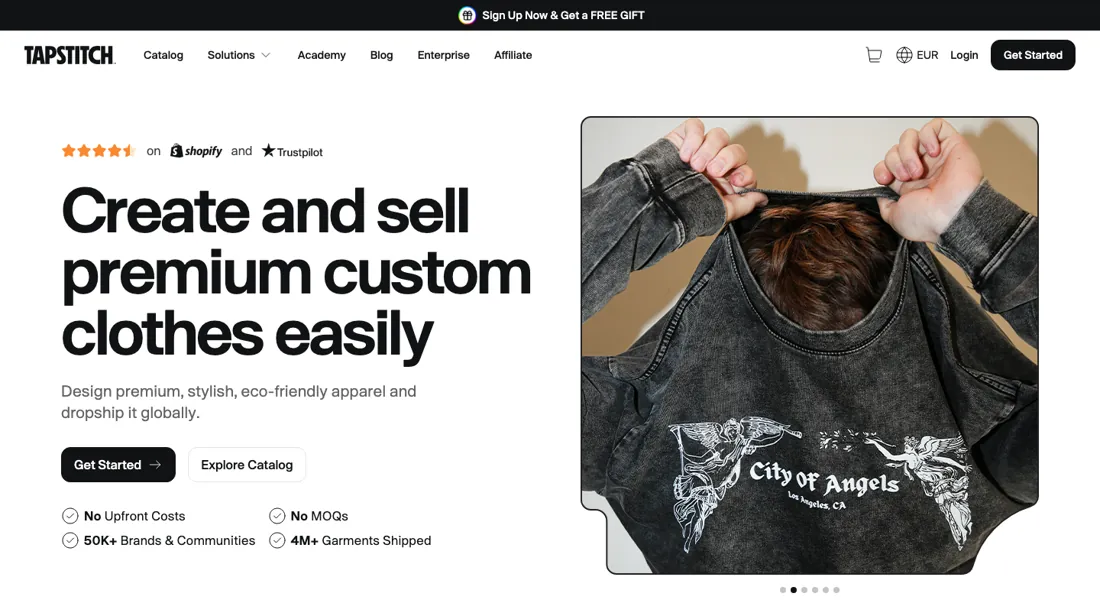
Fashion-first print-on-demand for brand-builders: premium heavyweight blanks (streetwear tees, oversized hoodies), bigger print areas and made-to-order apparel with no inventory — integrates with Shopify.
What buyers report about Tapstitch
Recurring themes from the buyer-review sites listed at the foot of this page, read in August 2026. We have not run Tapstitch ourselves, so this is other buyers' experience rather than ours. We summarise it here because the complaints are usually the part a vendor page leaves out.
- • The garments are the point — 250-400+ GSM blanks, and reviewers consistently use the word retail-quality about fabric weight and print. 4.7 across 80+ Shopify App Store reviews.
- • No subscription, no platform fee and no minimum order. You pay cost of goods, which is why sellers can price at $35-50 a tee.
- • Sizing runs about one size small against standard US sizing. Multiple reviewers report ordering XL and receiving what felt like L. Put that on your product page or you will eat the returns.
- • Misprint resolution is reported taking a month, and orders cancelled without explanation.
- • International shipping is slow, and the catalogue is apparel only.
Pages read (August 2026): Trustpilot
What you actually pay, per item
There is no plan to upgrade to and no threshold to cross: Tapstitch charges no subscription, no monthly fee and no minimum order quantity. You pay per item — production plus shipping — which changes the shape of the decision. A subscription punishes you for a slow month; a per-item model does not, so holding a dormant store through a quiet quarter costs nothing but time. For testing a design or running seasonal drops, that is a genuine structural advantage over platforms with a monthly floor.
What replaces the tier question is margin per sale. The all-products page on 14 September 2026 listed 48 blanks between $5.99 and $32.99, median $19.99, at weights from 110 to 470 gsm. Printify's lower product and shipping costs mean noticeably higher profit per sale on comparable items, and a far bigger catalogue besides. What no amount of spending fixes is time. Print-on-demand production runs 1-6 working days and international delivery 5-15, but non-print-on-demand items are a different clock entirely: 7 working days for sampling plus 7-15 days for bulk production.
Tapstitch also defaults new stores to International Fulfillment — cheaper per item, slower to arrive — unless you change it under Account, then Store, then Settings, then Order Settings. On a per-item model a delivery-driven refund costs you the full production cost, so settle all of it with one sample order before you publish.
How to actually use Tapstitch
The fastest route to something real is a free account plus one sample order. After signing up from the Get Started button and verifying the email address, the documented sequence runs Catalog, then the in-browser Designer, then Push to Store, where a platform and the product title and price are filled in before publishing. Tapstitch documents no minimum order quantity, so a single garment can be ordered first to judge fabric and print.
Budget genuine waiting time: the vendor's shipping page puts print-on-demand production at 1-6 working days and international delivery at 5-15 working days. Two settings cause most of the friction. Fulfillment preferences sit under Account, then Store, then Settings, then the Order Settings tab; left untouched, Tapstitch defaults to International Fulfillment, which is cheaper but slower than the US option. Published products also cannot be edited, so changed artwork means republishing as a new product and hiding the old listing.
Store orders that never appear are pulled in manually with New Orders under My Orders.
Distilled from Tapstitch catalogue (tapstitch.com/collections/all) and the manufacturing and shipping policy, re-read 14 September 2026; Tapstitch help centre articles, catalogue product pages and Shopify integration page, read 4 August 2026. The site publishes no /pricing page — that URL returns 404.
Tapstitch vs Printify, side by side
Both columns come from the same place: each vendor’s own published pricing, read on the date shown in the sources at the foot of this page. We do not average them into a score.
Both names above are affiliate links: we may earn a commission if you sign up, at no extra cost to you. Neither changes what this table says: both columns come straight from the vendors’ own pricing pages.
The natural comparison is Printify — the cheaper, higher-margin, bigger-catalogue POD. Weigh it against Printify on the job you actually need done.
Frequently asked questions
What does Tapstitch cost to use?
Nothing as a subscription — there is no monthly fee and no minimum order quantity. You pay per item produced plus shipping. On 14 September 2026 the all-products page listed 48 blanks between $5.99 and $32.99, median $19.99, at fabric weights from 110 to 470 gsm. Your real cost is the finished garment once your print and your shipping sit on top of the blank.
How does it compare with Printify on margin?
Printify generally wins on margin, and that is the honest summary: lower product and shipping costs mean more profit per sale. What Tapstitch offers instead is the blank itself — around 250 gsm tees and 350-380 gsm hoodies rather than lightweight stock. If your brand competes on garment quality the trade may be worth it; if it competes on price it is not.
How long does an order actually take?
Two different clocks, and the vendor publishes both. A print-on-demand order takes 1-6 working days to produce depending on quantity, and international shipping and delivery takes another 5-15 working days. Anything that is not print-on-demand — plain single-colour tees, sweatshirts and shirts in bulk — runs 7 working days for sampling plus 7-15 days for bulk production before shipping even starts.
Is there any fixed cost at all?
Not from Tapstitch as a platform fee. Your fixed costs are elsewhere — your storefront, your marketing and any sampling you do before launch. Order samples of the specific blanks before committing, since the whole argument for this supplier is the physical product.
What should I weigh before buying Growth & Revenue software?
It depends on whether you have the bottleneck it solves. Small teams get the most out of this category when one clear problem is already costing real hours or revenue; buying ahead of that just adds cost and another login. Price it against the hours or lost deals it removes, not against its feature list, and start on the smallest plan that covers the job.
Is this a hands-on review of Tapstitch?
This is a researched assessment, not a hands-on test — where we've used a tool ourselves, we say so explicitly. We name what each tool is good and bad at, and we earn a commission only if you sign up, at no cost to you.
- Buyer reviews on the Shopify App Store, Trustpilot and print-on-demand comparisons, read August 2026.
- Re-verified 2026-09-14 on tapstitch.com/collections/all; the site publishes no /pricing page — that URL returns 404.
- A dated screenshot of that pricing page, kept on this site as the receipt.
Others in this category
Reviewed growth & revenue tools that share ground with Tapstitch — comparable in what they do, not drop-in swaps:
New reviews, price changes we recorded, and the cost conditions we found. No sponsored placements. Unsubscribe anytime.
This is our researched assessment — not a paid placement. The “Visit” links on this page are affiliate links: we may earn a commission if you sign up, at no extra cost to you, and it never changes our take. How we review →