 Spocket Review (2026)Three Plans, Three Discounts
Transparency: the “Visit” links on this page are affiliate links — we may earn a commission if you sign up, at no extra cost to you. No vendor can pay for a better review or verdict. How we make money →
Spocket's pitch is faster-shipping US and EU suppliers, and that's real — but you still pay twice: the monthly subscription and the wholesale product cost, so margins depend on picking items with room to mark up.
Visit Spocket → Affiliate link — we may earn a commission if you sign up; it does not change what this page says.
Watch the 2-minute review
The video version of this review, from our YouTube channel.
⚡ Short on time? Watch the 30-second verdict Short.
Pricing (2026)
✓ Pricing re-verified 7 Sep 2026
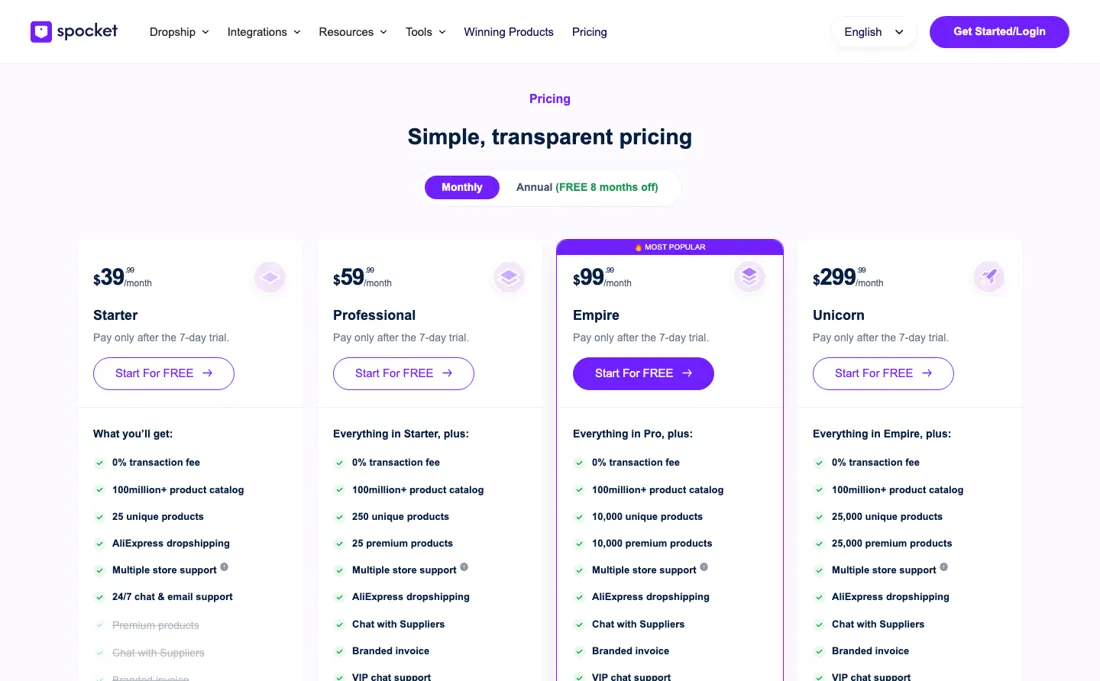
Four monthly plans, metered on unique products: Starter $39.99 (25 products), Pro $59.99 (250 products, 25 premium), Empire $99.99 (10,000 / 10,000) and Unicorn $299.99 (25,000 / 25,000). Annual billing is advertised as eight months free and the annual rates are printed on the cards: Pro $24 a month, Empire $57 and Unicorn $79, with stated savings of $432, $516 and $2,563.
Unicorn's two figures do not reconcile - $299.99 a month for a year less $79 a month for a year is $2,651.88, not $2,563. There is a 7-day trial and 0% transaction fee on every tier. Multiple-store support is listed on all plans, but the page states a separate subscription is required for each store. Unicorn carries the MOST POPULAR badge. Plans change — always verify the live price on their site.
Category context: Growth & Revenue. Across the 82 tools in this category that we researched with a public US-dollar price, the median entry price is about $29 a month (lowest paid plan as listed, per seat where the vendor prices per seat). Spocket’s entry price of $39.99 a month sits above that median. Compare pricing conditions in the Software Cost Atlas →
What the price did
We capture Spocket’s own pricing page every month and keep the figures, so this is our record of the page — not a forecast, and not someone else’s summary.
Spocket's annual savings lines were byte-for-byte identical in our July and August 2026 captures (the same $432, $516 and $2,563), and the monthly ladder returned unchanged on 17 August 2026 and again on 7 September 2026. Four readings, no movement.
What the pricing page doesn’t say
Catalog breadth is narrower than giant AliExpress-based tools (that's the trade for vetting and shipping speed), and the low Starter product cap pushes serious stores up to Pro quickly. It reduces, not removes, the usual dropshipping risks.
What Spocket does
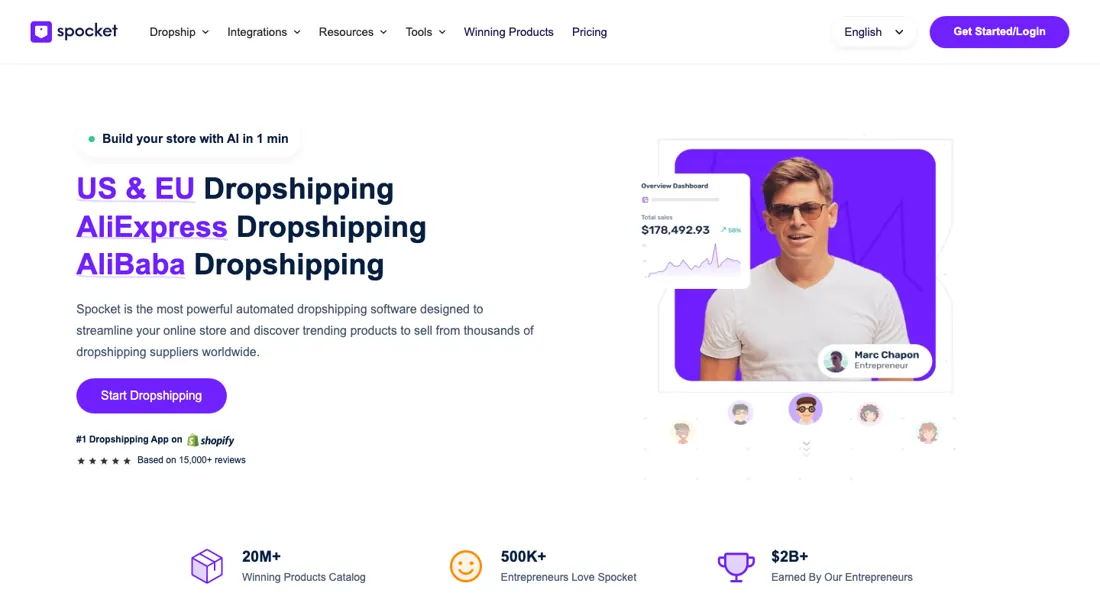
Dropshipping platform with vetted US and EU suppliers. Find fast-shipping products, add them to your store in a click and automate order fulfillment.
What buyers report about Spocket
Recurring themes from the buyer-review sites listed at the foot of this page, read in August 2026. We have not run Spocket ourselves, so this is other buyers' experience rather than ours. We summarise it here because the complaints are usually the part a vendor page leaves out.
- • Suppliers are vetted and mostly US and EU based, so shipping runs 2-5 days rather than weeks — that is the whole reason to pay for it over the free directories.
- • Branded invoices are included, which matters if you are building a store rather than flipping products.
- • Billing is the serious complaint. Reviewers report being upgraded to the $300+/month Unicorn plan without consent, including one charged $314.99 after uninstalling the app. Watch your statement from day one.
- • The 14-day trial converts without a warning email, and reviewers report charges continuing after cancellation.
- • 2.6 out of 5 across 41 Capterra reviews (read 25 August 2026), dragged down by support: robotic automated replies and slow responses when a billing error needs fixing.
- • Starter at $39.99 gives you 25 unique products, and practitioners argue much of the catalogue is not viable to dropship profitably anyway. Test margins on real products before committing.
Eight months free is true of none of the plans
Four plans, metered on unique products: Starter $39.99 a month for 25, Pro $59.99 for 250, Empire $99.99 for 10,000 and Unicorn $299.99 for 25,000. The upper three also carry premium-product allowances of 25, 10,000 and 25,000. There is a 7-day trial and 0% transaction fee on every tier - no per-order platform fee on top of the subscription. Annual billing is advertised as eight months free, and the annual rates are now printed on the cards: Pro $24 a month, Empire $57 and Unicorn $79.
Run those against the monthly rates and the headline fits none of them. Pro annually is $288 against $719.88 - 60% off, or 7.2 months free. Empire is $684 against $1,199.88, 43% off, or 5.2 months. Unicorn is $948 against $3,599.88, 74% off, or 8.8 months. One claim, three quite different offers, and furthest out on Empire. Unicorn's own two numbers also disagree with each other. The card says Save $2,563, but $299.99 a month for a year less $79 a month for a year is $2,651.88.
Work backwards from the $2,563 and you get $86.41 a month, not the $79 printed beside it. Read the annual total at checkout rather than either figure. The per-product inversion in this ladder depends entirely on how you pay, which is the part worth knowing. On monthly billing, per product slot, Starter is $1.60, Pro $0.24, Empire $0.010 and Unicorn $0.012 - so Unicorn is 20% worse per product than Empire, 2.5 times the catalogue for three times the price.
Switch to annual and it reverses: Empire is $0.0057 a slot and Unicorn $0.0032, making Unicorn the better rate by a wide margin. The plan Spocket badges MOST POPULAR is its most expensive, and it only earns that badge on the annual tab. One cost the tier list hides: multiple-store support appears on every plan, but the page states that a separate subscription is required for each store. Two stores is two subscriptions, not one plan shared.
And the subscription is not the real cost. You pay twice - the plan and the wholesale price of every item - so what decides this is whether the products you can find have room between wholesale and retail to carry a fixed monthly fee on top. Spend the 7-day trial finding ten items you would actually list and doing that arithmetic, not browsing the catalogue.
Our monthly capture read this vendor's pricing page in July 2026 and again in August 2026, and the amounts were the same both times. We keep watching — the registry records what moves.
How to actually use Spocket
Spend the 7-day trial on margin arithmetic, not on browsing. Find ten products you would genuinely list, write down the wholesale cost and the price you could realistically charge, and work out what monthly volume covers the subscription on top. You pay twice here - the plan and the product cost - so that gap is the whole business case. Ignore Starter unless you are testing. Twenty-five unique products is not a catalogue, and at $1.60 per product slot it is nearly seven times Pro's rate.
Decide the billing period before the tier, because it changes which tier is good value. On monthly billing Unicorn is 20% worse per product slot than Empire; on the annual rates - $57 and $79 a month - Unicorn is the better rate by some distance. And read the annual total at checkout rather than the 'eight months free' headline, which works out at 7.2 months on Pro, 5.2 on Empire and 8.8 on Unicorn.
If you plan to run more than one store, budget a separate subscription for each: the page lists multiple-store support on every plan but charges per store.
Distilled from spocket.co/pricing, read on 7 September 2026. The page is server-rendered and carries both billing tabs in the HTML at once, so the monthly cards ($39.99 / $59.99 / $99.99 / $299.99) and the annual cards ($24 / $57 / $79 a month, with the stated savings of $432 / $516 / $2,563) were read from the same document rather than by toggling - which is what made the discrepancy on Unicorn visible, since its stated saving and its stated annual rate cannot both be right. Product and premium-product allowances, the 0% transaction fee, the 7-day trial, the MOST POPULAR badge on Unicorn and the note that each store needs its own subscription all come from that page. spocket.co/llms.txt was read first and carries no pricing; spocket.co/pricing.md returns 404. Served in US dollars from a Netherlands connection.
Spocket vs Zendrop, side by side
Both columns come from the same place: each vendor’s own published pricing, read on the date shown in the sources at the foot of this page. We do not average them into a score.
Both names above are affiliate links: we may earn a commission if you sign up, at no extra cost to you. Neither changes what this table says: both columns come straight from the vendors’ own pricing pages.
The natural comparison is DSers or Zendrop — AliExpress-oriented alternatives with bigger catalogs but often slower shipping — Spocket trades breadth for US/EU speed.
Frequently asked questions
What does Spocket cost?
$39.99 a month for Starter, $59.99 for Pro, $99.99 for Empire and $299.99 for Unicorn. On annual billing the cards print $24, $57 and $79 a month for the upper three. Read on 7 September 2026.
What separates the tiers?
Catalogue size, almost entirely: 25 unique products on Starter, 250 on Pro, 10,000 on Empire and 25,000 on Unicorn, with premium-product allowances of 25, 10,000 and 25,000 on the upper three. Transaction fees are 0% on all of them, so you are buying how many products you may list rather than better terms on what you sell. Note that multiple-store support is listed on every plan but each store needs its own subscription.
Is the annual discount as good as it sounds?
It is steep, but 'eight months free' is true of none of the plans. Against the monthly rates, the annual price works out at 7.2 months free on Pro, 5.2 on Empire and 8.8 on Unicorn. Unicorn's card also contradicts itself: it claims a $2,563 saving, while its own $79-a-month annual rate implies $2,651.88. Read the annual total at checkout. The trade either way is commitment - dropshipping catalogues change and suppliers churn, so weigh a year up front against a seven-day trial that is short for proving a product line.
What should I weigh before buying Growth & Revenue software?
It depends on whether you have the bottleneck it solves. Small teams get the most out of this category when one clear problem is already costing real hours or revenue; buying ahead of that just adds cost and another login. Price it against the hours or lost deals it removes, not against its feature list, and start on the smallest plan that covers the job.
Is this a hands-on review of Spocket?
This is a researched assessment, not a hands-on test — where we've used a tool ourselves, we say so explicitly. We name what each tool is good and bad at, and we earn a commission only if you sign up, at no cost to you.
- Buyer reviews on Capterra, G2 and dropshipping practitioner reviews, read August 2026.
- Re-verified 2026-09-07.
- A dated screenshot of that pricing page, kept on this site as the receipt.
Others in this category
Reviewed growth & revenue tools that share ground with Spocket — comparable in what they do, not drop-in swaps:
New reviews, price changes we recorded, and the cost conditions we found. No sponsored placements. Unsubscribe anytime.
This is our researched assessment — not a paid placement. The “Visit” links on this page are affiliate links: we may earn a commission if you sign up, at no extra cost to you, and it never changes our take. How we review →