 PushOwl Review (2026)
Transparency: the “Visit” links on this page are affiliate links — we may earn a commission if you sign up, at no extra cost to you. No vendor can pay for a better review or verdict. How we make money →
The bundles are push-first: every paid tier still caps included email at 500 a month, so 'omnichannel' email at any real volume means buying separate credits — and consumption-based pricing gets harder to predict as your sends climb. It's also Shopify-exclusive, so it becomes a dead end the day you move platforms.
Visit PushOwl → Affiliate link — we may earn a commission if you sign up; it does not change what this page says.
Watch the 2-minute review
The video version of this review, from our YouTube channel.
⚡ Short on time? Watch the 30-second verdict Short.
Pricing (2026)
✓ Pricing re-verified 16 Sep 2026
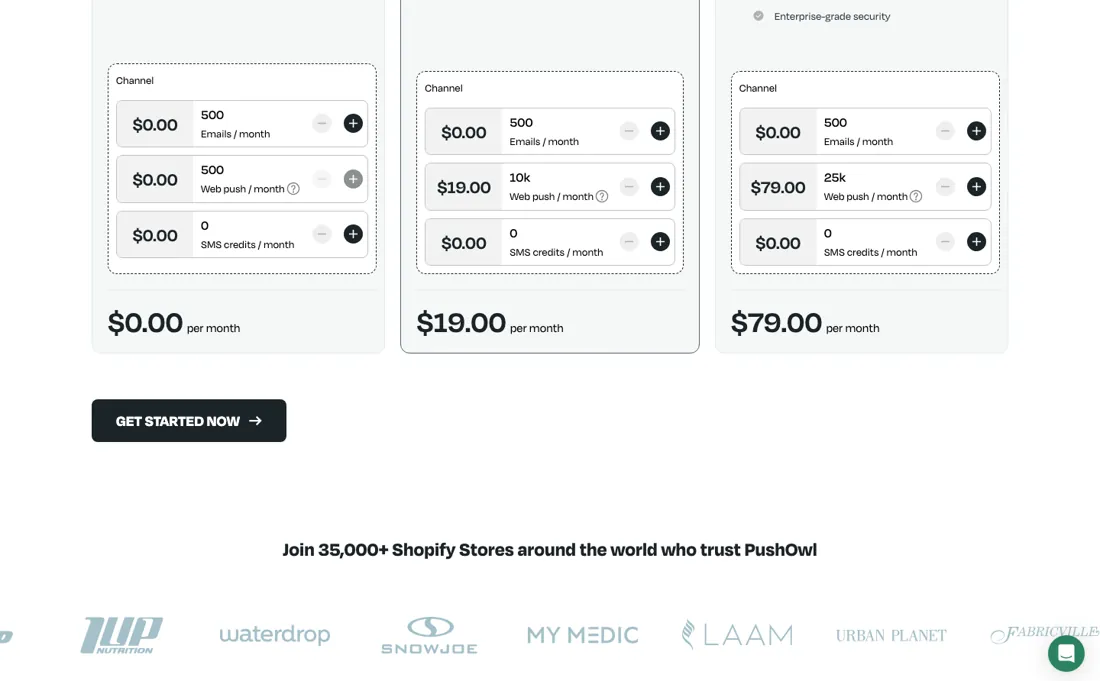
This is priced per channel and then added up, which is the part worth understanding before you compare it with anything. Each bundle sets a separate rate for email, web push and SMS, and the monthly figure is their sum. Basic is $0 and covers 500 emails and 500 web push notifications a month with no SMS credits. Plus is $19/month for 10,000 web push (10,000-30,000 band) and adds abandoned-cart automation.
Power is $79/month for 25,000 up to unlimited web push, with flash-sale and browse-abandonment triggers, segmentation and custom attribution windows. Yearly billing is advertised at 10% off, and 20% on the web push side of Plus. It is Shopify-only. Plans change — always verify the live price on their site.
Category context: Growth & Revenue. Across the 82 tools in this category that we researched with a public US-dollar price, the median entry price is about $29 a month (lowest paid plan as listed, per seat where the vendor prices per seat). PushOwl’s entry price of $19 a month sits below that median. Compare pricing conditions in the Software Cost Atlas →
PushOwl’s pricing page, as we read it
What PushOwl does
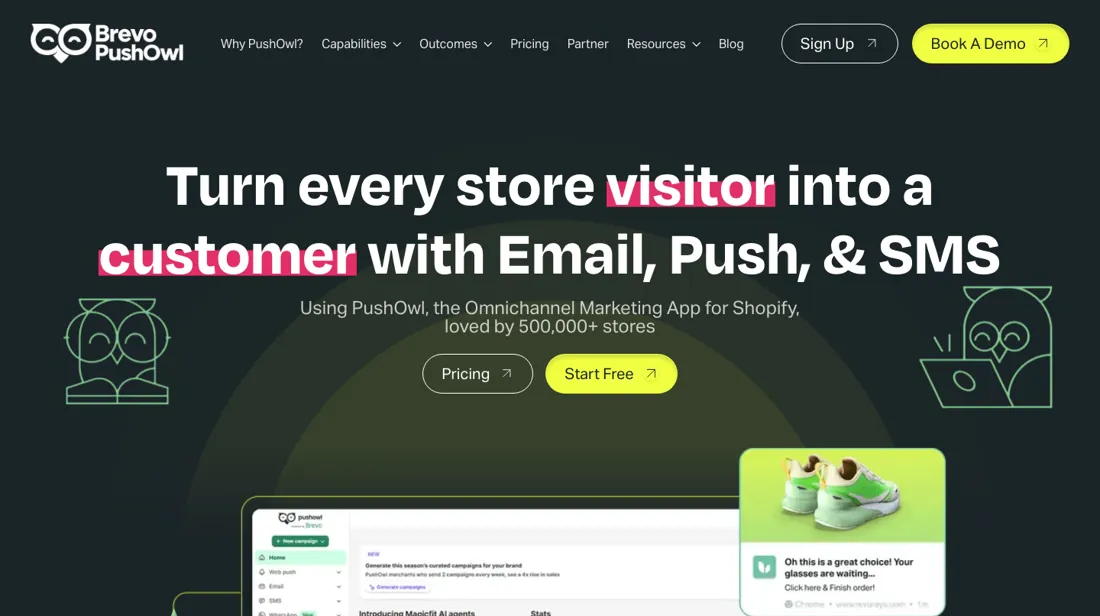
Shopify web-push and omnichannel marketing, now part of Brevo. One-click push lets stores re-engage shoppers who never leave an email — recovering abandoned carts and browsing sessions — then layer in email, SMS and WhatsApp on Brevo's deliverability stack. Usage-based pricing: you pay for what you send, not list size.
What buyers report about PushOwl
Recurring themes from the buyer-review sites listed at the foot of this page, read in August 2026. We have not run PushOwl ourselves, so this is other buyers' experience rather than ours. We summarise it here because the complaints are usually the part a vendor page leaves out.
- • 4.8 out of 5 across 2,030 Shopify App Store reviews (read 24 August 2026), with a genuinely free tier. Abandoned cart and back-in-stock are the automations merchants say pay for it.
- • No email address and no mobile app needed — the subscriber opts in from the browser, which is why the list builds faster than email.
- • Push attribution is inconsistent, so proving what it earned you is harder than it should be.
- • Targeting cannot segment by pages visited, and there is no detailed analytics dashboard.
- • Advanced segmentation and flash-sale triggers sit on the highest paid bundle, and removing the branding needs a paid tier too.
- • Results trail email and SMS. Treat it as an extra channel, not a replacement.
When the paid plan is worth it
PushOwl's free Basic Bundle covers stores sending up to 500 web push notifications and 500 emails a month with unlimited subscribers, which is enough for a small or early-stage Shopify store testing push and newsletter campaigns. The concrete trigger to upgrade is push volume: once notifications exceed 500/month you need the $19/month Plus Bundle (10,000-30,000 pushes) or the $79/month Power Bundle for higher volume and features like browse abandonment and segmentation.
What upgrading the push bundle does not solve is email and SMS capacity. Those run through a separate Brevo account with its own scaling: emails climb toward $300 for 250,000 sends, and SMS starts at $7.50 for 750 credits. So paying more for Power buys bigger push limits and automation, not more email or SMS volume.
Our monthly capture read this vendor's pricing page in July 2026 and again in August 2026, and the amounts were the same both times. We keep watching — the registry records what moves.
How to actually use PushOwl
Installation itself is fast. PushOwl's help center lists three steps to add the app from the Shopify App Store — go to the app listing, click Add app, then click Install App — with no verification needed to start collecting web push subscribers via the on-site opt-in prompt. The step that gates deliverable email and SMS campaigns is domain authentication: you connect a Brevo account, then add a Brevo code, DKIM record, and DMARC record to your domain's DNS.
Brevo warns this can take up to 48 hours to propagate; skipping it means mail goes out from a shared @brevosend.com address with worse deliverability, and PushOwl notes authentication has been mandatory for senders since February 1, 2024. SMS has a separate compliance step: toll-free numbers used to text US or Canadian recipients need carrier verification, which PushOwl's help center says can take up to 5 business days, and delivery is blocked until it clears.
In practice, the DNS wait and the SMS verification window are where new users stall between installing the app and sending their first fully authenticated campaign.
Distilled from PushOwl/Brevo help center and pricing docs, re-verified via WebFetch on 6 Aug 2026
The natural comparison is Klaviyo or Omnisend — the deeper Shopify email and SMS marketing platforms — PushOwl's edge is web push and a free tier that actually works; Klaviyo goes further on email flows and segmentation but costs more as you grow.
Frequently asked questions
What does PushOwl cost?
It is priced per channel and then added up, which is the part to understand before comparing it with anything. Read on 16 September 2026 on pushowl.com/pricing, where each bundle card shows three channel prices and their sum. The Basic bundle totals $0: email $0 for 500 a month, web push $0 for 500 a month, and $0 for zero SMS credits. Plus totals $19.00 a month — email $0 for 500, web push $19 for 10,000, SMS $0 for none. Power totals $79.00 a month — email $0 for 500, web push $79 for 25,000, SMS $0 for none. Annual billing is advertised as “Save 10%”, with 20% off the web-push side of Plus. It is built exclusively for Shopify.
Does that monthly price include email and SMS?
Barely, and this is where “omnichannel” gets expensive. In every bundle's default configuration — free, $19 and $79 alike — the included email allowance is 500 sends a month and the SMS allowance is zero credits. The number on the card is the web-push channel's price; email and SMS are separate rates that add to it. A store that wants push plus real email volume is therefore buying two channels, and the $19 or $79 is only the first of them. Push is what actually scales with the tier: up to 500 notifications a month on Basic, a 10,000–30,000 band on Plus, and 25,000 to unlimited on Power. Read 16 September 2026.
What does the free bundle actually do?
More than most free tiers. At $0 it carries 500 web push notifications and 500 emails a month with no cap on how many subscribers you collect, campaign sending and scheduling, price-drop and back-in-stock automation, and basic reports. What it does not carry is the recovery automation most people come here for: abandoned-cart automation starts on Plus, while flash-sale triggers, browse abandonment, segmentation, smart delivery and custom attribution windows start on Power. Read on pushowl.com/pricing, 16 September 2026. One structural caveat before you build on it: the app is Shopify-only, so none of this travels if you change platform.
What should I weigh before buying Growth & Revenue software?
It depends on whether you have the bottleneck it solves. Small teams get the most out of this category when one clear problem is already costing real hours or revenue; buying ahead of that just adds cost and another login. Price it against the hours or lost deals it removes, not against its feature list, and start on the smallest plan that covers the job.
Is this a hands-on review of PushOwl?
This is a researched assessment, not a hands-on test — where we've used a tool ourselves, we say so explicitly. We name what each tool is good and bad at, and we earn a commission only if you sign up, at no cost to you.
- Buyer reviews on the Shopify App Store and merchant reviews, read August 2026.
- Prices read 2026-08-17 in a browser; a plain fetch returns only the feature matrix, not the bundle prices.
- A dated screenshot of that pricing page, kept on this site as the receipt.
Others in this category
Reviewed growth & revenue tools that share ground with PushOwl — comparable in what they do, not drop-in swaps:
New reviews, price changes we recorded, and the cost conditions we found. No sponsored placements. Unsubscribe anytime.
This is our researched assessment — not a paid placement. The “Visit” links on this page are affiliate links: we may earn a commission if you sign up, at no extra cost to you, and it never changes our take. How we review →