 StoreSEO Review (2026)
Transparency: the “Visit” links on this page are affiliate links — we may earn a commission if you sign up, at no extra cost to you. No vendor can pay for a better review or verdict. How we make money →
Know what an SEO app can and cannot do before you buy any tier.
Visit StoreSEO → Affiliate link — we may earn a commission if you sign up; it does not change what this page says.
Watch the 2-minute review
The video version of this review, from our YouTube channel.
Pricing (2026)
✓ Pricing re-verified 28 Sep 2026
| This tool | $14.99 | 23th cheapest of 46 |
| Cheapest | $2.99 | MX AI |
| Median | $15 | |
| Most expensive | $450 | Attribuly |
Lowest paid entry price per account a month, billed monthly, in USD, among the 46 e-commerce growth apps we have researched (read between 2026-08-19 and 2026-10-02). Only tools priced in the same unit and on the same billing are compared — not a market survey, and cheapest is not best.
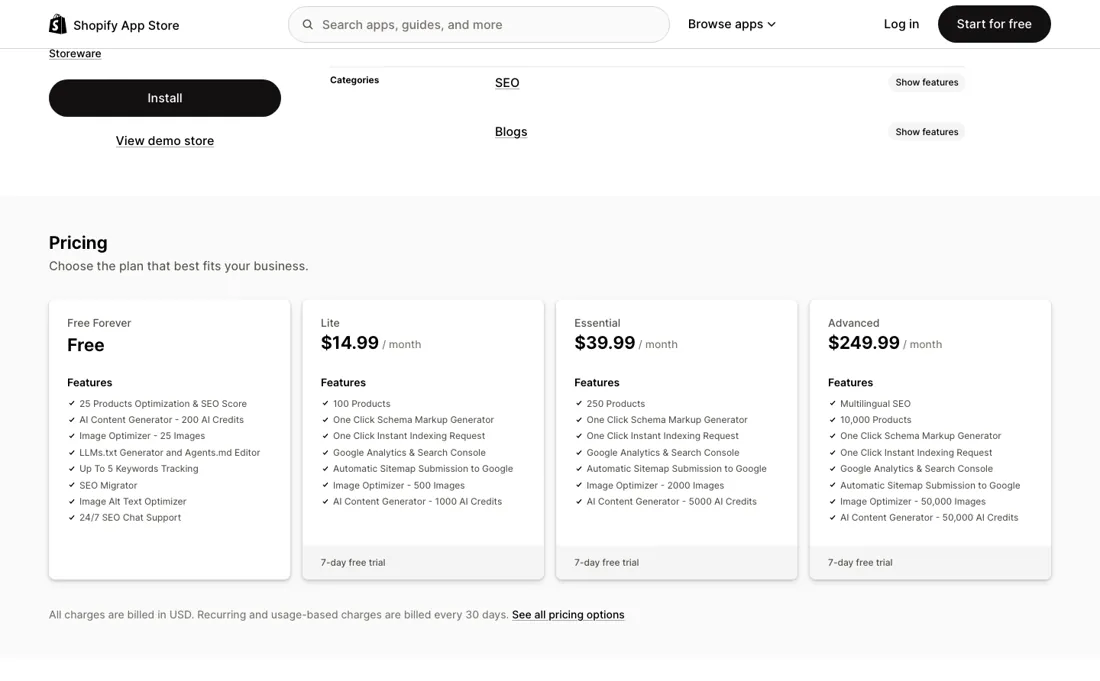
Free Forever covers 25 products with SEO scoring, 200 AI credits, 25 image optimisations, up to 5 tracked keywords, an LLMs.txt generator and Agents.md editor, an SEO migrator, alt-text optimisation and 24/7 chat support. Paid tiers are Lite $14.99, Essential $39.99 and Advanced $249.99 a month, each with a 7-day free trial. Lite covers 100 products, 500 image optimisations and 1,000 AI credits and adds one-click schema markup, instant indexing requests, Google Analytics and Search Console and automatic sitemap submission.
Essential covers 250 products, 2,000 images and 5,000 credits. Advanced covers 10,000 products, 50,000 images, 50,000 credits and adds multilingual SEO. All charges are billed in USD and recur every 30 days. Worth knowing: storeseo.com sells a Growth plan at $99.99 a month (1,000 products, 5,000 images, 12,500 AI credits, 200 keywords) that does not appear on the App Store listing at all, and also sells credit top-ups from $10 for 5,000 credits, $50 for 25,000 and $100 for 50,000.
Rating 5.0 from 753 App Store reviews on 28 September 2026 (751 on 19 September, 674 on 19 August). Developer Storeware, Milton, Delaware; the app launched 19 October 2021 and carries Shopify's “Built for Shopify” badge. Plans change — always verify the live price on their site.
What the price did
We capture StoreSEO’s own pricing page every month and keep the figures, so this is our record of the page — not a forecast, and not someone else’s summary.
The listing ladder has not moved across 19 August, 19 September and 28 September 2026: Lite $14.99, Essential $39.99 and Advanced $249.99 a month for 100, 250 and 10,000 products. The $99.99 Growth plan (1,000 products) is still sold only on storeseo.com. The one addition we saw on 28 September is a third credit top-up, 50,000 credits for $100, next to the $10 and $50 packs.
What the pricing page doesn’t say
This one fixes the mechanical layer well — meta titles and descriptions in bulk, alt text, compressed images, JSON-LD, sitemaps, indexing requests — and none of that creates demand for products nobody is searching for. It is maintenance, not marketing, and on a catalogue of 25 products the free tier already does most of it. Two specifics worth a raised eyebrow. The pricing gap between Essential at $39.99 for 250 products and Advanced at $249.99 for 10,000 is filled by a $99.99 Growth plan.
That plan lives on the vendor's own site but not on the App Store listing our link points to, which is a strange place to hide a tier. And the AEO/GEO features — the LLMs.txt generator, the Agents.md editor, the separate “agentic” ranking — are a bet, not a channel. No major search or AI vendor has committed to reading llms.txt, so treat those numbers as a hypothesis you are testing rather than traffic you are buying.
What StoreSEO does
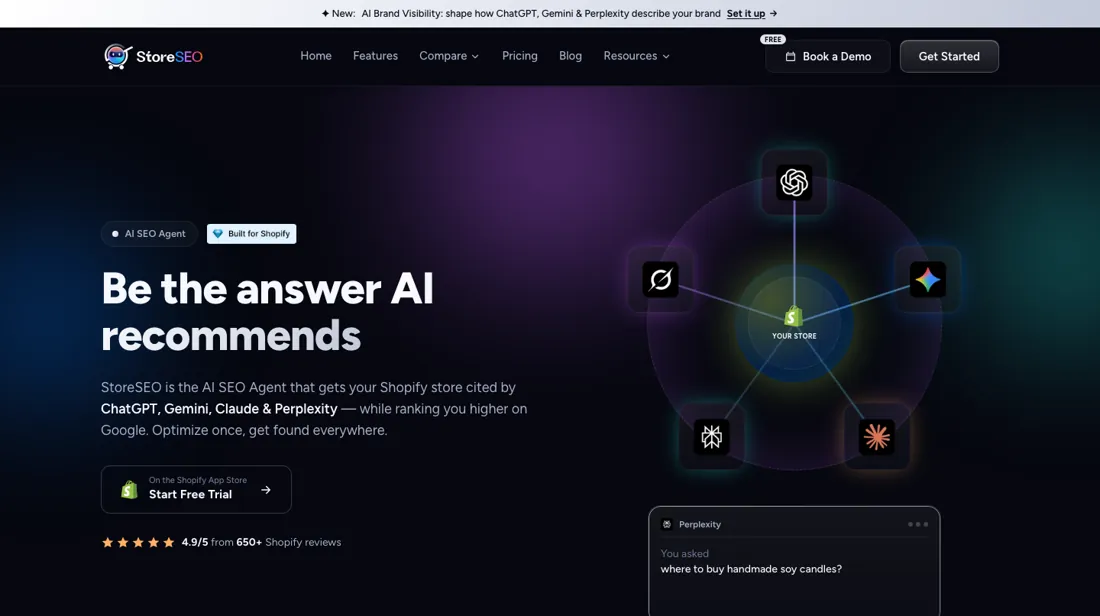
SEO suite for Shopify: bulk meta titles and descriptions, image compression and alt text, JSON-LD schema, sitemap submission, instant indexing requests and Search Console reporting, with AI credits for generated copy.
What buyers report about StoreSEO
Recurring themes from the buyer-review sites listed at the foot of this page, read in August 2026. We have not run StoreSEO ourselves, so this is other buyers' experience rather than ours. We summarise it here because the complaints are usually the part a vendor page leaves out.
- • Support is the most-named strength, with merchants crediting individual agents by name for walking them through the whole setup.
- • Bulk work is what merchants say they bought it for: product titles, descriptions and image alt text handled across the catalogue at once.
- • The app shows exactly what it intends to change before anything is applied, which reviewers call out as the reason they trusted it on a live store.
- • Scoring and recommendations put the mechanical SEO problems on one screen, including meta title length and missing tags, which merchants without a technical background say they could act on.
- • The sharpest complaint is that paid AI credits were spent on meta descriptions that ran past the length limit and pushed the store's own SEO score down.
- • One merchant reports a $68 charge they did not expect and did not feel they had agreed to, and describes the recurring monthly billing as unclear.
- • Merchants raising credit-consumption problems say support did not respond to them, which is the opposite of the setup experience the positive reviews describe.
- • Despite the automation promise, some reviewers say they still ended up optimising products one at a time.
Where the ratings disagree. Both sides of this come from the same platform, and that is the point: the listing surfaces the praise first, and the complaints only appear once you filter the reviews down to the low ratings. The two groups are also describing different phases — the praise is about setup and support, the complaints are about what the paid AI credits produced afterwards. Worth filtering yourself before you buy credits rather than after.
Pages read (August 2026): Shopify App Store
When the paid plan is worth it
The ladder is a product counter, and that is the whole decision. Free stops at 25 products, Lite at 100, Essential at 250 and Advanced at 10,000. Almost every feature that matters arrives at Lite — schema markup, instant indexing, Search Console and Analytics, automatic sitemap submission — and the only capability added higher up is multilingual SEO on Advanced. Everything else you are buying is allowance. Which makes the gap in the middle the thing to notice.
On the App Store listing the step from Essential to Advanced is 250 products to 10,000 products and $39.99 to $249.99: six times the money. On StoreSEO's own site there is a Growth plan at $99.99 covering 1,000 products that fills exactly that gap, and it is not on the listing we link to. If your catalogue is between 250 and 1,000 products, that missing tier is the difference between paying $99.99 and paying $249.99, so ask for it by name.
The AI credits are the second meter and they behave differently: they top up separately at $10 for 5,000 or $50 for 25,000, so running out of credits does not force a plan upgrade. Price the top-up against the next tier before you climb. At the bottom, the free tier is unusually complete for 25 products — real SEO scoring, alt text, the migrator — so a small catalogue can genuinely stay there.
The 7-day trial on paid plans is the right length to bulk-optimise once and see whether anything moves.
How to actually use StoreSEO
Run the free tier on your 25 best-selling products first and read the SEO score before you change anything — if it is already clean, the paid tiers are buying you scale you do not need. When you do upgrade, do the bulk pass once and then leave it alone: the value here is the first sweep across meta titles, alt text and image weight, and re-running it weekly changes nothing except your credit balance.
Connect Search Console on day one, because the only honest measure of whether any of this worked is impressions on the pages you touched, not the app's own score. Watch the two meters separately — products decide your plan, AI credits top up on their own at $10 for 5,000 — so do not upgrade a tier because you ran out of credits. And if your catalogue sits between 250 and 1,000 products, ask them about the $99.99 Growth plan on their site before you accept the $249.99 tier the listing offers.
Distilled from apps.shopify.com/storeseo and storeseo.com, read 19 August 2026; listing and the storeseo.com pricing section (plans, comparison, top-ups) re-read 28 September 2026 by plain fetch.
Frequently asked questions
What does StoreSEO cost?
Re-read on apps.shopify.com/storeseo on 19 September and again on 28 September 2026, with every amount and allowance unchanged since 19 August. Free Forever covers 25 products, 200 AI credits, 25 image optimisations and up to 5 tracked keywords. Lite is $14.99 a month for 100 products, 500 images and 1,000 credits, and is where schema markup, instant indexing, Google Analytics and Search Console and automatic sitemap submission arrive. Essential is $39.99 for 250 products, 2,000 images and 5,000 credits. Advanced is $249.99 for 10,000 products, 50,000 images and 50,000 credits, and adds multilingual SEO. The paid tiers carry a 7-day trial and bill in USD every 30 days.
Why is there such a jump from $39.99 to $249.99?
Because the tier that fills the gap is not on the Shopify listing. storeseo.com sells a Growth plan at $99.99 a month covering 1,000 products, 5,000 images, 12,500 AI credits and 200 keywords, and on 28 September 2026 it still appears nowhere on the App Store page. If your catalogue sits between 250 and 1,000 products, that omission is the difference between $99.99 and $249.99 a month, so ask for the plan by name rather than accepting the step the listing offers you.
What do I do when the AI credits run out?
Top them up rather than upgrading. Credits are a second meter that behaves differently from the product count: the vendor sells 5,000 for $10, 25,000 for $50 and 50,000 for $100 on its own site, so an empty credit balance is a $10 problem and not a reason to move up a tier. Keep the two apart when you size a plan -- your product count decides which rung you are on, and credits are consumable on top of it.
Will this actually get me more traffic?
It fixes the mechanical layer and nothing beyond it: meta titles and descriptions in bulk, alt text, compressed images, JSON-LD, sitemaps and indexing requests. That is maintenance rather than marketing, and it cannot create demand for products nobody searches for. Connect Search Console on day one and judge the app on impressions for the pages you touched, not on the score it gives itself. One caveat on the newest features: the LLMs.txt generator and the Agents.md editor are a bet on a standard no major search or AI vendor has committed to reading, so treat them as a hypothesis you are testing rather than a channel you are buying.
What should I weigh before buying SEO & Marketing software?
Judge it on evidence rather than adjectives. Look for a published security page, single sign-on and role controls on the plan you would actually buy (they are often gated to higher tiers), a status page with real incident history, and a clear answer on where your data is stored. If the tool will hold anything sensitive, those four answers matter more than any feature comparison.
Is this a hands-on review of StoreSEO?
This is a researched assessment, not a hands-on test — where we've used a tool ourselves, we say so explicitly. We name what each tool is good and bad at, and we earn a commission only if you sign up, at no cost to you.
- Buyer reviews on the Shopify App Store listing, positive and low-rated reviews read separately, read August 2026.
- Read 2026-08-19 on apps.shopify.com/storeseo, re-verified unchanged 2026-09-28.
- A dated screenshot of that pricing page, kept on this site as the receipt.
Others in this category
Reviewed seo & marketing tools that share ground with StoreSEO — comparable in what they do, not drop-in swaps:
New reviews, price changes we recorded, and the cost conditions we found. No sponsored placements. Unsubscribe anytime.
This is our researched assessment — not a paid placement. The “Visit” links on this page are affiliate links: we may earn a commission if you sign up, at no extra cost to you, and it never changes our take. How we review →