 SEOmatic Review (2026)
Transparency: the “Visit” links on this page are affiliate links — we may earn a commission if you sign up, at no extra cost to you. No vendor can pay for a better review or verdict. How we make money →
This app is eleven years old and has 151 reviews (28 September 2026; it was 114 in August).
Visit SEOmatic → Affiliate link — we may earn a commission if you sign up; it does not change what this page says.
Watch the 2-minute review
The video version of this review, from our YouTube channel.
Pricing (2026)
✓ Pricing re-verified 28 Sep 2026
| This tool | $15 | 24th cheapest of 46 |
| Cheapest | $2.99 | MX AI |
| Median | $15 | |
| Most expensive | $450 | Attribuly |
Lowest paid entry price per account a month, billed monthly, in USD, among the 46 e-commerce growth apps we have researched (read between 2026-08-19 and 2026-10-02). Only tools priced in the same unit and on the same billing are compared — not a market survey, and cheapest is not best.
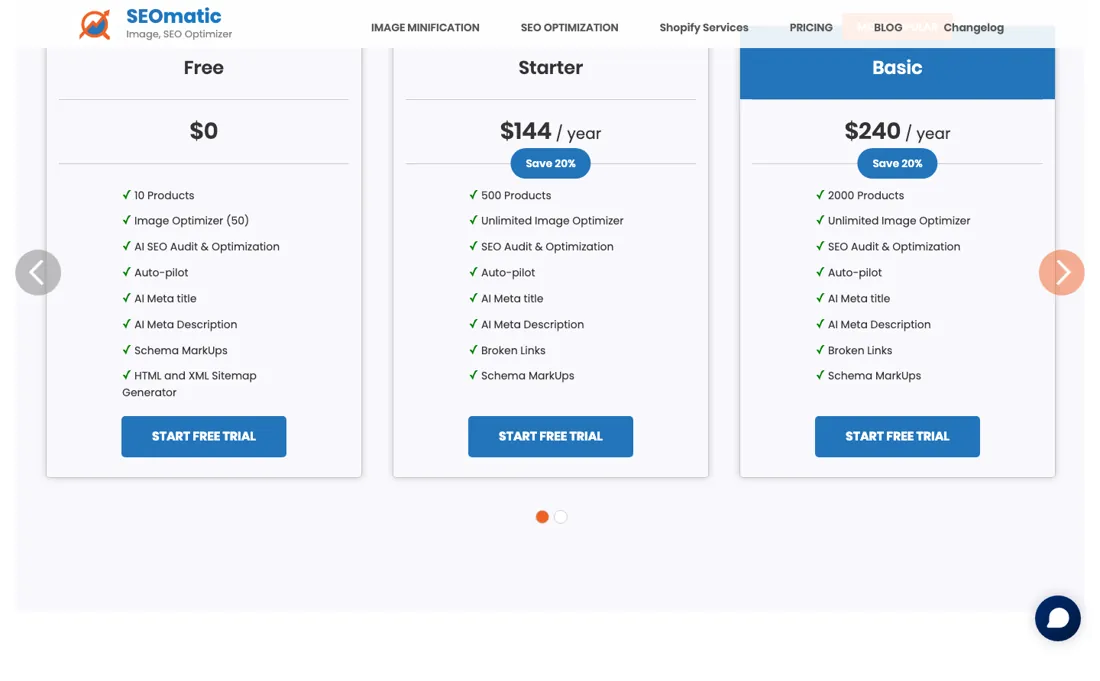
Four tiers, and the only thing that changes between the three paid ones is how many products they cover. Free: 10 products, 50 image optimisations, AI SEO audit, auto-pilot AI meta title and description, schema markup, HTML sitemap. Starter $15 a month or $144 a year (save 20%): 500 products, unlimited image optimiser, broken links, XML and HTML sitemaps, 14-day free trial.
Basic $25 a month or $240 a year: 2,000 products. Advanced $40 a month or $384 a year: 5,000 products. All charges are billed in USD and recur every 30 days. The vendor's own pricing page at seomatic.io publishes the identical ladder, which is worth noting because the two often disagree — here they do not. There is no plan above 5,000 products on either page, so a larger catalogue has no listed price at all.
Developer Aheadworks, 12495 S Parkland Bay Trail, Parkland, Florida; the app launched 18 August 2015 and carried a 4.4 average over 114 App Store reviews on 19 August 2026 and 4.4 over 151 on 28 September, and it holds Shopify's 'Built for Shopify' badge. Plans change — always verify the live price on their site.
What the price did
We capture SEOmatic’s own pricing page every month and keep the figures, so this is our record of the page — not a forecast, and not someone else’s summary.
No price movement in our readings of 19 August, 19 September and 28 September 2026: Starter $15 a month or $144 a year, Basic $25 or $240 and Advanced $40 or $384, for 500, 2,000 and 5,000 products, with the free plan at 10 products. What did move is the review count, from 114 to 151 at a steady 4.4.
What the pricing page doesn’t say
That is the number to sit with. On the same listing page Shopify shows three direct rivals. On 28 September 2026 SEOLab stood at 4.9 over 2,752 reviews, TinySEO at 5.0 over 2,518 and Smart SEO at 5.0 over 956; in our August reading SEOLab was free, Tiny SEO free to install and Smart SEO had a free plan. All three carry between six and eighteen times the review volume, all are rated higher, and none of them charges by product count.
SEOmatic's 4.4 is a real rating from real merchants, but it is the weakest track record on its own page. The distribution behind that 4.4 matters too: 81% five stars against 7% one star, with almost nothing in the middle. The most substantial recent review, from March 2025, is a merchant of six months saying it appears to work on images and nothing else, and that support is difficult and slow.
The vendor replied that the reports do exist, and asked them to get in touch. An older one-star from a merchant who lasted seventeen minutes reads 'Paid for it to tell me 0% savings'. Both are about the same thing — what the app actually did after installation was not visible to the person paying for it. And the product cap is a hard ceiling, not a soft one. There is no tier above 5,000 products on the listing or on seomatic.io, so if your catalogue is larger than that, the published ladder simply does not have a row for you.
What SEOmatic does
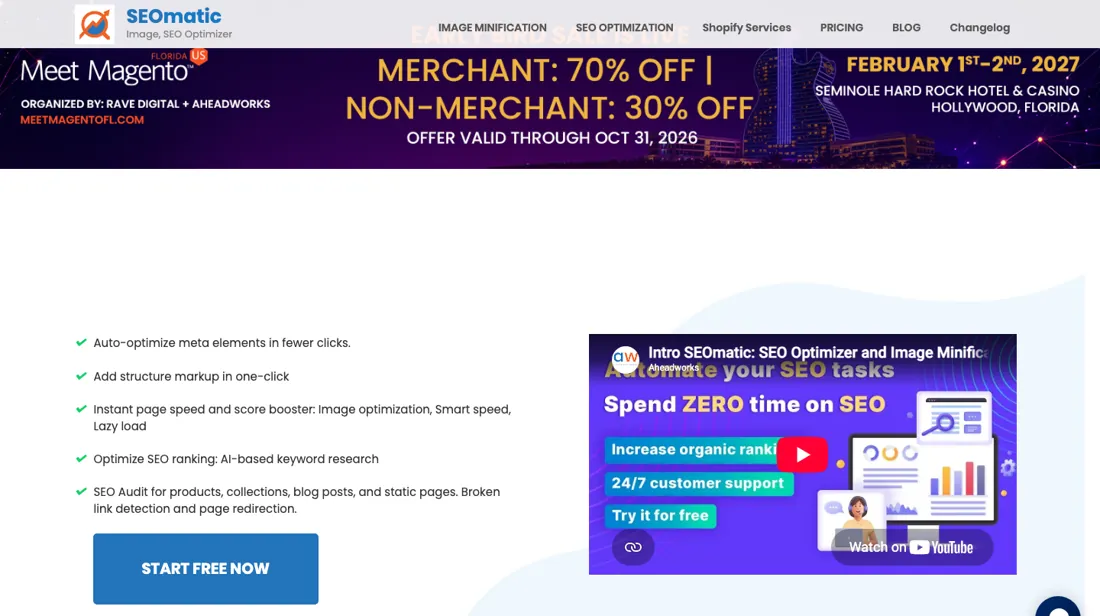
SEO suite for Shopify from Aheadworks: unlimited image compression with alt text, AI-generated meta titles and descriptions, SEO audit, schema markup and both XML and HTML sitemaps. Live since 2015.
What buyers report about SEOmatic
Recurring themes from the buyer-review sites listed at the foot of this page, read in August 2026. We have not run SEOmatic ourselves, so this is other buyers' experience rather than ours. We summarise it here because the complaints are usually the part a vendor page leaves out.
- • Recent reviewers rate the AI store audit: a Spanish merchant in October 2024 says the whole audit ran in a short sitting and read professionally.
- • Support is praised in the newer reviews, including by merchants on the free plan — a February 2024 reviewer notes they were helped despite paying nothing.
- • The original image-compression job is what the long-tenured five-stars are about, and they are short and consistent: it did what it said, it was cheap, it was simple.
- • The savings promise is the oldest and sharpest complaint. Multiple reviewers paid for compression advertised around 30% and measured about 12% afterwards — one spent over $110 for that result, another was told 0% savings after paying. Those reviews date from 2016-2017.
- • Damage that cannot be undone: a December 2021 reviewer paid $18.21 and describes hundreds of product photos coming back blurry, pixelated and discoloured with no reversal, and having to re-upload the originals. The vendor's reply points to a 30-day backup.
- • A December 2015 reviewer says the app removed all 725 images from their catalogue and broke the site.
- • Support latency recurs across years: a 2017 reviewer waited over a week with no reply, a 2020 reviewer got no help at all, and a March 2025 reviewer — six months into using it — calls support difficult and slow.
- • A March 2025 reviewer says it appears to work on images and nothing else, and that they see no reporting beyond what was done to the images. That is worth weighing against the app's current positioning as a full SEO optimizer.
- • A 2018 reviewer found the auto-generated alt text worse than their own and had to override each proposal manually.
Where the ratings disagree. The 4.4 across 114 reviews averages two different products. The listing began life as Minifier, an image-compression app, and nearly all of the nine one-stars come from that era and are about compression falling short of the advertised savings or damaging photos. The reviews from 2024 onward are about an AI SEO audit and are largely positive. Read the old reviews for how the vendor handles a merchant whose images came back worse, and the new ones for what the current product does — averaging them tells you about neither.
Pages read (August 2026): Shopify App Store
When the paid plan is worth it
Read the four feature lists side by side and the ladder collapses into one number: 500, 2,000, 5,000 products. Unlimited image optimisation, the SEO audit, auto-pilot meta titles and descriptions, broken-link detection, schema markup and both sitemap generators are on Starter and stay exactly the same on Basic and Advanced. You are not buying capability at $25 or $40, you are buying catalogue size. So the tier is picked for you by your product count, and the only real decision is Free versus Starter.
Free stops at 10 products and 50 image optimisations, which is a demonstration rather than a plan — enough to see what the audit flags on a handful of products, not enough to run a store on. The moment you have a real catalogue you are at $15. The annual option is the one place there is money on the table: $144 against $180 for twelve months of Starter, $240 against $300, $384 against $480.
The vendor's site frames the same discount as 'two months free with annual billing'; on the numbers it is closer to two and a half. Either way it is a fifth off for committing a year to an app whose paid trial is fourteen days.
How to actually use SEOmatic
Install on Free first and point it at ten products you know well — that is exactly what the free tier is for, and it is the only way to see whether the audit tells you anything you did not already know. Look specifically for the reporting. The recurring complaint in the reviews is that merchants could not see what the app had done, so before you pay, find the screen that lists the changes it made and check that it names products and fields, not just image counts.
Turn auto-pilot meta titles and descriptions on for a small collection rather than the whole catalogue, then look at those pages in Google Search Console a fortnight later; auto-generated meta descriptions are the setting most likely to be rewritten by Google anyway. Count your products before you pick a tier, because the tier is nothing but the product cap. Take the 14-day trial on Starter before committing to the annual price: a fifth off is only a saving if the app is still installed in month three.
Distilled from apps.shopify.com/minifier and seomatic.io, read 19 August 2026; listing and the seomatic.io pricing section re-read 28 September 2026 by plain fetch (plans, rating block, similar-apps panel).
Frequently asked questions
What does SEOmatic cost?
Four tiers, re-read on apps.shopify.com/minifier on 19 September and 28 September 2026 and unchanged since 19 August. Free covers 10 products and 50 image optimisations. Starter is $15 a month or $144 a year, a 20% saving, for 500 products. Basic is $25 or $240 for 2,000. Advanced is $40 or $384 for 5,000. The paid tiers carry a 14-day free trial and all charges are billed in USD every 30 days. seomatic.io publishes the identical ladder, which is worth saying because a listing and a vendor page disagree more often than not -- here they do not.
What do I get for $25 or $40 that $15 does not include?
Headroom, and nothing else. Put the three paid feature lists side by side and they are the same list: unlimited image optimiser, SEO audit and optimisation, auto-pilot, AI meta title and description, broken links, schema markup and both sitemap generators. The only thing that changes across them is the product cap -- 500, 2,000, 5,000. Your catalogue size picks your tier, so there is no capability decision to make and no reason to buy ahead of your product count.
Is the free plan enough to judge the app?
It is a demonstration rather than a plan: 10 products and 50 image optimisations is enough to point the audit at ten products you know well and see whether it tells you anything you did not already know. Use it to check one thing in particular. The recurring complaint from merchants is not being able to see what the app changed, so find the screen that lists its actions and confirm that it names products and fields rather than just counting images. If that screen does not convince you on ten products, it will not convince you on five hundred.
What if my catalogue is larger than 5,000 products?
Then there is no published price for you. The listing stops at Advanced, and seomatic.io’s own ladder stopped at the same 5,000-product cap when we read the two side by side on 19 August 2026; the listing is unchanged on 19 and 28 September, and seomatic.io still stops at the 5,000-product Advanced tier on 28 September. Neither page offers a quote route above it. Ask the developer -- Aheadworks -- what happens when a catalogue crosses that cap before you install, because nothing published answers it.
What should I weigh before buying SEO & Marketing software?
Judge it on evidence rather than adjectives. Look for a published security page, single sign-on and role controls on the plan you would actually buy (they are often gated to higher tiers), a status page with real incident history, and a clear answer on where your data is stored. If the tool will hold anything sensitive, those four answers matter more than any feature comparison.
Is this a hands-on review of SEOmatic?
This is a researched assessment, not a hands-on test — where we've used a tool ourselves, we say so explicitly. We name what each tool is good and bad at, and we earn a commission only if you sign up, at no cost to you.
- Buyer reviews on the Shopify App Store listing, read August 2026.
- Read 2026-08-19 on apps.shopify.com/minifier and on seomatic.io, re-verified unchanged on both 2026-09-28.
- A dated screenshot of that pricing page, kept on this site as the receipt.
Others in this category
Reviewed seo & marketing tools that share ground with SEOmatic — comparable in what they do, not drop-in swaps:
New reviews, price changes we recorded, and the cost conditions we found. No sponsored placements. Unsubscribe anytime.
This is our researched assessment — not a paid placement. The “Visit” links on this page are affiliate links: we may earn a commission if you sign up, at no extra cost to you, and it never changes our take. How we review →