 Seel Review (2026)Free Plan Stays Shopper-Paid, $99 for the AI
Two things to weigh, and neither is the price you pay — because you do not pay one.
Visit Seel → Affiliate link — the rest of this page is the honest version, including who should skip it.
Watch the 2-minute review
Same honest take, in video form — from our YouTube channel.
⚡ Short on time? Watch the 30-second verdict Short.
Pricing (2026)
✓ Pricing re-verified 7 Sep 2026
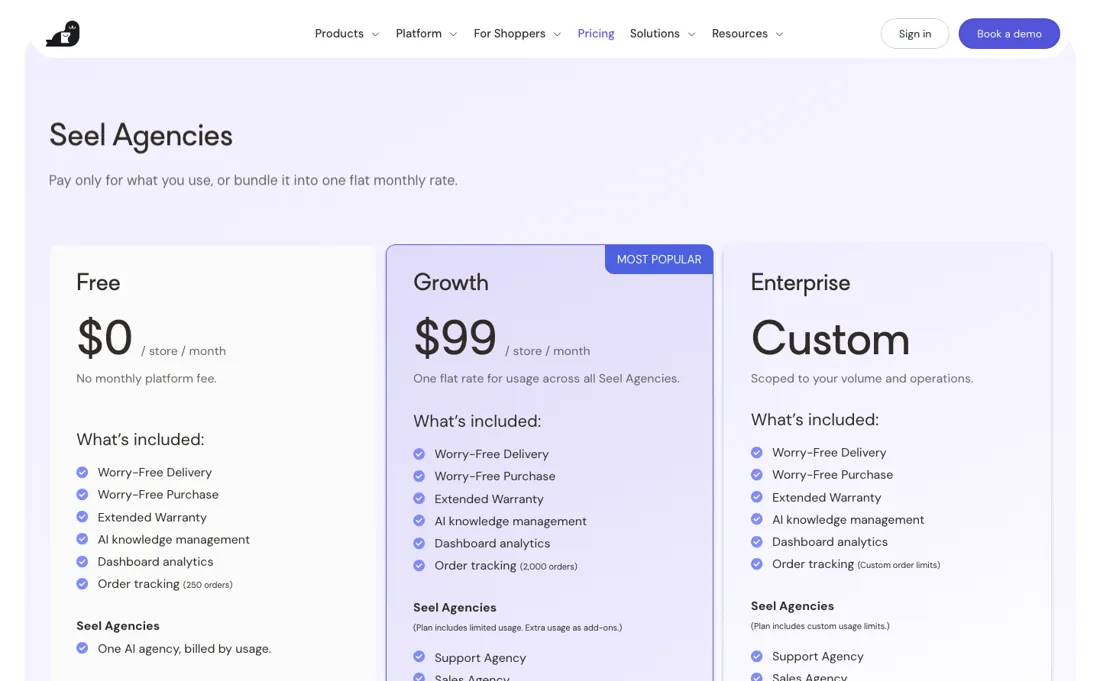
Three plans on seel.com/pricing, re-read 7 September 2026: Free at $0 per store per month (no monthly platform fee), Growth at $99 per store per month, Enterprise at custom pricing. Worry-Free Purchase (formerly Return Assurance), Worry-Free Delivery and Extended Warranty are listed as included on all three, so the returns-protection product stays shopper-paid: customers who add it pay roughly $2-$5, reported elsewhere as 3-5% of order value, set by Seel's algorithm.
The plans differ on the AI agencies. Free is pay-as-you-go for one agency at $0.99 per resolved ticket, $0.40 per listing, 3% of attributed GMV, $5 per store review and $29 per storefront regulation scan. Growth covers all five with capped usage — up to 100 resolved tickets, 100 listings, $500 attributed GMV, one Voice of Customer report (sentiment across your brand and three competitors), up to four 5-star reviews and one storefront regulation scan — and order tracking for 2,000 orders instead of 250; overage bills at the Free rate card.
Their FAQ states the subscription is fixed per store per month and that attributed GMV does not feed it. Enterprise usage scope and commercial terms sit in the merchant agreement. Insurance benefits are provided by Seel Insurance Inc. or Arch Specialty Insurance Company, with availability varying by jurisdiction and state. Plans change — always verify the live price on their site.
What the pricing page doesn’t say
First, you cannot set the fee. Seel's algorithm prices it, so if it lands too high for your niche and shoppers stop opting in, your only lever is switching the feature off entirely. Second, the charge appears on your checkout, not Seel's: shopper-side complaints filed with the BBB describe the fee arriving in the cart with the opt-out easy to miss, and that lands on your brand. Test it as a customer before you enable it.
Also check the platform list — Shopify, BigCommerce and Adobe Commerce only, with no WooCommerce, Wix or custom storefront support.
What Seel does
Shopper-paid returns and shipping protection for Shopify, BigCommerce and Adobe Commerce. Customers add Worry-Free Purchase at checkout and Seel pays the refund instead of you — free for the merchant.
What buyers report about Seel
Recurring themes from the buyer-review sites listed at the foot of this page, read in August 2026. We have not run Seel ourselves, so this is other buyers' experience rather than ours. We summarise it here because the complaints are usually the part a vendor page leaves out.
- • Merchants report conversion lifting by roughly 5% on average once Return Assurance is offered, and shoppers take it 24% of the time — far above the usual attach rate for a B2C add-on.
- • Merchant-side ratings run high: the Shopify App Store listing carries a strong average, and merchants point at the assurance flow paying for itself.
- • You cannot set the fee. Seel's algorithm prices it, so if the fee lands too high for your niche and customers stop opting in, there is no lever to pull.
- • Shopper-side complaints filed with the BBB describe the charge appearing in the cart with the opt-out easy to miss. That lands on your checkout, not Seel's.
- • Direct customer ratings run lower than the merchant-side ones: 3.8 out of 5 across 63 SmartCustomer reviews (read 25 August 2026), against 4.4 out of 5 across 7,845 on Trustpilot.
Where the ratings disagree. The Shopify App Store rating is merchants rating a revenue tool; the consumer-facing ratings are shoppers rating a charge they did not expect. Both are real, and only one of them is your customer.
Worry-Free Purchase stays free to you; $99 is for the AI agencies
Correction, 3 September 2026: when we verified Seel on 2 August 2026 the pricing page showed no plans and no rate card, and we said so in the title. It now shows three — Free at $0 per store per month, Growth at $99 per store per month, Enterprise at custom — plus a per-unit rate card for the AI agencies: $0.99 per resolved ticket, $0.40 per listing, 3% of attributed GMV, $5 per store review, $29 per storefront regulation scan.
Worry-Free Purchase, Worry-Free Delivery and Extended Warranty are listed under what's included on all three plans, and Free still says no monthly platform fee, so our reading is that the returns-protection product itself stays shopper-paid and free to the merchant; we have asked Seel to confirm that in writing and will update this line when they do. Customers who add Worry-Free Purchase pay roughly $2 to $5, reported elsewhere as 3-5% of order value, and Seel's own algorithm sets the figure.
What the $99 buys is not the protection but the agencies, and the difference between the two paid routes is breadth rather than volume. Their FAQ is explicit: Free is pay-as-you-go for ONE agency, and Growth gives you all five under the flat rate, with capped usage — up to 100 resolved tickets, 100 listings, $500 attributed GMV, one Voice of Customer report, four 5-star reviews and one storefront regulation scan — plus order tracking for 2,000 orders instead of 250.
Go over any cap and the overage bills at exactly the Free rate card, so the $99 is a bundle discount, never a ceiling on what you can be charged. It is also fixed: they confirm that attributed GMV is a Sales Agency usage metric and does not feed the subscription price. The $2-to-$5 shopper fee and the 3-5% description are worth reconciling, because together they tell you where the fee sits comfortably.
A $2 floor at 5% implies a $40 order; a $5 charge at 3% implies about $167. Between roughly $40 and $170 the two descriptions agree. Below that they do not: $2 on a $30 basket is 6.7%, above the stated range, and it will read as a large addition on a small order. If your average basket is under about $40, look hard at what your own shoppers are being shown.
Since the price to you is zero, the only honest way to evaluate the protection is as a conversion experiment rather than a purchase. The cost you carry is not money, it is the risk that an extra line item at checkout loses you completed orders — and that is measurable. Run it on part of your traffic and read completed checkouts, not opt-in rate. A high opt-in rate on a shrinking number of orders is a loss dressed as adoption.
Three constraints before any of that, and paying for a bigger plan fixes none of them. You cannot set the fee, so if the algorithm prices it too high for your niche and shoppers stop opting in, your only lever is switching the feature off — there is no dial on any tier. The charge appears on your checkout, under your brand: shopper complaints filed with the BBB describe the fee arriving in the cart with an opt-out that is easy to miss, and that reputational cost lands on you rather than on Seel.
And the cover is an insurance product underwritten by third parties, which the page's own footer says may not be available in every jurisdiction — eligibility and carrier participation vary by state, so some of your customers may not be offered it at all. Go through your own checkout as a customer, on a phone, before you leave it live. Platform support is Shopify, BigCommerce and Adobe Commerce only — no WooCommerce, Wix or custom storefronts.
How to actually use Seel
Buy something from your own store first, on a phone, with the feature switched on. That is the whole evaluation in one step: you are looking at how prominently the fee appears, how obvious the opt-out is, and whether the wording reads as your brand's or as a third party's. Shopper complaints about this product are about the checkout experience, not the coverage, and the checkout is yours. Then run it as a split rather than a switch.
Because there is no merchant fee, the only cost you can incur is a conversion one, so the number to watch is completed checkouts on the half that sees the offer against the half that does not. Opt-in rate on its own tells you nothing about whether the feature is paying for itself. Confirm two facts before you commit to it in your flow. You cannot set or cap the fee — the algorithm does, and your only control is on or off.
And check your platform: Shopify, BigCommerce and Adobe Commerce are supported, WooCommerce, Wix and custom storefronts are not.
Distilled from seel.com/pricing read on 7 September 2026. The page is served complete as HTML, so a plain fetch is enough and no browser controls needed operating; the three plan cards, the 'Compare plans' matrix beneath them, the asterisked footnotes and the FAQ were all read from that one document. The matrix is where the breadth difference lives — Free reads 'Pay-as-you-go usage for one AI agency' while Growth reads 'Includes capped usage for all AI agencies' — and the FAQ confirms it in words ('If you already know which agency you want to test, Free is the lowest-commitment way to start... Growth gives you access to all five'). The same FAQ supplies the overage rule (extra usage billed at the Free plan's per-unit rates), the statement that the subscription is fixed per store per month and that attributed GMV does not feed it, and the Enterprise distinction. Two footnotes matter: a Voice of Customer report is multi-channel sentiment tracking across your brand and three competitors, and Enterprise scope and commercial terms are documented in the merchant agreement rather than on the page. One slip to be aware of on a re-read: the page twice names a plan that does not exist on it, saying 'Starter plan pricing applies for additional usage' in the matrix and 'the per-unit Starter rate' in the FAQ, where the other copy on the same page says Free — the rate card is the Free one either way. The underwriting and jurisdiction wording sits in the page footer rather than in the plan cards, so a reading of the pricing table alone misses it. Not re-sourced in this reading and carried over from earlier rounds: the $2-$5 shopper fee and the 3-5% description, the BBB complaints about the checkout presentation, and the platform list (Shopify, BigCommerce, Adobe Commerce), none of which appear on the pricing page.
The natural comparison is Redo — the other shopper-paid model, but with merchant-side workflow control Seel does not offer.
More on Seel
Everything we publish about Seel links back here — the review stays the honest hub:
The ex-banker filter — the same yardstick on every review (how we review): My ex-banker filter is simple: does Seel remove a real cost — time, errors, missed revenue — bigger than what it charges?
Frequently asked questions
What should I weigh before buying E-commerce software?
Check your platform and version specifically. Shopify support is close to universal in this category, while WooCommerce, BigCommerce, Magento and headless setups vary a lot, and 'supported' sometimes means a generic API rather than a maintained app. A listing in your own platform's app store, with recent reviews there, is a better signal than the vendor's logo wall.
Is this a hands-on review of Seel?
This is a researched assessment, not a hands-on test — where we've used a tool ourselves, we say so explicitly. We name what each tool is genuinely good and bad at, and we earn a commission only if you sign up, at no cost to you.
- Buyer reviews on the Shopify App Store, SmartCustomer and BBB complaint filings, read August 2026.
- Seel’s own published pricing page.
- A dated screenshot of that pricing page, kept on this site as the receipt.
Others in this category
Reviewed e-commerce tools that share ground with Seel — comparable in what they do, not drop-in swaps:
New dossiers, cost-traps we found, and tools that earned a keep — no hype, no sponsored-disguised-as-advice. Unsubscribe anytime.
This is our researched assessment — not a paid placement. The “Visit” links on this page are affiliate links: we may earn a commission if you sign up, at no extra cost to you, and it never changes our take. How we review →