 Zendrop Review (2026)
Transparency: the “Visit” links on this page are affiliate links — we may earn a commission if you sign up, at no extra cost to you. No vendor can pay for a better review or verdict. How we make money →
The free plan is a catalogue browser rather than a working tier: it allows no linked products, so nothing can actually be sold through it.
Visit Zendrop → Affiliate link — we may earn a commission if you sign up; it does not change what this page says.
Watch the 2-minute review
The video version of this review, from our YouTube channel.
⚡ Short on time? Watch the 30-second verdict Short.
Pricing (2026)
✓ Pricing re-verified 18 Sep 2026
| This tool | $29 | 37th cheapest of 48 |
| Cheapest | $2.99 | MX AI |
| Median | $14.50 | |
| Most expensive | $450 | Attribuly |
Lowest paid entry price per account a month, billed monthly, in USD, among the 48 e-commerce growth apps we have researched (read between 2026-08-19 and 2026-10-04). Only tools priced in the same unit and on the same billing are compared — not a market survey, and cheapest is not best.
On the Shopify listing: free to install, with three paid tiers, Beginner $29, Pro $49 and Plus $79 a month. What separates them is not features but how many products you may link to your store. The free tier allows none at all (“No linked products allowed”), Beginner covers 1-20, Pro 21-100 and Plus 101 or more; the feature list on all three paid tiers is identical (trending products, Zendrop Academy, Zendrop AI access, custom branding).
Product and shipping cost is charged per order on top of every plan, and the listing states that external charges may be billed by Zendrop separately from your Shopify invoice. All charges are billed in USD and recur every 30 days. Rating 4.6 from 1,258 App Store reviews, up from 4.5 from 1,191 on 19 August 2026; the spread is 83% five-star (1.0K), 7% four-star (92), 2% three-star (19), 1% two-star (15) and 7% one-star (84).
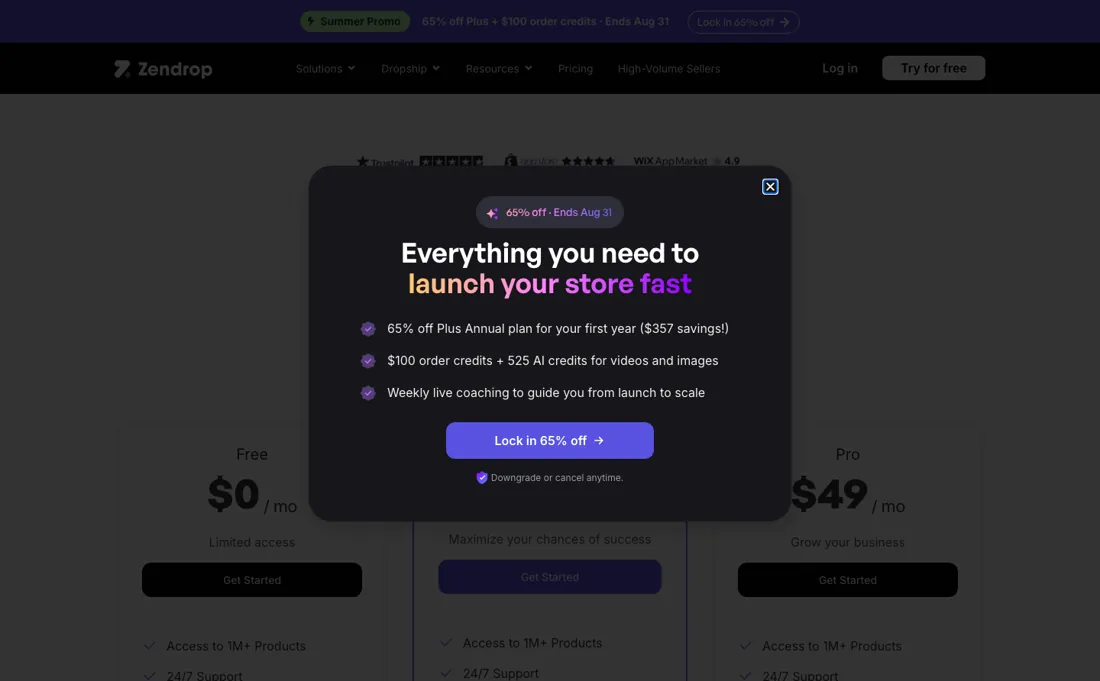
The listing does not carry Shopify's “Built for Shopify” badge. Developer Zendrop, 5499 North Federal Highway, Suite R, Boca Raton, FL, 33487, US; the app launched 4 November 2020. On zendrop.com/pricing the ladder is different: Free $0, Pro $49 a month or $399 a year, and Plus $79 a month or $549 a year, marked Most Popular. There is no $29 Beginner tier on their own site, and the annual rates appear only there — $399 is $33.25 a month and $549 is $45.75.
The Summer Promo recorded here on 19 August 2026 (65% off annual Plus for the first year, advertised as a $357 saving, plus $100 in order credits, ending 31 August 2026) is gone: the page carries no percentage-off offer at all on 18 September 2026. Their own site also lists products the App Store listing does not mention, including AI-Built Stores, an AI Ad Generator and an MCP Server for connecting AI agents to a store. Plans change — always verify the live price on their site.
Category context: E-commerce. Across the 34 tools in this category that we researched with a public US-dollar price, the median entry price is $19 a month (lowest paid plan as listed, per seat where the vendor prices per seat). Zendrop’s entry price of $29 a month sits above that median. Compare pricing conditions in the Software Cost Atlas →
What the pricing page doesn’t say
Past that you are paying for an allowance, not for capability — Beginner, Pro and Plus carry exactly the same feature list, and the only thing $79 buys over $29 is room for more than a hundred linked products. The subscription is also the smaller half of the bill: product and shipping cost lands per order on top, and Zendrop bills that separately from your Shopify invoice, so the figure you budget is not the figure you pay.
Their own pricing page and the App Store listing do not agree: the site sells Free, Pro and Plus with annual rates and no $29 tier, which means the price depends on where you sign up. And the 4.6 average covers a split verdict, with 83% five stars alongside 7% one star across 1,258 reviews — 84 people rating it bottom of the scale.
What Zendrop does
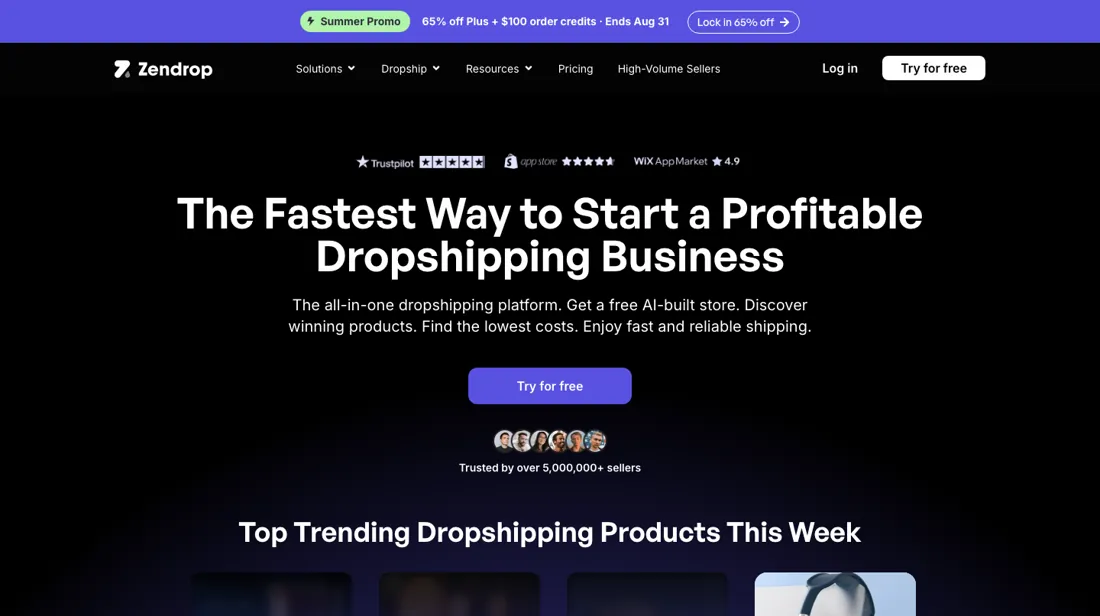
AI dropshipping and print-on-demand for Shopify: browse 1M+ products from US and global suppliers, link them to your store and let fulfilment and tracking run automatically, with custom branding, POD and 3PL as you scale.
What buyers report about Zendrop
Recurring themes from the buyer-review sites listed at the foot of this page, read in August 2026. We have not run Zendrop ourselves, so this is other buyers' experience rather than ours. We summarise it here because the complaints are usually the part a vendor page leaves out.
- • Support resolution is overwhelmingly what the positive reviews describe, and reviewers name individual agents. Several say a refund they did not expect was issued within minutes or after an agent stayed with the case for weeks.
- • Onboarding for beginners: reviewers repeatedly say the Shopify connection and product importing work without friction and that the interface is manageable for a first store.
- • Fulfilment itself gets steady credit from longer-tenured merchants — a UK store ten months in says order processing has been smooth.
- • Billing is the single biggest theme in the negative reviews, and it has a specific shape. Reviewers report that the advertised free trial charges immediately, that refunds are only available within five days of that charge, and that the cancellation path is hard to find — one June 2026 reviewer was charged for a renewal and could not locate a cancellation option at all.
- • The plan scales with how many products you link (free up to ten, then paid tiers). A June 2026 reviewer says the downgrade is behind a toggle that defaults to on, so you keep paying for products you are not selling.
- • Stock accuracy: the same reviewer built a store and ad campaign around products marked in stock, and found they flipped to out of stock at the moment of ordering a sample. Their advice — do not run ads on anything until you have successfully placed a real sample order — is the most actionable line in the negative reviews.
- • Margins: an August 2026 Shopify reviewer claims the wholesale prices on many items run $5-$10 above what the same goods retail for on Amazon or Walmart, before your margin, shipping and the $29-$79 monthly fee.
- • An August 2026 reviewer reports that installing the app published a Zendrop demo theme and deactivated their live theme on a store with paid traffic running. The vendor apologised publicly for the disruption.
- • A July 2026 reviewer was locked out for over a week by a blank white screen at login, with no way to reach support without being logged in first.
Where the ratings disagree. Two platforms, two different pictures. Trustpilot shows 4.6 across roughly 20,700 reviews with 2% one-stars; the Shopify App Store shows 4.5 across 1,197 with 79 one-stars, about 6.6%. The gap is in who writes and about what. A large share of the Trustpilot five-stars are people thanking a named agent for resolving a charge or issuing a refund — which means the volume of praise is partly a measure of how many buyers hit a billing problem in the first place. The Shopify reviews come from merchants who installed the app into a live store and write about margins, stock accuracy and the theme override. Read Trustpilot for how Zendrop handles you when something goes wrong, and the Shopify listing for what goes wrong.
Pages read (August 2026): Shopify App Store, Trustpilot
When the paid plan is worth it
Read what the free tier actually is before anything else: free to install means you may link zero products to your store. It is not a usable free plan, it is an empty account. Above that the tiers are a product allowance and nothing else — the feature list is identical on all three paid plans. Beginner at $29 covers 1 to 20 linked products, Pro at $49 covers 21 to 100, Plus at $79 covers 101 or more.
Per product at each ceiling that is about $1.45, $0.49 and under $0.78, so the middle tier is the best value per line and the step to Plus only pays once you are genuinely past a hundred. Since no feature is gated, upgrading early buys you nothing at all. Where you sign up changes the ladder. Zendrop's own pricing page has no $29 tier — just Free, Pro at $49 and Plus at $79 — and it is the only place the annual rates appear: $399 a year for Pro and $549 for Plus, which works out at $33.25 and $45.75 a month.
If you were going to run Pro for a year anyway, that is about $189 cheaper than twelve monthly charges. Neither figure is the bill. Product and shipping cost is charged per order on top of every plan, and the listing states external charges may be billed separately from your Shopify invoice, so the subscription is the smaller of the two lines you pay.
How to actually use Zendrop
Install on the free tier first and treat it as research: you can browse the full catalogue there, but you cannot link a product, so nothing ships until you are on a paid plan. Pick the tier by counting the products you actually intend to list rather than the ones you want to try, because the ladder is priced on linked products (1-20, 21-100, 101 or more) and that count is the only thing you are choosing.
Check both sign-up routes before you pay, because they are not the same ladder: the App Store listing has a $29 Beginner tier and no annual option, while zendrop.com sells Pro and Plus by the year at $399 and $549. Before committing, put the per-order product and shipping cost of your three best candidates next to your intended retail price — that number decides whether the store works, and no plan changes it.
Finally, the app bills outside your Shopify invoice, so put it in whatever you use to track subscriptions instead of expecting it to appear on the Shopify bill.
Distilled from apps.shopify.com/zendrop and zendrop.com/pricing, first read 19 August 2026 and re-read 18 September 2026 — tiers, linked-product allowances, per-order charges, review distribution and developer details from the listing; the annual rates and the absence of a Beginner tier from the vendor's own pricing page.
Frequently asked questions
What does Zendrop cost, and what is the free plan good for?
Read on apps.shopify.com/zendrop on 18 September 2026: free to install, then Beginner $29, Pro $49 and Plus $79 a month, unchanged since 19 August. The free tier is worth being blunt about — its own plan text says “No linked products allowed”, so you can browse a catalogue of a million-plus products and sell none of them. Treat it as a research account, not a starter plan, and read $29 as the real entry price. Watch the second bill too: product and shipping cost is charged per order on top of every tier, and the listing warns that external charges may be billed by Zendrop separately from your Shopify invoice. On a dropshipping app that per-order line is the larger of the two.
Is it cheaper to subscribe through Shopify or on Zendrop's own site?
They are not the same ladder, which is the part worth checking before you pay. As read on 18 September 2026, the App Store listing sells Beginner $29, Pro $49 and Plus $79 monthly with no annual option. zendrop.com/pricing has no $29 tier at all — Free, Pro $49 a month or $399 a year, Plus $79 a month or $549 a year — so the annual rates exist only there. That makes Pro about $33.25 a month bought yearly against $49 monthly, roughly $189 saved over twelve months, and Plus $45.75 against $79. If you need fewer than twenty linked products, the $29 tier only exists through the App Store; if you are committing for a year, their own site is the cheaper door.
Does a higher tier get me better features or faster fulfilment?
No, and the listing is unusually clear about it. All three paid tiers show an identical feature list — trending products, Zendrop Academy, Zendrop AI access, custom branding — and what changes is only how many products you may link: 1-20 on Beginner, 21-100 on Pro, 101 or more on Plus. Nothing about upgrading makes an order ship faster or cost less per unit. So the tier is a line-count decision, and paying for headroom you are not using buys nothing. Per product at each ceiling the rates work out at roughly $1.45, $0.49 and under $0.78, which makes Pro the best value per line and Plus worth it only once you are genuinely past a hundred products.
How good is its track record on the App Store?
It is the vendor's own sales channel rather than an independent panel, which is worth naming as a limit, and within that the record is strong but split. As read on 18 September 2026 the listing carries 1,258 reviews averaging 4.6, up from 1,191 averaging 4.5 a month earlier, so the direction is more reviews and a slightly better average. The distribution is the interesting part: 83% at the top and 7% at the bottom, which is 84 people rating it one star — an unusually heavy tail for a 4.6. That is the ordinary shape of dropshipping, where the same app is a success for someone whose margins work and a failure for someone whose supplier was slow. The listing also does not carry Shopify's “Built for Shopify” badge.
What should I weigh before buying E-commerce software?
Check your platform and version specifically. Shopify support is close to universal in this category, while WooCommerce, BigCommerce, Magento and headless setups vary a lot, and 'supported' sometimes means a generic API rather than a maintained app. A listing in your own platform's app store, with recent reviews there, is a better signal than the vendor's logo wall.
Is this a hands-on review of Zendrop?
This is a researched assessment, not a hands-on test — where we've used a tool ourselves, we say so explicitly. We name what each tool is good and bad at, and we earn a commission only if you sign up, at no cost to you.
- Buyer reviews on Trustpilot and the Shopify App Store listing, read August 2026.
- Re-read 2026-09-18 on apps.shopify.com/zendrop and on zendrop.com/pricing — the two do not carry the same ladder.
- A dated screenshot of that pricing page, kept on this site as the receipt.
Others in this category
Reviewed e-commerce tools that share ground with Zendrop — comparable in what they do, not drop-in swaps:
New reviews, price changes we recorded, and the cost conditions we found. No sponsored placements. Unsubscribe anytime.
This is our researched assessment — not a paid placement. The “Visit” links on this page are affiliate links: we may earn a commission if you sign up, at no extra cost to you, and it never changes our take. How we review →