 ProtectMyOrder Review (2026)
Transparency: we earn nothing from ProtectMyOrder; the links to it are plain links. How we make money →
Read on 18 September and again on 5 October 2026, the Shopify App Store listing for this app is gone: the page says it is not currently available and sends support questions to the vendor.
Watch the 2-minute review
The video version of this review, from our YouTube channel.
Pricing (2026)
✓ Pricing re-verified 5 Oct 2026
The App Store route has closed. apps.shopify.com/protectmyorder, the page this review was built on, now returns “This app is not currently available on the Shopify App Store. If you have support questions, contact ProtectMyOrder directly.” — no plan block, no review record, no install button. With it goes the only plan that carried a figure you could read before signing up: 19.99% of delivery protection revenue with a minimum charge of $20 per month, billed in USD.
ProtectMyOrder's own pricing page, re-read the same day, is unchanged and still sells three tiers, all priced as a share of upsell revenue rather than a monthly fee. Standard at 19.99% adds a profitability guarantee, a gradual roll-out to 50% of visitors, fully customisable design and wording, and an assigned support agent. Carbon at 24.99% adds automatic carbon calculation and offsetting for every delivery, with a choice of project.
Pro at 44.99% puts their own agents on your shipping-claim support with 24/7 cover and ten-minute replies, and for a further 30% of upsell revenue they assume the liability for refunds and replacements as well — 74.99% in total. Volume discounts are by call for brands above $20m of online revenue. Getting in is now described as a request rather than an install: add the app, fill in an installation request form, accept a collaborator-access request, and their team does the rest; merchants not on Shopify are pointed at email, live chat and an API.
No monthly minimum appears anywhere on that page, and the site's own footer still links “Download Shopify app” to the listing that no longer resolves. Plans change — always verify the live price on their site.
Category context: E-commerce. Across the 36 tools in this category that we researched with a public US-dollar price, the median entry price is $19 a month (lowest paid plan as listed, per seat where the vendor prices per seat). Compare pricing conditions in the Software Cost Atlas →
What the price did
We capture ProtectMyOrder’s own pricing page every month and keep the figures, so this is our record of the page — not a forecast, and not someone else’s summary.
Three dated readings. On 22 August 2026 the App Store plan read 19.99% of delivery protection revenue with a minimum charge of $20 a month. On 18 September and 5 October that listing was not available, and the vendor's own pricing page read the same both times: Standard 19.99%, Carbon 24.99% and Pro 44.99% of upsell revenue, a further 30% to transfer the liability for refunds and replacements, and no monthly minimum anywhere.
What the pricing page doesn’t say
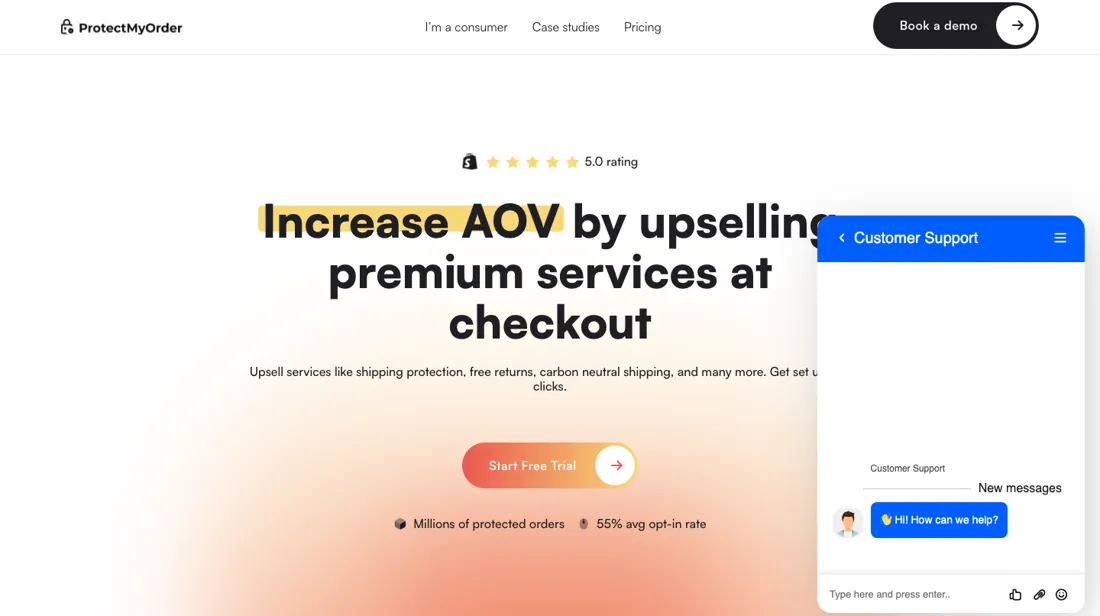
The vendor's site is still live and still selling, and its own footer still links to that dead page. The way in is now a form and a collaborator-access request rather than an install button, and the $20 monthly minimum — which only ever appeared on the App Store plan — no longer appears anywhere a buyer can read it. That removes the discrepancy this review was first built around and leaves a harder one.
Everything you can now learn about what this costs sits on a page the vendor controls, and all three tiers take a share of your upsell revenue rather than a fee. On Standard the pitch is that you keep 80%, and whether that is profit is settled by your own loss rate: a missing parcel is your replacement, your postage and your conversation. The public record has thinned with the listing.
Twelve reviews sat on it in August, most of them from 2024, and while it is down that record is not readable at all — the revenue figures merchants quote on the vendor's own site are theirs and unaudited. Selling package protection also brushes against insurance rules in some jurisdictions. The vendor says its arrangement has been verified with US and UK insurance lawyers, which is their statement rather than a regulator's; if you trade where that matters, ask your own adviser what you are allowed to sell before you turn it on.
What ProtectMyOrder does
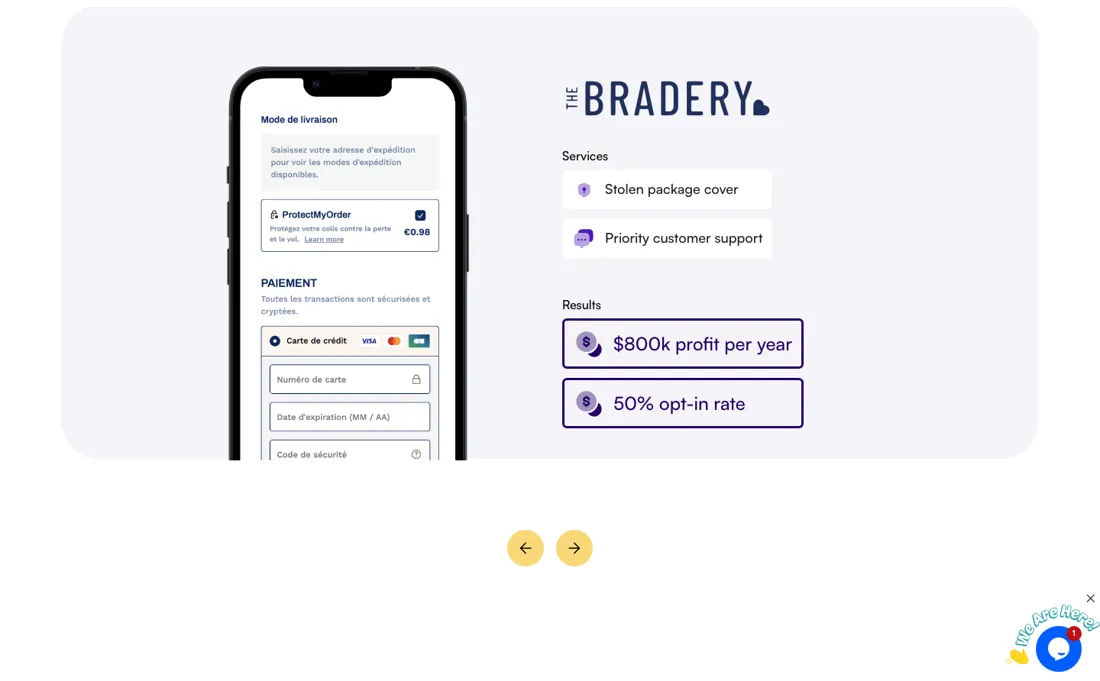
Shopify checkout upsell for premium services: package protection against lost and stolen parcels, carbon-neutral shipping and free returns, sold on the cart page, in checkout or through a custom widget, with fixed, dynamic or percentage pricing and an A/B test against half your traffic. On the vendor's own pricing page a 44.99% tier puts their agents on those claims, and a further 30% hands them the liability for refunds and replacements.
What buyers report about ProtectMyOrder
Recurring themes from the buyer-review sites listed at the foot of this page, read in August 2026. We have not run ProtectMyOrder ourselves, so this is other buyers' experience rather than ours. We summarise it here because the complaints are usually the part a vendor page leaves out.
- • Twelve reviews, all five stars. One carries a real number: pet-tags.co.uk (UK, about a year in, September 2024) reports £10,000–£15,000 of annual profit from the protection upsell at a 45% opt-in rate, and credits the team with setting it up.
- • The distinguishing feature merchants name is the revenue split rather than the coverage. Benji Ball (US, six months in, February 2024) says it is the one app in the category that lets the merchant share in the revenue and reports an instant increase in AOV; ameriDroid (US, 12 days, July 2023) values keeping the money from claims they were already handling themselves, instead of an outside party deciding each claim. motocross4u (UK, two months, September 2024) reports the added revenue with no customer complaints.
- • There is no published criticism at all: no review below five stars exists on the listing, so nothing here tests the model from the other side. What every positive review implies but none examines is that the merchant handles all claims — the same arrangement that keeps 80% of the upsell also means the support work lands on your desk, and no reviewer says what that costs in hours.
- • The reviewer base is narrow: of the ten reviews shown on the first page, six are UK stores and four US, and three of them come from merchants with under a month of use (17 days, 12 days, and one at two minutes).
Where the ratings disagree. The date range is the finding. Sorted by most recent, the newest review on the listing is 9 September 2024 — nearly two years without a public review, on an app that is still listed and still charging a percentage of upsell revenue. The five-star average describes the app as it was in 2023 and 2024, not as it is now, and the review that carries the £10–15K figure is from that same period.
When the paid plan is worth it
The tiers on the vendor's own page are not monthly fees, they are slices of your upsell revenue, and what they price is how much of the work you keep. Standard takes 19.99% and leaves the claims with you. Carbon takes 24.99% and offsets every delivery. Pro takes 44.99% and puts their agents on your shipping-claim support, and for a further 30% they assume the liability for refunds and replacements too — 74.99% in total, leaving you a quarter of what shoppers pay and none of the work.
So the real decision is make-or-buy on claims handling, and you can price it before you commit. Moving from Standard to Pro costs 25% of upsell revenue: on $2,000 of protection a month that is $500 for a staffed claims desk, and the only question is whether settling those claims costs your own team more than that. Handing over the liability is a second sum, another 30% against what you currently spend replacing parcels. Do both on paper before you assume Standard is the cheap plan.
How to actually use ProtectMyOrder
Do the loss-rate homework before you get in touch, not after. Pull the last six months of parcels you replaced or refunded for loss or damage, and divide by orders shipped. That is the number that decides everything else: whether keeping 80% on Standard is margin, or whether paying 44.99% to have their agents handle the claims is the cheaper answer. Then use the traffic split the vendor builds in.
It shows the offer to half your visitors, so run that and read two things rather than one: the opt-in rate, and the conversion rate of the half that saw the offer against the half that did not. Protection revenue can rise while orders fall, and that trade only shows up if you measure both halves. Set the price and the wording yourself, and write your claims process down before the first claim arrives — on Standard, you are the one settling it.
Distilled from apps.shopify.com/protectmyorder, which on 18 September 2026 shows the app as not currently available, and protectmyorder.com/pricing — tier cards, the comparison table, the trial description and the FAQ. First read 22 August 2026, re-read 18 September 2026. Re-read 5 October 2026: App Store listing still "not currently available"; protectmyorder.com/pricing unchanged (19.99%/24.99%/44.99%, +30% liability, $20m volume line, installation request form, footer link to the dead listing).
Frequently asked questions
Can I still install this from the Shopify App Store?
Not as of 5 October 2026, and not on 18 September either. apps.shopify.com/protectmyorder — the page this review was built on — now reads that the app is not currently available on the Shopify App Store and directs support questions to ProtectMyOrder, with no plan block, no reviews and no install button. The vendor's own site is still live and still selling: its instructions ask you to add the app, fill in an installation request form and accept a collaborator-access request, after which their team does the configuration. Its footer also still carries a “Download Shopify app” link pointing at the page that no longer resolves. From outside we cannot tell whether the listing is withdrawn, suspended or temporarily pulled, and the vendor does not say. Two things follow for a buyer: there is no public review record to read while it is down, and there is no App Store billing relationship, so ask how you will be invoiced before you grant anyone collaborator access to your store.
What will it actually cost me in a month?
There is no monthly fee to quote, and with the App Store plan went the $20 minimum charge. All three tiers on the vendor's pricing page, re-read 18 September and 5 October 2026, are a share of what your shoppers pay for protection: Standard 19.99%, Carbon 24.99% and Pro 44.99%, plus a further 30% if you want them to carry the cost of refunds and replacements, which is 74.99% at the top. The bill therefore scales with the upsell and is nothing in a month when nobody buys protection — a genuinely different risk profile from a flat subscription. What it does not tell you is your net, because on Standard every lost parcel is still yours to replace. Work it out as your share of protection revenue minus the claims you settle yourself, and read Pro as a quote for hiring that work out rather than as a premium tier. Brands above $20m of online revenue are told to book a call for volume discounts.
How do I prove it is not costing me orders?
Use the split the vendor builds in, and give it the full window. The pricing page describes a gradual roll-out that shows the offer to 50% of site visitors and a fourteen-day period after which you see the profit made and whether conversion moved. The vendor states that conversion was unaffected in 99% of the tests it has run and guarantees it will improve or stay the same, saying it covers lost sales otherwise and that this has never happened. That is their data about their own product, which is exactly why the fourteen days on your store are worth taking seriously rather than skipping. Read the conversion rate of both halves, not the protection revenue alone, and hold the test to a period without a sale or a campaign running across it — a discount week landing on one half of a 50/50 split will tell you nothing you can act on.
What should I weigh before buying E-commerce software?
Check your platform and version specifically. Shopify support is close to universal in this category, while WooCommerce, BigCommerce, Magento and headless setups vary a lot, and 'supported' sometimes means a generic API rather than a maintained app. A listing in your own platform's app store, with recent reviews there, is a better signal than the vendor's logo wall.
Is this a hands-on review of ProtectMyOrder?
This is a researched assessment, not a hands-on test — where we've used a tool ourselves, we say so explicitly. We name what each tool is good and bad at, and we have no affiliate relationship with ProtectMyOrder — we earn nothing whether you sign up or not.
- Buyer reviews on Shopify App Store (listed as “PMO: ProtectMyOrder”), read August 2026.
- Re-read 2026-09-18 and again on 2026-10-05.
- A dated screenshot of that pricing page, kept on this site as the receipt.
Others in this category
Reviewed e-commerce tools that share ground with ProtectMyOrder — comparable in what they do, not drop-in swaps:
New reviews, price changes we recorded, and the cost conditions we found. No sponsored placements. Unsubscribe anytime.
This is our researched assessment — not a paid placement. How we review →