 Intelis Review (2026)It Counts Variants, Not Products
Transparency: the “Visit” links on this page are affiliate links — we may earn a commission if you sign up, at no extra cost to you. No vendor can pay for a better review or verdict. How we make money →
The ladder counts variants, not products, and that is where stores get caught.
Visit Intelis → Affiliate link — we may earn a commission if you sign up; it does not change what this page says.
Watch the 2-minute review
The video version of this review, from our YouTube channel.
Pricing (2026)
✓ Pricing re-verified 1 Oct 2026
| This tool | $49 | 43th cheapest of 48 |
| Cheapest | $2.99 | MX AI |
| Median | $14.50 | |
| Most expensive | $450 | Attribuly |
Lowest paid entry price per account a month, billed monthly, in USD, among the 48 e-commerce growth apps we have researched (read between 2026-08-19 and 2026-10-04). Only tools priced in the same unit and on the same billing are compared — not a market survey, and cheapest is not best.
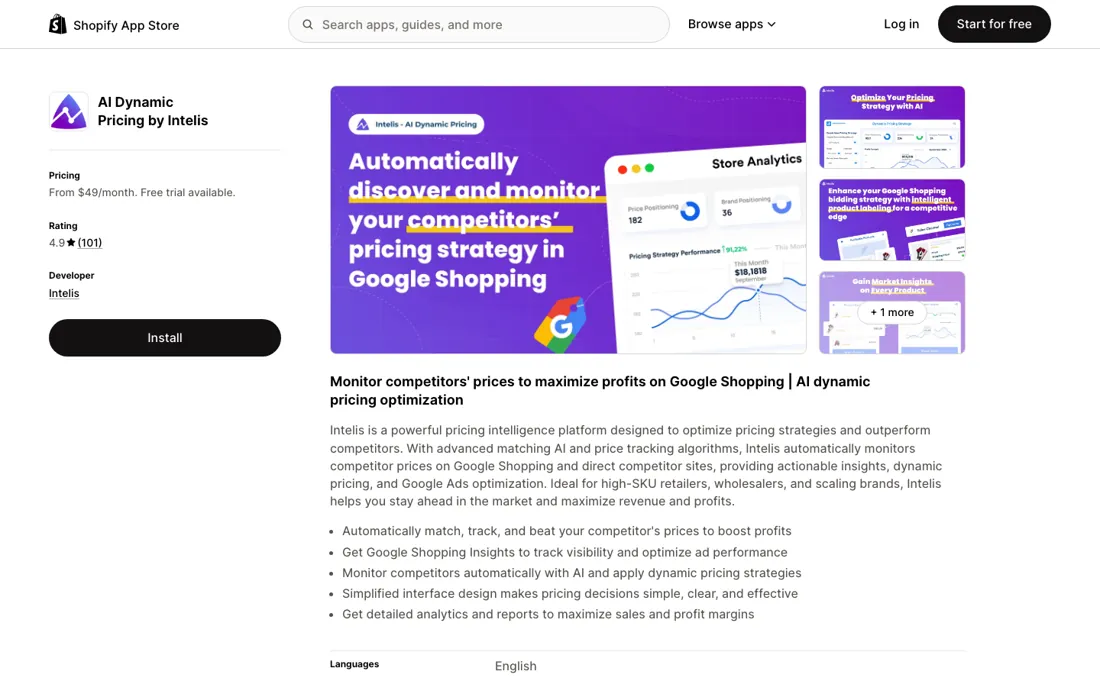
Four tiers on the Shopify listing, priced by how many products or variants you track, each with a 14-day free trial. Basic $49 a month or $490 a year, a 17% saving: up to 100 products or variants, Google Shopping competitor monitoring, AI automatch for unlimited competitors, dynamic pricing, unlimited competitor URL tracking, reports, pricing history and chat support. Professional $179 a month or $1,790 a year: up to 1,000, adding variant tracking, sales analysis, live feed export, pricing strategy monitoring, an AI assistant and premium chat support.
Premium $249 a month or $2,490 a year: up to 2,000, adding Shopify Markets support per market, Google Analytics integration and API access. Business $399 a month or $3,990 a year: up to 5,000, adding a custom labels feed for Google Merchant Center, MAP monitoring, a customised AI matching algorithm, pricing consultation, advanced analytics and A+ support. The vendor's own pages used to disagree with the listing above Premium -- on 21 August 2026 intelis.ai/pricing showed Business at $499 with a $4,990 annual rate and Enterprise at $849, while the homepage said $749.
That is now resolved: on 8 September 2026 the pricing page and the homepage both show Business at $399 ($3,990 a year) and Enterprise at $749 ($7,490 a year) for up to 10,000 SKUs, matching the listing. The vendor's own pages count SKUs where the listing counts products or variants. All charges are billed in USD and recur every 30 days. Developer Intelis; the app launched 6 July 2021 and carries a 4.9 rating from 97 reviews on 1 October 2026 (101 on 8 September). Plans change — always verify the live price on their site.
Category context: E-commerce. Across the 34 tools in this category that we researched with a public US-dollar price, the median entry price is $19 a month (lowest paid plan as listed, per seat where the vendor prices per seat). Compare pricing conditions in the Software Cost Atlas →
What the price did
We capture Intelis’s own pricing page every month and keep the figures, so this is our record of the page — not a forecast, and not someone else’s summary.
The Shopify listing held between 8 September and 1 October 2026: $49, $179, $249 and $399 a month, or $490, $1,790, $2,490 and $3,990 a year. The vendor's own pricing page moved once: on 21 August 2026 it showed Business at $499 ($4,990 a year) and Enterprise at $849; since 8 September it shows $399 ($3,990) and $749 ($7,490) for up to 10,000 SKUs, and still did on 1 October.
What the pricing page doesn’t say
A catalogue of forty garments in five sizes and three colours is six hundred variants, so a shop most people would call small lands on the $179 tier rather than the $49 one. Count your variants, not your line items, before you read the price. The vendor's own numbers above Premium used to contradict each other, and that is worth knowing mainly because it has been fixed. On 21 August 2026 the Shopify listing said Business was $399 while intelis.ai/pricing said $499 with a $4,990 annual rate, and the homepage and the pricing page gave Enterprise as $749 and $849.
Re-read on 8 September 2026, all three pages agree: Business $399 ($3,990 a year), Enterprise $749 ($7,490) for up to 10,000 SKUs. If you are working from a comparison written earlier this year, check its figures against the listing. And automatic repricing is not a switch you leave alone. The matching is AI-driven across Google Shopping and competitor sites, and a mismatched listing quietly reprices the wrong product, while an unbounded rule set on a busy category is how a store races itself to the bottom.
Set floor prices before you turn dynamic pricing on, and audit what the automatch decided in the first fortnight.
What Intelis does
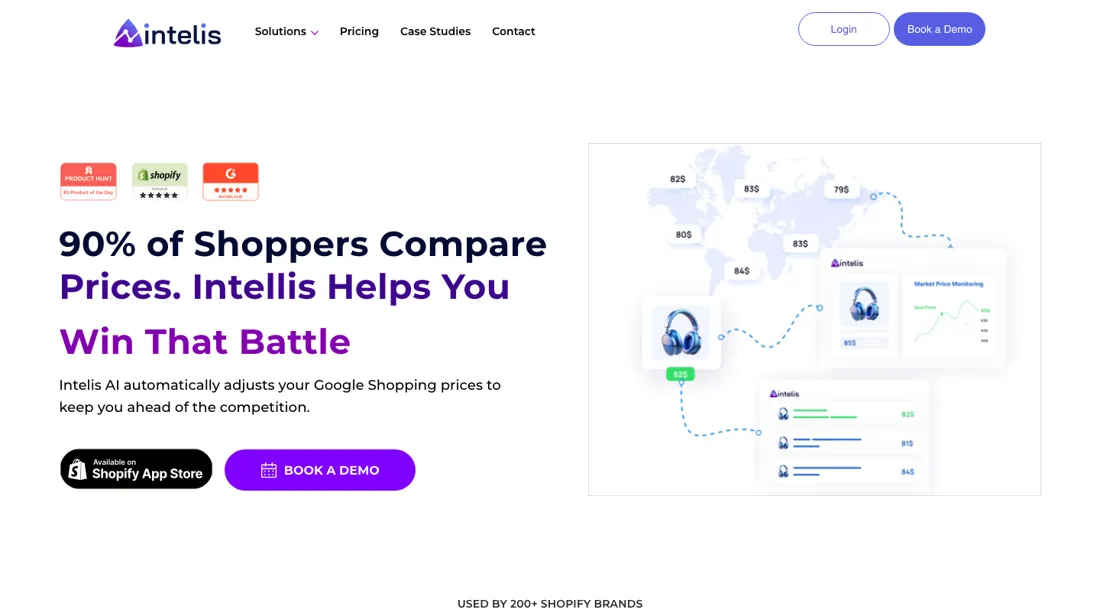
Monitors competitor prices on Google Shopping and direct competitor sites and reprices your Shopify catalogue automatically with AI matching rules.
What buyers report about Intelis
Recurring themes from the buyer-review sites listed at the foot of this page, read in August 2026. We have not run Intelis ourselves, so this is other buyers' experience rather than ours. We summarise it here because the complaints are usually the part a vendor page leaves out.
- • 4.9 over 75 reviews, 97% of them five stars, with no one-star review at all. The recurring claim is that the automation does the watching for you: redtrinket (France, 18 days in, August 2026) credits accurate competitor tracking and an intuitive dashboard with letting them react to market moves faster, and Woody Paper (UK, June 2026) says the automation "works perfectly" and saves a large amount of time.
- • Several merchants report a revenue effect rather than a workflow one — Anume Naturals (US, July 2026) reports a clear increase in sales, and PETOPIA (Finland, August 2026) says the pricing recommendations actually work. The vendor replies to most reviews under the founder's name.
- • The two reviews that are not five stars both concern matching, not pricing. cykelgarage.dk (Denmark, 14 days in, May 2026, four stars, edited) says the app works but mismatches products "even by ean numbers, which requires a lot of work to adjust" — for a bike shop with thousands of variants that adjustment is the job the app was bought to remove.
- • Jonny Sprockets Bike Shop (Australia, 14 minutes in, January 2026, two stars) writes that it "might be too smart for its own good. Could not get it to stop what it was doing and do it how I wanted it done." Intelis replied that an automated assistant had answered instead of live support, and that a full product resync has to be run by their team rather than by the merchant.
Where the ratings disagree. Read the tenures, not the ratings. Most of the praise is written one to four days after install — Keebs with Marianne at three days, Anume Naturals at one, PETOPIA at two — while a dynamic-pricing tool only proves itself over weeks of margin data. The two reviews written by merchants who had used it longer (18 days and 14 days) are the two that talk about match accuracy, and one of them is the four-star.
Pages read (August 2026): Shopify App Store
When the paid plan is worth it
The ladder counts products OR VARIANTS, and that word is where stores get caught. Basic is $49 a month for up to 100, Professional $179 for 1,000, Premium $249 for 2,000 and Business $399 for 5,000, each with a 14-day trial and roughly 17% off on annual billing. Above that the vendor now publishes an Enterprise tier at $749 a month ($7,490 a year) for up to 10,000 SKUs. Count your variants before you read those prices.
Per variant the ladder is genuinely generous -- $0.49 on Basic falling to $0.08 on Business and $0.075 on Enterprise -- but that only helps if your variant count sits comfortably inside a band. Sitting just above a boundary is the expensive place to be: 1,050 variants pays the same $249 as 2,000. The tiers above Premium used to be unquotable: the vendor published three different figures for Business across its own pages.
As of 8 September 2026 that is fixed -- listing, pricing page and homepage all say $399, and Enterprise is openly priced at $749 rather than negotiated. If you were quoted $499 earlier this year, that number is no longer published anywhere. One operational cost no tier covers, and no upgrade removes: automatic repricing is not a switch you leave alone. Buying Business does not make the automatch more careful; it only raises the SKU ceiling.
Set floor prices before you enable dynamic pricing, and audit what the automatch decided in the first fortnight -- that fortnight of attention is part of the price at every tier.
How to actually use Intelis
Count variants, not products, before you read the price list. The tiers meter on products or variants, and a catalogue of forty garments in five sizes and three colours is six hundred variants -- so a shop most people would call small lands on the $179 Professional tier rather than the $49 Basic one. This is the single most common way stores misprice this app. Read the price off the Shopify listing rather than a comparison article.
The vendor's pages disagreed with the listing above Premium as recently as August 2026, and although they now match -- Business $399, Enterprise $749 for up to 10,000 SKUs, checked 8 September 2026 -- the listing is what Shopify billing actually charges you, so it stays the number to start from. Set floor prices before you switch dynamic pricing on, not after. Automatic repricing is not a feature you leave alone: an unbounded rule set in a competitive category is how a store races itself to the bottom, and a floor is the only thing that stops it.
Then audit the matching in the first fortnight. The competitor matching is AI-driven across Google Shopping and competitor sites, and a mismatched listing quietly reprices the wrong product against the wrong rival. Spend the 14-day trial checking what the automatch decided, product by product, on your top twenty sellers.
Where this section comes from: our research notes (118 words)
Three of the vendor's own published price tables, read side by side on 8 September 2026: the Shopify App Store listing (apps.shopify.com/ecoprice-analytics), intelis.ai/pricing on both its monthly and annual toggles, and the plan cards on the Intelis homepage. Reading all three is the point rather than a precaution -- on 21 August 2026 they gave three different figures for the same tier, and comparing them again today is what established that the vendor has since aligned them.
The per-variant arithmetic below is our own, on those published rates. Re-read 1 October 2026: the Shopify listing in the served HTML, and intelis.ai/pricing rendered in a headless browser on both the Monthly and the Annual toggle (the prices render client-side).
Frequently asked questions
What does Intelis cost?
Four tiers on the Shopify listing, re-read on 19 September 2026 and unchanged since 8 September, each with a 14-day free trial and about 17% off on annual billing. Basic is $49 a month or $490 a year for up to 100 products or variants. Professional is $179 or $1,790 for 1,000. Premium is $249 or $2,490 for 2,000. Business is $399 or $3,990 for 5,000. The vendor’s own pages add an Enterprise tier at $749 a month ($7,490 a year) for up to 10,000 SKUs.
Does the plan count products or variants?
Variants, and this is the most common way stores misprice this app. A rail of forty garments that comes in five sizes and three colours counts as six hundred, which puts a shop most people would describe as small on the $179 rung instead of the $49 one. Do that sum before you read the price list. Per variant the ladder is genuinely generous -- $0.49 on Basic falling to $0.08 on Business -- but only if your count sits comfortably inside a band. Sitting just over a boundary is the expensive place to be: 1,050 variants pays the same $249 as 2,000 does.
Why do I see a different price for Intelis elsewhere?
Because the vendor’s own pages used to disagree with the Shopify listing above Premium. On 21 August 2026 the listing said Business was $399 while intelis.ai/pricing said $499 with a $4,990 annual rate, and Enterprise appeared as $749 on the homepage and $849 on the pricing page. That is resolved: on 8 September all three pages matched, and the listing’s figures are unchanged on 19 September. But a comparison article written earlier this year may still carry the old numbers, and the Shopify listing is what Shopify billing actually charges you, so start from there.
What should I set up before turning dynamic pricing on?
Floor prices first, an audit of the matching second. Automatic repricing is not a feature you switch on and leave: an unbounded rule set in a competitive category is how a store races itself to the bottom, and a floor is the only thing that stops it. Matching is done by AI across Google Shopping and rival storefronts, and one bad match sends your price chasing something that is not really your product. Spend the 14-day trial checking what the automatch decided on your top twenty sellers, product by product -- that is the work the trial is for.
What should I weigh before buying E-commerce software?
Check your platform and version specifically. Shopify support is close to universal in this category, while WooCommerce, BigCommerce, Magento and headless setups vary a lot, and 'supported' sometimes means a generic API rather than a maintained app. A listing in your own platform's app store, with recent reviews there, is a better signal than the vendor's logo wall.
Is this a hands-on review of Intelis?
This is a researched assessment, not a hands-on test — where we've used a tool ourselves, we say so explicitly. We name what each tool is good and bad at, and we earn a commission only if you sign up, at no cost to you.
- Buyer reviews on Shopify App Store (listed as “AI Dynamic Pricing by Intelis”), read August 2026.
- Re-verified 8 September 2026 on apps.shopify.com/ecoprice-analytics, intelis.ai/pricing and the Intelis homepage; listing and pricing page re-read 1 October 2026, unchanged.
- A dated screenshot of that pricing page, kept on this site as the receipt.
Others in this category
Reviewed e-commerce tools that share ground with Intelis — comparable in what they do, not drop-in swaps:
New reviews, price changes we recorded, and the cost conditions we found. No sponsored placements. Unsubscribe anytime.
This is our researched assessment — not a paid placement. The “Visit” links on this page are affiliate links: we may earn a commission if you sign up, at no extra cost to you, and it never changes our take. How we review →