Pythago Review (2026)Third Store Costs Just $19
 By Daan Haket · Researched and written with an AI assistant · who does what
Pythago bills per store, so every store you add adds a full subscription and the bill scales linearly: ten stores is $390 a month, twenty is $780, and there is no enterprise step that flattens the curve.
dropshippers running multiple Shopify stores who want real-time ROAS and ROI tracking plus AI product research in one dashboard.
you run a single small store (the entry is $59 a month, not the $39 on the 3+ card) or you are still validating a product idea with little ad spend.
Transparency: the “Visit” links on this page are affiliate links — we may earn a commission if you sign up, at no extra cost to you. No vendor can pay for a better review or verdict. How we make money →
Pricing (2026)
✓ Pricing re-verified 22 Sep 2026
| Plan | Price | What you get |
|---|---|---|
| 1 Store | $59/mo | Google Ads ROI tracking, product research, competitor monitoring, email support |
| 2 Stores | $49/store/mo | Google Ads ROI tracking, product research, competitor monitoring, priority support, advanced translations |
| 3+ Stores | $39/store/mo | Google Ads ROI tracking, product research, competitor monitoring, automation tools, API access |
Summarised from the pricing notes below; the notes carry the conditions.
(2026) Cancel anytime, per-store pricing. 1 Store $59/mo; 2 Stores $49/store/mo; 3+ Stores $39/store/mo. Every tier carries full Google Ads ROI tracking, product research and competitor monitoring, but the tiers are NOT otherwise identical: email support on 1 Store; priority support and advanced translations from 2 Stores; automation tools and API access only at 3+ (re-verified 22 September 2026 on pythago.io's own pricing section; every amount and every feature line unchanged since 4 September 2026).
The headline has been corrected since our earlier readings: on 22 September 2026 the hero and the closing call to action both read “From $59/month”, the page’s own SoftwareApplication schema carries price 59 USD, and the FAQ answers “Does this work if I only have one store?” with “Yes. The entry plan is a single store at $59/month”. The string $39 now occurs exactly once on the page, on the 3+ Stores card.
Earlier readings of ours recorded an advertised “from $39/month”; that framing is no longer there. The page still publishes no free trial and no money-back guarantee — the words trial, free and guarantee do not occur on it — and the published terms remain “Upgrade anytime • No setup fees • Cancel anytime”, with a custom plan by email. Plans change — always verify the live price on their site.
Category context: E-commerce. Across the 39 tools in this category that we researched with a public US-dollar price, the median entry price is $19 a month (lowest paid plan as listed, per seat where the vendor prices per seat). Pythago’s entry price of $59 a month sits above that median. Compare pricing conditions in the Software Cost Atlas →
What the pricing page doesn’t say
The rate does improve with volume — $59 for one store, $49 each at two, $39 each from three up — so price the trajectory rather than this month’s bill. The $39 on the 3+ card is not an entry price; one store is $59, which the vendor now states plainly in its hero and its FAQ.
Watch the video review
The video version of this review, from our YouTube channel.
⚡ Short on time? Watch the 30-second verdict Short.
What Pythago does
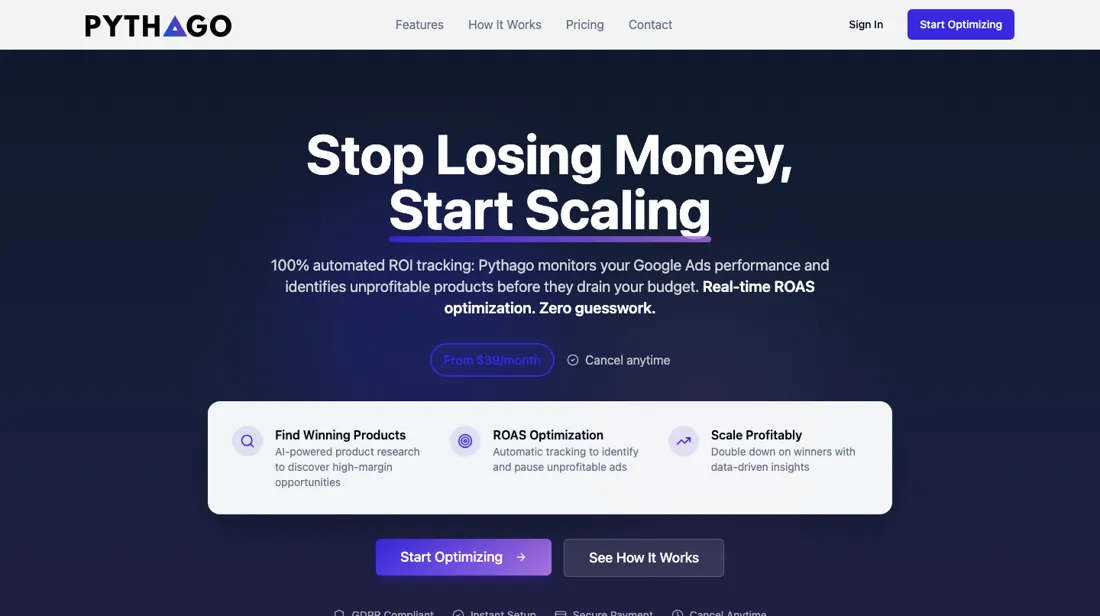
AI analytics and ROI tracking for dropshippers — real-time ROAS optimization, product research and competitor tools across one or more Shopify stores.
What buyers report about Pythago
Hands-on: not tested by usReported by buyers: Trustpilot, read August 2026
Themes from the buyer-review sites listed at the foot of this page, read in August 2026. We have not run Pythago ourselves, so this is other buyers' experience rather than ours. We summarise it here because the complaints are usually the part a vendor page leaves out.
- • Live ROI per product is what reviewers name — seeing which items make money and which do not, fast enough to act on it.
- • Reviewers describe it as inexpensive for what it does.
- • Four Trustpilot reviews at a 4.0 score. Trustpilot itself notes the company has not invited customers to review, so this is a self-selected handful rather than a picture. There is not enough independent evidence here to lean on.
- • We found no substantive complaint pattern either way. In August 2026 we also found no published pricing detail; Pythago now publishes per-store pricing (see the pricing section above). Trial it against your own data before committing.
Pages read (August 2026): Trustpilot
Your third store is the cheapest one you will add
Pythago charges per store, and the published ladder is $59 a month for one, $49 per store for two, and $39 per store from three up. Every tier carries the tracking itself — full Google Ads ROI tracking, product research and competitor monitoring — so the core is not what climbing the ladder buys. Three things are: priority support and advanced translations arrive at two stores, and automation tools and API access only at three.
If you need the API, your tier is decided for you and the volume decision is moot. Otherwise it is purely a volume decision, and it behaves oddly. Read it as marginal cost rather than as a rate card and the shape appears. One store is $59. Two stores is $98, so the second store costs you $39. Three stores is $117, so the third store costs $19 — less than half the advertised per-store price and the cheapest addition on the ladder.
From the fourth store on it is flat $39 each. If you run two stores and have been putting off a third, the pricing is not the reason to wait: the step from two to three is the smallest one Pythago ever asks you to take. Two corrections, and the first one is no longer ours to make. The $39 on the 3+ card is not an entry price — one store is $59, which is 51% more — and Pythago now says so itself: read on 22 September 2026, the hero and the closing call to action both read “From $59/month”, the page’s own schema carries a price of 59, and the FAQ answers the one-store question with “the entry plan is a single store at $59/month”.
Our earlier readings recorded an advertised “from $39/month”, so if you have seen that figure quoted as the starting price, including by us, it is out of date. The second correction is ours alone: it is not true that there is no volume break below three stores, as we once had it — two stores at $49 each is already a discount on the single-store rate. The break exists, it is just smaller than the one at three.
Past three stores the model is honest and unforgiving in equal measure: it is linear, with no further breaks. Ten stores is $390 a month, twenty is $780. There is no enterprise step that flattens the curve, so an operator adding stores steadily should price the trajectory rather than the current bill. Billing is monthly and you can cancel any time, which makes the first month cheap to test — start with the store you know best and see whether the ROAS tracking tells you something your ad platform does not.
How to actually use Pythago
Start with one store on the month-to-month billing, but read the feature ladder first, because it is not flat. Every tier carries full Google Ads ROI tracking, product research and competitor monitoring. What the single-store tier leaves out is priority support and advanced translations, which start at two stores, and automation tools and API access, which appear only at three. If you intend to pull the data into your own stack, the API sets your tier rather than your store count — and you can cancel any time.
Know the marginal cost before you add one. Store one is $59, the second adds $39 for a $98 total, and the third adds only $19 for $117 — the cheapest store you will ever add. Every store after that is a flat $39. If you have been putting off a third store, the pricing is not the reason to wait. Then reconcile it against a source you already trust.
Connect the store you know best and check whether Pythago's ROAS figure matches what your ad platform reports, and where it differs — attribution windows, returns and shipping costs are the usual reasons. A dashboard you cannot reconcile is not worth $59 a month, and finding the discrepancy in month one is far cheaper than trusting it for a quarter.
Where this section comes from: our research notes (288 words)
Pythago's own pricing section (pythago.io/#pricing), read in a browser on 4 September 2026 — the three per-store tiers ($59 for one store, $49 per store at two, $39 per store from three), the per-tier feature lists that are NOT identical (email support on 1 Store; priority support and advanced translations from 2 Stores; automation tools and API access only at 3+), the strapline 'Every plan includes full Google Ads ROI tracking and competitor monitoring', and the published terms 'Upgrade anytime • No setup fees • Cancel anytime' with a custom plan by email.
The page publishes no free trial and no money-back guarantee. A separate /pricing URL returns 404; the pricing lives on the homepage anchor. Re-read 22 September 2026 (pythago.io, 78,010 bytes, sha256 ebdd2df0d8d1648958ca54e74fe6158296fcb7327336c502b14cdea80aad1e0f): all nine price and feature lines unchanged, and the page has added a 'What Pythago can and cannot do in your accounts' section covering the Google Ads and Shopify permissions, data location and retention, and how to revoke access.
The FAQ questions below it render their answers only on expand, so they were not read. Nagelezen op 22 september 2026 door blok 3: de tiertarieven ($59 / $49 / $39 per store) zijn ongewijzigd, maar de kop is dat niet. De pagina adverteert nu tweemaal “From $59/month” (hero en slot-CTA), de SoftwareApplication-schema geeft price 59 USD, en de FAQ zegt letterlijk “The entry plan is a single store at $59/month”.
De eerder vastgelegde advertentie “from $39/month” staat er niet meer; $39 komt nog precies eenmaal voor, op de 3+ Stores-kaart. Onze knock, skip, price en premium_worth verweten de leverancier een misleidende kop die hij inmiddels heeft gerepareerd, en de knock sprak bovendien premium_worth tegen over de volumekorting onder drie stores; alle vier gecorrigeerd.
The natural comparison is Triple Whale — Triple Whale is the established e-commerce analytics heavyweight for bigger brands; Pythago is the dropshipping-focused, per-store-priced alternative — leaner, but the per-store model adds up across a portfolio.
Frequently asked questions
What can Pythago actually change inside my Google Ads and Shopify accounts?
It asks for write access to both, and on 22 September 2026 it spells out the limits itself in a section called What Pythago can and cannot do in your accounts. On Google Ads it connects through Google's official OAuth flow, so it never sees your password, and it states that write access is part of the job: it can pause campaigns and exclude a product or variant from an asset group. It says it never touches budgets or bids, and that automated actions are off by default and configured per campaign — so the destructive-sounding half is opt-in, campaign by campaign. On Shopify it reads and writes orders, products, markets and publications, and states it cannot edit your storefront, change your listings, contact your customers or issue refunds. That combination is consistent with the product: excluding a losing product from an asset group is the action the dashboard is there to justify. If you are not comfortable with pause-and-exclude rights, the tool still reports, but you are paying $59 a month for a read-only view of numbers you will act on by hand.
Where does my store data live, and what happens to it if I cancel?
Pythago publishes both answers on its homepage, read 22 September 2026. The data is hosted in Europe (the page names the CJ2 region), encrypted with TLS 1.2 or higher in transit and AES-256 at rest. It is kept while your account is active and deleted within 30 days of cancelling — or immediately, if you ask. Access is revocable without going through support: you can disconnect from your Pythago settings, or revoke it directly from your Google and Shopify account pages, and the page says so in those words — no email, no support ticket. For a tool that holds order-level revenue and cost data for every product you sell, those are the three things worth knowing before you connect, and they are unusually plainly stated. What the page does not publish is a data processing agreement or a subprocessor list, so if your own customers' order data crossing into an analytics vendor needs paperwork on your side, that is a question for support rather than something the site answers.
I run one store. Is $59 a month the right entry, or should I wait?
Know the shape of the ladder before you decide, because it is not linear. One store is $59 a month. Two stores is $49 each, so $98 — the second store costs $39. Three stores is $39 each, so $117 — the third store costs $19, less than half the advertised per-store price and the cheapest addition Pythago will ever sell you. From the fourth store on it is a flat $39 each, with no further breaks: ten stores is $390 a month and twenty is $780. For a single store the honest framing is that you are paying the top per-store rate, 51% above the $39 headline, and there is no trial and no money-back guarantee on the page to soften a first month that turns out wrong (checked 22 September 2026: the words trial and guarantee do not appear). What you do get is monthly billing and cancel-anytime, so the real test is cheap: connect the store, compare Pythago's ROAS against what Google Ads reports, and see whether the gap — attribution window, returns, shipping — tells you something you did not already know.
Is this a hands-on review of Pythago?
This is a researched assessment, not a hands-on test — where we've used a tool ourselves, we say so explicitly. We name what each tool is good and bad at, and we earn a commission only if you sign up, at no cost to you.
- Buyer reviews on Trustpilot, read August 2026.
- Pythago’s own published pricing page.
- A dated screenshot of that pricing page, kept on this site as the receipt.
Others in this category
Reviewed e-commerce tools that share ground with Pythago — comparable in what they do, not drop-in swaps:
New reviews, price changes we recorded, and the cost conditions we found. No sponsored placements. Unsubscribe anytime.
This is our researched assessment — not a paid placement. The “Visit” links on this page are affiliate links: we may earn a commission if you sign up, at no extra cost to you, and it never changes our take. How we review →