 Dynasort Review (2026)
Sorting driven by 40+ blended signals is powerful and opaque in the same breath: a recipe that ranks by margin, velocity and stock at once will sometimes bury a product you wanted seen, and there is real trial and error in getting the recipes to match how you actually merchandise.
Visit Dynasort → Affiliate link — the rest of this page is the honest version, including who should skip it.
Pricing (2026)
✓ Pricing re-verified 15 Sep 2026
| This tool | $99 | 22th cheapest of 25 |
| Cheapest | $4.99 | Scarcity.AI |
| Median | $29 | |
| Most expensive | $250 | Seller Snap |
Entry price per month, USD. Our own dated readings of 25 e-commerce tools — not a market survey, and cheapest is not best.
Four tiers, all billed in USD and recurring every 30 days. Demo is free for as long as you like: 2 collections sorted round the clock, 10 recipes drawn from 40+ signals, 2 managed collections that build themselves, 10,000 serves a month, 7 days of serving analytics and a re-sort every 60 minutes. The three paid cards are described by four capacity lines and three yes/no lines rather than by feature lists.
Basic is $99 a month for 25 sorted collections, 10 managed collections, 20 recipes and a 30-minute processing schedule, with custom attributes, partner integration and product boost all switched off. Pro is $249 for 100 sorted collections, 25 managed, 25 recipes and a 20-minute schedule, and switches all three of those on. Enterprise is $499 for 1,000 sorted collections, 100 managed, 250 recipes and a 10-minute schedule.
Every paid tier carries a 30-day free trial, which is long enough to actually measure the effect. One number the paid cards do not publish is a serve allowance: only the free Demo card names one, so if serves are what your traffic will consume, ask before you buy. This reading corrects an earlier one made on 14 September 2026, which recorded the Pro and Enterprise capacity blocks the other way round; on 15 September the ladder rises from Basic to Enterprise on every line. Plans change — always verify the live price on their site.
What the pricing page doesn’t say
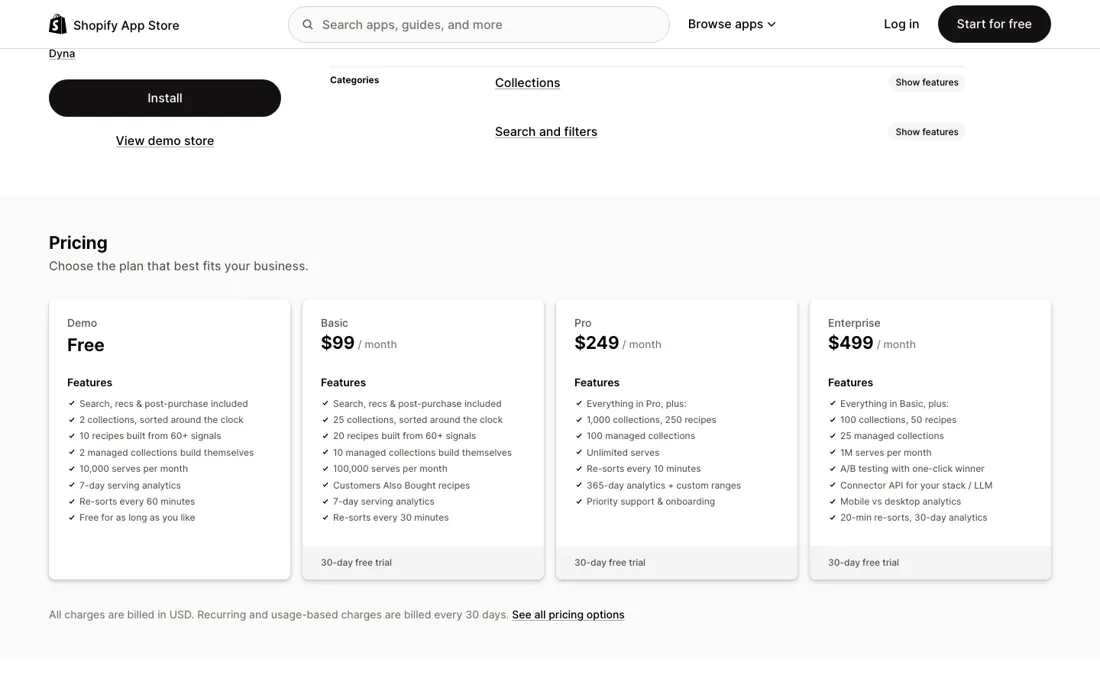
The jump from free to paid is steep at $99 a month, and it buys capacity without capability — custom attributes, partner integration and product boost all start at $249. The paid cards also publish no serve allowance, so the meter the free tier is capped on (10,000 serves a month) disappears from the page exactly where you start paying. And the evidence base is thin: 4.6 from 15 reviews, with fourteen fives and a single one-star and nothing in between.
It is Shopify-only, so it is not an option if any part of your catalogue lives elsewhere.
What Dynasort does
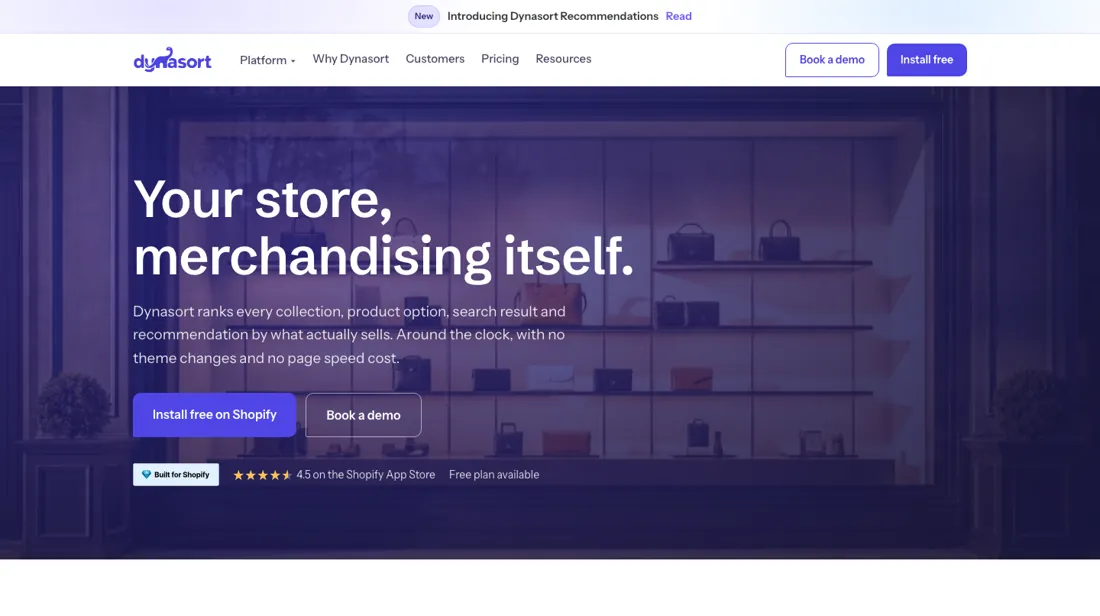
Shopify app that re-sorts collections, variant lists, search results and upsell blocks automatically, using recipes built from 60+ signals such as sales, margin, inventory and reviews. Free Demo tier; paid $99 to $499 a month.
What buyers report about Dynasort
Recurring themes from the buyer-review sites listed at the foot of this page, read in September 2026. We have not run Dynasort ourselves, so this is other buyers' experience rather than ours. We summarise it here because the complaints are usually the part a vendor page leaves out.
- • Tenure is the unusual part of this set. Reviewers write at almost three years, at over a year twice, and at eleven months of continuous use — a different signal from a wall of first-week enthusiasm. The long-tenure reviewers are retailers in Israel, the United States and the United Kingdom.
- • Sorting on margin is described as a money outcome rather than a convenience. An Australian bathware retailer at about a year says they make better margins because they can prioritise the products that earn well, in an industry where sell prices track the market.
- • A US golf retailer says the app's ordering converts at a higher rate than Shopify's own. A UK fabric merchant gives the concrete version: out-of-stock products pushed to the bottom of every collection, hours saved each week against doing it by hand, and recipes flexible enough to follow the seasons as new stock replaces last year's sellers.
- • It is the app that survived a bake-off at high SKU counts. A US fashion brand lists Algolia, Boost, Sort'd and Fast Simon as tools they had used and says Dynasort is the only one that could handle what they do.
- • One support name recurs across independent reviews — Wade — described as answering within minutes, building custom work including multi-location views, and fixing a year's single issue on the spot.
- • The single negative review is worth reading in full before you install. A US merchant three days in calls it a completely non-working app and a waste of time, and says two days of support produced generic replies with no specifics and that the basic rules could not be set up.
- • The vendor's public reply to that review names a cause that belongs on any buyer's checklist: the merchant's theme was overriding Shopify's manual sort order by defaulting to best-selling, a theme-level setting that bypasses whatever a collection app writes through the Shopify API. Check your theme's default collection sort before you judge the app — by the vendor's account it affects every app in this category, not only this one.
- • The scoring takes learning. A UK merchant nine days in says it takes a while to understand the logic of the scoring before it becomes powerful, which is the same opacity our own note on this page flags.
- • The base is small and English-speaking: fifteen reviews from the United States, the United Kingdom, Israel and Australia, and not one of them describes a failure mode other than the theme conflict above.
Where the ratings disagree. Fifteen reviews is a thin base and the shape is all-or-nothing — fourteen fives and one single star, with nothing in between. What makes it more useful than a larger pile of first-week praise is the spread over time: the set runs from November 2024 to June 2026, and several reviewers are writing at one to three years of continuous use, which is the durability evidence a new app cannot offer. It also helps that the one bad experience has a documented technical cause the vendor answered in public, so you can check whether it applies to your theme rather than guessing.
Pro is the feature step, Enterprise is the volume step
Read the three paid cards as two different purchases rather than as one ladder. Basic at $99 a month buys capacity and nothing else: 25 sorted collections, 10 managed, 20 recipes, a 30-minute re-sort, with custom attributes, partner integration and product boost all switched off. Pro at $249 is where the product turns on rather than where it gets bigger — those three lines flip to yes, while the capacity gain is modest at 100 sorted collections, 25 managed and 25 recipes.
Enterprise at $499 is the opposite kind of step: it adds no capability the Pro card does not already have, and instead multiplies volume, with 1,000 sorted collections, 100 managed, 250 recipes and a re-sort every 10 minutes. So buy Pro for what the app can do and Enterprise for how much of your catalogue it does it to. What no tier fixes is the work: the recipes still have to be built and watched, a sort blended from several signals will still bury products you wanted seen, and the paid cards publish no serve allowance at all, so the meter the free tier is capped on is not on the page at any price.
How to actually use Dynasort
Use the free Demo tier properly rather than as a preview: it sorts 2 collections around the clock, which is exactly enough for a controlled comparison. Pick your best-selling collection and one you suspect is badly ordered, record the conversion rate and revenue per visit for both before you change anything, and let a single recipe run for a full two weeks. Start with one clear signal — push sold-out products down, or sort by sell-through — before you blend margin and inventory into it, because a recipe built from six signals at once is one you cannot reason about when a product disappears from view.
Watch which products drop as much as which ones rise; that is where automated merchandising goes wrong. Then ask what serve allowance comes with the tier you are buying, because only the free Demo card publishes one and the paid cards print none, and take the full 30-day trial to see a real sales cycle.
Distilled from The Shopify App Store listing at apps.shopify.com/dynasort, read 14 September 2026 and re-read 15 September 2026: all four pricing cards with their capacity lines and trial terms, the “All charges are billed in USD” note, the feature and integration lists, and the rating block, which reads 4.6 from 15 reviews (93% five-star, 7% one-star). The listing carries Shopify's Built for Shopify badge, names the developer as Dyna and dates the app's launch to 19 September 2022. The 15 September re-read is the one the pricing and plan-comparison text above is built on; it corrected the capacity figures recorded on 14 September for the Pro and Enterprise tiers.
More on Dynasort
Everything we publish about Dynasort links back here — the review stays the honest hub:
The ex-banker filter — the same yardstick on every review (how we review): My ex-banker filter is simple: does Dynasort remove a real cost — time, errors, missed revenue — bigger than what it charges?
Frequently asked questions
What does Dynasort cost?
Read on 15 September 2026 on its Shopify App Store listing: a free Demo tier, then Basic $99 a month, Pro $249 and Enterprise $499. All charges are in USD and recur every 30 days, and every paid tier carries a 30-day free trial. The Demo tier is free for as long as you like and is a working plan rather than a countdown: 2 collections sorted round the clock, 10 recipes, 2 managed collections, 10,000 serves a month and a re-sort every 60 minutes.
Which tier do I actually need?
It depends on whether you are buying features or volume. Custom attributes, partner integration and product boost are all off on Basic and on from Pro, so if you need any of those the answer is $249 regardless of how small your catalogue is. If you need none of them, Basic's 25 sorted collections and 20 recipes are the question, and Enterprise at $499 adds no capability over Pro at all — it multiplies capacity to 1,000 sorted collections, 250 recipes and a 10-minute re-sort.
How many serves do I get on a paid plan?
The listing does not say. Only the free Demo card publishes a serve allowance (10,000 a month); the three paid cards describe collections, recipes and the processing schedule but print no serve number. Since serves are what a busy store consumes fastest, get that figure from the developer in writing before you commit, and use the 30-day trial to measure your own volume.
What should I weigh before buying E-commerce software?
Check your platform and version specifically. Shopify support is close to universal in this category, while WooCommerce, BigCommerce, Magento and headless setups vary a lot, and 'supported' sometimes means a generic API rather than a maintained app. A listing in your own platform's app store, with recent reviews there, is a better signal than the vendor's logo wall.
Is this a hands-on review of Dynasort?
This is a researched assessment, not a hands-on test — where we've used a tool ourselves, we say so explicitly. We name what each tool is genuinely good and bad at, and we earn a commission only if you sign up, at no cost to you.
- Buyer reviews on Shopify App Store listing apps.shopify.com/dynasort (15 reviews, 4.6 average: 14 five-star, one one-star, and nothing at four, three or two), read September 2026.
- Re-read 15 September 2026 on apps.shopify.com/dynasort.
- A dated screenshot of that pricing page, kept on this site as the receipt.
Others in this category
Reviewed e-commerce tools that share ground with Dynasort — comparable in what they do, not drop-in swaps:
New dossiers, cost-traps we found, and tools that earned a keep — no hype, no sponsored-disguised-as-advice. Unsubscribe anytime.
This is our researched assessment — not a paid placement. The “Visit” links on this page are affiliate links: we may earn a commission if you sign up, at no extra cost to you, and it never changes our take. How we review →