PulseMonitor Review (2026)50 Free Monitors, Pro $9, No Refunds
 By Daan Haket · Researched and written with an AI assistant · who does what
The refund policy is strict: monthly and yearly fees are non-refundable, including the unused part of a year, so the $90 annual plan is a commitment.
developers and small teams who want HTTP, API, SSL and keyword uptime checks plus a basic SEO audit in one cheap tool, with a free plan that covers 50 monitors.
you need multi-location checks, phone or SMS alerting, or a vendor whose legal entity and jurisdiction are stated in its terms, or you want the option of a refund on a yearly plan.
Transparency: the “Visit” links on this page are affiliate links — we may earn a commission if you sign up, at no extra cost to you. No vendor can pay for a better review or verdict. How we make money →
Pricing (2026)
✓ Pricing re-verified 14 Oct 2026
Two plans, no per-seat pricing. Free costs nothing and needs no credit card: 50 monitors at a 5-minute check interval, HTTP, port (TCP) and keyword monitoring, email alerts for down and recovered, Discord and Telegram, an incident timeline with uptime and response-time stats, SSL expiry checks, the one-click SEO analyzer and 3 months of data retention. Pro is $9 a month or $90 a year: 1-minute checks, 500 monitors, ping (ICMP), DNS and JSON/API response monitors, webhook alerts with escalation, teams and roles, unlimited status pages, maintenance windows, unlimited heartbeat monitors for cron jobs and workers, REST API access, SEO audit export and 24 months of retention.
The refund policy says fees for monthly and annual subscriptions are non-refundable, with no prorated refund on cancellation; refunds are at the vendor's discretion for billing errors, extended service failure or where the law requires one. Plans change — always verify the live price on their site.
What the pricing page doesn’t say
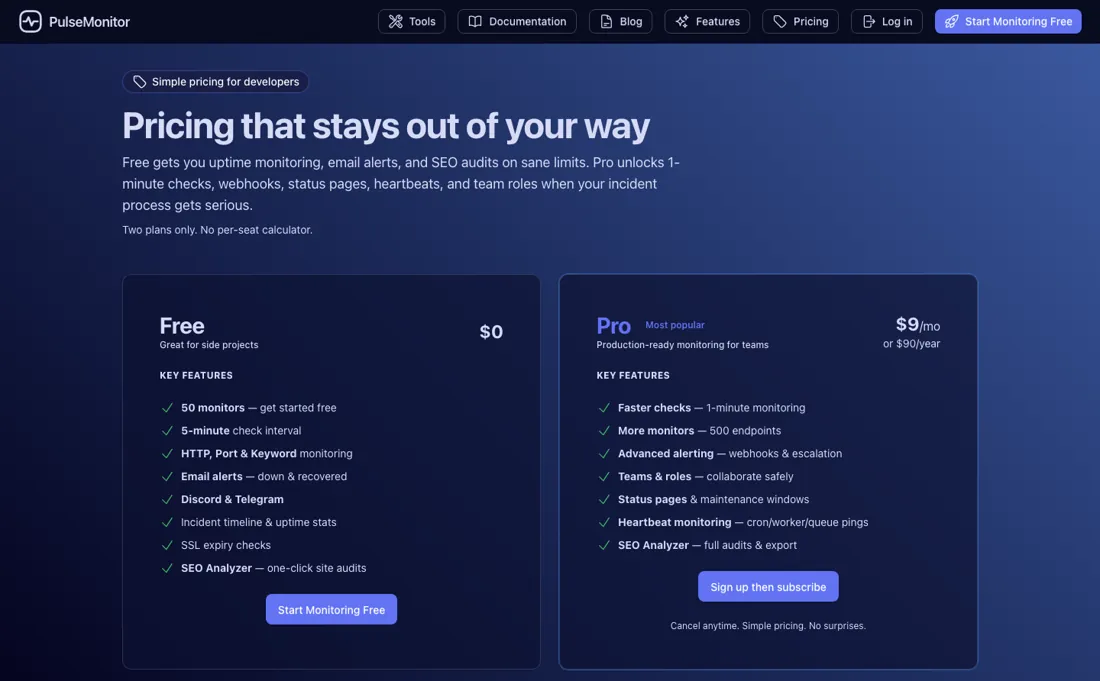
Neither the terms nor the refund policy name the company behind PulseMonitor or the country whose law applies; the terms say only the jurisdiction in which we operate. The free plan checks every 5 minutes and alerts only by email, Discord and Telegram, while Slack, PagerDuty, status pages and cron heartbeats need Pro. The SEO analyzer is a one-click site audit, not rank tracking. We have not used PulseMonitor ourselves.
What PulseMonitor does
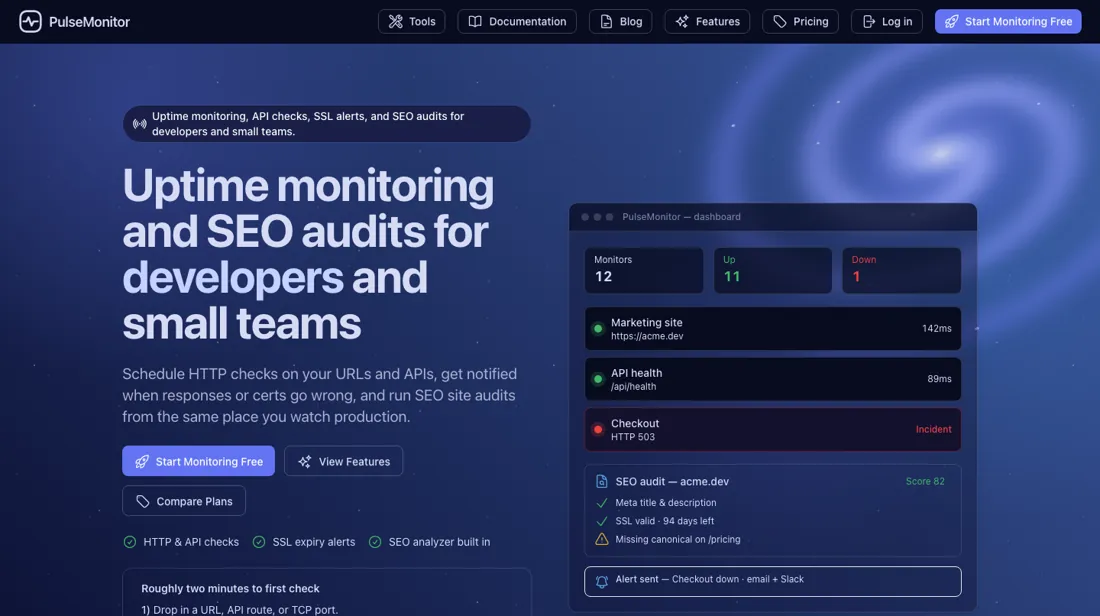
Uptime monitoring for developers and small teams: HTTP, API, port, keyword and SSL checks with incident history, plus a built-in SEO site audit; free plan with 50 monitors and a paid plan for 1-minute checks, webhooks, status pages and heartbeats.
Free watches, Pro wakes you up
Free is a real monitoring plan, not a teaser: 50 monitors is more than most side projects and small apps need, and HTTP, port, keyword, SSL and the SEO analyzer are all included. Its limits are speed and routing. A 5-minute interval means an outage can run up to five minutes before the first check sees it, and alerts go to email, Discord or Telegram only. Pro at $9 a month is about the things around the check.
One-minute polling, webhooks (the pricing page names Slack and PagerDuty as the reason to want them), escalation, status pages for customers, heartbeats that notice a cron job that silently stopped, ping and DNS monitors and JSON validation of API responses are all Pro-only. Retention goes from 3 to 24 months. Yearly billing at $90 against $108 for twelve months is a saving of $18, our arithmetic. Weigh it against the refund policy: annual fees are non-refundable, so a year paid upfront is a year committed.
How to actually use PulseMonitor
Start on Free with your three most important URLs: the home page, a health endpoint of your API and the checkout or login page. Add a keyword check on a page whose content matters, because a page can return 200 while showing an error message, and keyword monitoring is on the free plan. Set up alerts in the channel your team actually reads. On Free that is email, Discord or Telegram; if your on-call lives in Slack or PagerDuty you will need Pro's webhooks.
Run the SEO analyzer once on your own site to see whether that half of the product is useful to you, since it is part of the reason to pick PulseMonitor over a pure uptime tool. Only move to Pro when you can name the trigger: one-minute detection, a public status page, or a cron job that must not fail silently. Pay monthly first; the refund policy gives no refund on a year you no longer want.
Where this section comes from: our research notes (94 words)
PulseMonitor's own pages, read in a live browser on 14 October 2026: the pricing page at pulsemonitor.io/pricing (both plans, the feature matrix with retention, monitor types and Pro-only features), the home page, the refund policy at pulsemonitor.io/refund (last updated 14 October 2026) and the terms at pulsemonitor.io/terms. The terms and the refund policy do not name the company behind the service or its country; the terms refer only to the laws of the jurisdiction in which we operate.
PulseMonitor is an affiliate partner of ours through Lemon Squeezy. We have not used PulseMonitor ourselves.
PulseMonitor vs UptimeRobot, side by side
Each column shows the vendor’s own published entry price, read on the date shown. Entry prices can cover different services or units, so check what each one buys. We do not average them into a score.
Both names above are affiliate links: we may earn a commission if you sign up, at no extra cost to you. Neither changes what this table says.
The natural comparison is UptimeRobot — UptimeRobot is in our dossiers too: Free at $0 and Solo from $144 a year, quoted yearly, read over a US connection on 26 August 2026 and re-checked in euros on 29 September 2026. PulseMonitor, read on 14 October 2026, is $90 a year on Pro for 500 monitors at 1-minute checks with status pages and heartbeats, and adds an SEO analyzer that UptimeRobot does not sell. UptimeRobot is the older, larger service with more published detail about who runs it; PulseMonitor is cheaper on paper and bundles SEO audits..
Frequently asked questions
Is PulseMonitor free?
Yes, read on 14 October 2026: the Free plan includes 50 monitors at a 5-minute interval, HTTP, port and keyword checks, SSL expiry checks, email, Discord and Telegram alerts, the SEO analyzer and 3 months of history, with no credit card. Pro is $9 a month or $90 a year.
Can PulseMonitor alert Slack or PagerDuty?
Through webhooks, which are Pro-only. The pricing page itself says to reach for Pro when alerts must hit Slack or PagerDuty. The free plan alerts by email, Discord and Telegram. Read on 14 October 2026.
Can I get a refund from PulseMonitor?
Generally not. The refund policy, last updated 14 October 2026, says monthly and annual fees are non-refundable and there is no prorated refund on cancellation. Refunds are at their discretion for billing errors, extended outages you reported promptly, or where the law in your country requires one.
Is this a hands-on review of PulseMonitor?
This is a researched assessment, not a hands-on test — where we've used a tool ourselves, we say so explicitly. We name what each tool is good and bad at, and we earn a commission only if you sign up, at no cost to you.
- Read 2026-10-14 in a live browser on pulsemonitor.io/pricing, the home page and the refund policy dated 14 October 2026.
- A dated screenshot of that pricing page, kept on this site as the receipt.
Others in this category
Reviewed developer tools that share ground with PulseMonitor — comparable in what they do, not drop-in swaps:
Also in developer tools, for browsing rather than as an alternative:
New reviews, price changes we recorded, and the cost conditions we found. No sponsored placements. Unsubscribe anytime.
This is our researched assessment — not a paid placement. The “Visit” links on this page are affiliate links: we may earn a commission if you sign up, at no extra cost to you, and it never changes our take. How we review →