 Postscript Review (2026)The $0 Plan Has a $49 Floor
The $0 a month is not free — it carries a $49 monthly minimum spend, which means $49 is your floor whether you send anything or not.
Watch the 2-minute review
Same honest take, in video form — from our YouTube channel.
⚡ Short on time? Watch the 30-second verdict Short.
Pricing (2026)
✓ Pricing re-verified 5 Sep 2026
(2026-08-30, re-read on their own pricing page from a US exit) Starter is shown as $0 a month with a $49 monthly minimum spend, at $0.015 then $0.009 per SMS and $0.045 per MMS, plus carrier fees. Growth is $100 a month at $0.01 then $0.008 per SMS and $0.03 per MMS. Professional is $500 a month at $0.007 per SMS and $0.024 per MMS.
Enterprise is contact-sales. Carrier fees are asterisked on every tier and are quantified in the footnote below the feature list: average US carrier fees of $0.00418 per SMS and $0.00841 per MMS, with the listed rates covering the US 50 states and Canada only. A free trial is offered. Plans change — always verify the live price on their site.
What the pricing page doesn’t say
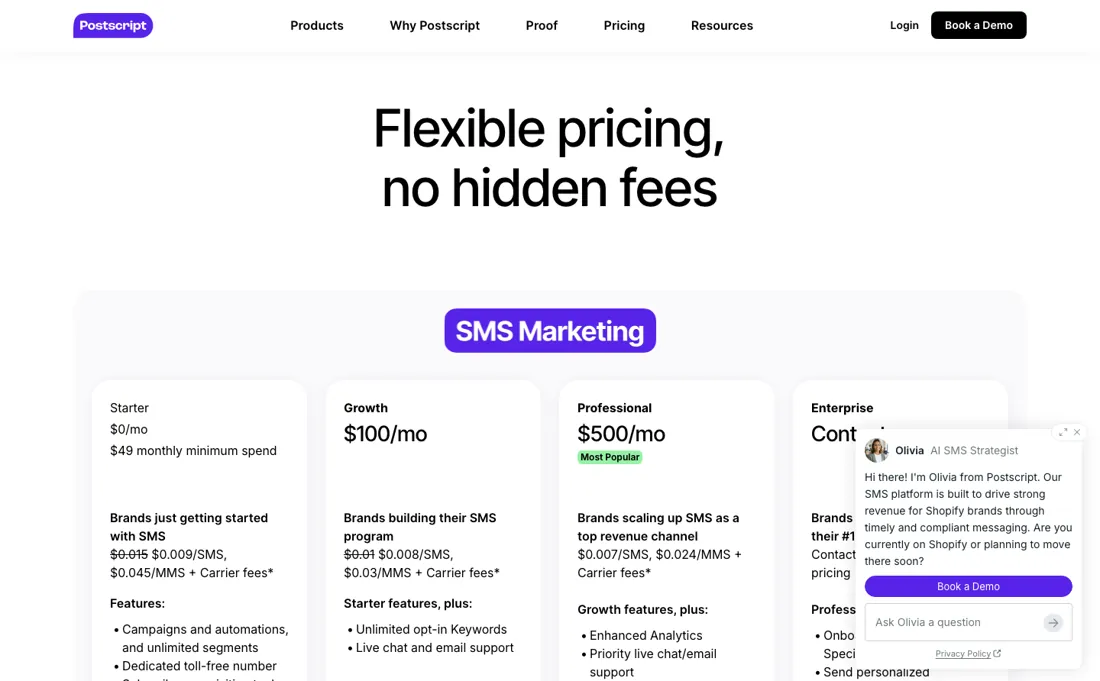
Read the tiers as what they are: a platform fee plus a per-message rate plus carrier fees. That third line is easy to miss because it sits in a footnote rather than on the tier cards, and it is not small: the page puts the average US carrier fee at $0.00418 an SMS and $0.00841 an MMS, so against the $0.009 volume rate on Starter it adds close to half again.
Before you compare this with anything, work out your monthly message volume and multiply it out on all three published tiers: Growth costs $100 more than Starter but saves a fifth of a cent per message, so it pays back somewhere around 50,000 messages a month.
What Postscript does
SMS marketing for Shopify stores: campaigns, automations and opt-in tools.
What buyers report about Postscript
Recurring themes from the buyer-review sites listed at the foot of this page, read in August 2026. We have not run Postscript ourselves, so this is other buyers' experience rather than ours. We summarise it here because the complaints are usually the part a vendor page leaves out.
- • Built only for Shopify, and it shows — the data model and flows are native rather than adapted. Dr. Squatch, Brooklinen and True Classic run on it.
- • The Starter plan is free with pay-per-message pricing, so you can start without a subscription.
- • Support was replaced with AI, and reviewers say so directly — a January 2026 App Store review criticises exactly that, and a 2025 one describes nobody on chat and no email reply.
- • Reviewers report being locked into long-term plans and charged after unsubscribing.
- • Shopify only. If you add another storefront, this does not come with you.
- • The platform fee sits on top of the per-message costs: Growth is $100 a month and Professional $500.
The $0 plan has a $49 floor
Treat that $0 headline as a floor rather than a free plan: the minimum applies whether you send a single message or none at all. Growth is $100 a month, Professional $500, and Enterprise is quoted. On top of any of them sits a per-message rate — Starter at $0.015 then $0.009 an SMS and $0.045 an MMS, Growth at $0.01 then $0.008 and $0.03, Professional at $0.007 and $0.024 — plus carrier fees (2026-08-30, re-read on their own pricing page from a US exit).
So read the tiers as what they are: a platform fee, plus a per-message rate, plus carrier fees that the mobile networks levy per message. That third line does carry a figure, but it sits in a footnote under the feature list rather than on the cards: average US carrier fees of $0.00418 an SMS and $0.00841 an MMS. Put it into your own arithmetic rather than leaving it at the bottom of the page, because against the $0.009 volume rate on Starter it is close to half again on top.
The same footnote draws a boundary the tier cards do not: the listed rates are for the US 50 states and Canada only, so sending anywhere else is not priced here at all. On the tier choice, the arithmetic depends on a boundary the page does not publish — where the introductory rate ends and the volume rate begins. Growth costs $100 more in platform fee. It saves half a cent an SMS at the introductory rate, but only a tenth of a cent at the volume rate.
So the payback sits somewhere between about 20,000 and 100,000 messages a month, depending on how much of your volume falls in each band. Ask where the rate steps down; that single answer settles the decision. Professional is a further $400 for another tenth of a cent an SMS, which needs roughly 400,000 messages a month to justify on text alone. If you send picture messages the answers arrive much sooner.
MMS drops from $0.045 to $0.03, a saving of a cent and a half, so Growth pays for itself at roughly 6,700 MMS a month — a fraction of the SMS threshold. Professional drops it again to $0.024, which pays back at about 67,000 MMS a month against Growth. A picture-heavy programme belongs on the higher tiers long before a text-only one does. There is a free trial, and the honest way to use it is to send one real campaign and read the invoice line by line rather than the dashboard.
How to actually use Postscript
Ask where the rate steps down before you model anything, because that is the one number the page does not give: Starter runs $0.015 then $0.009 an SMS, Growth $0.01 then $0.008, and without the boundary between the two you cannot work out which tier is cheaper for you. The carrier fees the tier cards asterisk are answered, just not next to the price — the footnote below the feature list puts them at $0.00418 an SMS and $0.00841 an MMS on average in the US, and adds that the listed rates cover the US 50 states and Canada only.
Then count your monthly volume and split it by message type, because SMS and MMS answer differently. On text alone the $100 Growth fee pays back somewhere between roughly 20,000 and 100,000 messages a month depending on that boundary; on picture messages it pays back at about 6,700, because MMS drops from $0.045 to $0.03. Budget the floor even in a quiet month. Starter's $0 headline carries a $49 minimum spend, so a month where you send nothing still costs $49 — which also means a seasonal programme should be priced across the whole year rather than its peak.
Use the free trial on one real campaign, and read the resulting invoice line by line rather than the dashboard summary. The platform fee, the per-message rate and the carrier fees appear separately there, which is the only place you will see all three against your own volume.
Distilled from Postscript pricing page (postscript.io/pricing), read 30 August 2026 from a US exit — the four tiers, the $49 minimum spend on Starter, the per-message SMS and MMS rates, and the footnote below the feature list that quantifies average US carrier fees and limits the listed rates to the US 50 states and Canada.
The natural comparison is Attentive or Klaviyo SMS — the direct SMS peers for ecommerce — compare total cost at your real monthly send volume, including carrier fees, not the platform fee.
The ex-banker filter — the same yardstick on every review (how we review): My ex-banker filter is simple: does Postscript remove a real cost — time, errors, missed revenue — bigger than what it charges?
Frequently asked questions
What should I weigh before buying SEO & Marketing software?
Judge it on evidence rather than adjectives. Look for a published security page, single sign-on and role controls on the plan you would actually buy (they are often gated to higher tiers), a status page with real incident history, and a clear answer on where your data is stored. If the tool will hold anything sensitive, those four answers matter more than any feature comparison.
Is this a hands-on review of Postscript?
This is a researched assessment, not a hands-on test — where we've used a tool ourselves, we say so explicitly. We name what each tool is genuinely good and bad at, and we have no affiliate relationship with Postscript — we earn nothing whether you sign up or not.
- Buyer reviews on the Shopify App Store, G2, Capterra and Software Advice, read August 2026.
- 2026-08-30, re-read on their own pricing page from a US exit.
- A dated screenshot of that pricing page, kept on this site as the receipt.
Others in this category
Reviewed seo & marketing tools that share ground with Postscript — comparable in what they do, not drop-in swaps:
New dossiers, cost-traps we found, and tools that earned a keep — no hype, no sponsored-disguised-as-advice. Unsubscribe anytime.
This is our researched assessment — not a paid placement. How we review →