Moosend Review (2026)$7/mo Buys 500 Contacts
 By Daan Haket · Researched and written with an AI assistant · who does what
The friendly $7-9 headline is the entry rate at the smallest list size (500 contacts), and the ladder above it does not fall smoothly: paid annually, 8,000 contacts costs $51 a month while 10,000 costs $70, so a list of 9,000 sits on the wrong side of the sharpest jump on the slider.
small businesses and marketers who want affordable email marketing and automation with a low entry price, a real free trial and a clean drag-and-drop builder.
you run a very large list where per-subscriber pricing adds up, or you only need transactional/API email — a developer-focused sender is cheaper for that.
Transparency: the “Visit” links on this page are affiliate links — we may earn a commission if you sign up, at no extra cost to you. No vendor can pay for a better review or verdict. How we make money →
Pricing (2026)
✓ Pricing re-verified 9 Oct 2026
A 30-day free trial with no credit card. Pro is priced by list size across 21 steps from 500 to 1,000,000 contacts, quoted monthly, biannually (sold as 15% off) or annually (sold as 20% off). At 500 contacts it is $9 monthly, $8 biannual and $7 annual. The ladder is not monotonic per contact: paid annually, 8,000 contacts is $51 a month against $70 at 10,000, 75,000 is $333 against $499 at 100,000, and 500,000 is $2,317 against $2,829 at 600,000 — three steps up the slider that cost more per head than the step below them.
The discounts round to whole dollars and so land short at small sizes: at 1,000 contacts $16 monthly becomes $14 biannual (12.5% off) and $13 annual (18.75% off). Instead of a subscription you can buy email credits outright with no expiry: 350,000 for $350, 500,000 for $500, 750,000 for $750 and 1,000,000 for $1,000 — a flat $0.001 per email with no volume discount.
Full pricing notes (2 more paragraphs)
Above Pro the page shows Moosend+ (a custom plan assembled from add-ons: dedicated IPs, transactional emails, audience discovery, custom dashboards, hosted files, extra team members, SSO and SAML) and Enterprise, both quote-only. On 30 September 2026 all 21 steps on all three billing terms and the four credit packs were identical to the September reading. The comparison table allows 2 team members on the trial and 5 on Pro, with 10 or more on Enterprise, and the FAQ says credit buyers get a notification at 80% use.
Re-read on 9 October 2026 from the page's own selector, Pro per month billed monthly / biannually / annually: 500 $9 / $8 / $7, 1,000 $16 / $14 / $13, 2,000 $24 / $20 / $19, 3,000 $32 / $27 / $26, 5,000 $48 / $41 / $38, 8,000 $64 / $54 / $51, 10,000 $88 / $75 / $70, 25,000 $160 / $136 / $128, 50,000 $315 / $268 / $252, 75,000 $416 / $354 / $333, 100,000 $624 / $530 / $499, 150,000 $936 / $796 / $749, 200,000 $1,216 / $1,034 / $973, 250,000 $1,520 / $1,292 / $1,216, 300,000 $1,808 / $1,537 / $1,446, 400,000 $2,352 / $1,999 / $1,882, 500,000 $2,896 / $2,462 / $2,317, 600,000 $3,536 / $3,006 / $2,829, 700,000 $4,080 / $3,468 / $3,264, 800,000 $4,640 / $3,944 / $3,712, 1,000,000 $5,840 / $4,964 / $4,672.
Plans change — always verify the live price on their site.
Category context: Marketing. Across the 23 tools in this category that we researched with a public US-dollar price, the median entry price is $29 a month (lowest paid plan as listed, per seat where the vendor prices per seat). Moosend’s entry price of $7 a month sits below that median. Compare pricing conditions in the Software Cost Atlas →
What the pricing page doesn’t say
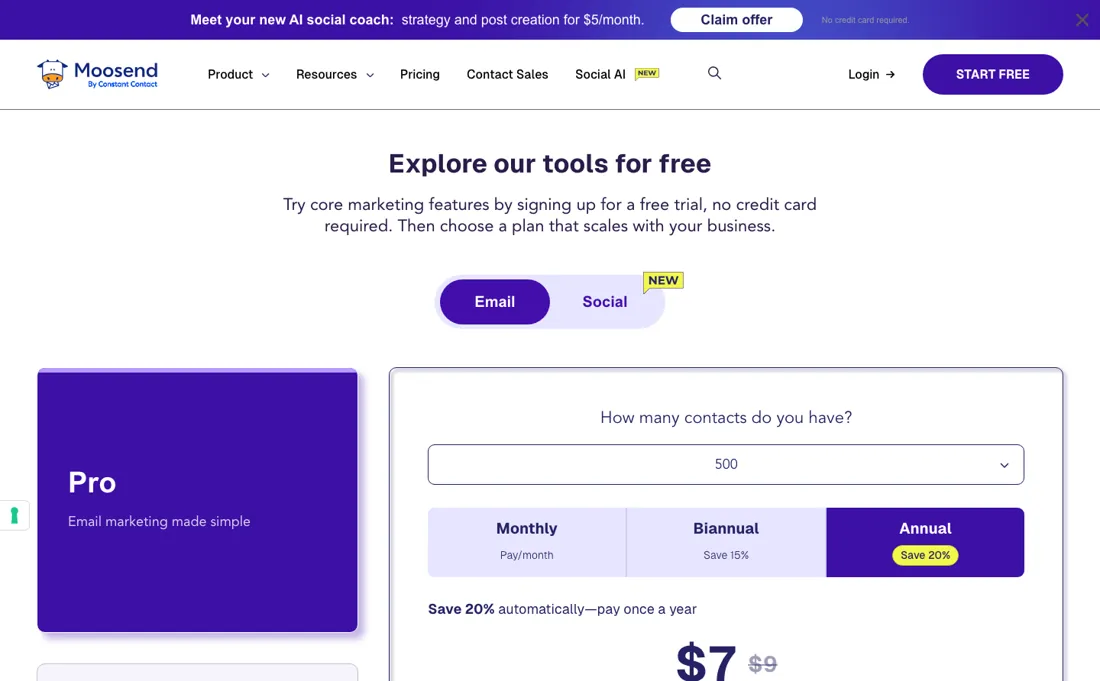
The same reversal repeats at 100,000 and at 600,000. Read the comparison table before you assume Pro covers you, too: transactional emails, SSO and SAML, a dedicated IP, hosted files and an account manager are Moosend+ add-ons or Enterprise rather than included.
Watch the video review
The video version of this review, from our YouTube channel.
⚡ Short on time? Watch the 30-second verdict Short.
What Moosend does
Email marketing and automation platform — drag-and-drop campaigns, automation workflows, landing pages and subscription forms, priced by contact-list size with a 30-day free trial and pay-as-you-go email credits as an alternative.

What buyers report about Moosend
Hands-on: not tested by usDocumented by the vendor: 2 features, read 2026-10-09Reported by buyers: G2, Capterra and Trustpilot, read August 2026
Themes from the buyer-review sites listed at the foot of this page, read in August 2026. We have not run Moosend ourselves, so this is other buyers' experience rather than ours. We summarise it here because the complaints are usually the part a vendor page leaves out.
- • Price against feature set is the reason people choose it — 50-70% below Mailchimp, from $9/month, and the automation builder handles cart abandonment and behaviour flows properly. 4.7 on G2 across 717+ reviews.
- • Live chat in under five minutes is reported by name.
- • Auto-renewal without notice and refused refunds are what the one-star reviews describe.
- • Constant Contact acquired Moosend in June 2025, which leaves genuine uncertainty about the roadmap. Worth weighing if you are committing to it long-term.
- • Above about 50 users the custom pricing turns opaque and the app ecosystem runs thin.
Where the ratings disagree. 4.7 on G2 against 3.4 on Trustpilot across roughly 79 reviews. Small Trustpilot sample, and the theme in it is renewal rather than the product.
Pages read (August 2026): Trustpilot
When the paid plan is worth it
The $7-to-$9 headline is real but it is the price at 500 contacts, the smallest of 21 steps on a slider that runs to a million. The ladder is worth reading step by step, because it does not fall smoothly. Paid annually, 8,000 contacts costs $51 a month and 10,000 costs $70 — 37% more money for 25% more list, and the worst value on the slider below 25,000. The same reversal happens twice more: 75,000 costs $333 where 100,000 costs $499, and 500,000 costs $2,317 where 600,000 costs $2,829.
Per thousand contacts, 8,000, 75,000 and 500,000 are the cheap steps, and the rung above each is dearer per head rather than cheaper. The advertised discounts also round against you at the bottom. Annual billing is sold as 20% off and biannual as 15%; at 1,000 contacts the real figures are 18.75% and 12.5%, because every amount rounds to whole dollars. What none of it buys is transactional email, SSO and SAML, a dedicated IP, hosted files or an account manager.
Those sit in Moosend+ or Enterprise and are quoted separately, so a team needing transactional sending alongside marketing is not buying the plan it thinks it is.
How to actually use Moosend
Price at your own list size and then check the step above and below it, because the ladder reverses in three places. Paid annually, 8,000 contacts is $51 a month and 10,000 is $70, so a list sitting at 9,000 is on the wrong side of the sharpest jump on the slider and trimming it under 8,000 saves $19 a month. The same trap sits at 100,000 and again at 600,000.
Then decide subscription against credits, a genuinely different meter. The packs are 350,000 emails for $350, 500,000 for $500, 750,000 for $750 and a million for $1,000 — a flat tenth of a cent per email, no volume discount at any size, and no expiry date. If you send hard for three months a year that beats paying for list size twelve months a year. Read the comparison table before assuming Pro covers you.
Transactional emails, SSO and SAML, dedicated IPs, hosted files and an account manager are Moosend+ add-ons or Enterprise rather than included. The 30-day trial needs no card.
Where this section comes from: our research notes (105 words)
Moosend's own pricing page (moosend.com/pricing/), read 6 September 2026 from a Netherlands exit — the complete Pro ladder taken from the contact-count selector's own data attributes, which carry the monthly, biannual and annual amount for all 21 steps from 500 to 1,000,000 contacts; the credit packs together with the number of emails each one buys; and the three-column layout of Pro, Moosend+ and Enterprise with the add-on list underneath Moosend+.
moosend.com/llms.txt exists but is 81 bytes long and says nothing about price. Re-read 30 September 2026: the selector's data attributes again for all 21 steps, the credit packs, the comparison table and the credits FAQ.
The natural comparison is Mailchimp — Mailchimp is the recognized incumbent that gets pricey as your list grows; Moosend undercuts it on entry price with comparable automation — just watch how the per-subscriber tiers climb as you scale.
Frequently asked questions
What does Moosend cost?
At 500 contacts, $9 a month billed monthly, $8 biannually or $7 annually, rising with list size across 21 steps to a million contacts. Biannual billing is sold as 15% off and annual as 20%, though at small list sizes the rounding to whole dollars makes it less: at 1,000 contacts it is 12.5% and 18.75%. There is a 30-day trial with no card. Read on 6 September 2026 and unchanged, step for step, on 30 September 2026.
Does the price per contact keep falling as my list grows?
Not everywhere. Paid annually, 8,000 contacts costs $51 a month and 10,000 costs $70 — 37% more for 25% more list. The same reversal happens at 100,000 (against 75,000) and at 600,000 (against 500,000). If your list sits just above one of those thresholds, trimming it back is worth real money.
What is the credit option for?
Senders whose volume is lumpy. Instead of a monthly subscription you buy email credits outright and they do not expire: 350,000 emails for $350, 500,000 for $500, 750,000 for $750 and a million for $1,000. That is a flat tenth of a cent per email with no volume discount at any size, so the packs are worth it for the timing rather than the rate — if you send three big campaigns a year rather than a weekly newsletter, you stop paying for list size in the months you send nothing.
Is this a hands-on review of Moosend?
This is a researched assessment, not a hands-on test — where we've used a tool ourselves, we say so explicitly. We name what each tool is good and bad at, and we earn a commission only if you sign up, at no cost to you.
- Buyer reviews on G2, Capterra and Trustpilot, read August 2026.
- Re-verified 2026-09-06 and again 2026-09-30.
- A dated screenshot of that pricing page, kept on this site as the receipt.
Others in this category
Reviewed marketing tools that share ground with Moosend — comparable in what they do, not drop-in swaps:
New reviews, price changes we recorded, and the cost conditions we found. No sponsored placements. Unsubscribe anytime.
This is our researched assessment — not a paid placement. The “Visit” links on this page are affiliate links: we may earn a commission if you sign up, at no extra cost to you, and it never changes our take. How we review →