EmailListVerify Review (2026)Credits Never Expire
 By Daan Haket · Researched and written with an AI assistant · who does what
The $5 entry pack is the most expensive way to buy: $0.005 per check versus $0.00196 at the 50k tier — a 2.5x spread that rewards guessing your volume upfront.
teams cleaning real sending lists before campaigns — bulk verification at volume rates, with credits that never expire.
you verify tiny batches occasionally (the entry rate is the worst per-check price), or you mainly want prospecting — the finder burns credits five to ten at a time.
Transparency: the “Visit” links on this page are affiliate links — we may earn a commission if you sign up, at no extra cost to you. No vendor can pay for a better review or verdict. How we make money →
Pricing (2026)
✓ Pricing re-verified 19 Sep 2026
Pay-as-you-go credits that never expire: 1,000 for $5 ($0.005/check), 5,000 for $17 ($0.0034), 10,000 for $27 ($0.0027), 25,000 for $54 ($0.00216), 50,000 for $98 ($0.00196), 100,000 for $186 ($0.00186). Monthly subscription at the same volumes: 5,000 for $16 ($0.0032), 10,000 for $25 ($0.0025), 25,000 for $49 ($0.00196), 50,000 for $89 ($0.00178), 100,000 for $168 ($0.00168), 250,000 for $346. The subscription discount runs from 5.9% at 5,000 credits to 9.7% at 100,000, so it grows with volume rather than being a flat rate.
API included at every level; the email finder costs 5 credits per address found when a first or last name is supplied and 10 when only a domain is supplied, charged only on a high- or medium-confidence result (confirmed by EmailListVerify support, 24 Sep 2026). Subscription credits reset each billing cycle; unused ones are lost (same source). Free tools: email validator, inbox-placement test, DMARC/SPF generators.
Note that /llms.txt and /pricing.md both serve the 404 page under an HTTP 200, so the JSON-LD on the pricing page is the machine-readable source here. Plans change — always verify the live price on their site.
Category context: Marketing. Across the 23 tools in this category that we researched with a public US-dollar price, the median entry price is $29 a month (lowest paid plan as listed, per seat where the vendor prices per seat). Compare pricing conditions in the Software Cost Atlas →
What the pricing page doesn’t say
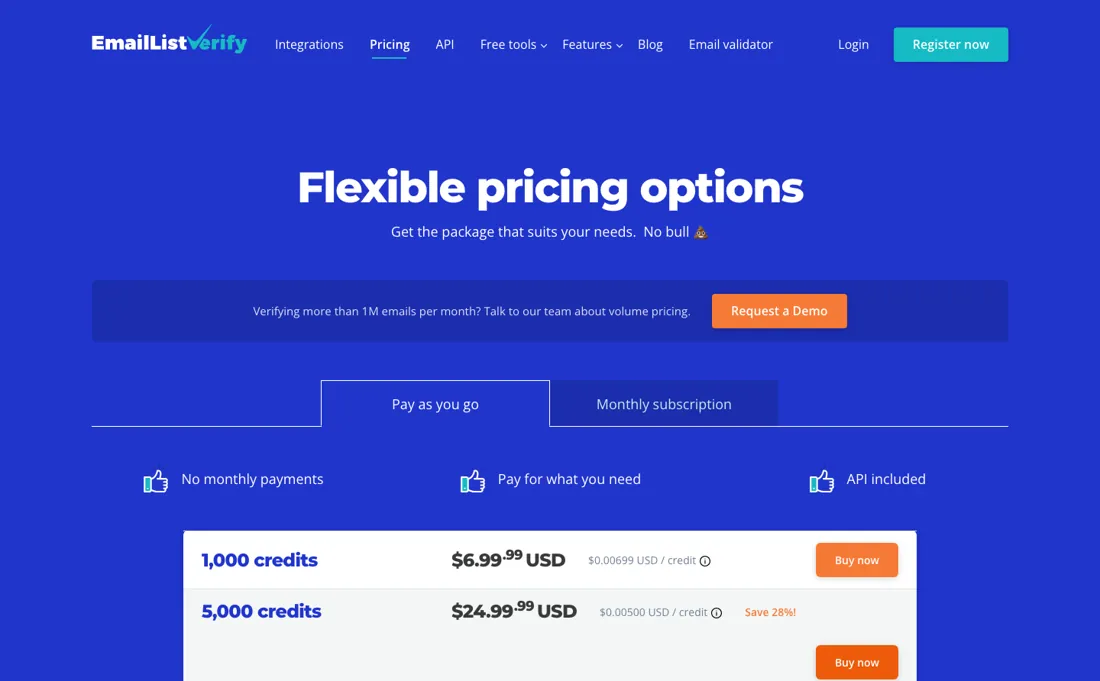
And the email finder quietly consumes 5 credits per found address (10 if you only have the domain), so a 1,000-credit pack finds at most 200 emails, not 1,000. Subscription credits also reset every month, so an unused allowance is simply lost.
Watch the 2-minute review
The video version of this review, from our YouTube channel.
⚡ Short on time? Watch the 30-second verdict Short.
What EmailListVerify does
Email verification with never-expiring pay-as-you-go credits — bulk list cleaning, real-time API, inbox-placement testing and free DMARC/SPF tools, plus a credit-based email finder.
What buyers report about EmailListVerify
Hands-on: not tested by usReported by buyers: G2, Trustpilot, Capterra and independent accuracy comparisons, read August 2026
Themes from the buyer-review sites listed at the foot of this page, read in August 2026. We have not run EmailListVerify ourselves, so this is other buyers' experience rather than ours. We summarise it here because the complaints are usually the part a vendor page leaves out.
- • Credits never expire, unlike competitors that void them after twelve months. For a team that buys in bulk for occasional projects that removes the whole cost pressure.
- • It undercuts the category badly — around $24 per 10,000 addresses against ZeroBounce at $75 and NeverBounce at $50. 4.5 on G2, 4.7 on Trustpilot.
- • The advertised 97% accuracy is not what independent comparisons measure — real-world results land closer to 91% depending on the list. Catch-all domains are where it misclassifies, and that is exactly where enterprise lists live.
- • Reviewers describe the accuracy tiers as disingenuous: cheaper verification produces cheaper results.
- • At least one reviewer reports a refund refused and an error unacknowledged.
Pages read (August 2026): Trustpilot
When the paid plan is worth it
The unusual thing here is that credits never expire, and that single fact should decide how you buy. Pay-as-you-go runs 1,000 checks for $5 (half a cent each), 5,000 for $17, 10,000 for $27, 25,000 for $54, 50,000 for $98 and 100,000 for $186 -- which is $0.00186 a check, about 63% cheaper per check than the smallest bundle. Because nothing expires, buying the biggest bundle you can justify beats buying small repeatedly.
A monthly subscription saves between 6% and 10% against pay-as-you-go, and the discount grows with volume rather than sitting flat: 5,000 credits cost $16 a month against $17 bought outright, while 100,000 cost $168 against $186. A subscription also bills every month whether you verify a list or not, and its credits reset at the end of each billing cycle — EmailListVerify support confirmed on 24 September 2026 that unused subscription credits are lost — while a pay-as-you-go balance waits until you need it.
For anyone cleaning lists in bursts, before a campaign or after an import, that single-digit discount is cheap insurance to skip; for steady weekly volume it is free money. Decide on your rhythm, not on the percentage. One rate to note separately: the email finder costs 5 credits per address found when you supply a name and 10 when you supply only a domain -- five to ten times the price of verifying one, charged only on a high- or medium-confidence result.
Budget those two apart. The API is included at every level, and the free validator, inbox-placement test and DMARC/SPF generators cost nothing at all.
How to actually use EmailListVerify
Estimate your volume for the year, not the month, because credits never expire. That single fact removes the usual risk of buying too big, and the spread is severe: 1,000 credits at $5 is $0.005 a check, while 50,000 at $98 is $0.00196. Buying fifty thousand credits a thousand at a time would cost $250 for the same work — so if you will get through a large pack within a sensible horizon, buy it now and save well over half.
Test with the free validator first. There is a free email validator, an inbox-placement test and DMARC and SPF generators on the site, and running a sample of addresses you already know the status of tells you whether the verdicts match reality before you commit credits to a list. Budget the email finder separately. It consumes five credits per address found when you give it a name, and ten when you give it only a domain, so a 1,000-credit pack finds at most two hundred addresses rather than a thousand — and only a hundred from bare domains.
You are charged only for high- or medium-confidence hits, but the distinction still catches people out halfway through a prospecting run. And fix your authentication while you are there. The DMARC and SPF generators are free, and a clean list sent from an unauthenticated domain still lands in spam — verification improves your list, not your reputation.
Where this section comes from: our research notes (138 words)
Vendor pricing page https://www.emaillistverify.com/pricing (read 2026-08-31 from a European exit) -- the full pay-as-you-go and monthly-subscription ladders with per-credit rates were taken from the JSON-LD Offer/UnitPriceSpecification blocks embedded in that page, and the email-finder rate of 5 credits per address found at medium-or-higher confidence from the FAQ on the same page. Checked and rejected as sources on the same date: https://www.emaillistverify.com/llms.txt and https://www.emaillistverify.com/pricing.md, which both return the site's 404 document under an HTTP 200 status.
Two points the page leaves open were answered by EmailListVerify support (Lucia) by email on 24 September 2026: monthly subscription credits reset every billing cycle and unused ones are lost, and the email finder charges 5 credits when a first and/or last name is supplied and 10 when only a domain is supplied, only on a high- or medium-confidence result (API doc: https://api.emaillistverify.com/api-doc#/Verification%20Endpoints/findContact).
EmailListVerify vs Bouncer, side by side
Each column shows the vendor’s own published entry price, read on the date shown. Entry prices can cover different services or units, so check what each one buys. We do not average them into a score.
Both names above are affiliate links: we may earn a commission if you sign up, at no extra cost to you. Neither changes what this table says.
The natural comparison is Bouncer — Bouncer leans into deliverability polish and EU data residency; EmailListVerify wins on raw per-check price at volume, with never-expiring pay-as-you-go credits.
Frequently asked questions
The page says a subscription saves 10% over pay-as-you-go. Does it?
Not at any volume they print. Work the two columns against each other and the saving runs from 5.9% to 9.7%: 5,000 credits cost $17 one-off against $16 a month, 10,000 $27 against $25, 25,000 $54 against $49, 50,000 $98 against $89, and 100,000 $186 against $168. That last one, $18 off $186, is the closest to the promise and still short of it. The 10% is a headline, not a rate, and the real discount grows with volume rather than being flat — so at the small end you are paying a subscription for a saving of one dollar.
Do my credits disappear at the end of the month?
Only on the monthly subscription. The FAQ says pay-as-you-go credits do not expire and keep working until you use them up, and every pay-as-you-go entry in their pricing data repeats the phrase. The pricing page itself says nothing about leftover subscription credits, so we asked EmailListVerify support, and on 24 September 2026 they answered plainly: monthly subscription credits reset every billing cycle, and whatever you have not used in that month is lost. So if you buy the $168 subscription for 100,000 a month and use 60,000, the other 40,000 are gone. That is the real price of the subscription discount — it only pays if you reliably use the allowance every month.
I want to find addresses, not just check them. What does that cost?
It comes out of the same balance, which is convenient and easy to underestimate. The FAQ says you can split credits between verification and the email finder as you like. What a lookup costs depends on what you give it: EmailListVerify support confirmed on 24 September 2026 that a search costs 5 credits when you supply a first name, a last name or both, and 10 credits when you supply only the domain — and that you are charged only when it returns a result at high or medium confidence, so a search that finds nothing costs nothing. At the smallest $5 pack that is about 2.5 cents per found address with a name and 5 cents with a domain only; at the 100,000-a-month subscription rate about 0.8 and 1.7 cents. There is no separate finder allowance to budget — a heavy finding week eats the list-cleaning credits you bought it for.
Is this a hands-on review of EmailListVerify?
This is a researched assessment, not a hands-on test — where we've used a tool ourselves, we say so explicitly. We name what each tool is good and bad at, and we earn a commission only if you sign up, at no cost to you.
- Buyer reviews on G2, Trustpilot, Capterra and independent accuracy comparisons, read August 2026.
- Re-verified 2026-08-31 on emaillistverify.com/pricing, read from the page's own JSON-LD offer data.
- A dated screenshot of that pricing page, kept on this site as the receipt.
Others in this category
Reviewed marketing tools that share ground with EmailListVerify — comparable in what they do, not drop-in swaps:
New reviews, price changes we recorded, and the cost conditions we found. No sponsored placements. Unsubscribe anytime.
This is our researched assessment — not a paid placement. The “Visit” links on this page are affiliate links: we may earn a commission if you sign up, at no extra cost to you, and it never changes our take. How we review →