 EasyDMARC Review (2026)From $35.99/mo for Two Domains
You are buying domains and history, not features.
Visit EasyDMARC → Affiliate link — the rest of this page is the honest version, including who should skip it.
Watch the 2-minute review
Same honest take, in video form — from our YouTube channel.
⚡ Short on time? Watch the 30-second verdict Short.
Pricing (2026)
✓ Pricing re-verified 17 Sep 2026
- Plus — $US 35.99/mo billed annually$44.99 monthly; 2 domains, 3 months of report history, 1 invited user
- Premium — $US 71.99/mo billed annually$89.99 monthly; 4 domains, a year of history, TLS reports
- Enterprise — quotedunlimited emails and users, 3 years of history, managed services
Plus is 44.99 a month, or 35.99 billed annually, for 2 domains, three months of report history and one invited user. Premium is 89.99, or 71.99 annually, for 4 domains, a year of history, TLS reports, EasySPF, alert management and unlimited invited users, with a dedicated CS manager on the yearly plan. Enterprise is quoted and carries three years of history, unlimited users and domains, managed services, a dedicated DMARC engineer, SSO, audit logs, reputation monitoring and API access.
Annual billing is marked as 20% off plus bonus features, and MSPs and MSSPs get a separate tab with their own ladder. The number that actually sets your tier is monthly email volume: each card has its own selector, running 100,000 to 1,000,000 messages on Plus and up to 5,000,000 on Premium, so the headline is the floor for the smallest bracket.
Prices are exclusive of taxes and taxes may be applied at checkout. On the currency: read from the Netherlands the page prints these as euro amounts and read over a US connection as the identical dollar figures — €44.99 there is $44.99 here, so the symbol changes and the number does not. Plans change — always verify the live price on their site.
What the pricing page doesn’t say
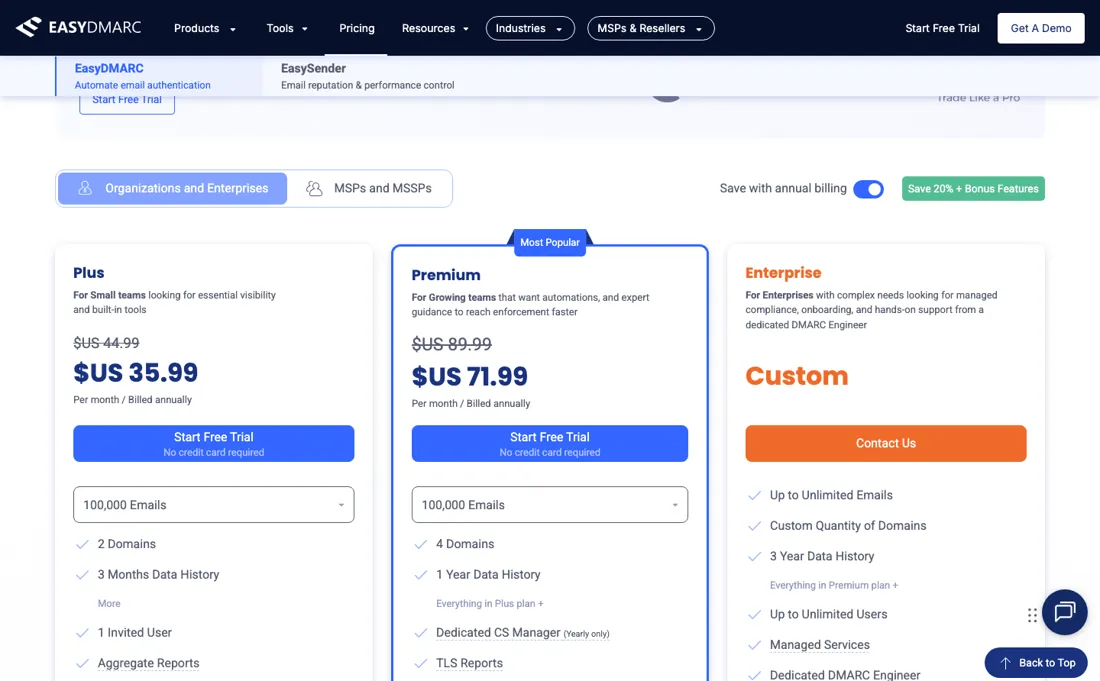
Plus covers two domains; a company with a main domain, a marketing subdomain and a legacy domain it forgot about is already over. And the history window is the part that bites later: three months on Plus means that when you are investigating a spoofing campaign that started in the spring, the reports are gone. The page also does not say what happens when you pass the message volume. Their own FAQ does: you lose access to your reports and dashboard rather than being billed for overage.
That is a harsher failure mode than an overage charge, and worth knowing before you size the plan.
What EasyDMARC does
DMARC, SPF and DKIM monitoring — stop others sending email as your domain.
What buyers report about EasyDMARC
Recurring themes from the buyer-review sites listed at the foot of this page, read in August 2026. We have not run EasyDMARC ourselves, so this is other buyers' experience rather than ours. We summarise it here because the complaints are usually the part a vendor page leaves out.
- • Dashboard clarity is the reason people pick it over the harder DMARC tools — 4.8 on G2 across 165 reviews.
- • Support is quick and knowledgeable by consistent account.
- • The free tier was cut from unlimited domains to one, and reviewers report prices doubling. If you signed up under the old terms, check what you are on now.
- • Free covers 2 domains; $39.99/month covers 5. It gets expensive fast in a multi-domain environment.
- • The pricing structure itself confuses reviewers.
- • A DKIM detection bug features in the Trustpilot complaints.
When the paid plan is worth it
Read the comparison table rather than the feature bullets, because what you are buying is domains, history and message volume. Free carries 1 domain, 1,000 messages a month, 14 days of history and 1 invited user. Plus at €44.99 a month (€35.99 billed annually) takes that to 2 domains, 3 months of history and still 1 invited user. Premium at €89.99 (€71.99 annually) is the first tier with room for a team: 4 domains, 1 year of history and unlimited invited users.
Enterprise is quote-only for up to unlimited domains, 3 years of history and the managed pieces. So upgrading to Plus does not give you a second person in the tool — that gap closes only at Premium, and the dedicated customer-success manager it adds is stated as yearly billing only. Nor does any upgrade shorten the DNS work: SPF, DKIM and DMARC records still have to be published and moved to enforcement by you or your provider. Prices are exclusive of taxes.
How to actually use EasyDMARC
The unpaid route is genuinely useful first. Their free record checkers and generators — DMARC, SPF, DKIM, BIMI, MX and a domain scanner — let you see what your domain publishes today and generate a syntactically valid DMARC record before you sign up for anything. From there the pattern is the standard one: publish a DMARC TXT record at p=none with the reporting address pointing at the platform, let aggregate reports arrive, identify every legitimate sender they reveal, and only then tighten the policy.
Two managed options exist to keep you out of DNS afterwards. Managed DMARC routes the record through a single CNAME so policy changes happen in the dashboard rather than at your registrar, and EasySPF flattens SPF dynamically to survive the ten-lookup limit after a one-time DNS change. The free tier's 14-day history is the constraint while you are still learning what your senders are.
Distilled from Vendor pricing page with its full plan comparison table (easydmarc.com/pricing) and the vendor's own machine-readable index describing the free tools, Managed DMARC and EasySPF (easydmarc.com/llms.txt), both read 18 August 2026. The vendor knowledge base at support.easydmarc.com renders client-side and returned no readable text.
The natural comparison is Valimail or dmarcian — the direct DMARC-platform peers — compare on domains included and history retention, not on the feature list.
More on EasyDMARC
Everything we publish about EasyDMARC links back here — the review stays the honest hub:
The ex-banker filter — the same yardstick on every review (how we review): My ex-banker filter is simple: does EasyDMARC remove a real cost — time, errors, missed revenue — bigger than what it charges?
Frequently asked questions
What sets my EasyDMARC tier — domains or email volume?
Both, and the volume selector is the one buyers miss. Read on easydmarc.com/pricing on 17 September 2026: the headline rate on each card is the floor for its smallest volume bracket, and each card carries its own selector on top. Plus runs from 100,000 to 1,000,000 messages a month; Premium adds a 5,000,000 step; Enterprise is quoted for anything above. So the 44.99 a month on Plus (35.99 billed annually) buys 2 domains, three months of report history and one invited user at the smallest volume bracket, and 89.99 on Premium (71.99 annually) buys 4 domains, a year of history, TLS reports, EasySPF, alert management and unlimited invited users. Annual billing is marked as 20% off plus bonus features. Prices exclude tax, and their FAQ says tax may be applied at checkout.
What happens if I go over my monthly email volume?
You lose the reporting, which is a harsher failure than a bill. Their own FAQ, read 17 September 2026, puts it plainly: exceed your plan quota and you lose access to your reports and dashboard, and access is restored once you upgrade. There is no overage rate on the page, so this is not a question of paying more that month — the product stops showing you anything until you move up a tier. That matters most in exactly the situation you bought it for: a spoofing campaign that spikes your report volume is also the moment the dashboard goes dark. Two softer facts from the same FAQ are worth knowing alongside it. Upgrading mid-term applies a prorated credit from your old plan, so you pay the difference rather than the full new price, and annual plans paid by card renew automatically.
I have more than two domains — what does that cost?
The page will not tell you, and that is the single biggest gap in this price list. Read 17 September 2026: Free covers 1 domain, Plus 2, Premium 4, and Enterprise a custom quantity. The FAQ's answer to needing extra domains is to email sales@easydmarc.com for an understanding of the pricing — there is no published per-domain add-on rate anywhere on the page. So a company with a main domain, a marketing subdomain and a legacy domain it forgot about is already past Plus, and a fourth takes it to the edge of Premium. Count your sending domains before you compare tiers, including the parked and legacy ones, because those are exactly the domains an attacker will spoof and the reason the reporting exists. Data history scales with the same ladder: 14 days free, 3 months on Plus, 1 year on Premium, 3 years on Enterprise.
What should I weigh before buying Security software?
Judge it on evidence rather than adjectives. Look for a published security page, single sign-on and role controls on the plan you would actually buy (they are often gated to higher tiers), a status page with real incident history, and a clear answer on where your data is stored. If the tool will hold anything sensitive, those four answers matter more than any feature comparison.
Is this a hands-on review of EasyDMARC?
This is a researched assessment, not a hands-on test — where we've used a tool ourselves, we say so explicitly. We name what each tool is genuinely good and bad at, and we earn a commission only if you sign up, at no cost to you.
- Buyer reviews on G2, Capterra, GetApp and Trustpilot, read August 2026.
- Re-read 2026-09-17 on easydmarc.com/pricing, which now redirects to /pricing/easydmarc/businesses; every amount and every plan limit below is unchanged since 26 August 2026.
- A dated screenshot of that pricing page, kept on this site as the receipt.
Others in this category
Nothing we have reviewed in security does the same job as EasyDMARC; these are neighbours by category only:
New dossiers, cost-traps we found, and tools that earned a keep — no hype, no sponsored-disguised-as-advice. Unsubscribe anytime.
This is our researched assessment — not a paid placement. The “Visit” links on this page are affiliate links: we may earn a commission if you sign up, at no extra cost to you, and it never changes our take. How we review →