 CrowdStrike Review (2026)Falcon Go Caps at 100 Devices
Two numbers decide whether this is for you, and neither is the headline.
Watch the 2-minute review
Same honest take, in video form — from our YouTube channel.
⚡ Short on time? Watch the 30-second verdict Short.
Pricing (2026)
✓ Pricing re-verified 28 Aug 2026
(2026-08-28, taken from the bundle table on their pricing page; the three published per-device rates have not moved since 1 Aug 2026) Priced per device. Falcon Go $7.99 per device per month, or $59.99 per device billed annually — capped at a maximum of 100 devices. Falcon Pro $14.99 monthly or $99.99 annually per device. Falcon Enterprise $19.99 per device per month, or $184.99 per device billed annually — a rate the 1 Aug reading recorded as unpublished.
Larger tiers and managed services are quote-only. The free trial is a single 15-day Falcon Free Trial covering Next-Gen Antivirus, Device Control and Express Support, not a trial of each paid tier. Annual subscriptions are billed in full at the start of the term and can be cancelled within 30 days for a full refund. Plans change — always verify the live price on their site.
What the pricing page doesn’t say
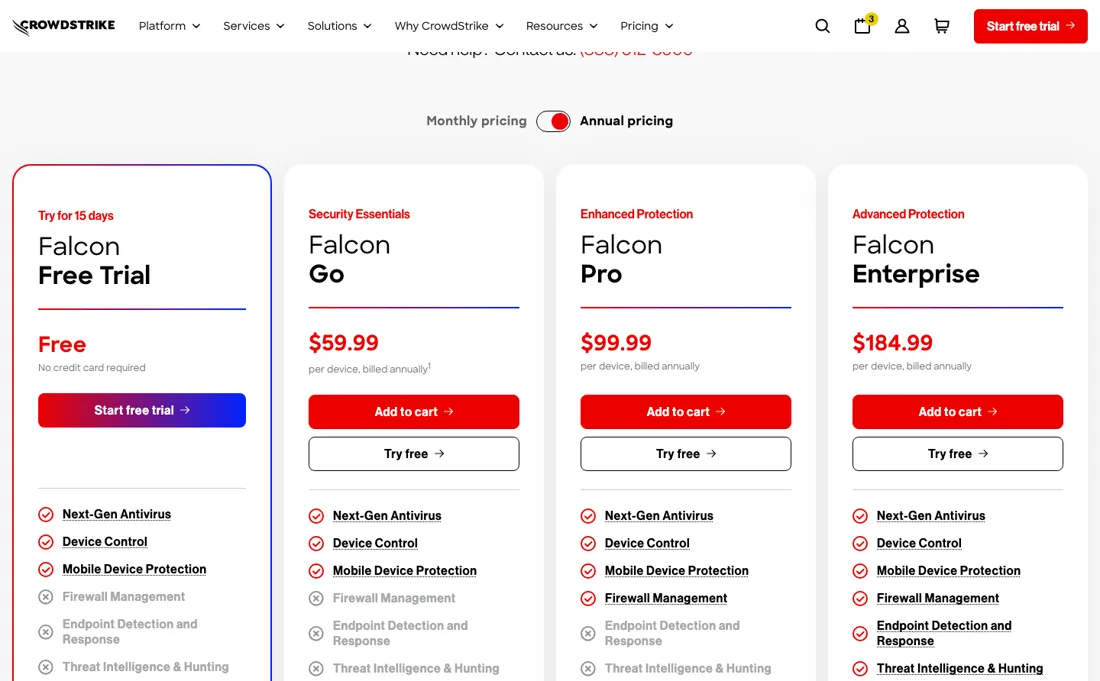
The first is the 100-device ceiling on Falcon Go: it is not a soft limit you grow through, it is the point where you change product. The second is the annual rate, which is worth doing the division on — $59.99 a year against $7.99 a month is $95.88, so annual saves 37%, one of the larger annual discounts in security software. Beyond that, be honest with yourself about which tier you are comparing: Go is antivirus with a good agent, and the endpoint detection and response that CrowdStrike is famous for starts at Pro.
Comparing Go against a full EDR product from a competitor is comparing the wrong things.
What CrowdStrike does
Endpoint protection built around a cloud-delivered agent: antivirus, EDR and threat hunting.
What buyers report about CrowdStrike
Recurring themes from the buyer-review sites listed at the foot of this page, read in August 2026. We have not run CrowdStrike ourselves, so this is other buyers' experience rather than ours. We summarise it here because the complaints are usually the part a vendor page leaves out.
- • Detection and threat hunting are best in class — that is the consensus even among reviewers who complain about everything else. 8.6 out of 10 on PeerSpot.
- • Falcon Go at $5 per device brought it within reach of small businesses for the first time.
- • A full EDR deployment at $15+ per device costs three to four times Bitdefender or ESET. You are paying for the detection, so decide whether you need that grade.
- • Module complexity — working out which tier and which modules you actually need is itself a project.
- • Year-over-year increases run 5-8%, and contracts auto-renew on a one-year term with notice required to cancel. Diarise it.
- • Fully loaded runs $15-$25 per endpoint per month; managed Falcon Complete lands around $200-$400 per endpoint per year at 1,000-endpoint scale.
When the paid plan is worth it
Priced per device, and the annual discount is where the tier decision quietly gets made. Falcon Go is $7.99 a device monthly or $59.99 a year -- a 37% saving. Falcon Pro is $14.99 monthly or $99.99 a year, 44%. Because the discount is bigger on Pro, the gap shrinks when you commit: paying monthly, Pro costs 88% more than Go; paying annually, only 67% more. If you were going to sign for a year anyway, the upgrade is cheaper than the monthly rates make it look.
The harder constraint is not price but the ceiling: Falcon Go is capped at 100 devices. Growing past it forces a move regardless of the feature set, so if you are near a hundred endpoints, price Pro now rather than migrating mid-year. Falcon Enterprise is $19.99 per device per month or $184.99 a year -- a 23% saving, the smallest of the three -- and everything above it is quote-only.
One caution on the trial: it is a single 15-day product covering antivirus, device control and support rather than a trial of each tier, so it cannot settle the Go-versus-Pro question -- the EDR that separates them is not in it.
How to actually use CrowdStrike
Count your devices first: the 100-device ceiling on Falcon Go is not a limit you grow through, it is the point at which you change product. If you are near it, evaluate Pro from the start rather than migrating under pressure later. Then make sure you are comparing the right thing. Falcon Go is antivirus with a very good agent; the endpoint detection and response that CrowdStrike is known for begins at Pro.
Putting Go side by side with a competitor's full EDR product compares two different categories, and it is the most common mistake here. The free trial will not settle it: it is one 15-day product covering antivirus and device control, without the EDR that separates the tiers. Take annual billing if you take anything. At $59.99 a year against $7.99 a month, Go saves 37%, and Pro at $99.99 against $14.99 saves 44% — unusually large discounts for security software, large enough to be part of the decision rather than a footnote.
Roll it out to a pilot group before the fleet. Endpoint agents are the class of software where a conflict with something already installed shows up as a slow laptop rather than an error message — find that on ten machines, not three hundred.
Distilled from CrowdStrike's own Falcon Go pricing page, crowdstrike.com/en-us/pricing/falcon-go/, read 10 September 2026 from a Netherlands exit (the page quotes US dollars and states 'All prices listed are in US Dollars'): the monthly/annual toggle on the plan cards, the line 'Purchases of Falcon Go are limited to a maximum of 100 devices', the trial offer 'Try Falcon Go free for 15 days', the 30-day money-back assurance, and the comparison rows for Falcon Go at $59.99 per device billed annually or $7.99 billed monthly against Falcon Pro at $99.99 billed annually. The 37 per cent figure is our own arithmetic on those two numbers ($7.99 x 12 = $95.88 against $59.99), not a saving CrowdStrike advertises.
The natural comparison is SentinelOne or Microsoft Defender for Business — the direct endpoint peers — Defender is often already in your Microsoft licence, so price that first before comparing per-device rates.
The ex-banker filter — the same yardstick on every review (how we review): My ex-banker filter is simple: does CrowdStrike remove a real cost — time, errors, missed revenue — bigger than what it charges?
Frequently asked questions
What should I weigh before buying Security software?
Judge it on evidence rather than adjectives. Look for a published security page, single sign-on and role controls on the plan you would actually buy (they are often gated to higher tiers), a status page with real incident history, and a clear answer on where your data is stored. If the tool will hold anything sensitive, those four answers matter more than any feature comparison.
Is this a hands-on review of CrowdStrike?
This is a researched assessment, not a hands-on test — where we've used a tool ourselves, we say so explicitly. We name what each tool is genuinely good and bad at, and we have no affiliate relationship with CrowdStrike — we earn nothing whether you sign up or not.
- Buyer reviews on PeerSpot, Software Advice and practitioner write-ups, read August 2026.
- CrowdStrike’s own published pricing page.
- A dated screenshot of that pricing page, kept on this site as the receipt.
Others in this category
Reviewed security tools that share ground with CrowdStrike — comparable in what they do, not drop-in swaps:
Also in security, for browsing rather than as an alternative:
New dossiers, cost-traps we found, and tools that earned a keep — no hype, no sponsored-disguised-as-advice. Unsubscribe anytime.
This is our researched assessment — not a paid placement. How we review →