 AISDR Review (2026)
AISDR is priced like an SDR salary because it's meant to replace part of that function — so judge it on cost-per-meeting, not the sticker, and expect a quarterly commitment rather than a flip-the-switch monthly.
Visit AISDR → Affiliate link — the rest of this page is the honest version, including who should skip it.
Watch the 2-minute review
Same honest take, in video form — from our YouTube channel.
⚡ Short on time? Watch the 30-second verdict Short.
Pricing (2026)
✓ Pricing re-verified 17 Aug 2026
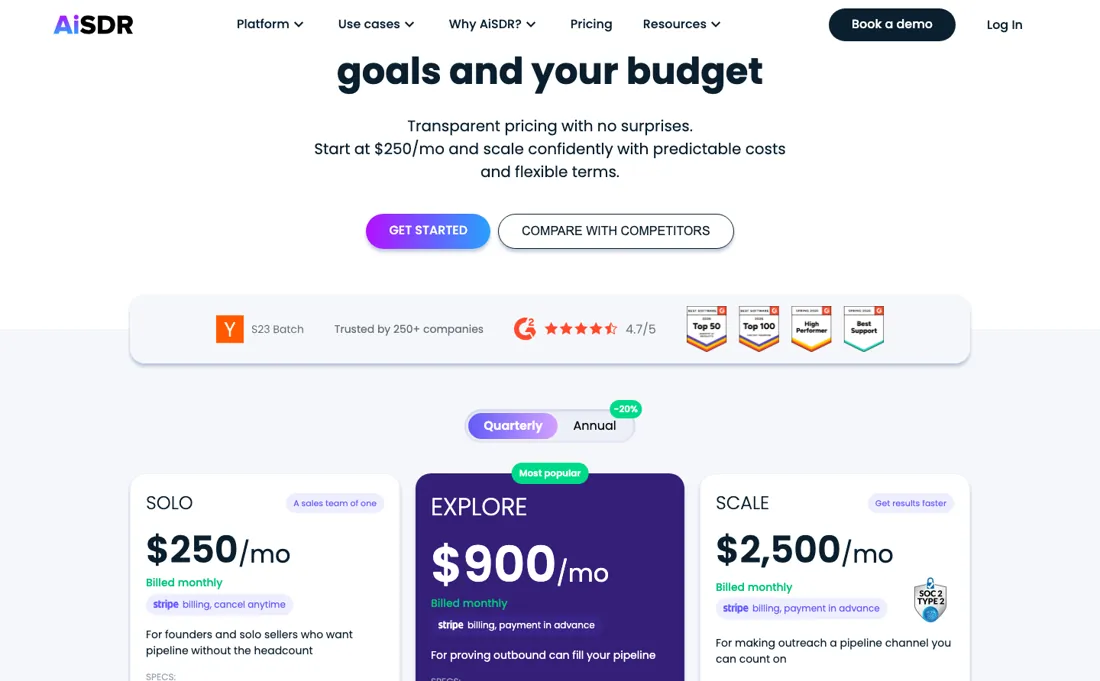
There are three published plans. Solo is $250/mo or $2,400/yr for a sales team of one: 200 AI-researched contacts a month, 1 user, 1 domain, 3 mailboxes, month-to-month. Explore is $900/mo or $8,640/yr (800 contacts a month, unlimited users, 2 domains, 6 mailboxes), and Scale $2,500/mo or $24,000/yr. Annual billing takes 20% off. Explore and Scale carry a quarterly commitment; Solo runs month to month.
Managed service is extra: +$149 per campaign, or fully managed from +$2,500/mo. Enterprise is custom. Priced by contact volume rather than by seat above Solo. Plans change — always verify the live price on their site.
Correction after re-checking: (re-verified 2026-07-24) AiSDR now lists a $250/mo Solo entry tier (200 AI-researched contacts, 1 user, 3 mailboxes) below the $900/mo Explore plan. The top published tier is Scale at $2,500/mo for 2,500 contacts with 18 mailboxes. That replaces the older single $900-minimum entry point and the higher per-plan "message" allowances. Solo is billed monthly and cancelable anytime; Explore and Scale are quarterly contracts paid in advance.
What the pricing page doesn’t say
Autonomous AI outreach is only as good as your targeting, list quality and messaging guardrails; point it at a bad list and you'll automate bad outreach (and risk your sending reputation). For teams with a solid ICP and offer, it can book meetings at a real cost-per-meeting; for those still figuring out messaging, it's premature.
What AISDR does
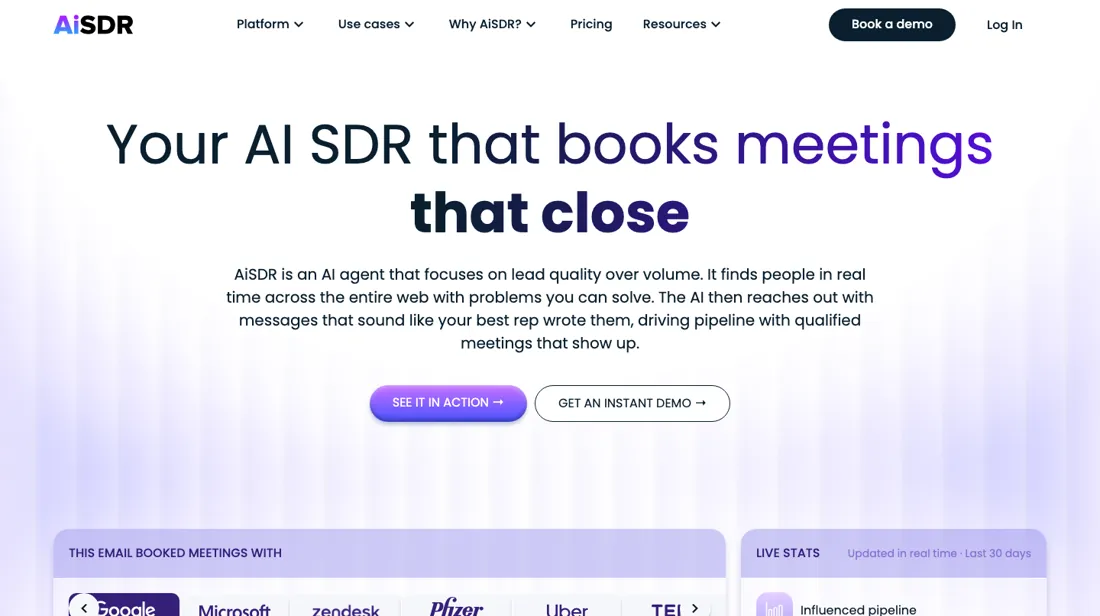
Deploy an autonomous AI Sales Development Rep. It qualifies leads, books meetings, and handles initial outreach conversations 24/7.
What buyers report about AISDR
Recurring themes from the buyer-review sites listed at the foot of this page, read in August 2026. We have not run AISDR ourselves, so this is other buyers' experience rather than ours. We summarise it here because the complaints are usually the part a vendor page leaves out.
- • Personalisation at speed is the recurring praise — it pulls from LinkedIn, company sites and public data and reviewers say the output reads human. 4.6 on G2 across 89+ reviews.
- • Live in about 7 days with a dedicated onboarding engineer, which reviewers say beats the competitors they tried.
- • Quarterly billing with no free trial is the single most frequent criticism. The minimum commitment is around $2,700 up front, which makes it hard to evaluate against alternatives.
- • Billing is by emails sent, not seats, so a two-person team and a twenty-person team pay the same at the same volume. Model it on throughput.
- • Sequence customisation runs out on complex qualification workflows.
- • Reply accuracy slips in edge cases, and the automated reply can reach the prospect before anyone reviews it.
When the paid plan is worth it
AiSDR has no free tier and no pay-per-use option, so the real decision is which paid step to buy. Solo at $250/mo (200 AI-researched contacts, 1 user, 3 mailboxes) fits a founder validating whether the AI's copy actually earns replies before committing budget; it is billed monthly and cancelable anytime. Explore at $900/mo pays for itself once more than one person needs access: it adds unlimited users and 6 mailboxes, and the extra mailboxes matter more than the higher 800-contact ceiling.
Scale at $2,500/mo (2,500 contacts, 18 mailboxes) only earns its keep if you can genuinely feed that volume. Note that Explore and Scale are quarterly contracts paid in advance, not month-to-month like Solo. Upgrading buys reach, not results — it does not fix weak targeting, off-tone messages, or a cold domain. Because AiSDR runs domain warmup before full sending, you pay before peak volume arrives; and if replies are flat at Solo volume, a bigger tier just sends more of the same. Annual billing takes 20% off.
Our monthly capture read this vendor's pricing page in July 2026 and again in August 2026, and the amounts were the same both times. We keep watching — the registry records what moves.
How to actually use AISDR
The self-serve route is five steps: request and assign mailboxes on new domains, invite your team and connect LinkedIn, build AI sales personas by answering a short questionnaire, connect your CRM, then launch campaigns from the Campaigns page. AiSDR frames this as minutes from sign-up to sending. The real gate to first value is infrastructure, not the software: new domains need a warmup period before you can safely send at volume, so being "launched" and "producing replies" are not the same milestone. Budget for that warmup gap, not just setup time.
Distilled from vendor documentation and independent walkthroughs
The natural comparison is 11x or a human SDR / Instantly-style stack — other AI-SDR tools or a human rep — compare cost-per-meeting; AISDR bills by message volume with unlimited seats.
More on AISDR
Everything we publish about AISDR links back here — the review stays the honest hub:
The ex-banker filter — the same yardstick on every review (how we review): My ex-banker filter is simple: does AISDR remove a real cost — time, errors, missed revenue — bigger than what it charges? If the job above is genuinely yours, it's worth a look. We never publish fake or “exclusive” prices, so always confirm the current plan on their site.
Frequently asked questions
What should I weigh before buying Growth & Revenue software?
It depends on whether you have the bottleneck it solves. Small teams get the most out of this category when one clear problem is already costing real hours or revenue; buying ahead of that just adds cost and another login. Price it against the hours or lost deals it removes, not against its feature list, and start on the smallest plan that covers the job.
Is this a hands-on review of AISDR?
This is a researched assessment, not a hands-on test — where we've used a tool ourselves, we say so explicitly. We name what each tool is genuinely good and bad at, and we earn a commission only if you sign up, at no cost to you.
- Buyer reviews on G2, read August 2026.
- Re-verified 2026-08-17 from AiSDR's own machine-readable pricing page.
- A dated screenshot of that pricing page, kept on this site as the receipt.
We list our sources because most review sites do not. How we review →
Others in this category
The growth & revenue tools closest to AISDR that we have also reviewed. They overlap rather than match:
New dossiers, cost-traps we found, and tools that earned a keep — no hype, no sponsored-disguised-as-advice. Unsubscribe anytime.
This is our researched assessment — not a paid placement. The “Visit” links on this page are affiliate links: we may earn a commission if you sign up, at no extra cost to you, and it never changes our take. How we review →
Spotted an error? Tell us — we verify and fix fast, whether or not it flatters the product.