 Emergent Review (2026)Pro Costs More Per Credit
The real cost is credit consumption, not the flat sticker -- a genuinely complex app burns 10-20+ credits per big change, so serious builders move up tiers faster than the price list implies.
Visit Emergent → Affiliate link — the rest of this page is the honest version, including who should skip it.
Watch the 2-minute review
Same honest take, in video form — from our YouTube channel.
⚡ Short on time? Watch the 30-second verdict Short.
Pricing (2026)
✓ Pricing re-verified 31 Aug 2026
Free $0 (10 credits/mo); Standard $20/mo, or $17/mo billed annually, for 100 credits (the page states a $36 annual saving, 15%); Pro $200/mo, or $167/mo billed annually, for 750 credits (a $396 saving, 16.5%). Above Pro the ladder is quote-only: Business and Enterprise both show 'Custom' and route to Book a demo, adding RBAC, SSO, shared workspaces and co-editing (Business) and user-level credit limits, audit logs, self-hosted database support, VPC deployment and priority SLAs (Enterprise).
The $300/mo Team tier with 1,250 shared credits is no longer offered. Credits meter the work -- simple changes 1-2, medium features 5-10, complex refactors 10-20+ -- which comes from earlier research and was not re-confirmed on the 31 Aug read of the pricing page. Plans change — always verify the live price on their site.
What the pricing page doesn’t say
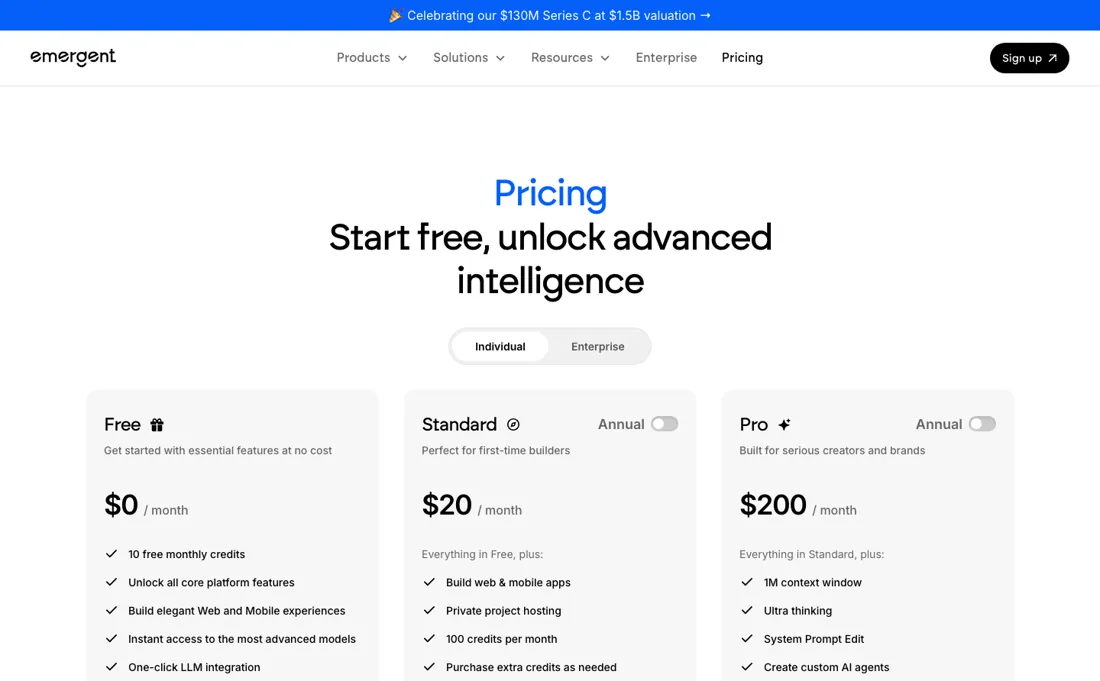
Now do the division, because Emergent's own pricing page doesn't. Standard is $20 for 100 credits, so 20 cents a credit. Pro is $200 for 750, which is 26.7 cents. Moving up a tier makes every unit of work more expensive, not less: Pro costs 33% more per credit than Standard, and annual billing keeps the gap (17 cents against 22.3). That is the opposite of the volume discount the ladder looks like -- you are buying a 1M-token context window, custom agents and priority support, not cheaper work.
And there is nowhere cheap to go above it: Business and Enterprise are both quote-only, so passing 750 credits a month means a sales call rather than a bigger plan. Check what your month actually needs before you upgrade; one Standard month plus purchased extra credits may beat one Pro month. AI-generated code still needs a human eye: review it for security, correctness and maintainability before anything touches real users.
What Emergent does
AI app builder. Describe what you want and Emergent builds full-stack web apps for you — an agentic, credit-based platform that turns prompts into working software with no manual coding.

What buyers report about Emergent
Recurring themes from the buyer-review sites listed at the foot of this page, read in August 2026. We have not run Emergent ourselves, so this is other buyers' experience rather than ours. We summarise it here because the complaints are usually the part a vendor page leaves out.
- • It is genuinely fast at turning a prompt into a working full-stack app, and reviewers who got a result say nothing else matched it for speed.
- • Backed by a $70M Series B at a $300M valuation in January 2026, so it is not a weekend project.
- • Credits vanish in debugging loops. When the AI gets stuck fixing its own mistake it keeps spending on every failed attempt — one reviewer's 110 credits did not last a day, another burned through a plan fixing AI-generated errors and ended with no working app. Watch the counter, and stop it yourself when it loops.
- • Unused credits expire at the end of each billing period. There is no bank.
- • Complex apps hit context limits and freeze mid-task, and fixing one bug can break a feature that worked.
- • Free 10 credits, Standard $20 for 100, Pro $200 for 750; above Pro the ladder is quote-only, with Business and Enterprise both priced 'Custom' (pricing page re-read 31 August 2026).
Where the ratings disagree. Trustpilot sits around 2.7 with reviews heavily split — people either ship something impressive or burn a month's credits on nothing. That is not a middling product, it is a high-variance one, and the variance is in how well the first prompt lands.
When the paid plan is worth it
This ladder runs backwards, and it is worth checking the arithmetic yourself before upgrading. Standard is $20 a month for 100 credits, which is 20 cents a credit. Pro is $200 for 750, which is 26.7 cents -- a third MORE per credit than the tier below it. Annual billing keeps the gap rather than closing it: $17 against $167 works out at 17 cents a credit versus 22.3. So Standard is the cheapest credit on the menu and Pro is the dearest; you are paying a premium to buy in bulk rather than getting a discount for it.
That makes the reason to move up something other than price. Pro adds a 1M-token context window, ultra thinking, system-prompt editing, custom agents and priority support -- capabilities rather than cheaper work, and that is the case you have to make for it, because on credits alone it does not stand up. What upgrading does not solve is the credit ceiling itself. Above Pro there is no published tier to climb to: Business and Enterprise are both quoted, so the moment 750 credits a month is not enough you are in a sales conversation rather than picking a bigger plan.
Extra credits can be bought as needed on Standard and above, which is the real release valve. Count the work you actually plan before choosing a tier.
How to actually use Emergent
Start on Standard and measure before you climb, because the ladder works against you. Standard is 20 cents a credit and Pro is 26.7 -- moving up makes every unit of work more expensive rather than less. Spend a month on Standard's 100 credits and record what your actual changes cost: simple edits run 1 to 2 credits, medium features 5 to 10, complex refactors 10 to 20 and beyond.
Then do the division the pricing page does not. If your month needs 150 credits, check whether one Standard month plus purchased extra credits beats one Pro month before you upgrade -- you are buying context window, custom agents and support at the higher tier, not cheaper work. Scope your prompts to the credit bands. A request phrased as one complex refactor costs 10 to 20 credits; the same work split into three medium changes you can check between is 15 to 30 but fails cheaper when it goes wrong.
Early on, while you are learning how this model interprets your codebase, smaller steps waste fewer credits. And review everything before it touches real users. This is an excellent way to get from a prompt to a working prototype or MVP quickly, and it is not a hands-off factory for production software. Read the generated code for security, correctness and maintainability, and budget that reading time as part of the cost.
Distilled from Vendor pricing page https://emergent.sh/pricing (read 2026-08-31 from a European exit -- the Individual tab gives Free, Standard and Pro with both monthly and annual rates and the stated $36 and $396 annual savings; the Enterprise tab gives Business and Enterprise, both priced 'Custom' behind Book a demo, with their feature lists). Vendor link index https://emergent.sh/llms.txt (read 2026-08-31), which points to the same pricing page as the source for plans and credit costs. The per-task credit bands (1-2 / 5-10 / 10-20+) are carried over from earlier research and are not stated on either of those pages.
The natural comparison is Lovable, Bolt or Replit Agent — close AI app-builder rivals — compare credit economics and output quality on the kind of app you actually build.
More on Emergent
Everything we publish about Emergent links back here — the review stays the honest hub:
The ex-banker filter — the same yardstick on every review (how we review): My ex-banker filter is simple: does Emergent remove a real cost — time, errors, missed revenue — bigger than what it charges?
Frequently asked questions
What should I weigh before buying IT & Productivity software?
Judge it on evidence rather than adjectives. Look for a published security page, single sign-on and role controls on the plan you would actually buy (they are often gated to higher tiers), a status page with real incident history, and a clear answer on where your data is stored. If the tool will hold anything sensitive, those four answers matter more than any feature comparison.
Is this a hands-on review of Emergent?
This is a researched assessment, not a hands-on test — where we've used a tool ourselves, we say so explicitly. We name what each tool is genuinely good and bad at, and we earn a commission only if you sign up, at no cost to you.
- Buyer reviews on Trustpilot and app-builder comparisons, read August 2026.
- Re-verified 2026-08-31 on emergent.sh/pricing.
- A dated screenshot of that pricing page, kept on this site as the receipt.
Others in this category
The it & productivity tools closest to Emergent that we have also reviewed. They overlap rather than match:
New dossiers, cost-traps we found, and tools that earned a keep — no hype, no sponsored-disguised-as-advice. Unsubscribe anytime.
This is our researched assessment — not a paid placement. The “Visit” links on this page are affiliate links: we may earn a commission if you sign up, at no extra cost to you, and it never changes our take. How we review →