 TicketTailor Review (2026)$0.85 Flat, No Percentage
The fee honesty is the product — flat cents per ticket instead of percentage skims makes it dramatically cheaper than the big platforms on higher-priced tickets (a $0.30-0.85 fee on a $50 ticket vs a percentage is no contest). Throughout this review we weigh it against Eventbrite.
Visit TicketTailor → Affiliate link — we may earn a commission if you sign up; it does not change what this page says.
Watch the 2-minute review
The video version of this review, from our YouTube channel.
⚡ Short on time? Watch the 30-second verdict Short.
Pricing (2026)
✓ Pricing re-verified 26 Sep 2026
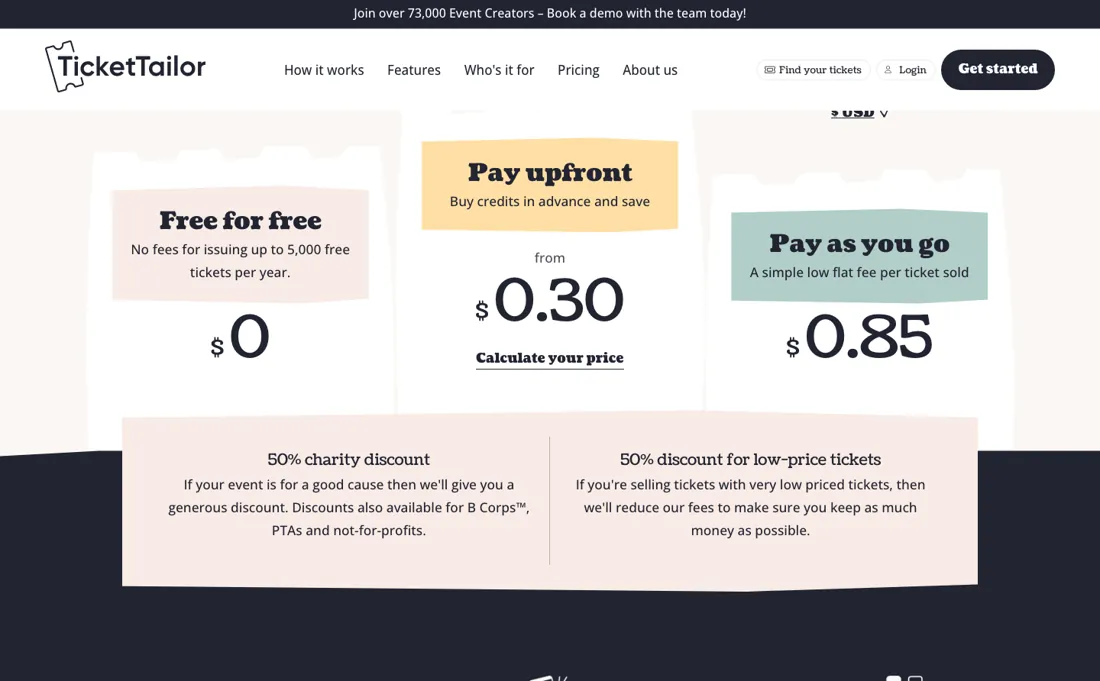
No subscription and no contract: pay-as-you-sell $0.85 a ticket, or prepaid credits from $0.70 down to $0.34 depending on volume — 100 credits (the minimum) cost $70, 500 cost $300, 1,000 cost $520 and 20,000 cost $6,800. Credits carry no time limit. Free events are free up to 5,000 tickets a year, the first five paid tickets cost nothing, and charities, B Corps, PTAs and not-for-profits get 50% off, as do very low-priced tickets.
Seated tickets cost two credits rather than one. Prices switch across GBP, EUR, USD, AUD and CAD. Stripe, PayPal or Square fees apply separately and Ticket Tailor never touches the payment. Note one contradiction in their own FAQ: one answer puts the free-ticket allowance at 5,000 a year, another at 2,000. Plans change — always verify the live price on their site.
What the pricing page doesn’t say
The trade: you bring your own audience. There's no discovery marketplace pushing your event, so if you rely on a platform's browsing traffic to sell out, the cheap fees won't fill seats.
What TicketTailor does
Low-fee event ticketing and box-office software: sell tickets online, manage check-in and keep more of your revenue without per-ticket booking fees.
What buyers report about TicketTailor
Recurring themes from the buyer-review sites listed at the foot of this page, read in August 2026. We have not run TicketTailor ourselves, so this is other buyers' experience rather than ours. We summarise it here because the complaints are usually the part a vendor page leaves out.
- • No percentage cut. Pay-as-you-sell is $0.85 a ticket — and $0.60 once you buy credits in blocks of 500 — against Eventbrite's percentage model, which on a decent ticket price is a large difference. 99% positive sentiment.
- • There is nothing to pause between events, because there is no subscription to pause — you pay per ticket sold and nothing when you are not selling. Charities, B Corps, PTAs and not-for-profits get 50% off, and support answers quickly on chat.
- • The fee information itself is described as unclear — work out your own per-ticket total before you launch.
- • Support is 9-5 only, which does not cover an event evening.
- • Add-on costs accumulate and some branding options cost more than reviewers expected.
- • Migration tooling is thin and the desktop interface is dated.
The flat fee wins as ticket prices rise
No subscription and no contract: $0.85 a ticket as you sell, or prepaid credits that get cheaper the more you buy. These are the US figures. The credit question our earlier reading left open is answered on the page, twice: credits have no time limit and can be used over an unlimited period. Prepaying is a discount, not a bet. We stepped their calculator through its whole range to get the ladder: 100 credits cost $0.70 each and 100 is the minimum purchase, 500 cost $0.60, 1,000 cost $0.52, 5,000 cost $0.43, and the slider bottoms out at 20,000 for $0.34 — so the '$0.30' on the card is below anything the public calculator will sell you.
Against pay-as-you-sell, 500 credits saves $125. Two things change that arithmetic. A ticket sold through a seating chart costs two credits rather than one, so a seated venue should budget double. And when your balance reaches zero you revert to $0.85 automatically, which is why they offer top-ups at 25 credits. The flat fee is the whole argument: at $0.60 you pay 1.2% on a $50 ticket and 12% on a $5 one, so the advantage over percentage platforms is largest at the top and gone at the bottom.
The trade is that you bring your own audience — there is no discovery marketplace.
How to actually use TicketTailor
Work out where your sales came from last time before you switch. Ticket Tailor has no discovery marketplace, so every sale has to come from your own list, your own social channels or your own posters. If a meaningful share of your last event was filled by people browsing a platform, that is the traffic you are giving up and no fee saving replaces it. Then compare fees on your actual ticket price, not in the abstract.
A flat $0.85 is 1.7% of a $50 ticket and 17% of a $5 one — divide your per-ticket fee by your current platform's percentage to find the price at which they cost the same. And if you run a seated venue, budget two units per ticket: seat reservations cost an extra credit each. Start on pay-as-you-sell, then prepay once you know your volume. Credits have no time limit, so five hundred at $300, which saves $125 against the $0.85 rate, still pay off for an organiser who runs three events a year; the smallest purchase is 100 credits.
Check too whether you qualify for the 50% charity, B Corp, PTA or not-for-profit rate, and connect your own Stripe, PayPal or Square account so the money reaches you on your processor's schedule.
Distilled from www.tickettailor.com/pricing read on 9 September 2026 with the currency selector set to USD — the three price cards, the pricing FAQ, and the ticket-credit calculator stepped through its full range (100 to 20,000 credits) to record the per-credit rate at each rung rather than only the two figures the cards advertise. Re-read 26 September 2026 in the browser pane (a plain fetch returns 403) with the currency set to USD: the cards (free up to 5,000 free tickets a year, pay-as-you-go $0.85, prepaid 'from $0.30') and the FAQ unchanged. The calculator's per-credit ladder was read from the rate table in the page's own script rather than from the slider, whose label lagged a step behind when moved by keyboard: USD 100 credits $0.70, 500 $0.60, 1,000 $0.52, 5,000 $0.43, 20,000 $0.34, and above 20,000 a custom quote from sales. The FAQ is the source of the buyer questions: credits over an unlimited period, auto top-up monthly or at 25 credits or fewer, payouts through your own Stripe, PayPal or Square account, PAYG fees deducted on Stripe or invoiced monthly on PayPal and Square, and the free-ticket allowance given as 5,000 in one answer and 2,000 in another.
The natural comparison is Eventbrite or Humanitix — Eventbrite trades higher percentage fees for discovery traffic; Humanitix routes fees to charity — Ticket Tailor wins on raw cost per ticket. Weigh it against Eventbrite on the job you actually need done.
Frequently asked questions
Do Ticket Tailor credits expire?
No. The pricing FAQ (read 26 September 2026) says prepaid credits can be used over an unlimited time period. When the balance reaches zero you drop back to pay-as-you-sell at $0.85 a ticket, which is why you can set credits to top up automatically, monthly or when 25 or fewer are left. The minimum purchase is 100 credits at $0.70 each, $70; a seated ticket uses two credits.
When do I get the money from Ticket Tailor ticket sales?
As you sell, not after the event. Ticket Tailor never holds the money: you connect your own Stripe, PayPal or Square account, and the FAQ (read 26 September 2026) says revenue appears there almost immediately, though it may take a week or so to reach your bank. On pay-as-you-sell with Stripe the fee is deducted automatically; with PayPal or Square, Ticket Tailor invoices the previous month's fees once a month.
Are free events on Ticket Tailor really free?
Mostly. The pricing card (read 26 September 2026) says issuing up to 5,000 free tickets a year costs nothing; above that, support quotes a small per-ticket fee. One FAQ answer puts the threshold at 2,000 tickets instead, so confirm it if you are near either number. Free tickets sold through a seating chart are not free: each uses one credit.
What should I weigh before buying Growth & Revenue software?
It depends on whether you have the bottleneck it solves. Small teams get the most out of this category when one clear problem is already costing real hours or revenue; buying ahead of that just adds cost and another login. Price it against the hours or lost deals it removes, not against its feature list, and start on the smallest plan that covers the job.
Is this a hands-on review of TicketTailor?
This is a researched assessment, not a hands-on test — where we've used a tool ourselves, we say so explicitly. We name what each tool is good and bad at, and we earn a commission only if you sign up, at no cost to you.
- Buyer reviews on Capterra, GetApp, SourceForge and Software Advice, read August 2026.
- Re-verified 2026-09-09 and re-read unchanged 2026-09-26 on tickettailor.com/pricing with the currency switched to USD.
- A dated screenshot of that pricing page, kept on this site as the receipt.
Others in this category
Reviewed growth & revenue tools that share ground with TicketTailor — comparable in what they do, not drop-in swaps:
New reviews, price changes we recorded, and the cost conditions we found. No sponsored placements. Unsubscribe anytime.
This is our researched assessment — not a paid placement. The “Visit” links on this page are affiliate links: we may earn a commission if you sign up, at no extra cost to you, and it never changes our take. How we review →