 SurveyMonkey Review (2026)The First Seat Costs More
The free tier is a teaser.
Visit SurveyMonkey → Affiliate link — we may earn a commission if you sign up; it does not change what this page says.
Watch the 2-minute review
The video version of this review, from our YouTube channel.
⚡ Short on time? Watch the 30-second verdict Short.
Pricing (2026)
✓ Pricing re-verified 8 Sep 2026
Team plans are annual-only in practice: pricing.md lists Team Advantage Monthly and Team Premier Monthly as Canada-only and "currently not available to any user". The geography tables separate a core seat from each additional seat, and the per-user figure the pricing page advertises is the additional one. United States: Team Advantage Annual is $468 a year for the core seat plus $360 for every seat after it; Team Premier Annual is $1,668 plus $1,104.
Euro storefronts carry the same shape at €432 plus €360 and €1,188 plus €900. Team plans require three or more users, Enterprise five or more on a custom quote. Overage above the included response limit is priced per storefront: $0.15 a response in dollar countries, €0.10 in euro countries, £0.15 in sterling. That included limit is stated nowhere in pricing.md, whose feature matrix marks responses "Unlimited" on every paid plan.
Confirmed by the SurveyMonkey partner team by email on 24 September 2026: the $0.15 overage is the current self-serve rate, while Enterprise plans have custom response limits and contract pricing and SurveyMonkey Audience responses are bought separately; Team Advantage and Team Premier are $30 and $92 per user a month as monthly equivalents, billed annually from three users with no monthly option; the only monthly plan is the individual Standard Monthly at $99 a month; and the free Basic plan allows 10 questions per survey and shows up to 25 responses per survey, with anything beyond that visible only after upgrading. Plans change — always verify the live price on their site.
What the price did
We capture SurveyMonkey’s own pricing page every month and keep the figures, so this is our record of the page — not a forecast, and not someone else’s summary.
The amounts have been stable across our July, August and September 2026 readings. The apparent instability was ours. We carried $0.15 per additional response, then "corrected" it to €0.10 and noted that $0.15 appeared in none of our readings. Both figures are correct: SurveyMonkey's pricing.md prices the overage per storefront — $0.15 in dollar countries, €0.10 in euro ones, £0.15 in sterling — so the two were never in conflict, and that earlier correction is withdrawn (read 2026-09-08).
What the pricing page doesn’t say
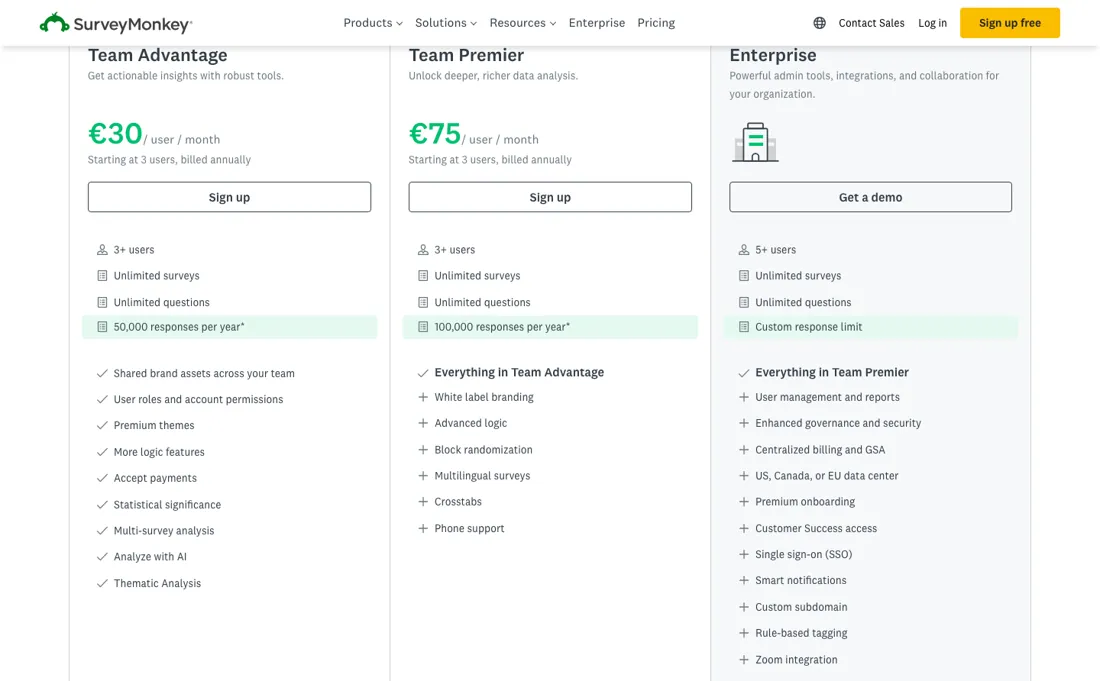
Response caps on the self-serve plans trigger $0.15-per-response overages (US rate; Enterprise contracts set their own limits) that become a hidden cost on big studies. Branding and customisation are limited, and a lot of the good analytics and logic sit behind higher tiers.
What SurveyMonkey does
Survey and feedback platform: build surveys, collect responses at scale and analyze results for market research, CX and employee feedback. A native Salesforce integration pushes responses straight into Salesforce, triggers workflows off the answers themselves (churn-risk follow-up or an NPS detractor landing on a rep's desk, for instance) and ties feedback back to accounts and pipeline, so sales and CS read it inside the tool they already work in rather than in a separate reporting dashboard.
What buyers report about SurveyMonkey
Recurring themes from the buyer-review sites listed at the foot of this page, read in August 2026. We have not run SurveyMonkey ourselves, so this is other buyers' experience rather than ours. We summarise it here because the complaints are usually the part a vendor page leaves out.
- • Everyone knows what a SurveyMonkey link is, and response rates benefit from that familiarity — it remains the default for a reason.
- • Question logic and templates cover most research needs without training.
- • Auto-renewal is on by default and accounts renew indefinitely whether used or not. An August 2024 BBB complaint documents a $276 renewal the customer says they never authorised.
- • Paid fees are essentially never refunded. Annual plans bill the full year up front and are non-refundable — cancel before the renewal date or you have paid for the year.
- • Cost dominates the complaints: expensive appears 116 times on G2 alone, with 91 mentions of limitations. Team plans need three users minimum, so the entry price is never the entry price for a team.
- • Support below Premier is email only — no phone, no chat — and reviewers report unreachable numbers when chasing a charge.
Where the ratings disagree. 3.2 on Trustpilot and 1.6 on PissedConsumer with 83% unfavourable, against solid scores on the software directories. The directories rate the survey tool; the consumer sites rate the subscription.
Pages read (August 2026): Trustpilot
The first seat costs more than the rest
The advertised team price is a per-user figure, and nobody pays only that. SurveyMonkey's own pricing.md separates a core seat from each additional seat, and the figure the pricing page advertises is the additional one. In the US table, Team Advantage Annual is $468 a year for the core seat and $360 for every seat after it, so the three-seat minimum comes to $1,188 a year rather than the $1,080 you get by multiplying the advertised $30 a month by three.
Team Premier is $1,668 plus $1,104 a seat, so three seats is $3,876. Team plans are annual-only in practice: the monthly variants are listed as Canada-only and unavailable to any user. Individual paid plans sit alongside those, and the free tier — 10 questions per survey, and only the first 25 responses of each survey visible until you upgrade — is not a research instrument by any definition; 25 responses cannot support a conclusion about anything.
The mechanic that costs real money is the response meter, and it has an unusual shape. On paid plans, response limits are counted across all surveys and all users rather than per survey. A three-person team therefore shares one pool, which means a colleague's large study quietly consumes the allowance everyone else was planning to use. Additional responses are charged at €0.10 each once you pass the limit. Put a real study through that and the subscription stops being the main number.
Five thousand responses beyond your allowance is €500 in euro countries and $750 in dollar ones — between two fifths and two thirds of what three seats cost for an entire year. On any serious piece of research the overage dominates, which makes the included response count the single most important figure on the page. SurveyMonkey's own pricing.md makes that worse rather than better: its feature matrix marks responses "Unlimited" on every paid plan, while the same document charges an overage "above the plan's included response limit" and never states that limit.
Get the number in writing before you sign, alongside confirmation that the pool is shared. One correction while we are here: we previously treated our own $0.15 overage figure as a misreading against a €0.10 truth. It was not. The overage is priced per storefront — $0.15 a response in dollar countries, €0.10 in euro ones, £0.15 in sterling — so both were right, and which one applies to you depends on where you buy.
Two more costs sit outside all of it. SurveyMonkey Audience — respondents supplied by SurveyMonkey rather than from your own list — is sold separately, so if you do not have an audience the research cost is a third line item entirely. And a good deal of the useful analytics and question logic sits on higher tiers, with branding and customisation limited below them. Price this from your response volume and your analysis needs, not from the advertised per-seat price.
Our monthly capture read this vendor's pricing page in July 2026 and again in August 2026, and the amounts were the same both times. We keep watching — the registry records what moves.
How to actually use SurveyMonkey
Ask two questions before you buy: how many responses are included on the tier you are considering, and whether that pool is shared across every user and every survey on the account. Both matter more than the subscription. Responses beyond the limit cost €0.10 each in euro countries and $0.15 in dollar ones, so a 5,000-response study adds €500 or $750 on top of a three-seat plan that costs €1,152 or $1,188 for the whole year — and on a shared pool, a colleague's project can spend your allowance.
Budget the real entry price, not the advertised one. Team plans start at three users and the first seat costs more than the rest: in the US that is $468 plus two seats at $360, so $1,188 for the year, and the higher team tier is $1,668 plus $1,104 a seat. Euro storefronts read €432 plus €360. If you are one person, look at the individual plans instead rather than paying for two colleagues you do not have.
Pilot on the free tier only to check the question types and the logic you need, never to test a study — 10 questions and 25 responses cannot tell you anything about your research question. And if you do not have your own list to survey, price SurveyMonkey Audience separately before you commit; supplied respondents are a third cost on top of the plan and the overage.
Distilled from surveymonkey.com/pricing.md — the vendor's own machine-readable pricing reference — read on 8 September 2026; its header dates the content 2026-08-31. Every amount in this review comes from that document: the Plans Overview, the Plan Selection Rules (one user goes to the individual plans, three or more to Team, five or more to Enterprise on a custom quote), the Feature Comparison matrix, and the three geography tables that price each storefront separately — Core Seat, Additional Seat and RBP Overage. surveymonkey.com/llms.txt was read in the same pass; it indexes the site for agents and carries no prices. One caveat belongs with the source rather than buried in the text: pricing.md is internally inconsistent on the single figure that decides a research budget. Its feature matrix marks responses 'Unlimited' on every paid plan, while its overage table charges per response 'above the plan's included response limit' — and that limit appears nowhere in the document. Where this review names an included response count, it comes from an earlier reading of the live pricing page on 26 August 2026 over a US connection, and is flagged as such rather than attributed to pricing.md. On 24 September 2026 the SurveyMonkey partner team confirmed three points by email: the $0.15 self-serve overage rate (Enterprise limits and pricing are set by contract), the Team range of $30 to $92 per user a month as monthly equivalents billed annually, and the limits of the free Basic plan; their reference page is surveymonkey.com/pricing/teams.
The natural comparison is Google Forms or Typeform — the free-basic and the design-led form tools.
Vendor listing: SurveyMonkey on the AIBM Marketplace — information supplied by the vendor, kept separate from this review.
Frequently asked questions
What does SurveyMonkey cost for a team?
More than three times the advertised per-user price. SurveyMonkey's own pricing.md charges a core seat and then a lower rate for each additional seat, and the figure the pricing page advertises is the additional one. In the US that is $468 a year for the core seat plus $360 for each seat after it, so the three-seat minimum is $1,188 a year, not the $1,080 you get by multiplying $30 by three. Team Premier is $1,668 plus $1,104 a seat. Euro storefronts read €432 plus €360, and €1,188 plus €900. Team plans need three users and are annual-only in practice (read 2026-09-08).
What happens if I go over my response limit?
On the self-serve plans you are charged per response above your plan's included limit, at a rate that depends on your storefront: $0.15 in dollar countries, €0.10 in euro ones, £0.15 in sterling. Two things make that bigger than it looks: on paid plans the limit is counted across all surveys and all users rather than per survey, so a colleague's popular survey can consume the whole team's allowance, and SurveyMonkey Audience responses are sold separately on top. Enterprise plans work differently: custom response limits and contract pricing. The included limit itself is not published in the vendor's pricing.md, which marks responses "Unlimited" on every paid plan while still pricing the overage — so ask for the number in writing.
Is the free plan enough to test the product?
For the interface, yes; for a real survey, no. The free Basic plan allows ten questions per survey and shows only the first twenty-five responses of each survey; it keeps collecting, but anything past twenty-five stays hidden until you upgrade. Treat it as a demo. For a genuine pilot, the only plan billed monthly is the individual Standard Monthly at $99 a month (team plans are billed annually from three users), and check its response ceiling against your list size first.
What should I weigh before buying Operations & Workflow software?
Usually it sits on top rather than replacing everything. Tools in this class tend to become the layer where work is tracked and handed off, while your existing systems stay the source of truth for their own data. Before you buy, map which tools it would replace outright and which it would merely sync with. If the answer is that it syncs with all of them, you are adding a layer rather than removing one.
Is this a hands-on review of SurveyMonkey?
This is a researched assessment, not a hands-on test — where we've used a tool ourselves, we say so explicitly. We name what each tool is good and bad at, and we earn a commission only if you sign up, at no cost to you.
- Buyer reviews on G2, Trustpilot, the BBB and PissedConsumer, read August 2026.
- Read 2026-09-08 in surveymonkey.com/pricing.md, the vendor's own machine-readable pricing reference, whose header dates the content 2026-08-31.
- A dated screenshot of that pricing page, kept on this site as the receipt.
Others in this category
Reviewed operations & workflow tools that share ground with SurveyMonkey — comparable in what they do, not drop-in swaps:
New reviews, price changes we recorded, and the cost conditions we found. No sponsored placements. Unsubscribe anytime.
This is our researched assessment — not a paid placement. The “Visit” links on this page are affiliate links: we may earn a commission if you sign up, at no extra cost to you, and it never changes our take. How we review →