 Sunsama Review (2026)One Page, Two Prices
The pricing page contradicts itself: the plan card says $17 yearly and $22 monthly, the FAQ on the same page says $20 yearly and $25 monthly.
Watch the 2-minute review
Same honest take, in video form — from our YouTube channel.
⚡ Short on time? Watch the 30-second verdict Short.
Pricing (2026)
✓ Pricing re-verified 30 Aug 2026
| This tool | $22 | 6th cheapest of 16 |
| Cheapest | $8.33 | QuillBot |
| Median | $45 | |
| Most expensive | $699 | Wing Assistant |
Entry price per month, USD. Our own dated readings of 16 operations & workflow tools — not a market survey, and cheapest is not best.
(2026-08-30, re-read on their own pricing page from a US exit) The page gives two different numbers and it is worth knowing both. The plan card says $17 a month billed yearly, or $22 billed monthly, for the Pro plan, with unlimited usage and integrations; Enterprise is quote-only. The FAQ on the same page says Sunsama costs $25 a month per person, or $20 a month on yearly plans, and gives a worked example of $50 a month for two people.
There is a free trial with no card required. The page also explains, unprompted, that they price at $25.00 rather than $24.99 because they consider the latter 'deceitful psychological trickery'. Their own llms.txt, read the same day, lists Pro at $17 per person a month billed yearly and $22 billed monthly, plus a 14-day trial at $0 with no card required — so the machine-readable file agrees with the plan card and not with the FAQ. Plans change — always verify the live price on their site.
What the pricing page doesn’t say
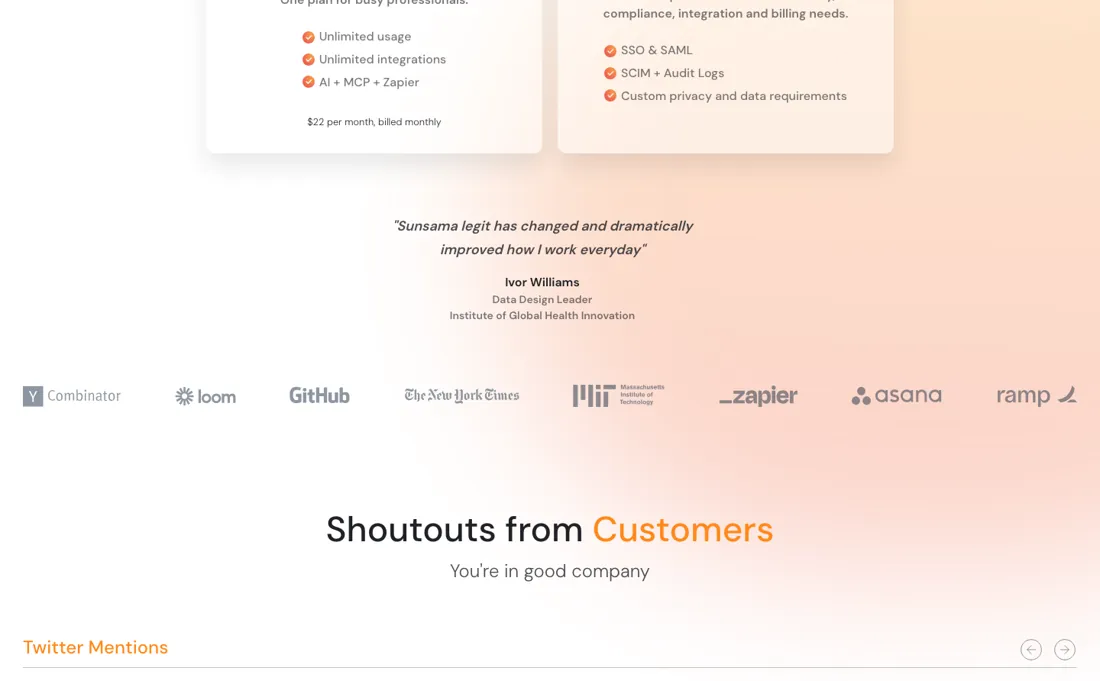
One of those is stale, and until you know which, treat $25 as the number you might actually be charged. That is an odd thing to have to say about a company that goes out of its way on that same page to explain why it refuses to use $24.99 pricing — the transparency is real and so is the inconsistency. The other thing to be clear about is that this is per person with no team discount mentioned: two people is two subscriptions, and their own example says $50.
What Sunsama does
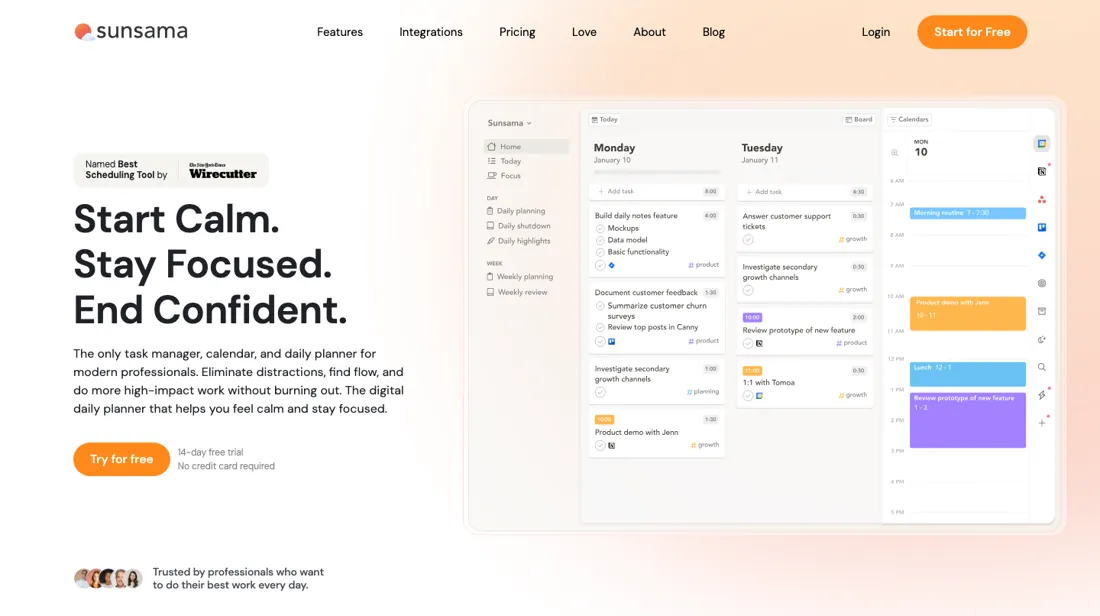
Daily planning that pulls tasks from your other tools into one deliberate schedule.
What buyers report about Sunsama
Recurring themes from the buyer-review sites listed at the foot of this page, read in August 2026. We have not run Sunsama ourselves, so this is other buyers' experience rather than ours. We summarise it here because the complaints are usually the part a vendor page leaves out.
- • The planning and shutdown rituals are the product, and reviewers say they genuinely change how a day goes — scattered work becomes a realistic plan.
- • Integrations with Jira, Asana, Todoist, Outlook and Google Calendar pull everything into one morning view.
- • $25 a month monthly, $20 on annual, and there is no free tier at all — Sunsama says deliberately so. Price is the most-named drawback.
- • The mobile app cannot do advanced planning or the daily review, so the ritual only works at a desk.
- • There is no AI layer at all in 2026 while every competitor has added scheduling and prioritisation.
- • Project tracking is limited and the interface is starting to look dated.
One page, two prices
The pricing page contradicts itself, and you should know both numbers before you sign up. The plan card says $17 a month billed yearly or $22 billed monthly for Pro, with unlimited usage and integrations. The FAQ on that same page says Sunsama costs $25 a month per person, or $20 on yearly plans, and works through an example of $50 a month for two people. Enterprise is quote-only (2026-08-30, re-read on their own pricing page from a US exit).
One of those is stale, and there is a third source that narrows it down: the machine-readable llms.txt on their own domain gives Pro as $17 a month billed yearly and $22 billed monthly, which is the plan card rather than the FAQ. That makes the FAQ the likelier stale half, but it does not settle what your card is charged — so budget on $25, the higher of the two, and check the number on the payment screen against the number that persuaded you.
There is an irony worth naming here rather than scoring points with. The stance is genuine and it is the kind of thing that tells you something real about a company. It also sits oddly beside two different prices on one page — and the second thing is the one that affects your card. The structural point is simpler: this is per person, with no team discount mentioned anywhere. Two people is two subscriptions, which their own FAQ confirms with the $50 example.
For a tool whose premise is daily planning and calendar integration, that is worth modelling across the whole team before anyone else asks for it. The free trial needs no card, which is the right way in. What you are testing is not features but whether the daily ritual — planning each day deliberately, in a tool, every morning — is one you keep doing after two weeks. That is a question about you rather than about the software, and no tier changes the answer.
How to actually use Sunsama
Check the price on the payment screen against the price that persuaded you, because the pricing page gives two. The plan card says $17 a month billed yearly and $22 monthly; the FAQ on the same page says $20 yearly and $25 monthly, with a worked example of $50 for two people. Budget on $25 until you have seen which one your account is actually on. Then start the free trial — no card is needed — and treat it as a test of a habit rather than of a feature list.
The premise here is that you plan each day deliberately, every morning. What you need to know after two weeks is whether you still did it in week two, because that is the entire value and no tier affects it. Connect your real calendars and task sources on day one rather than trying it clean. Sunsama's argument is that it pulls everything into one daily plan, and that argument only becomes testable when everything is actually in there — including the sources that make your day messy.
If you are buying for a team, multiply properly: this is per person with no team discount mentioned, so their own example of $50 for two is the shape of it.
Distilled from Sunsama pricing page (sunsama.com/pricing), the machine-readable sunsama.com/llms.txt, and the Sunsama User Manual index (help.sunsama.com), read 30 August 2026 from a US exit — the two conflicting prices on the pricing page, the plan and trial lines in llms.txt, and the daily-planning, timeboxing and calendar-integration sequence the manual is organised around.
The natural comparison is Motion or Akiflow — the direct daily-planning peers — all three are per person, so compare on which one actually gets you to close the planning ritual each morning.
The ex-banker filter — the same yardstick on every review (how we review): My ex-banker filter is simple: does Sunsama remove a real cost — time, errors, missed revenue — bigger than what it charges?
Frequently asked questions
What should I weigh before buying Operations & Workflow software?
Usually it sits on top rather than replacing everything. Tools in this class tend to become the layer where work is tracked and handed off, while your existing systems stay the source of truth for their own data. Before you buy, map which tools it would replace outright and which it would merely sync with. If the answer is that it syncs with all of them, you are adding a layer rather than removing one.
Is this a hands-on review of Sunsama?
This is a researched assessment, not a hands-on test — where we've used a tool ourselves, we say so explicitly. We name what each tool is genuinely good and bad at, and we have no affiliate relationship with Sunsama — we earn nothing whether you sign up or not.
- Buyer reviews on Product Hunt, Software Advice and practitioner reviews, read August 2026.
- 2026-08-30, re-read on their own pricing page from a US exit.
- A dated screenshot of that pricing page, kept on this site as the receipt.
Others in this category
Reviewed operations & workflow tools that share ground with Sunsama — comparable in what they do, not drop-in swaps:
New dossiers, cost-traps we found, and tools that earned a keep — no hype, no sponsored-disguised-as-advice. Unsubscribe anytime.
This is our researched assessment — not a paid placement. How we review →