Papaya Global Review (2026)Two-Year Term, Quoted Rate
 By Daan Haket · Researched and written with an AI assistant · who does what
Every headline price is a 'starting from' that dead-ends at 'book a demo'.
finance-led mid-market and enterprises already running legal entities in several countries. They want to consolidate fragmented multi-country payroll and cross-border payments into one platform, with real-time workforce-cost dashboards, automated GL mapping, same-day local payouts and deep ERP/HRIS integration (Workday, SAP, NetSuite, HiBob). And they can absorb premium quote-only pricing for a white-glove managed service.
you're a startup or SMB making a handful of hires abroad and want it fast and cheap. Papaya is finance-led enterprise tooling: contractors are a paid add-on, EOR outside its roughly 40 owned-entity countries runs through in-country partners, and onboarding is slower than Deel's. The platform is overkill and overpriced for domestic-only or first-hire use.
Transparency: the “Visit” links on this page are affiliate links — we may earn a commission if you sign up, at no extra cost to you. No vendor can pay for a better review or verdict. How we make money →
Pricing (2026)
✓ Pricing re-verified 1 Oct 2026
| Plan | Price | What you get |
|---|---|---|
| EOR | from $499 per employee/month | — |
| Contractor of Record | from $199 per contractor/month | — |
| Contractor | from $5 per contractor/month | lighter Contractor solution |
| Payroll Plus | from $29 per employee/month | — |
| OnePay | $0 platform fees | — |
| Workforce OS | no published price | quote only |
| Contingent OS | no published price | quote only |
Summarised from the pricing notes below; the notes carry the conditions.
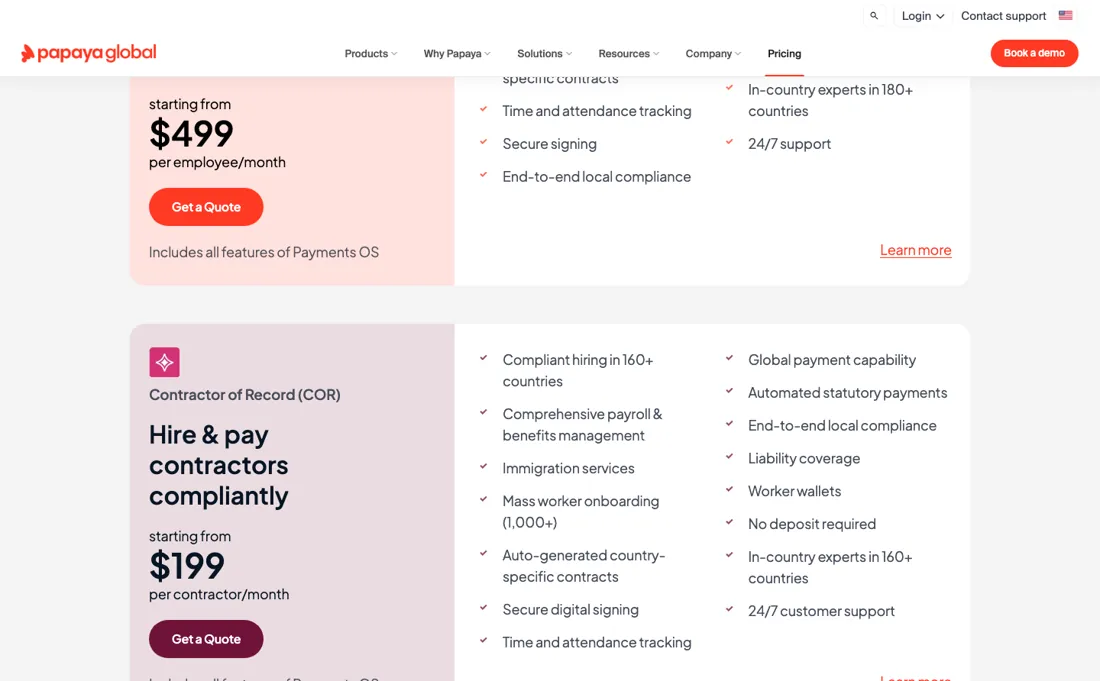
Papaya publishes floors on its own pricing page, read in a browser because the page returns HTTP 403 to plain fetches. EOR from $499 per employee/month, Contractor of Record from $199 per contractor/month, the lighter Contractor solution from $5 per contractor/month, Payroll Plus from $29 per employee/month, OnePay at $0 platform fees. Workforce OS and Contingent OS carry no figure — quote only.
Every one of those numbers stood unchanged across our readings on 4 September, 10 September and 1 October 2026. These are 'starting from' floors under a 'Get a Quote' button, not a rate card, and they sit BELOW the third-party trackers this dossier used to rely on: Business.com (Feb 2026) had EOR 'starts at $599/employee/mo', eorHQ (Jun 2026) roughly $650 standard / $770 premium.
Per Business.com the contract is typically a two-year agreement with a rolling 90-day termination-for-convenience clause, and individual reviewers report bills running 30-50% over quote plus setup, FX and filing fees. Plans change — always verify the live price on their site.
Category context: HR & People. Across the 13 tools in this category that we researched with a public US-dollar price, the median entry price is $14 a month (lowest paid plan as listed, per seat where the vendor prices per seat). Papaya Global’s entry price of $499 a month sits above that median. Compare pricing conditions in the Software Cost Atlas →
What the price did
We capture Papaya Global’s own pricing page every month and keep the figures, so this is our record of the page — not a forecast, and not someone else’s summary.
Papaya's own pricing page carried the same floors on 4 September, 10 September and 1 October 2026: EOR from $499 per employee a month, Contractor of Record from $199, the Contractor solution from $5, Payroll Plus from $29 and OnePay at $0 platform fees. Before we could read those floors, this review leaned on third-party trackers that put EOR higher: Business.com from $599 (February 2026), eorHQ about $650 standard (June 2026).
What the pricing page doesn’t say
And multiple reviewers report the real bill runs bigger than the sticker: 30-50% over quote, with setup, FX and filing fees surfacing after signing (reviewer reports, not universal terms). The documented contract is typically a two-year agreement with a rolling 90-day termination clause, so read the term and exit clauses closely before signing. The deeper structural knock is where the work happens. Outside the countries where Papaya owns entities, it delivers EOR through in-country partners; a third-party estimate puts the owned count near 40, and Papaya does not disclose which are owned versus partner.
So at 15+ countries you're often one escalation removed from whoever actually runs your payroll. Clients report a recurring set of problems: invoicing errors, data that doesn't sync between Papaya and the partner, and missed or late payroll runs. Support decays from a named account manager into a rotating ticket queue with no live channel.
Watch the video review
The video version of this review, from our YouTube channel.
⚡ Short on time? Watch the 30-second verdict Short.
What Papaya Global does
Enterprise workforce-payments platform unifying global payroll, EOR hiring, contractor management and cross-border payments in one system — finance-first, with same-day local payouts on owned payment rails and deep ERP/HRIS integration. Premium, quote-only pricing.

What buyers report about Papaya Global
Hands-on: not tested by usDocumented by the vendor: 1 feature, read 2026-10-09Reported by buyers: G2, Capterra and Trustpilot, read August 2026
Themes from the buyer-review sites listed at the foot of this page, read in August 2026. We have not run Papaya Global ourselves, so this is other buyers' experience rather than ours. We summarise it here because the complaints are usually the part a vendor page leaves out.
- • Payroll accuracy and compliance coverage across many countries from one screen — that is what finance and HR reviewers rate. 4.5 weighted across 117 verified reviews.
- • Navigating multi-country payroll is genuinely clear once you are in.
- • The $650 EOR rate is a starting point. Employer taxes, statutory contributions and optional benefits layer on top and vary by country — reviewers name pricing transparency as the main procurement watch-out.
- • Support is the biggest complaint: 3.3 on Trustpilot, with slow responses during payroll cycles and inconsistent follow-through at scale. Response times are worse for less common markets.
- • The interface is consistently flagged on G2 as the weakest part, and Papaya has been slower than competitors to simplify it.
- • Implementation takes longer than expected for complex multi-country setups.
Pages read (August 2026): Trustpilot
What actually drives the quote
Papaya publishes floors now, and they are lower than the trackers said. Read on 4 September 2026 and unchanged on 10 September and 1 October, its own pricing page carries Employer of Record from $499 per employee a month, Contractor of Record from $199 per contractor, the lighter Contractor solution from $5, Payroll Plus from $29 per employee and OnePay at $0 platform fees; Workforce OS and Contingent OS still carry no figure at all.
Note what those are: 'starting from' floors under a 'Get a Quote' button rather than a rate card. Note also that they undercut the independent trackers this review used to lean on — Business.com had EOR starting at $599 in February 2026, eorHQ roughly $650 standard and $770 premium in June — which is a reason to treat the floor as the opening of a negotiation rather than the end of one.
What matters more than the headline is what reviewers report happens after it. Bills running 30 to 50% over quote, with setup, FX and filing fees surfacing after signature. Those are reviewer reports rather than universal terms, but they are consistent enough to be the thing you protect against. Ask for the fully landed monthly cost per employee, itemised, including setup, currency conversion and statutory filing. And get it in the contract rather than the proposal.
The contract shape needs the same care. Business.com documents a typical two-year agreement with a rolling 90-day termination-for-convenience clause. That is a long commitment for a service you cannot price in advance, so read the term and exit clauses before the rate. There is a structural point that no negotiation changes. Outside the countries where Papaya owns entities, EOR is delivered through in-country partners — and a third-party estimate puts the owned count near forty, with Papaya not disclosing which are owned versus partner.
At fifteen-plus countries you are often one escalation removed from whoever actually runs your payroll. The pain clients report follows from exactly that: invoicing errors, data that does not sync between Papaya and the partner, missed or late payroll runs, and support that decays from a named account manager into a rotating ticket queue. Before signing, ask which of YOUR countries are owned entities. That single question predicts your experience better than the rate does.
How to actually use Papaya Global
Ask which countries Papaya owns entities in and which are delivered through partners — by name, for the countries you actually hire in. A third-party estimate puts the owned count near forty and Papaya does not disclose the split, and in a partner country you are one escalation removed from whoever really runs your payroll. That single distinction predicts the pain clients report: invoicing errors, data that does not sync between Papaya and the partner, and missed or late payroll runs.
Read the term and exit clauses closely before anything else. The documented contract is typically a two-year agreement with a rolling 90-day termination-for-convenience clause. So your notice date is three months before you want to leave, and the commitment is nothing like a monthly subscription. Put both dates in a calendar at signature. Budget above the quote and ask for the extras to be itemised. Those are reviewer reports rather than published terms, but they are consistent enough to plan around.
Ask for setup, currency conversion and statutory filing to be quoted explicitly rather than described as included. And ask what support looks like in month twelve rather than month one. The recurring report is a named account manager decaying into a rotating ticket queue with no live channel, so establish now what is contractual and what is goodwill. And go in with Papaya's own published floors rather than a tracker's: as of 1 October 2026 its pricing page states EOR from $499 per employee a month, Contractor of Record from $199, Payroll Plus from $29 and OnePay at $0 platform fees.
Those are floors under a 'Get a Quote' button, so the distance between them and your quote is the whole conversation.
Where this section comes from: our research notes (149 words)
Papaya Global's own pricing page (papayaglobal.com/pricing), read in a browser on 4 September 2026 because the page returns HTTP 403 to plain fetches — the published 'starting from' floors for Employer of Record ($499 per employee/month), Contractor of Record ($199 per contractor/month), the Contractor solution ($5 per contractor/month), Payroll Plus ($29 per employee/month) and OnePay ($0 platform fees), the confirmed absence of any figure on Workforce OS and Contingent OS, and the 'Get a Quote' button on every card.
The contract shape (two-year term, rolling 90-day termination for convenience), the over-quote reports and the owned-versus-partner entity count remain third-party: Business.com (February 2026), eorHQ (June 2026) and reviewer reports, not Papaya's own published terms. Re-read on 1 October 2026 in a headless browser, where the page served normally: the same five floors, each still under a Get a Quote button, and still no figure on Workforce OS or Contingent OS.
Papaya Global vs Deel, side by side
Each column shows the vendor’s own published entry price, read on the date shown. Entry prices can cover different services or units, so check what each one buys. We do not average them into a score.
Both names above are affiliate links: we may earn a commission if you sign up, at no extra cost to you. Neither changes what this table says.
The natural comparison is Deel — Deel is HR-led and built to hire someone abroad this week — broad, fast, contractor-friendly; Papaya is finance-led and built to consolidate multi-country payroll and payments at enterprise scale. Pick by whether your buyer sits in HR or Finance.
Frequently asked questions
Is $499 per employee a month what I will actually pay?
Treat it as the floor of a negotiation. Papaya's own pricing page, read 4 September and again 10 September 2026, publishes Employer of Record from $499 per employee a month, Contractor of Record from $199 per contractor, the lighter Contractor solution from $5, Payroll Plus from $29 per employee and OnePay at $0 platform fees — each under a Get a Quote button rather than on a rate card, and Workforce OS and Contingent OS carry no figure at all. Those floors sit below the independent trackers: Business.com had EOR starting at $599 in February 2026, eorHQ roughly $650 standard and $770 premium in June. What reviewers report after signature matters more than the headline — bills running 30 to 50% over quote, with setup, currency-conversion and statutory filing fees surfacing afterwards. Ask for the fully landed monthly cost per employee, itemised, and get it into the contract rather than the proposal. (Re-read in a headless browser on 1 October 2026: all five floors unchanged, each still under Get a Quote.)
Which of my countries does Papaya run itself?
Ask that by name, country by country, before the rate comes up — it predicts your experience better than the price does. Outside the countries where Papaya owns entities, EOR is delivered through in-country partners; a third-party estimate puts the owned count near forty, and Papaya does not publish which countries are owned and which are partner-delivered. In a partner country you are one escalation removed from whoever actually runs your payroll, and the problems clients report follow from exactly that: invoicing errors, data that does not sync between Papaya and the partner, missed or late payroll runs, and support that decays from a named account manager into a rotating ticket queue. If your hiring map is one or two countries, get them named. If it is fifteen, the split is the deal.
What am I committing to if it does not work out?
A longer commitment than a monthly per-employee rate implies. Business.com documents a typical agreement of two years with a rolling 90-day termination-for-convenience clause, so your notice date is three months before the day you want to be gone, and the exit is a clause you exercise rather than a subscription you cancel. Put the signature date and the notice date in a calendar on the day you sign. Read the term and exit clauses before the rate, because you are committing for two years to a service whose price you cannot verify in advance: every figure on the pricing page is a starting-from under a demo booking, and two of the products carry no figure at all. The two questions belong together — what the fully landed cost is, and what it takes to leave.
Is this a hands-on review of Papaya Global?
This is a researched assessment, not a hands-on test — where we've used a tool ourselves, we say so explicitly. We name what each tool is good and bad at, and we earn a commission only if you sign up, at no cost to you.
- Buyer reviews on G2, Capterra and Trustpilot, read August 2026.
- Price re-verified 2026-10-01.
- A dated screenshot of that pricing page, kept on this site as the receipt.
Others in this category
Reviewed hr & people tools that share ground with Papaya Global — comparable in what they do, not drop-in swaps:
New reviews, price changes we recorded, and the cost conditions we found. No sponsored placements. Unsubscribe anytime.
This is our researched assessment — not a paid placement. The “Visit” links on this page are affiliate links: we may earn a commission if you sign up, at no extra cost to you, and it never changes our take. How we review →