Mktg.ai Review (2026)A 404 Where the Pricing Page Should Be
 By Daan Haket · Researched and written with an AI assistant · who does what
What the FAQ does publish is the tier names, Growth and Enterprise, and the fact that EU data residency is Enterprise-only.
marketing teams with real media spend across channels who want an always-on AI analyst — unified creative visibility, live performance signals and plain-language questions over their own data. It layers on top of your existing platforms rather than replacing them, with the vendor putting real-time data in week one and full onboarding at two to three weeks.
your ad spend is modest (the value scales with budget waste, and yours is small), or you want transparent self-serve pricing before a sales call.
Transparency: the “Visit” links on this page are affiliate links — we may earn a commission if you sign up, at no extra cost to you. No vendor can pay for a better review or verdict. How we make money →
Pricing (2026)
✓ Pricing re-verified 25 Sep 2026
No public pricing (re-verified 25 September 2026): mktg.ai/pricing still returns 404 and the navigation carries no pricing item, so every route ends at 'Book a Demo'. The tiers themselves are no longer secret, though — the FAQ names Growth and Enterprise above the entry level and describes what they add (dedicated onboarding on both; a dedicated customer success manager, SLA-backed response times and quarterly business reviews on top of that).
Email support is on every plan; custom integrations and EU data residency are Enterprise-only, with US data centres the default. The machine-readable llms.txt is Wix boilerplate advertising an MCP endpoint and carries no price either. Rates require a sales conversation. Plans change — always verify the live price on their site.
Category context: Marketing. Across the 23 tools in this category that we researched with a public US-dollar price, the median entry price is $29 a month (lowest paid plan as listed, per seat where the vendor prices per seat). Compare pricing conditions in the Software Cost Atlas →
What the pricing page doesn’t say

The price is still hidden — a 404 where the pricing page should be, and no pricing item in the navigation — which for a tool that promises spend transparency is an irony worth noticing, and the FAQ makes it sharper: its own introduction says it covers what the platform costs, and then no answer in it names a figure. The ROI story is also the vendor's own: the homepage tile assumes a $5M budget and puts a 3% efficiency gain at $150K alongside $100K of reallocated spend, which is 2% of the same budget. Ask for verified case numbers at your spend level on the demo call.
Watch the video review
The video version of this review, from our YouTube channel.
⚡ Short on time? Watch the 30-second verdict Short.
What Mktg.ai does
Always-on AI marketing analyst: unified creative visibility, live performance signals and plain-language questions over your own spend data — no public pricing, demo-first.
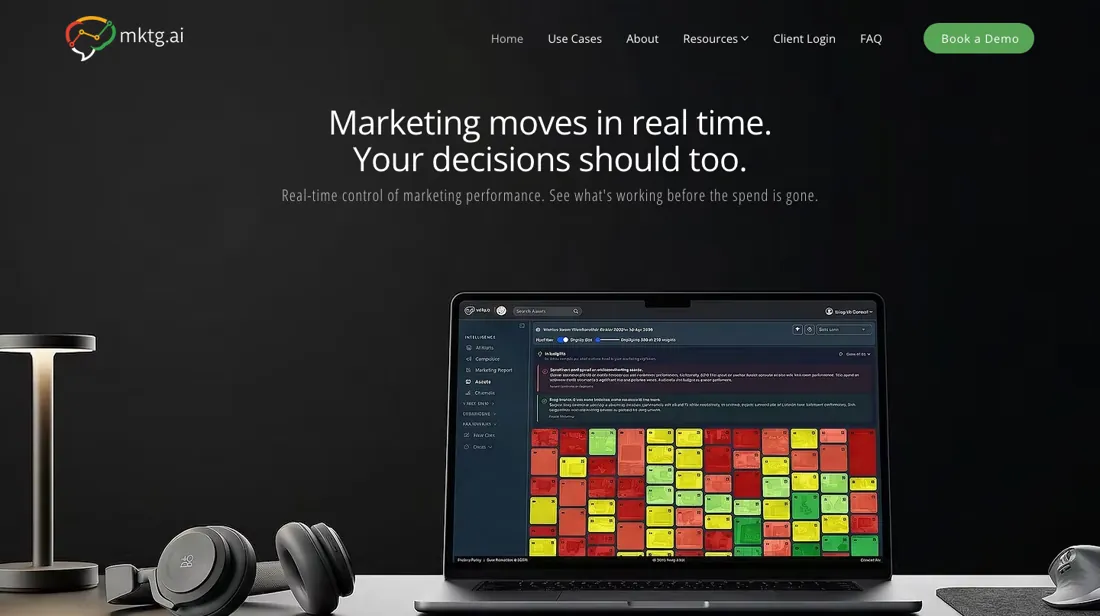
What the vendor's material says about Mktg.ai
Hands-on: not tested by usReported by buyers: none found
We found no independent buyer reports of Mktg.ai. The points below come from vendor material and category comparisons, read in August 2026. They describe what is offered, not what buyers experienced, so weigh them as documentation, not as reviews.
- • It joins creative metadata to KPI data in one dashboard, so you can see which specific assets are working rather than which channels are — that is a genuinely different cut of the data.
- • 30-day pilot programmes before committing, and reported results of 5-10 hours a week saved per analyst with 15-20% of spend reallocated within the first months.
- • Those performance figures are the vendor's own. We found no independent verification and no user reviews on G2, Capterra or Trustpilot.
- • Pricing is quote-only, scaled to team size and creative volume. Nothing is published.
- • It competes with Bynder, Tenovos and Tableau — bigger names with real review histories. Weigh the absence of an independent track record accordingly.
What actually drives the quote
There is still no published rate — mktg.ai/pricing still returned 404 on 25 September 2026 and the navigation carries no pricing item — but the tier structure is no longer hidden, and that is new. The FAQ names two plans above the entry level, Growth and Enterprise, and says what each buys: dedicated onboarding on both, plus a dedicated customer success manager, SLA-backed response times and quarterly business reviews. Email support comes with every plan.
Custom integrations are Enterprise-only, and so is EU data residency — US data centres are the default, which for a European buyer is a contract question rather than a preference. Worth noticing before the call: the FAQ's own introduction says it covers what the platform costs, and then no answer in it names a figure. Its own homepage promises you will see what is working before the spend is gone; the one figure it does not publish is its own.
So ask what the licence is counted on — media spend, seats, connected platforms or data volume. A tool priced against your ad spend grows with the budget you hired it to shrink, and that is the one shape you cannot renegotiate later.
How to actually use Mktg.ai
Bring your own media-spend figure to the demo, because every number the vendor publishes is anchored to a $5M budget that is probably not yours. The homepage business-case tile sets out four: $5M assumed annual spend, $150K as a 3% efficiency gain, $70K of labour saved per year based on 1,050 hours, and $100K of reallocated underperforming media spend. Two describe the same budget at different rates — $150K is 3%, $100K is 2% — and the labour figure implies about $67 an hour.
The FAQ adds a third scale: 15–20% of ad spend often reallocated within the first few months. Ask which of those a customer at your spend actually reached. Ask about onboarding in the same breath. The FAQ puts real-time data in week one and full onboarding — connectors, KPI configuration, training — at two to three weeks. Then get the contract shape in writing: term, notice period, renewal, and whether your data sits in the US or the EU, since residency is an Enterprise-only option.
Where this section comes from: our research notes (152 words)
mktg.ai's own site, read 6 September 2026 from a Netherlands exit — the FAQ page (www.mktg.ai/faqs) for the plan names, support tiers, integrations, onboarding times, ROI claims and data-residency rules; the homepage business-case tile for the four figures behind the $5M illustration; www.mktg.ai/pricing, which returns 404, and the site navigation, which carries no pricing item; and mktg.ai/llms.txt, which is Wix's boilerplate MCP file and carries no price. Re-read 25 September 2026 (plain HTML): mktg.ai/pricing still 404, the FAQ unchanged on Growth and Enterprise, onboarding (real-time data in the first week, full onboarding two to three weeks), support, integrations, US data by default with EU residency on Enterprise, data ownership ('You do'; not used for training), and the ROI lines (over $100K on a $5M budget, 5-10 hours a week per analyst, 15-20% of spend reallocated); the homepage business-case tile still shows $5M, $150K at 3%, $70K on 1,050 hours and $100K reallocated.
Mktg.ai vs Diginius, side by side
Where a vendor publishes a price, its column shows the entry price we read and when; where it does not, the column says so rather than filling in a figure from elsewhere. We do not average them into a score.
Both names above are affiliate links: we may earn a commission if you sign up, at no extra cost to you. Neither changes what this table says.
The natural comparison is Diginius — Diginius manages PPC and e-commerce performance hands-on with published pricing; Mktg.ai sells the always-on AI-analyst layer on top of your channels — but with no public prices, you’re comparing a sticker against a sales call.
Frequently asked questions
How long before mktg.ai shows anything useful?
About a week for data, two to three weeks for the full setup, by the vendor's own account. The FAQ (read 25 September 2026) says most teams see real-time data within their first week, and that full onboarding — connector setup, KPI configuration and team training — typically takes two to three weeks. Dedicated onboarding is included on the Growth and Enterprise plans; the FAQ does not say what onboarding the entry plan gets, so ask.
Who owns the data I connect, and is it used to train models?
You own it, according to the FAQ (read 25 September 2026): customer data is your property under their terms, and they say they never use it to train models or share it across customers. Data is stored in US data centres by default; EU data residency is available only on Enterprise. The FAQ also lists encryption in transit and at rest, role-based access per organisation and GDPR compliance. Check the terms themselves for what happens to the data when you leave, which the FAQ does not cover.
Do I have to replace my current ad tools?
No. The FAQ (read 25 September 2026) says mktg.ai sits alongside existing tools and ingests their data, and that most teams keep buying through Meta Ads Manager, Google Ads and the like, using mktg.ai as an intelligence layer above them. The most-used integrations it names are Meta, Google Ads, TikTok, LinkedIn, YouTube and The Trade Desk; custom integrations are for Enterprise customers. It positions itself against attribution tools such as Northbeam and Triple Whale as answering which creative worked rather than which channel.
Is this a hands-on review of Mktg.ai?
This is a researched assessment, not a hands-on test — where we've used a tool ourselves, we say so explicitly. We name what each tool is good and bad at, and we earn a commission only if you sign up, at no cost to you.
- Buyer reviews on vendor material and category comparisons, read August 2026.
- Mktg.ai’s own published pricing page.
- A dated screenshot of that pricing page, kept on this site as the receipt.
Others in this category
Reviewed marketing tools that share ground with Mktg.ai — comparable in what they do, not drop-in swaps:
New reviews, price changes we recorded, and the cost conditions we found. No sponsored placements. Unsubscribe anytime.
This is our researched assessment — not a paid placement. The “Visit” links on this page are affiliate links: we may earn a commission if you sign up, at no extra cost to you, and it never changes our take. How we review →