Meeri Review (2026)
Start with the numbers on the vendor’s own homepage, because they do not match the App Store.
small Shopify stores that want a cart-recovery channel which costs almost nothing and takes no commission on what it recovers — and that are willing to treat the free 300 notifications a month as a measurement of their own push opt-in rate before paying anything.
you need the recovered contacts anywhere other than the browser that opted in, you run recovery through Klaviyo, Postscript or another stack you want this to feed, or you cannot get the usage-based charge on Pro quoted as a rate before you enable it.
Transparency: the “Visit” links on this page are affiliate links — we may earn a commission if you sign up, at no extra cost to you. No vendor can pay for a better review or verdict. How we make money →
Pricing (2026)
✓ Pricing re-verified 19 Sep 2026
| This tool | $4.99 | 4th cheapest of 51 |
| Cheapest | $2.99 | MX AI |
| Median | $14.99 | |
| Most expensive | $450 | Attribuly |
Lowest paid entry price per account a month, billed monthly, in USD, among the 51 e-commerce growth apps we have researched (read between 2026-08-19 and 2026-10-06). Only tools priced in the same unit and on the same billing are compared — not a market survey, and cheapest is not best.
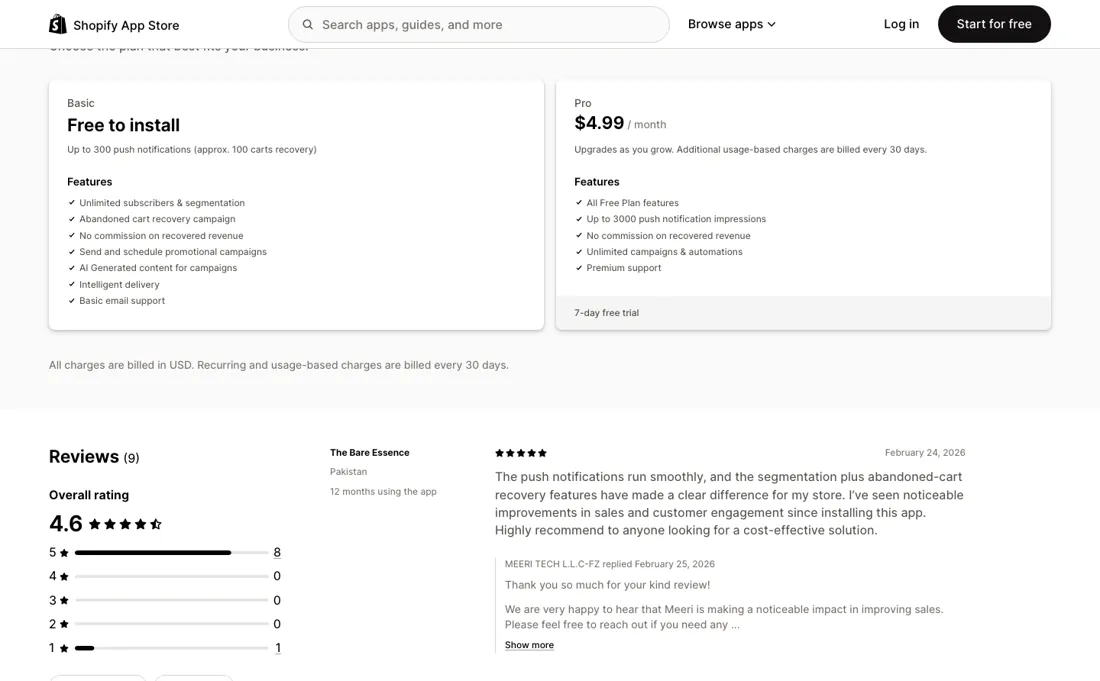
Two plans, and the free one is a real plan rather than a demo. Basic is free to install and covers up to 300 push notifications a month, which the listing itself translates as roughly 100 recovered carts. It carries unlimited subscribers and segmentation, the abandoned-cart recovery campaign, scheduled promotional campaigns, AI-generated campaign content, intelligent delivery timing and basic email support, and it takes no commission on recovered revenue.
Pro is $4.99 a month with a 7-day free trial and adds up to 3,000 push notification impressions, unlimited campaigns and automations and premium support. All charges are billed in USD, and recurring and usage-based charges are billed every 30 days. The plan text says Pro “upgrades as you grow” and that additional usage-based charges are billed every 30 days, without printing a rate anywhere on the listing.
The vendor’s own site sells the same two tiers at the same prices, calling Basic free forever and Pro’s allowance 3,000 notification impressions a month, and it does not print a usage rate either. The app is English-only, works with Shopify Admin and sits in Shopify’s abandoned-cart category. Developer MEERI TECH L.L.C-FZ, Dubai; the app launched on 23 February 2024 and carried 9 App Store reviews in August 2026 and 11 on 19 September 2026. Plans change — always verify the live price on their site.
Category context: Marketing. Across the 22 tools in this category that we researched with a public US-dollar price, the median entry price is $27 a month (lowest paid plan as listed, per seat where the vendor prices per seat). Meeri’s entry price of $4.99 a month sits below that median. Compare pricing conditions in the Software Cost Atlas →
What the pricing page doesn’t say
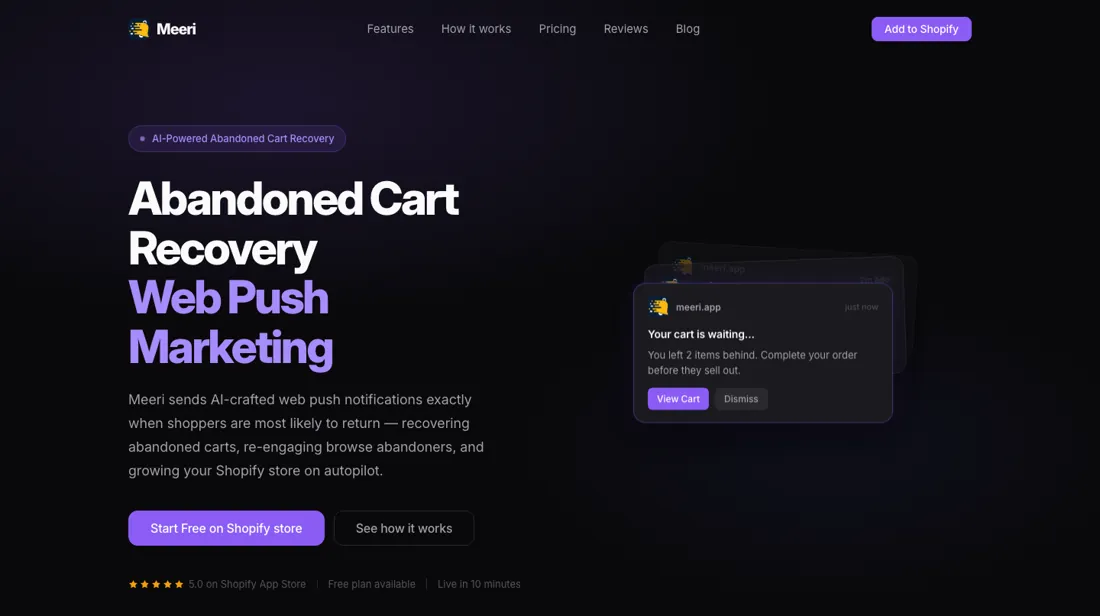
Read on 19 September 2026, meeritech.com still says “5.0 on Shopify App Store”, “100% five-star reviews” and “5.0 average — 8 verified reviews on Shopify” — word for word what it said on 23 August. The listing that same morning shows 4.7 from 11 reviews: ten at five stars and one at one star. So the vendor’s figure is what you get by leaving the single bad review out, and its review count has stood still while the real one moved.
Nothing about the app is settled by that, but a marketing page that rounds its own rating up by dropping the worst review, and then does not refresh it for a month, is a useful thing to know before you weigh the rest of the page. The review base is thin whichever number you use. Eleven reviews on an app that launched in February 2024, and the three the listing shows first come from one store in the United Kingdom and two in Pakistan, one of which had been using the app for seven days when it wrote.
That is not evidence of anything wrong; it is very little evidence of anything at all, and it cannot tell you how this behaves on a store like yours. Then there is the channel itself, which is the real decision. Web push needs a browser-level subscription, and the app’s own pitch is that no email or phone number is required to get one. That cuts both ways: the list is easier to build and worthless off the browser that built it.
You cannot export those subscribers into an email tool, you cannot reach them anywhere else, and your recovery ceiling is set by opt-in rate rather than by the app. Measure the opt-in rate first — 300 free notifications a month is enough to find out — because it decides everything the paid plan can do for you. One more limit worth reading before you install: the listing names English as the only language, and Shopify Admin as the only integration.
There is no Klaviyo, no email platform, no SMS tool on that line, so this sits beside your existing stack rather than inside it.
Watch the 2-minute review
The video version of this review, from our YouTube channel.
What Meeri does
Shopify app that recovers abandoned carts with AI-written web push notifications instead of email or SMS — no address or phone needed to subscribe, and no commission on recovered revenue.
What buyers report about Meeri
Recurring themes from the buyer-review sites listed at the foot of this page, read in August 2026. We have not run Meeri ourselves, so this is other buyers' experience rather than ours. We summarise it here because the complaints are usually the part a vendor page leaves out.
- • 4.6 over nine reviews, eight of them five stars. Two of the longest-tenured reviewers are the most concrete: ShoePlanet.pk (Pakistan, two years in, February 2026) keeps it for the abandoned-cart recovery and the customisable reminder workflow, and The Bare Essence (Pakistan, 12 months, February 2026) credits the segmentation and delivery with noticeable sales improvement.
- • KHAS STORES (Pakistan, 12 months in, August 2025) frames it as the cost-effective option for recovery and segmentation, which fits a listing whose paid tier is $4.99 a month. Kabishah (Pakistan, one month, February 2026) reports installation and audience targeting were straightforward.
- • The single one-star, LEWIJE (Australia, April 2026), reads in full "Scam stay away everyone" with no detail, and the listing shows a tenure of 14 minutes. The vendor replied pointing at that tenure and offering direct contact. There is nothing verifiable in it either way.
- • One further review — Pureganics (Pakistan, two years in, May 2026) — carries a rating but no written text, so the two longest-tenured accounts on the listing between them leave only one paragraph of actual detail.
Where the ratings disagree. Nine reviews is not a record you can lean on, and it is geographically narrow: most of the named stores are in Pakistan, with one each in the UAE and India. Nothing public here speaks to push opt-in rates or deliverability in other markets, and no reviewer states a recovered-revenue figure, so the listing's own "roughly 100 recovered carts" for the free tier remains a vendor claim rather than something buyers have confirmed.
Pages read (August 2026): Shopify App Store
When the paid plan is worth it
There is one paid step here and it costs $4.99, so the question is not whether you can afford it but what the meter actually counts. Basic gives you 300 push notifications a month. Pro gives you 3,000 impressions. Those are two different words, and neither page defines the second one, so a notification sent to a thousand subscribers may be one notification or a thousand impressions depending on which meaning applies.
That single ambiguity decides whether Pro is ten times the free plan or roughly the same size, and it is worth one email to support before you upgrade. The more open end is the sentence next to Pro's price: additional usage-based charges are billed every 30 days. No rate is published on the App Store listing, and none appears on meeritech.com either. On a $4.99 plan an unquoted variable charge is the whole cost risk, because everything else here is small.
Ask what triggers it and what it costs per unit, and get the answer in writing before you enable the plan. What you do not pay is a commission on recovered revenue, and both tiers say so explicitly. That is genuinely unusual in cart recovery, where a percentage of what the tool recovers is the normal model, and it is the strongest thing on this pricing page.
How to actually use Meeri
Install it on the free plan and do not upgrade for at least a month. Web push lives or dies on the opt-in prompt, and the only number that matters is what share of your visitors accept it — which you cannot know in advance and which 300 free notifications a month is enough to measure. While that runs, watch two things rather than one. The opt-in rate tells you how big the channel can get.
The recovery rate on the notifications you do send tells you whether it is worth having. A high opt-in with weak recovery usually means the timing or the offer, both of which you control here, and both of which are cheaper to fix before you are paying for impressions. Before you move to Pro, get two answers in writing: whether the 3,000 on that plan counts sends or impressions, and what the additional usage-based charge is per unit.
Those are the only two unknowns on a $4.99 plan, and support answering them clearly is itself a signal.
Distilled from apps.shopify.com/meeripush-push-notifications and meeritech.com, both read 23 August 2026.
Frequently asked questions
Do I need Meeri Pro, or is the free plan enough?
Start on Basic, because the free plan is sized to answer the only question that matters before you pay. Read on 19 September 2026 and unchanged since August, the free tier hands you 300 notifications a month — which the listing itself translates as roughly 100 recovered carts — together with unlimited subscribers and segmentation, the abandoned-cart campaign, scheduled promotions, AI-generated campaign content and intelligent delivery. Upgrading multiplies that allowance tenfold for less than five dollars, throws in unlimited campaigns and automations, and swaps basic email support for premium; neither tier takes a cut of what it recovers, and the paid one opens with a week you do not pay for. What decides the upgrade is not the feature list but your opt-in rate: web push only reaches browsers that accepted the prompt, so a month on Basic tells you how many of your visitors that actually is. If 300 notifications a month is more than you can send because too few people opted in, the paid plan buys you nothing. If you run out in the first week, it costs less than one recovered order.
What are the usage-based charges on top of the $4.99?
Nobody outside the vendor knows, and that is worth one email before you enable the plan. The Pro card says “Upgrades as you grow. Additional usage-based charges are billed every 30 days”, and the footer repeats that recurring and usage-based charges are billed every 30 days in USD. No rate appears anywhere on the listing, and meeritech.com does not print one either — both re-read on 19 September 2026. There is a second ambiguity stacked on the first: Basic is measured in 300 push notifications and Pro in 3,000 push notification impressions. Those are different words, and neither page defines the second, so one campaign sent to a thousand subscribers might count as one notification or as a thousand impressions. Between them, those two unpublished details decide whether Pro is ten times the free plan or roughly the same size, and what happens when you pass it. Ask support for the impression definition and the overage rate in writing, and keep the reply.
Is the 5.0 rating on Meeri’s website real?
No, and the gap is easy to check yourself. On 19 September 2026 meeritech.com advertises “5.0 on Shopify App Store”, “100% five-star reviews” and “5.0 average — 8 verified reviews on Shopify”. The App Store listing the same day shows 4.7 from 11 reviews, with ten at five stars and one at one star. The vendor’s number is the average you get by omitting the only bad review, and its count has been frozen at eight since at least 23 August while the listing added two more. Treat both numbers as very thin evidence rather than as a dispute worth settling: eleven reviews on an app that launched in February 2024 cannot tell you much either way, and one of the three the listing shows first was written after seven days of use. Judge this on your own opt-in rate over a free month, not on anyone’s star average.
What should I weigh before buying Marketing software?
Usually yes for the major platforms, but check yours specifically. Tools in this class typically ship native connectors for the big CMS, CRM and email platforms and fall back on Zapier, webhooks or an API for everything else. The practical question is whether your stack is on the native list or needs glue, because a missing native connector normally means either manual work or a paid middleware layer. Check the integrations page for your exact tools before you buy.
Is this a hands-on review of Meeri?
This is a researched assessment, not a hands-on test — where we've used a tool ourselves, we say so explicitly. We name what each tool is good and bad at, and we earn a commission only if you sign up, at no cost to you.
- Buyer reviews on Shopify App Store (listed as “Meeri Abandoned Cart Recovery”), read August 2026.
- Read 2026-08-23 on apps.shopify.com/meeripush-push-notifications, listed as “Meeri Abandoned Cart Recovery”, and on meeritech.com; both re-read 2026-09-19 with no amount changed.
- A dated screenshot of that pricing page, kept on this site as the receipt.
Others in this category
Reviewed marketing tools that share ground with Meeri — comparable in what they do, not drop-in swaps:
New reviews, price changes we recorded, and the cost conditions we found. No sponsored placements. Unsubscribe anytime.
This is our researched assessment — not a paid placement. The “Visit” links on this page are affiliate links: we may earn a commission if you sign up, at no extra cost to you, and it never changes our take. How we review →