 Hello Bar Review (2026)Billed on Views, Not Signups
Transparency: the “Visit” links on this page are affiliate links — we may earn a commission if you sign up, at no extra cost to you. No vendor can pay for a better review or verdict. How we make money →
The meter is views, not results: every visitor who sees a popup counts against your quota, so a traffic spike eats the allowance regardless of how many emails you actually captured, and at the limit the campaigns pause until the next billing cycle — a busy site outgrows the entry tier fast. Throughout this review we weigh it against OptinMonster.
Visit Hello Bar → Affiliate link — we may earn a commission if you sign up; it does not change what this page says.
Watch the 2-minute review
The video version of this review, from our YouTube channel.
⚡ Short on time? Watch the 30-second verdict Short.
Pricing (2026)
✓ Pricing re-verified 24 Sep 2026
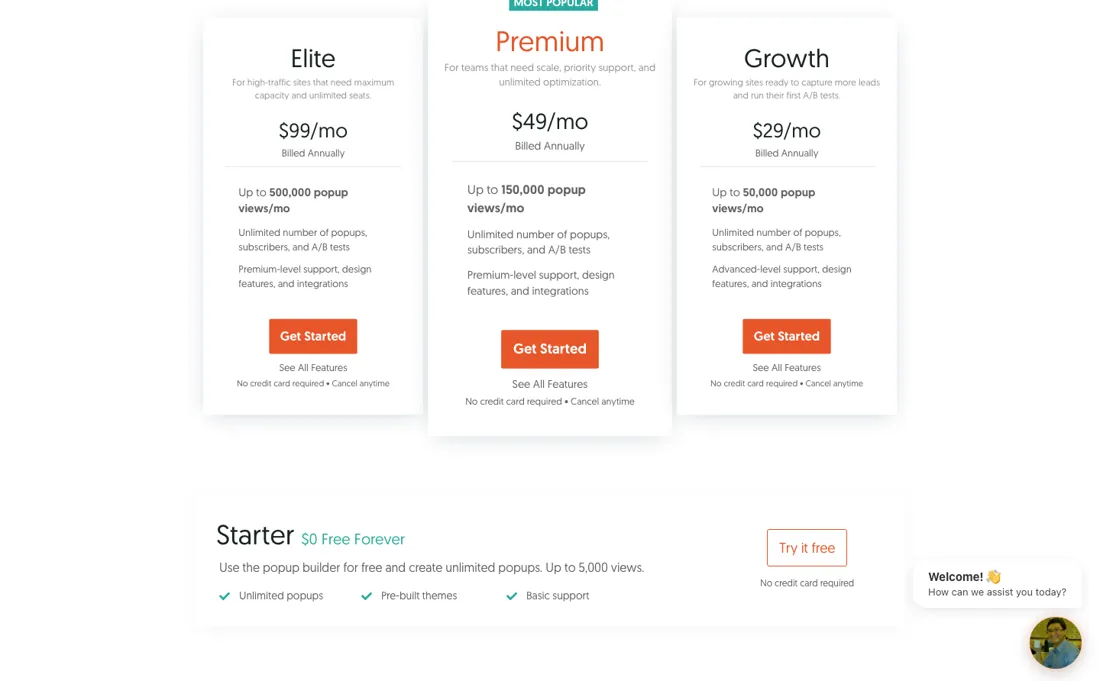
Hello Bar publishes exact prices, so the ranges we carried before were wrong: they were the monthly and the annual rate side by side. Paid tiers meter monthly popup VIEWS. Growth is $39 a month billed monthly or $29 billed annually, up to 50,000 views a month; Premium $69 or $49, up to 150,000; Elite $129 or $99, up to 500,000, with unlimited seats.
The annual feature table states the same quotas as 600,000, 1.8 million and 6 million views a year. Starter is $0 forever with 5,000 views in total rather than per month. The view limit applies per website, and only a custom agency or enterprise plan can move it to a per-account basis. A view is one display per page load per visitor.
When a site reaches its monthly limit its campaigns pause until the next billing cycle; the page describes no overage charge, and an upgrade takes effect immediately. Seats: 1 on Starter, 3 on Growth, unlimited on Premium and Elite. Monthly plans stay active to the end of the period after cancelling, annual plans to the end of the term, and a cancelled account drops to Starter with campaigns and subscriber data kept.
No credit card is needed to start, and first-time customers on an annual plan get a 30-day money-back guarantee. Plans change — always verify the live price on their site.
Category context: Growth & Revenue. Across the 82 tools in this category that we researched with a public US-dollar price, the median entry price is about $29 a month (lowest paid plan as listed, per seat where the vendor prices per seat). Hello Bar’s entry price of $29 a month sits roughly at that median. Compare pricing conditions in the Software Cost Atlas →
What the pricing page doesn’t say
And the honest fundamental of every popup tool: it amplifies an offer, it doesn't create one. A weak lead magnet with a beautiful popup is still a weak lead magnet, and aggressive full-screen takeovers can cost more goodwill (and Core Web Vitals) than they capture.
What Hello Bar does
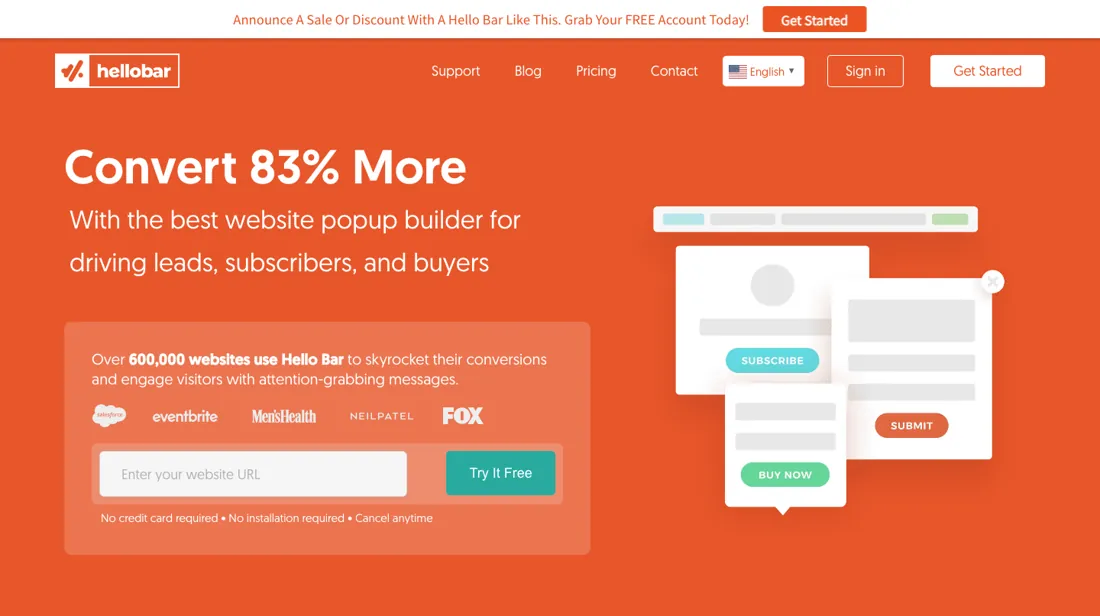
Sticky bars, popups, slide-ins and full-screen takeovers for lead capture, with A/B testing and targeting rules. The meter is popup views rather than signups, so a traffic spike raises the bill however few emails you captured.
What buyers report about Hello Bar
Recurring themes from the buyer-review sites listed at the foot of this page, read in August 2026. We have not run Hello Bar ourselves, so this is other buyers' experience rather than ours. We summarise it here because the complaints are usually the part a vendor page leaves out.
- • Custom pop-ups and banners live within minutes with no technical skill — reviewers name simplicity as the whole point.
- • There is a free tier, and $29 a month billed annually ($39 month to month) buys 50,000 views with full features.
- • Pricing is view-based, so your cost tracks traffic rather than results. Exceed your tier without upgrading and you pay roughly $5 per extra 10,000 views.
- • Targeting options are basic and analytics are shallow — reviewers wanting to segment properly run out.
- • There is no real automation for nurturing the leads you capture.
When the paid plan is worth it
The meter is popup VIEWS, not conversions, and that is the thing to grasp first. Every visitor who sees a bar counts whether they subscribe, ignore it or close it — so a traffic spike spends allowance on visitors who did nothing. It does not bill you extra: per the FAQ, a site that reaches its monthly limit has its campaigns paused until the next billing cycle. The cost of under-buying is a popup that vanishes mid-month, not a surprise invoice.
Unusually, the ladder rewards volume properly — and the prices are exact, not the ranges we carried before: those were the monthly and the annual rate side by side. Growth is $39 monthly or $29 annually for 50,000 views, Premium $69 or $49 for 150,000, Elite $129 or $99 for 500,000. On the annual rate that is $0.58, $0.33 and $0.20 per thousand views — the top tier is roughly three times better per view than the entry one.
So if your traffic is genuinely at the higher band, climbing is cheaper per unit rather than merely bigger, which is the opposite of most metered tools we look at. Practically: a site doing 60,000 monthly pageviews with a sitewide bar has already outgrown the entry tier, because a sitewide bar shows on every page. Count pages viewed, not visitors — that is where the estimate usually goes wrong by a factor of three or four.
One thing no tier changes: the quota counts per website, so a quiet second site cannot lend its unused views to a busy one. And what no tier fixes: a popup amplifies an offer, it does not create one. On a small site the honest advice is to fix distribution first — a popup shown to 200 visitors captures almost nothing at any price.
Our monthly capture read this vendor's pricing page in July 2026 and again in August 2026, and the amounts were the same both times. We keep watching — the registry records what moves.
How to actually use Hello Bar
Write the offer before you build the popup. Every tool here amplifies an offer; none creates one. If you cannot say in one sentence why someone would give you their email, fix that first and the software second. Then estimate the right number, because the meter catches people out. You are billed on popup VIEWS, not on emails captured, so every visitor who sees it counts whether they convert or not.
Take your monthly pageviews for the pages the popup will appear on — not sessions, not conversions — and check them against the tier quotas: 50,000 views a month on Growth, 150,000 on Premium, 500,000 on Elite, and 5,000 in total on the free Starter. A site-wide popup on a modest blog can exhaust an entry tier on its own. Restrict where it fires from day one. Targeting the popup to the pages where the offer actually makes sense both improves the conversion rate and keeps you off a higher tier — the two goals point the same way here.
Watch what a full-screen takeover does to your Core Web Vitals and your goodwill; both are real costs that never appear on the invoice. And note the quota is counted per website: the FAQ says every plan can run on several sites, each managed as its own property, and only a custom plan pools views across the account.
Distilled from the Hello Bar pricing page at https://www.hellobar.com/pricing/, read 24 September 2026 (previously 3 September 2026). The annual figures are printed on the cards and the monthly ones on the Pay Monthly toggle; the feature table gives the view quotas (600 thousand, 1.8 million and 6 million a year; 5,000 lifetime on Starter) and seat counts (1, 3, unlimited, unlimited). The FAQ on the same page supplies the definition of a view, the pause at the monthly limit, the per-website counting and the custom-plan exception, multi-site use, immediate upgrades, and the cancellation and 30-day money-back terms.
Hello Bar vs Poptin, side by side
Both columns come from the same place: each vendor’s own published pricing, read on the date shown in the sources at the foot of this page. We do not average them into a score.
Both names above are affiliate links: we may earn a commission if you sign up, at no extra cost to you. Neither changes what this table says: both columns come straight from the vendors’ own pricing pages.
The natural comparison is OptinMonster or Poptin — close popup-tool rivals — compare the view-quota math at your real traffic level, since that's what you're actually billed on. Weigh it against OptinMonster on the job you actually need done.
Frequently asked questions
What happens when my site hits its Hello Bar view limit halfway through the month?
The popups stop, the bill does not grow. Read 24 September 2026, the FAQ on hellobar.com/pricing says a view is recorded each time a bar, popup or widget is displayed - one impression per page load per visitor - and that when a site reaches its monthly allowance (50,000 on Growth, 150,000 on Premium, 500,000 on Elite) its campaigns pause automatically until the next billing cycle. It describes no overage charge. An upgrade takes effect immediately if you need the popup back before the reset. So the risk of buying too small a tier is lost captures in the busiest part of the month, and the fix is to count page views on the pages the popup targets, not site visitors.
Can one Hello Bar plan cover several of my websites?
Yes, but the allowance does not pool. Read 24 September 2026, the FAQ says all plans support multiple websites, each managed as a separate property with its own campaigns, subscriber list and analytics, and that on Growth, Premium and Elite the monthly view limit applies on a per-website basis. Only a bespoke agency or enterprise plan may count views per account, shared across the sites. In practice that means your busiest site decides the tier: a store at 120,000 monthly popup views needs Premium ($49 a month annually, $69 monthly) even if your other sites use almost nothing, because their unused views cannot be moved to it.
If Hello Bar does not work for us, do we get money back?
Only on an annual plan, and only the first time. Read 24 September 2026, the cancellation FAQ says you can cancel any plan at any time with no fees; a monthly plan stays active to the end of the current billing period, an annual plan to the end of its term. First-time customers on an annual plan are covered by a 30-day money-back guarantee. After cancelling, the account drops to the free Starter plan and keeps its campaigns, subscriber data and settings - but Starter allows 5,000 views in total, not per month, and one seat, against 3 on Growth and unlimited on Premium and Elite. No card is needed to start on Starter, so test there before paying.
What should I weigh before buying Growth & Revenue software?
It depends on whether you have the bottleneck it solves. Small teams get the most out of this category when one clear problem is already costing real hours or revenue; buying ahead of that just adds cost and another login. Price it against the hours or lost deals it removes, not against its feature list, and start on the smallest plan that covers the job.
Is this a hands-on review of Hello Bar?
This is a researched assessment, not a hands-on test — where we've used a tool ourselves, we say so explicitly. We name what each tool is good and bad at, and we earn a commission only if you sign up, at no cost to you.
- Buyer reviews on G2, Capterra, GetApp and Software Advice, read August 2026.
- Re-verified 2026-09-24 against hellobar.com/pricing; amounts unchanged since 3 Sep 2026.
- A dated screenshot of that pricing page, kept on this site as the receipt.
Others in this category
Reviewed growth & revenue tools that share ground with Hello Bar — comparable in what they do, not drop-in swaps:
New reviews, price changes we recorded, and the cost conditions we found. No sponsored placements. Unsubscribe anytime.
This is our researched assessment — not a paid placement. The “Visit” links on this page are affiliate links: we may earn a commission if you sign up, at no extra cost to you, and it never changes our take. How we review →