 Gorgias Review (2026)Never Priced Per Agent
Never priced per agent is a real advantage, but it starts one tier up: the comparison table caps Starter at 3 user seats, and only Basic and above open the inbox to 500.
Pricing (2026)
✓ Pricing re-verified 8 Sep 2026
| This tool | $90 | 7th cheapest of 7 |
| Cheapest | $4.99 | AskNest |
| Median | $19 | |
| Most expensive | $90 | this one |
Entry price per month, USD. Our own dated readings of 7 customer support tools — not a market survey, and cheapest is not best.
Not priced per agent -- their own line -- but the seats are capped: the comparison table gives Starter 3 user seats and Basic, Pro and Advanced 500 each. Two meters stack. Starter is $40/month all in, monthly billing only: a $10/month helpdesk with 50 tickets included and $0.40 per ticket beyond, plus the AI Agent at $30/month with 30 automated interactions.
Basic is $90/month month-to-month or $77/month billed annually ($924 a year), including 300 tickets and 30 automated interactions with the same $0.40 ticket overage; the $50 helpdesk and $27 AI Agent printed on that card sum to the annual rate, not the monthly one. Pro is $550/month or $471/month billed annually ($5,652 a year) -- $300 helpdesk plus $171 AI Agent -- including 2,000 tickets and 190 automated interactions, with ticket overage falling to $0.36.
Advanced is $1,430/month or $1,227/month billed annually ($14,724 a year) -- $750 plus $477 -- including 5,000 tickets and 530 automated interactions, also at $0.36. Above 5,000 conversations a month it is quote-only, and that custom tier is the only one with SSO via SAML, audit logs and an API above the 2 requests a second every listed plan gets. The page contradicts itself on the AI meter: every plan card says $1.50 per automated interaction past the limit, while the comparison table on the same page prices it at $1.00 on Starter, $0.90 on Basic and Pro and $0.85 on Advanced. Plans change — always verify the live price on their site.
What the pricing page doesn’t say
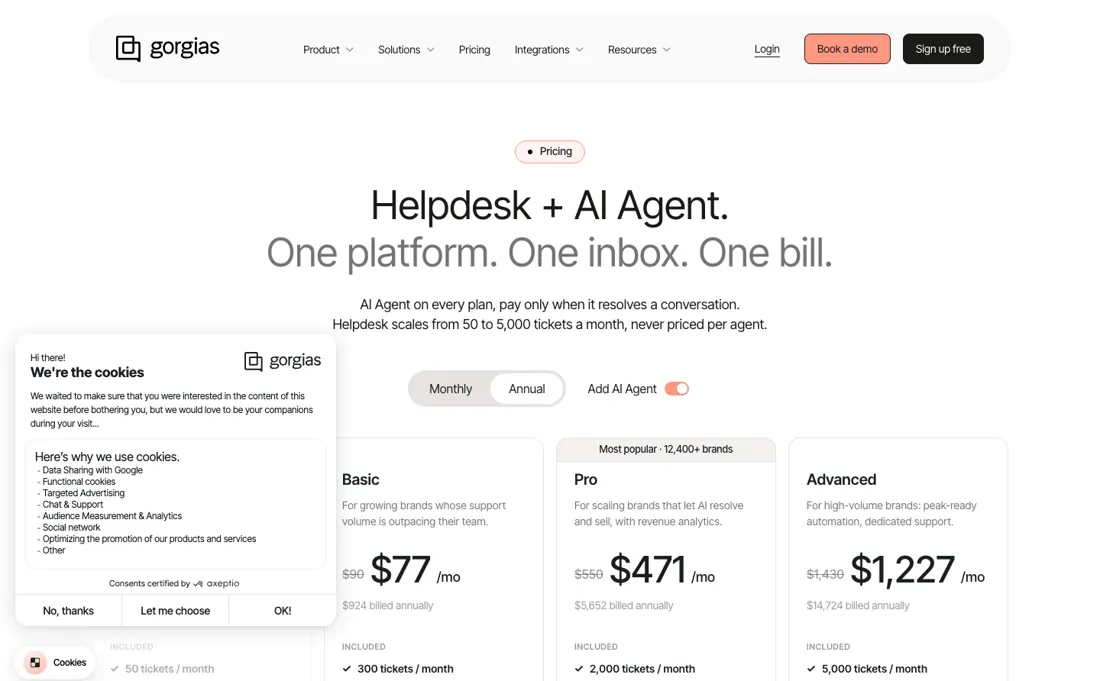
On Basic upwards your whole team can be in there without the bill moving, which is the main reason to choose this over a per-seat helpdesk. The cost sits on two meters instead, and both bite. Tickets beyond your allowance are $0.40 each on Starter and Basic, $0.36 on Pro and Advanced, so a bad week costs money rather than attention. And the AI agent -- the thing the homepage leads with -- is a separate $30 a month on the entry plan, which is three times the helpdesk it sits on.
So the honest entry price for the product as advertised is $40, not $10. Count a normal month's tickets and a busy month's, and price both. Then check the AI meter separately: the plan cards charge $1.50 per automated interaction past the included allowance while the comparison table on the same page says $1.00 to $0.85 depending on tier. When a vendor publishes two rates for the same meter, get the one that will be on your invoice in writing before you switch the agent on.
What Gorgias does
Helpdesk built for ecommerce: tickets, automations and an AI agent, priced by volume rather than by seat -- though the entry tier caps you at three users.
What buyers report about Gorgias
Recurring themes from the buyer-review sites listed at the foot of this page, read in August 2026. We have not run Gorgias ourselves, so this is other buyers' experience rather than ours. We summarise it here because the complaints are usually the part a vendor page leaves out.
- • It bills per ticket, not per seat, so your whole company can log in without buying licences. Reviewers name that as the reason it fits collaborative teams.
- • Fast to set up, and the partner ecosystem is the largest in ecommerce support.
- • Per-ticket billing means your cost tracks volume, not headcount — and it is genuinely hard to forecast. There is a cliff between Basic (300 tickets, $60/mo) and Pro (2,000 tickets, $360/mo), so stores landing at 400-800 tickets pay the most per ticket of anyone.
- • The AI Agent costs about $1.00 per resolved conversation ($0.90 annual) on top of the ticket, and reviewers report it double-billing. It is Shopify-only.
- • Voice and SMS carry their own per-ticket charges of roughly $0.40 to $1.20.
- • Reviewers report costs rising over time while support responsiveness fell. Reporting is shallow for data-heavy teams.
When the paid plan is worth it
This is not priced per agent -- their own line -- and instead runs two meters that stack, so work out both before comparing anything. Starter is $40 a month all in: a $10 helpdesk with 50 tickets included and $0.40 per ticket beyond, plus the AI Agent at $30 with 30 automated interactions. Basic is $90 month-to-month or $77 billed annually ($924 a year), including 300 tickets and 30 interactions at the same overage rates.
The crossover is calculable and it comes sooner than you would guess. On Starter, tickets beyond the first 50 cost $0.40, so reaching Basic's $90 takes 125 extra tickets: at 175 tickets a month the two plans cost the same, and above that Starter is the more expensive option. If your desk handles more than about 175 tickets, move up. There is a second reason to leave Starter, and the pricing page prints it only in the comparison table: Starter allows 3 user seats, Basic and above allow 500.
The not-priced-per-agent advantage does not actually start until $77 a month, so a four-person team is on Basic whatever its ticket count says. The AI meter scales differently from the tickets: Starter and Basic both include exactly 30 automated interactions, Pro includes 190 and Advanced 530. Past the allowance the plan cards charge $1.50 each while the comparison table on the same page says $1.00 to $0.85 -- at either figure, an AI agent that works well is the line most likely to surprise you.
What no tier fixes is the overage itself. The allowances rise; the per-ticket and per-interaction rates never reach zero, so a genuinely spiky month costs money on every plan.
How to actually use Gorgias
Count a normal month's tickets and a busy month's, separately, because the overage is where this bills. Tickets past your allowance are $0.40 each on Starter and Basic and $0.36 on Pro and Advanced, so a bad week costs you money rather than just attention -- and the allowances are small at the bottom: 50 tickets on Starter, 300 on Basic. Count your people too. Starter allows 3 user seats and Basic upwards allow 500, so if four people need the inbox, Starter is out whatever your volume says.
Do the crossover before you pick. Starter at $40 plus $0.40 a ticket reaches Basic's annual $77 at about 143 tickets a month -- so below that Starter is cheaper and above it Basic is, by a widening margin. At 300 tickets Starter would cost $140 against Basic's $77. Price the product as advertised: the AI agent is a separate $30 a month on the entry plan, three times the $10 helpdesk it sits on, so the honest entry price is $40, not $10.
Past the included 30 interactions the plan cards charge $1.50 each while the comparison table on the same page quotes $1.00 to $0.85 -- ask which rate lands on your invoice. Then take the advantage where it is real: from Basic up this is not priced per agent, which their own page says plainly. Put your whole team in the inbox, including the people who only answer occasionally -- it costs nothing there.
Distilled from gorgias.com/pricing read on 8 September 2026 -- the four plan cards with the helpdesk and AI Agent components broken out, their included ticket and automated-interaction allowances, and the Compare plans table underneath, which is where the user-seat caps, the per-interaction rates and the API rate limits are published. gorgias.com/pricing.md returns 404, so there is no machine-readable version to check the rendered page against; the two internal contradictions noted above were found by reading the cards and the table against each other.
Gorgias vs Zendesk, side by side
Both columns come from the same place: each vendor’s own published pricing, read on the date shown in the sources at the foot of this page. We do not average them into a score.
The natural comparison is Zendesk or Freshdesk — the standing comparison — Gorgias wins when your team is larger than your ticket volume suggests, and loses when your volume is high and steady.
The ex-banker filter — the same yardstick on every review (how we review): My ex-banker filter is simple: does Gorgias remove a real cost — time, errors, missed revenue — bigger than what it charges?
Frequently asked questions
What should I weigh before buying Customer Support software?
Judge it on evidence rather than adjectives. Look for a published security page, single sign-on and role controls on the plan you would actually buy (they are often gated to higher tiers), a status page with real incident history, and a clear answer on where your data is stored. If the tool will hold anything sensitive, those four answers matter more than any feature comparison.
Is this a hands-on review of Gorgias?
This is a researched assessment, not a hands-on test — where we've used a tool ourselves, we say so explicitly. We name what each tool is genuinely good and bad at, and we have no affiliate relationship with Gorgias — we earn nothing whether you sign up or not.
- Buyer reviews on G2, Capterra and practitioner reviews, read August 2026.
- Re-verified 8 September 2026 on their own pricing page.
- A dated screenshot of that pricing page, kept on this site as the receipt.
Others in this category
Reviewed customer support tools that share ground with Gorgias — comparable in what they do, not drop-in swaps:
Also in customer support, for browsing rather than as an alternative:
New dossiers, cost-traps we found, and tools that earned a keep — no hype, no sponsored-disguised-as-advice. Unsubscribe anytime.
This is our researched assessment — not a paid placement. How we review →